
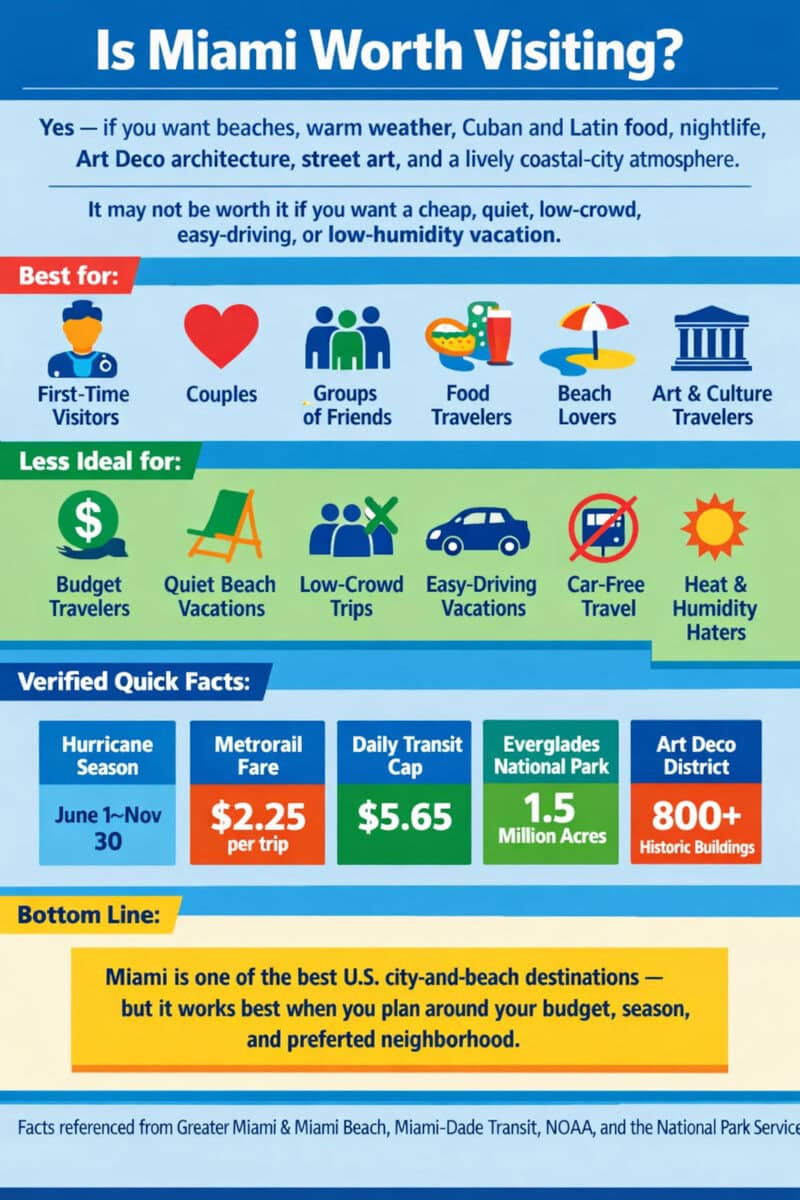
Yes, Miami is worth visiting if you want beaches, warm weather, Cuban and Latin food, nightlife, Art Deco architecture, street art, and a lively coastal-city atmosphere. It may not be worth it if you want a cheap, quiet, low-crowd, easy-driving, or low-humidity vacation.
Miami is one of the most distinctive city-and-beach destinations in the United States.
It packs South Beach, Cuban culture in Little Havana, murals in Wynwood, high-rise dining in Brickell, tropical weather, and quick access to nature trips like Everglades National Park into a small area.
The official Greater Miami & Miami Beach tourism site names the region's beaches, food, arts, culture, Little Havana, and Wynwood as its main draws for visitors.
For most first-time travelers, the answer is yes, especially for a short trip built around beaches, food, art, and nightlife.
Few U.S. cities put oceanfront hotels, tropical weather, Cuban-American culture, Art Deco architecture, and creative neighborhoods this close together.
The catch is that Miami can feel expensive, busy, humid, and traffic-heavy.
The best version of the trip depends on where you stay, when you go, and whether you base yourself in Miami Beach, the city of Miami, or both.
Who is Miami worth visiting for?
Miami suits travelers who want both beach time and city energy.
It works well for first-time visitors, couples, groups of friends, food travelers, nightlife travelers, art lovers, and anyone after a warm-weather escape without leaving the country.
Beach travelers usually do well in Miami Beach, South Beach, Mid-Beach, North Beach, and Key Biscayne.
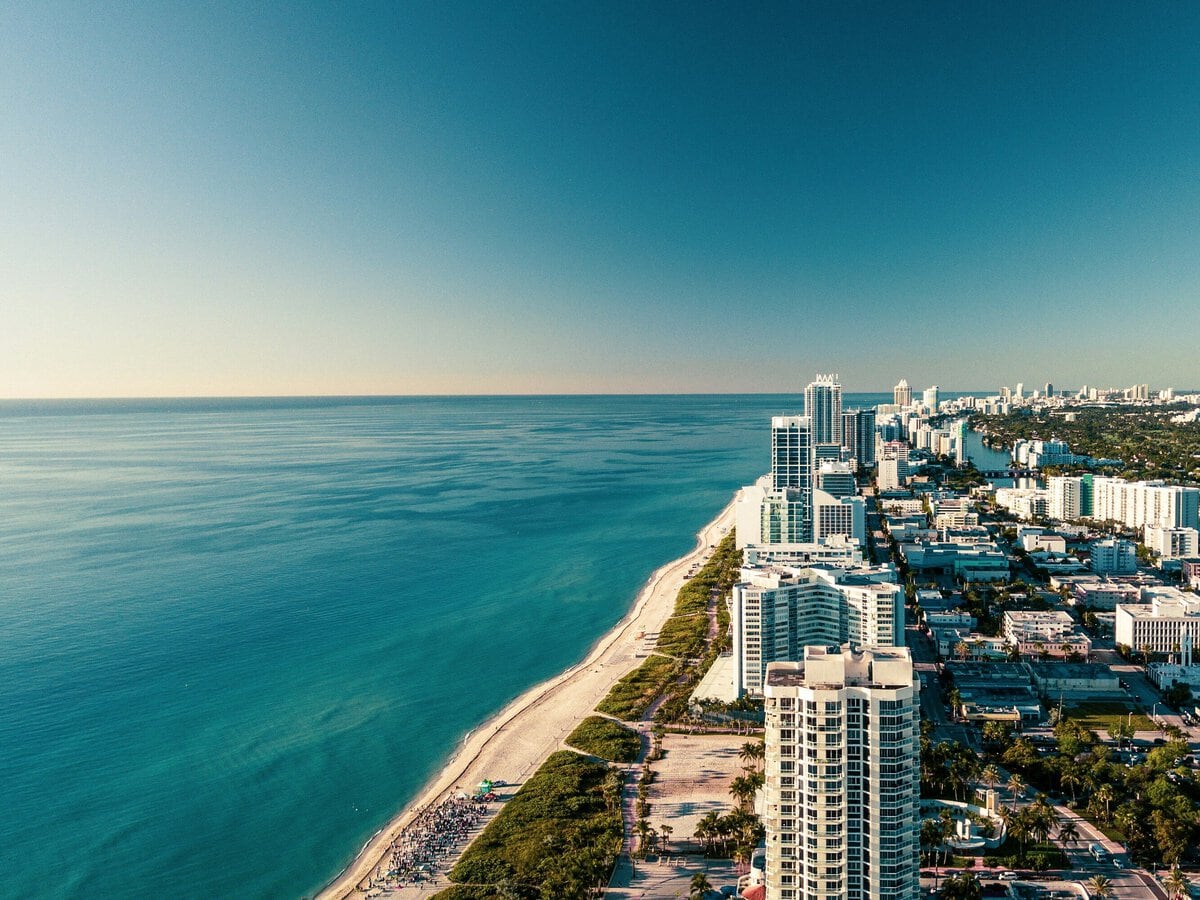
South Beach is the postcard version of Miami: sand, palms, Ocean Drive, Art Deco hotels, restaurants, nightlife, and walkable beach access.
The official tourism site describes South Beach as the place to take in Miami Beach's Art Deco past alongside its beaches.
Food and culture travelers should not skip Little Havana.
The neighborhood carries Miami's Cuban and Hispanic identity, with Calle Ocho, Cuban restaurants, ventanitas, festivals, Domino Park, and landmarks like Versailles Restaurant.
Art and design travelers should add Wynwood and the Art Deco Historic District.
Wynwood is full of murals, galleries, and street art, anchored by Wynwood Walls, while the Art Deco District gives Miami Beach its most recognizable look.
Bottom line: Miami is worth it for travelers who want beaches plus a real city around them.
It is a weaker pick for anyone whose ideal trip is quiet, cheap, and built around a single resort.
Who may not enjoy Miami?
Miami is a poor fit for a quiet, inexpensive, slow-paced trip.
South Beach gets crowded and loud, beachfront hotels run costly, and parking and traffic can wear you down during big events or peak weeks.
Budget travelers can still make it work with planning: stay outside the priciest beach zones, use transit or rideshare selectively, eat in neighborhood restaurants, and lean on free attractions.
If your ideal is a quieter stretch of sand, Mid-Beach and North Beach are calmer than South Beach, and Key Biscayne and Coconut Grove feel more residential.
A fully car-free trip across the whole metro is also hard.
Some areas are walkable and Downtown and Brickell work well with transit, but many beaches, parks, and day trips are far easier with a car or rideshare.



Best reasons to visit Miami
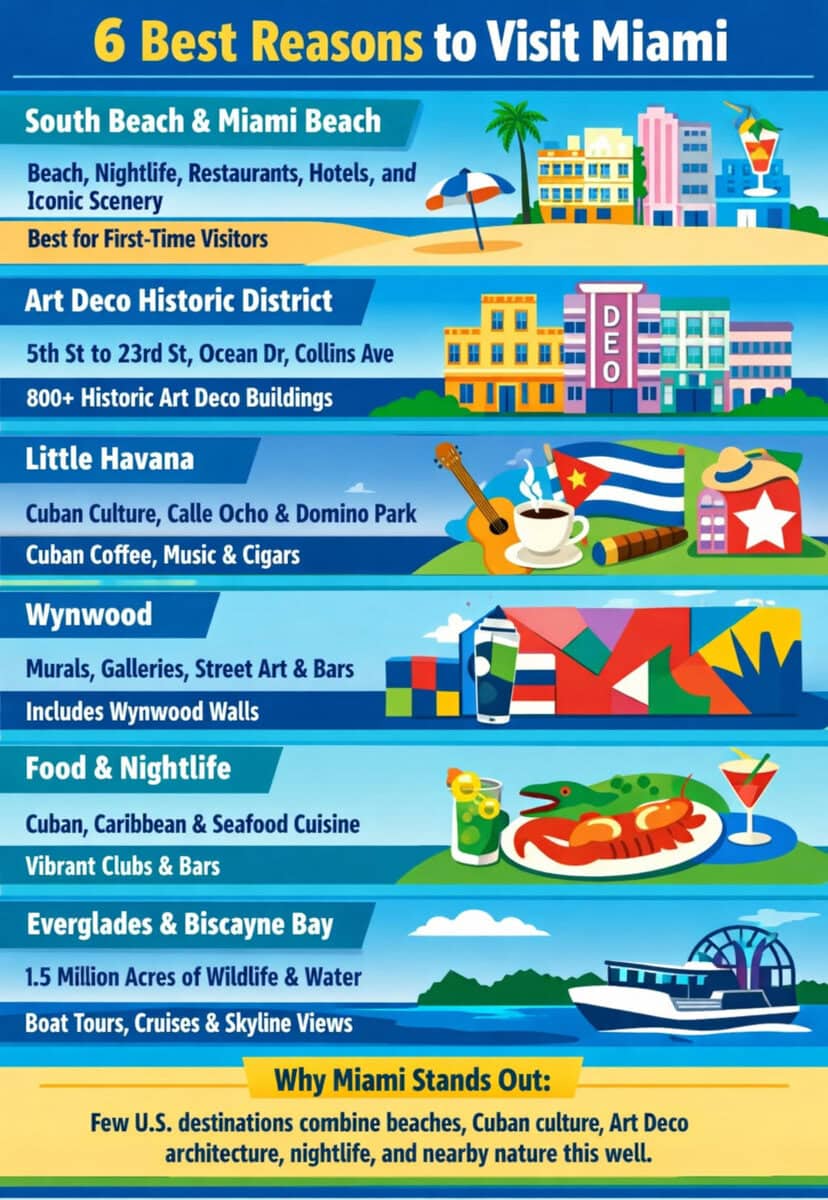
1. South Beach and Miami Beach
South Beach is the single biggest reason to come.
You get beach, nightlife, restaurants, hotels, people-watching, and historic architecture in a few walkable blocks.
For a first trip, this is the area that matches the Miami in your head.
Miami Beach is not the city of Miami, but for most tourists it is the center of the vacation.
If the beach, oceanfront hotels, and nightlife are the point, staying in Miami Beach usually beats Downtown.
2. The Art Deco Historic District
The Art Deco Historic District runs through Miami Beach between 5th and 23rd streets, along Ocean Drive, Collins Avenue, and Washington Avenue.
The official tourism site counts more than 800 historic Art Deco buildings inside it.
That density is one of the strongest reasons to pick Miami over a generic beach town.
The pastel facades, neon signs, palm-lined streets, and historic hotels create a look you won't find anywhere else in the country.
3. Little Havana
Little Havana gives Miami depth past the beach.
Calle Ocho, Cuban coffee, live music, cigar shops, murals, Domino Park, and Cuban restaurants make it the easiest place to feel the city's Latin and Cuban roots in a short visit.
It works as a half-day stop or a food-focused walk.
4. Wynwood
Wynwood is the move for street art, galleries, murals, restaurants, and bars.
The official tourism site describes it as an arts district packed with murals, galleries, and street art, with Wynwood Walls as its best-known stop.
It gives travelers a contemporary, urban counterpoint to the beach.
5. Food and nightlife
Miami rewards anyone who likes Cuban, Caribbean, Latin American, and seafood cooking, plus high-end dining.
Little Havana, Brickell, Wynwood, Coconut Grove, Miami Beach, and the Design District each cover a different part of the food scene; the Design District pairs luxury retail with restaurants and public art.
Nightlife is its own draw.
South Beach is the famous one, but Brickell, Downtown, and Wynwood add bars, lounges, and rooftops that stay busy late.
6. Everglades and Biscayne Bay day trips
Miami doubles as a base for the outdoors.
Everglades National Park protects 1.5 million acres of wetland, forest, and marine habitat, which the National Park Service calls the largest subtropical wilderness in the country.
A day trip there adds wildlife to a city-and-beach itinerary.
Closer in, Biscayne Bay separates the mainland from Miami Beach and is where the city's boat tours, sandbar trips, and skyline cruises run.
A short cruise or a kayak afternoon is an easy way to see Miami from the water.
When is Miami not worth visiting?
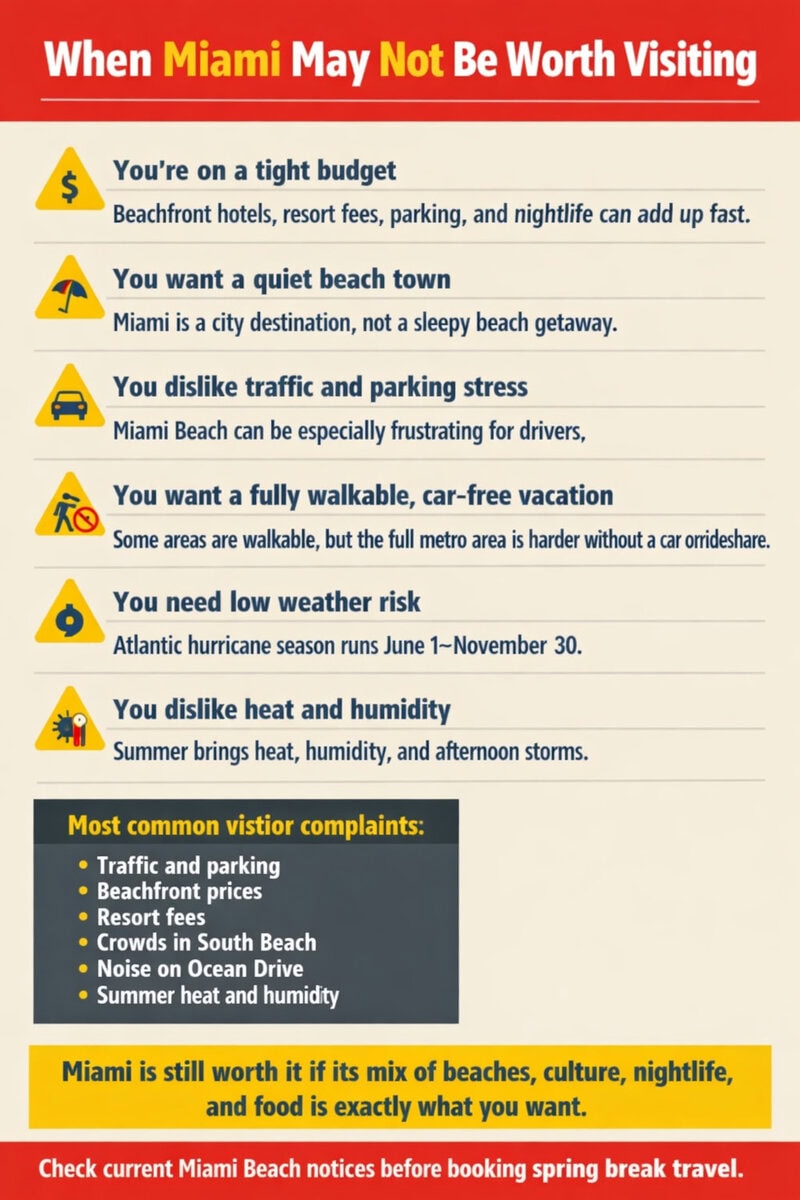
Skip Miami, or rethink the timing, in these cases:
- during peak spring break weekends, if you dislike crowds and noise;
- on a tight budget, since beachfront costs add up fast;
- when you want a quiet beach town rather than a city;
- if traffic and parking stress you out;
- during hurricane season, if you need a fixed, low-risk date;
- when you want a fully walkable, car-free destination across the whole metro.
Common complaints about Miami
The gripes you see most often from past visitors are consistent: traffic and parking around Miami Beach, prices at beachfront hotels and clubs, aggressive resort fees, crowds and noise on Ocean Drive in season, and the heat and humidity in summer.
None of these is a dealbreaker on its own.
Together they explain why some travelers love Miami and others leave underwhelmed.
Bottom line: Miami is worth it when its specific mix of beach, culture, and nightlife is what you want.
It is not worth it as a generic, budget, or low-effort beach trip.
Miami vs Miami Beach
Miami and Miami Beach are two different cities, and the difference shapes the whole trip.
Miami is the mainland city.
It holds Downtown, Brickell, Wynwood, Little Havana, Coconut Grove, museums, restaurants, and business districts.
Miami Beach is a separate island city across Biscayne Bay.
It holds South Beach, Mid-Beach, North Beach, Ocean Drive, beach hotels, and most of the classic tourist scene.
For a first trip, the best plan usually includes both.
Base yourself in Miami Beach for the beach and the iconic scenery; base yourself in Downtown, Brickell, or Wynwood for food, museums, transit, and a more urban feel.
| Best for | Miami | Miami Beach |
|---|---|---|
| Beach vacation | Not the main choice | Best choice |
| Nightlife | Brickell, Wynwood, Downtown | South Beach |
| Culture | Little Havana, museums, Wynwood | Art Deco, Ocean Drive |
| Car-free base | Downtown / Brickell | South Beach |
| First-time tourists | Good with planning | Often better |
Bottom line: Choose Miami Beach if the trip centers on beaches, South Beach, and nightlife.
Choose Downtown or Brickell if you want restaurants, museums, and transit access.
Is Miami expensive to visit?
Yes, Miami can run expensive, especially in Miami Beach, in peak season, and in tourist-heavy areas.
It does not have to be luxury-only, though.
Here is where the money goes, and how to spend less.
Hotels and resort fees
Beachfront hotels in South Beach command the highest rates, and many add resort fees on top of the nightly price.
Staying a few blocks back from the ocean, or on the mainland in Brickell or Downtown, cuts the bill while keeping you close.
Parking and rental cars
Parking near the beach is costly and gets worse during events.
On peak spring break weekends in 2026, Miami Beach garages in the Art Deco District charged flat rates of $40 to $100, and nearby street parking or surface lots listed at $20 per hour, up to a $100 daily maximum, under Miami Beach's spring break parking rules.
A rental car adds fuel, insurance, and daily parking on top.
If your trip stays central, you may not need one.
Dining and nightlife
Oceanfront restaurants and South Beach clubs carry tourist pricing, with bottle service and cover charges climbing fast.
Cuban and Latin spots in Little Havana and casual neighborhood places cost a fraction of that.
Free or low-cost things to do
Plenty of Miami is cheap or free: the beaches themselves, walking Ocean Drive and the Art Deco District, the murals around Wynwood Walls, Domino Park, and the free Metromover loop through Downtown and Brickell.
How to make Miami cheaper
Stay outside South Beach, travel outside peak holiday weeks, eat in neighborhood restaurants, use the Metromover and rideshare instead of a rental car, and pick free attractions over paid clubs.
If you only want a simple beach holiday, Fort Lauderdale often delivers better value.



Is Miami safe for tourists?
Miami is generally manageable for tourists in popular areas, but safety varies by neighborhood, time of day, and behavior.
Use normal big-city precautions, especially around nightlife areas, crowded beaches, and unfamiliar streets at night.
A few habits help: use rideshare when you need it, keep belongings close in crowds, never leave valuables visible in a parked car, and book accommodation in an area that matches how you travel.
Do you need a car in Miami?
Not always; it depends on the itinerary.
If you stay in South Beach, Downtown, or Brickell and stick to nearby restaurants, beaches, museums, and nightlife, you can get by on walking, rideshare, the Metromover, the Metrorail, and the occasional taxi.
The Metromover is free and built for the central city, so it covers Downtown and Brickell well.
The Metrorail charges $2.25 per trip, with a daily fare cap of $5.65 on the same card, according to Miami-Dade Transit.
A car earns its keep if you plan to reach the Everglades, Key Biscayne, the Florida Keys, several spread-out neighborhoods, or family attractions outside the core.
The trade-off is traffic and parking, which feel worst around Miami Beach.
Best time to visit Miami
Winter and spring bring the most comfortable weather and the busiest calendar, along with the highest prices and crowds.
Summer trades heat, humidity, afternoon storms, and tropical-weather risk for lower hotel rates.
The Atlantic hurricane season officially runs June 1 to November 30, so anyone traveling then should watch forecasts and keep plans flexible, per NOAA.
Spring break needs its own note.
After two calmer years, Miami Beach eased some crowd-control rules for 2026: it removed most barricades, reopened parking garages, and dropped the early beach closures and the blanket midnight curfew.
It still designates all of March a high-impact period with a heavy police presence, expensive parking, license-plate readers, and traffic restrictions on the busiest weekends, March 12 to 15 and March 19 to 22, according to city officials and local reporting.
If you want a quiet beach trip, those are the weekends to avoid.
| Season | Worth it? | Best for | Watch out for |
| Winter | Yes | Weather, beach, events | Higher prices |
| Spring | Yes | Weather, nightlife | Spring break crowds |
| Summer | Sometimes | Lower rates, beach | Heat, humidity, storms |
| Fall | Sometimes | Lower crowds | Hurricane-season risk |
Bottom line: Winter and spring give the best weather at the highest prices; summer and fall trade comfort for value and a hurricane-season gamble.
How many days do you need in Miami?
For a first trip, three to four days is enough to judge whether Miami is for you.
That covers South Beach, the Art Deco Historic District, Little Havana, Wynwood, Brickell or Downtown, and possibly one day trip.
A weekend gives you a taste but can feel rushed; four days is the better balance.
| Trip length | Best for | What you can do |
| 1 day | Quick stopover | South Beach, Art Deco, and Little Havana or Wynwood |
| 2–3 days | Weekend trip | Beach, food, nightlife, one or two neighborhoods |
| 4 days | Best first visit | Beach, Art Deco, Little Havana, Wynwood, Brickell, plus Everglades or Key Biscayne |
| 5–7 days | Relaxed trip | Add museums, boat tours, Everglades, Key Biscayne, Coconut Grove, shopping, beach days |
Bottom line: Four days is the sweet spot for a first visit; stretch to five to seven if you want day trips and downtime.
Is Miami worth visiting without going to the beach?
Yes. The non-beach side of Miami stands on its own: Little Havana, Wynwood, Brickell, Coconut Grove, the Design District, and the city's museums.
Pérez Art Museum Miami sits on Biscayne Bay with strong contemporary collections and a waterfront terrace, and Vizcaya Museum & Gardens preserves an early-1900s estate with formal gardens near Coconut Grove.
Add Cuban food, gallery-hopping, and nightlife, and you have a full trip without sand.
Just be intentional about it.
Miami's identity is tied to its coastline, so travelers who dislike beaches entirely might prefer a city with denser museums or stronger public transit.
Miami vs other Florida destinations
Miami vs Fort Lauderdale
Pick Miami for stronger nightlife, more food variety, Cuban culture, Art Deco architecture, and big-city energy.
Pick Fort Lauderdale for a calmer beach, simpler logistics, and lower prices; its beachfront is mellower, parking is easier, and it sits about 30 miles north, close enough for a day trip from Miami.
Many travelers stay in one and visit the other.
Miami vs Orlando
Pick Miami for beaches, nightlife, food, art, and culture.
Pick Orlando for theme parks and family attractions.
They serve different trips, and some families split a Florida vacation between the two.
Miami vs Key West
Pick Miami for a city with beaches, restaurants, nightlife, and museums.
Pick Key West for a slower island pace, sunsets at Mallory Square, and historic streets.
Key West sits at the end of the Overseas Highway, about a three-and-a-half-hour drive south, so it also works as a multi-day add-on.
Final verdict: Is Miami worth visiting?
Miami is worth visiting if you want a warm, high-energy destination with beaches, Cuban food, Art Deco architecture, Wynwood murals, nightlife, and nature day trips within reach.
For a short city-and-beach vacation, few U.S. cities compete.
It is not worth visiting if you want cheap, quiet, low-crowd, easy-driving, or low-humidity travel.
Plan around your style: pick the right neighborhood, dodge the wrong season, budget honestly, and treat Miami and Miami Beach as the two separate cities they are.
FAQ
Is Miami worth visiting for tourists?
Yes. Miami suits tourists who want beaches, warm weather, Cuban and Latin food, nightlife, Art Deco architecture, street art, and a busy city atmosphere.
Is Miami Beach worth visiting?
Yes, if you want beaches, Ocean Drive, Art Deco hotels, nightlife, restaurants, and the classic Miami vacation.
Is South Beach worth visiting?
Yes, for first-time travelers, beach lovers, and nightlife travelers who want Miami's most famous scenery. It can feel too crowded or loud for anyone seeking quiet.
Is Miami worth visiting for couples?
Yes. Couples do well with the beaches, restaurants, hotels, sunsets, and nightlife, especially over a long warm-weather weekend.
Is Miami worth visiting on a budget?
Yes, with careful planning.
Skip South Beach hotels in peak season, avoid pricey parking, eat in neighborhood spots, and lean on free attractions and the Metromover.
Is Little Havana worth visiting?
Yes. Go for Cuban food, Calle Ocho, live music, Cuban coffee, murals, and Domino Park, the easiest way to feel the city's Cuban culture in a short visit.
Is Wynwood worth visiting?
Yes. Go for the murals, street art, galleries, restaurants, and bars around Wynwood Walls.
Is Miami expensive?
Yes, it can be, especially in Miami Beach and South Beach during peak winter, holidays, and major events. Hotels, parking, dining, nightlife, and resort fees push the total up.
Can you visit Miami without a car?
Yes, if you stay in a walkable area and use rideshare, the Metromover, the Metrorail, and taxis. A car helps more for the Everglades, Key Biscayne, the Florida Keys, and spread-out itineraries.
When should you avoid Miami?
Avoid peak spring break weekends if you dislike crowds and noise. Take care during the Atlantic hurricane season, June 1 to November 30, if you need a fixed, low-risk trip.
How many days are enough in Miami?
Three to four days suit most first-time visitors, enough for Miami Beach, Art Deco, Little Havana, Wynwood, food, nightlife, and a one-day trip.
Is Miami good for families?
It can be, with the right base and activities. Families often prefer Key Biscayne, quieter beach zones, museums, parks, boat tours, and daytime cultural neighborhoods over late-night South Beach.
Sources
- Greater Miami & Miami Beach official tourism site (miamiandbeaches.com): citywide overview, South Beach, Little Havana, Wynwood, Art Deco District, Metromover
- National Park Service, Everglades National Park (nps.gov)
- Miami-Dade Transit, Metrorail fares and daily fare cap (miamidade.gov)
- NOAA, Atlantic hurricane season dates (noaa.gov)


Independent Publisher Notice
BestAttractions is an independent editorial publisher. We are not affiliated with, endorsed by, or acting on behalf of any location, business, property owner, manager, government agency, or organization described in this article.
Comments posted on this page are not forwarded to, reviewed by, or acted upon by any entity mentioned in the article.
For official inquiries, complaints, applications, bookings, or other requests, please contact the relevant entity directly through its official website or other verified channels.