
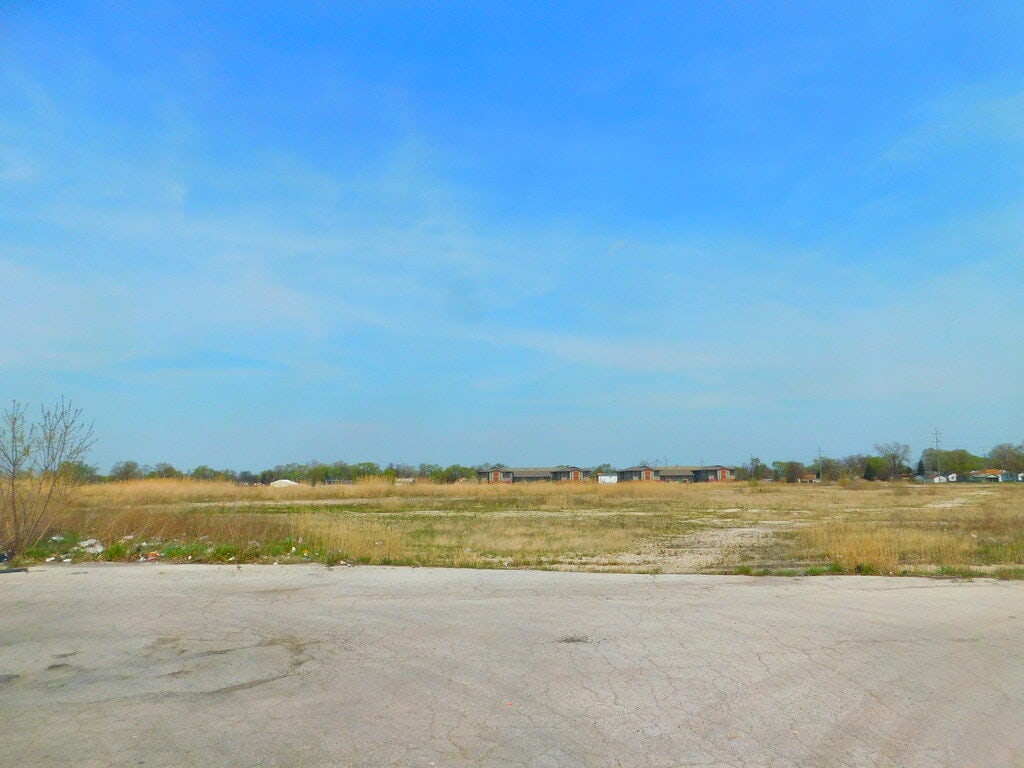
Standing on Dixie Highway on the west side of Harvey, Illinois, sits a graded, empty 39-acre lot that used to be an enclosed shopping mall.
Dixie Square Mall opened here in stages during 1966, anchored by Montgomery Ward and JCPenney. By 1970, a discount store, Turn Style, had joined the east side and taken the building past 800,000 square feet.
The mall was renamed Dixie Mall in 1975. The mall kept emptying anyway, and the concourses closed in November 1978. The complex lasted another 33 years, mostly abandoned.
The buildings came down in 2012. Harvey owns the 39-acre parcel now and still has warehouses on the table. A 500,000-square-foot logistics facility has been proposed, and nothing has been built.
Montgomery Ward opened Dixie Square a year early
On October 21, 1965, Montgomery Ward opened a 182,000-square-foot store on Dixie Highway in Harvey, Illinois, with a separate auto service center nearby and no mall to walk into.
The mall it anchored was still a construction site.
The land had been the Dixie Hi golf course, nine holes on the city's west side.
Meyer C. Weiner's development group had the site by 1964, and the city rezoned 58 to 60 acres for shopping that year.
It was priced at $12 million when announced and $25 million by the end. Hornbach, Steenwyk & Thrall of Grand Rapids drew the plans.
Ward traded ahead of the mall for the next 10 months while crews closed in the concourses around it.
Fifty stores and a 25-foot Wonderfalls display
The mall opened to the public on August 31, 1966, with three dozen stores open or about to open.
The formal dedication came on November 9. A time capsule set for 75 years had been placed near the Montgomery Ward court during the August opening.
The grand-opening program ran the 10th through the 12th with 50 businesses open.
Walgreens had given away a color television at the August opening, and Ned Locke from "Bozo's Circus" came for the children in November.
Inside, five columns carried a heavy liquid down fine nylon strands, dropping 25 feet into a planted, rock-filled bed.
From a distance the falling droplets looked solid.
The Wonderfalls display shared the common areas with three fountain pools and artificial tropical foliage.
The center had 4,200 parking spaces. JCPenney took 144,000 square feet across two floors.
Woolworth ran the Harvest House restaurant, Walgreens a Grill Room, and Jewel a supermarket.
64 stores and a third anchor
Mall management put first-year revenue above $40 million, and by 1968 the center had 64 stores.
In February 1967, seven insurance companies placed an $8.3 million mortgage on it.
That trade came off somewhere.
Harvey's older downtown lost shoppers to it, and Park Forest officials blamed part of a 1967 sales drop at Park Forest Plaza on Dixie Square and River Oaks Center.
An east-side addition went up in 1969, and Turn Style, a discount chain tied to Jewel, opened there that year with 108,400 square feet, taking the building past 800,000.
The Turn Style store went quiet early, closing in January 1974, four years before the chain's closings were publicized.
Renamed Dixie Mall, then the anchors left
Management shortened the name to Dixie Mall in the summer of 1975 and spent $500,000 on a renovation that reopened that October.
A large triangular Dixie sign went up.
The competition had already arrived.
River Oaks Center opened the same year Dixie Square did, Lincoln Mall opened in Matteson in 1973, and Orland Square followed mid-decade, taking JCPenney with it.
Violent incidents on and near the property in 1972 and 1973 cost the mall its regional pull.
By 1978, theft losses had passed what the stores could absorb.
Montgomery Ward closed on October 4, 1976. JCPenney's regular business was gone by early 1978 as sales and profits fell.
By then, the mall was down to about 20 tenants. The concourses shut in November 1978, 12 years after they opened.
Walgreens and Jewel, with doors onto the parking lot, kept going into 1979.
Universal rented the empty mall for a car chase
The Penney space opened once more in January 1979, for a liquidation billed as "Dixie's Last Gasp."
That same month Harvey-Dixmoor School District 147 moved classes into the complex while a new school was built, and the old Turn Style box became a gymnasium.
That summer the district handed the building to Universal Pictures on July 23, 1979.
The script needed a working mall, so crews dressed the empty storefronts with brands that had never traded there.
The old Walgreens front became Toys "R" Us.
Then they drove through it. The Bluesmobile and a line of police cars went through glass, racks, walls, and display counters.
The film came out in June 1980. In December 1981 the district went after Universal over damage it said was never repaired.
The teardown that made things worse
After the district left, most of the building had no use.
Vandalism turned severe in 1984 and 1985: windows out, metal stripped, sealed sections forced open.
Harvey took the property over on August 27, 1985, and cleared the Ward auto-service area for a police station.
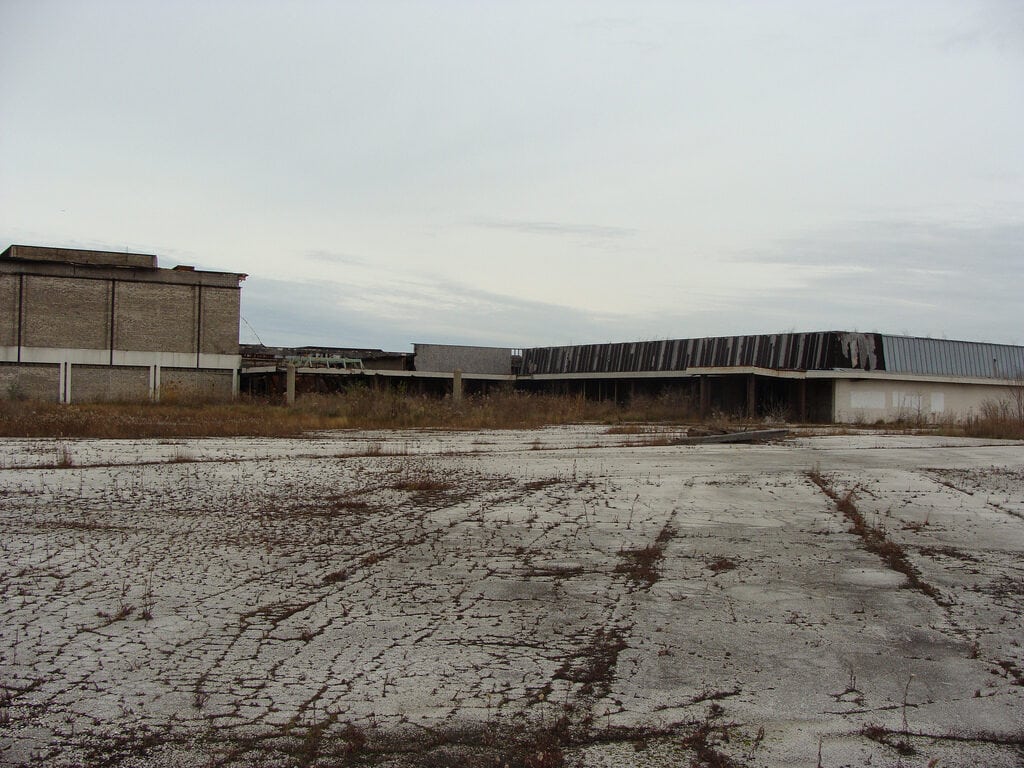
Once the roof failed, rain and snow got deep into the building. Photographers kept coming anyway.
The concourses still held old storefronts and leftovers from the film set.
In January 2005, a Harvey food manufacturer, American Kitchen Delights, paid the city $100,000 under a deal for the Montgomery Ward property and began gutting it for warehouse use.
A developer was promoting a big-box plan for the rest, naming Costco, Kohl's, and Old Navy.
Inspectors found asbestos in the debris that June and stopped the work.
On Christmas Eve, a demolition crew wrecked a large part of the Ward building the food company had just paid to reuse.
What's on the 39 acres today
Flooding is what finally paid for the cleanup.
The 2008 floods pushed asbestos runoff into the sewers, which qualified the site for federal disaster money, and the governor announced $4 million in September 2010.
Red tape held it up through 2011.
Abatement began that January, demolition started on February 15, 2012, and the last of the complex came down on May 17.
A private owner fell behind on the taxes, so Harvey took the 39-acre parcel at 15151 Dixie Highway through Cook County's no-cash bid program in 2016.
A contract claim from an old redevelopment deal ended in March 2026, when the state Supreme Court refused to hear it.
The land is graded and empty now, inside what the city calls the Southland Logistics Center.
A 500,000-square-foot warehouse has been proposed for the old mall footprint, and Harvey's February 2025 plan keeps a regional commercial center open as an option.
As of August 2026 nothing has a construction start, and the plan already tells whoever builds there to screen the trucks from the houses along the edge.

Independent Publisher Notice
BestAttractions is an independent editorial publisher. We are not affiliated with, endorsed by, or acting on behalf of any location, business, property owner, manager, government agency, or organization described in this article. Comments posted on this page are not forwarded to, reviewed by, or acted upon by any entity mentioned in the article. For official inquiries, complaints, applications, bookings, or other requests, please contact the relevant entity directly through its official website or other verified channels.