
Royal Hawaiian Shopping Center opened on Kalakaua Avenue in Waikiki, in Honolulu, Hawaii, in 1980. The mall is still there, three buildings on the same ground, under a shorter name.
For 25 years it was a concrete mall that faced inward, with its shops behind thick walls. Kamehameha Schools owned it, and its tenants ran from souvenir shops to international luxury brands.
By the early 2000s vacancies had climbed as high as 40 percent. The school rebuilt the center between 2005 and 2008. The walls came down. An open grove went in where the waterfall court had been.
The rebuilt center sold shows, food, and culture as well as goods, so in February 2008 the word Shopping came off its name. Royal Hawaiian Center is the name on it today, 18 years later.
Royal Hawaiian Shopping Center rises on Helumoa
In the late 1970s two of Waikiki's mid-century shop buildings came down on Kalakaua Avenue.
One was the Watumull Beach Shops, built in 1950. The other was a McInerny department store finished in 1958.
Both stood on the Kalakaua frontage of Helumoa, the seaside land that passed from Kamehameha V to his half-sister Ruth Keelikolani, and from Ruth to Bernice Pauahi Bishop.
Pauahi lived there in the 1870s and 1880s, and in 1884 she wrote the final two codicils of the will that led to Kamehameha Schools.
Kamehameha Schools owned that ground, and it started building its own center there in 1976.
What went up was Brutalist concrete, about 293,000 square feet of it, with thick walls on the street side and fountains, waterfalls, and escalators inside.
Three heavy concrete bridges joined its sections.
They blocked the view from Kalakaua Avenue through to the Royal Hawaiian Hotel, and the whole design faced inward.
The center was built to earn money for the school, and it cost more than $40 million.
When it was finished in 1979, it was Kamehameha Schools' largest revenue-producing commercial property.
It opened to the public in 1980 as the Royal Hawaiian Shopping Center.
McInerny moved into the new building, and ABC Stores was among the first tenants.
The showroom goes dark and McInerny leaves
The fourth floor held the 800-seat Aloha Showroom, and by the 1990s it was running Legends in Concert, two shows a night.
In May 1999 the show ended its regular run there. The room stayed empty, and it was still empty in 2004.
The rest of the center was under pressure by then. Its Japanese visitor market had weakened.
Newer shopping options were opening around Waikiki, including King Kalakaua Plaza and DFS Galleria, while Ala Moana Center remained a major competitor.
After September 11, 2001, visitor traffic across Waikiki collapsed, and the center cut minimum rent for every tenant for October and November.
McInerny went next. In 2002 it ran two stores in the center, together roughly a quarter of the retail area.
It closed the larger one that year and planned to shut the other by the end of January 2003.
With the center's biggest local department store gone, vacancies climbed as high as 40 percent.
Kamehameha Schools had been planning a redevelopment since 2001.
Royal Hawaiian Center tears its walls open
In 2004 Kamehameha Schools brought in The Festival Companies to run that redevelopment, and main construction started in August 2005.
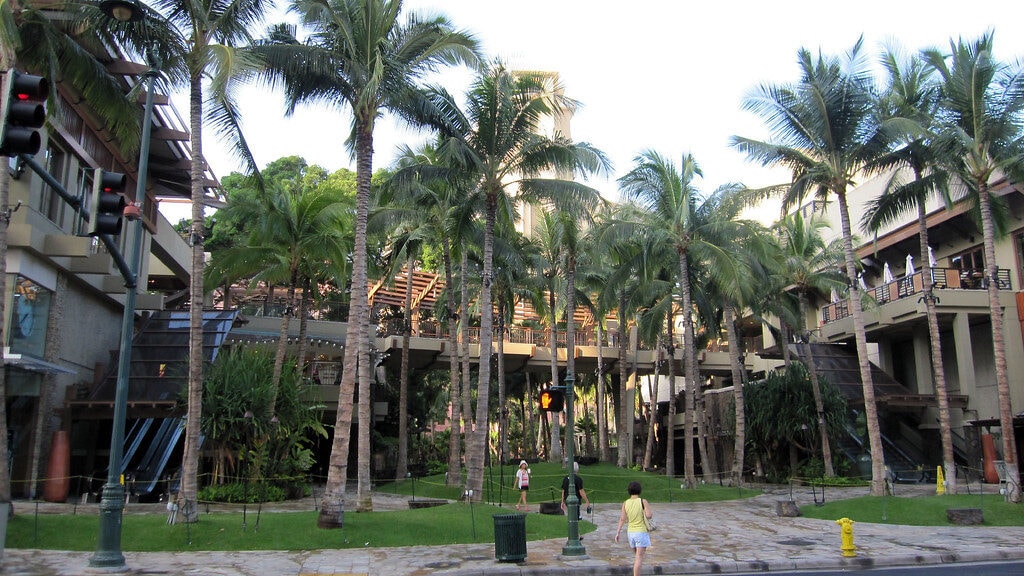
The heavy concrete walls came down, and all three bridges over the center were taken out for a single new crossing.
At the Seaside Avenue end, demolition cleared away the fountain and escalators.
The result was a sightline from Kalakaua Avenue to the Royal Hawaiian Hotel and its banyan.
The center stayed open the whole time. Stores shifted around the property while barricades cut off large sections.
By October 2006, construction had squeezed occupancy down to about 20 percent.
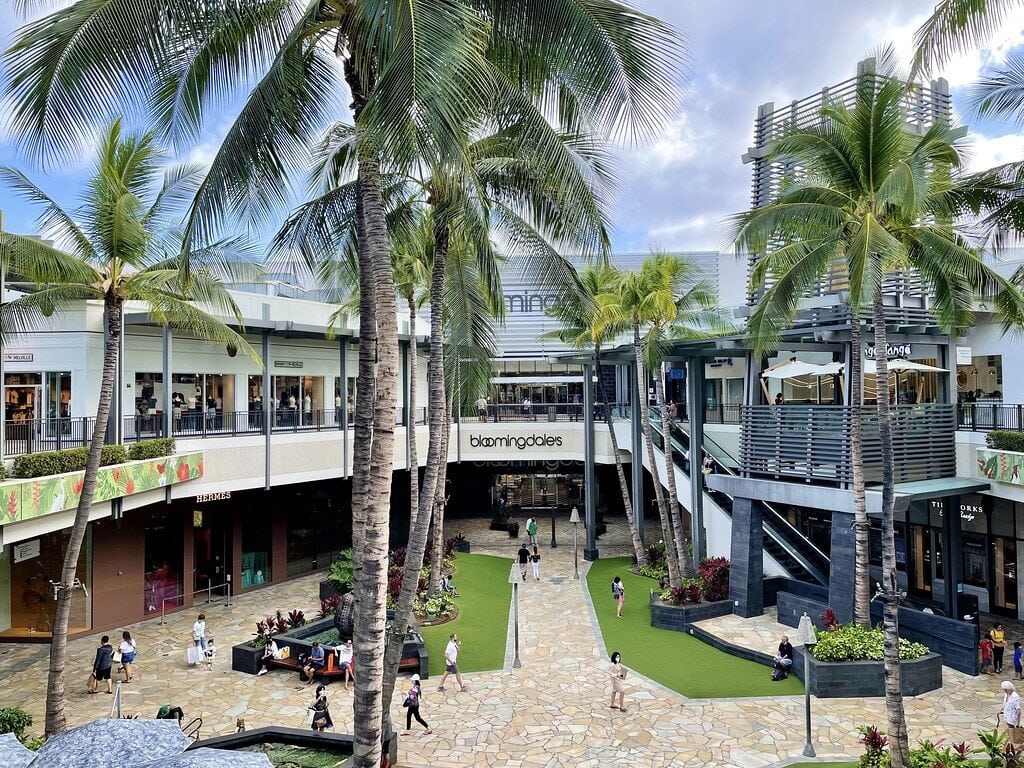
The old waterfall and performance area in the middle became the Royal Grove, 30,000 square feet of open ground.
The plans for it called for about 70 coconut trees, water, seating, and a statue of Pauahi.
Helumoa had once been a grove of more than 10,000 coconut trees.
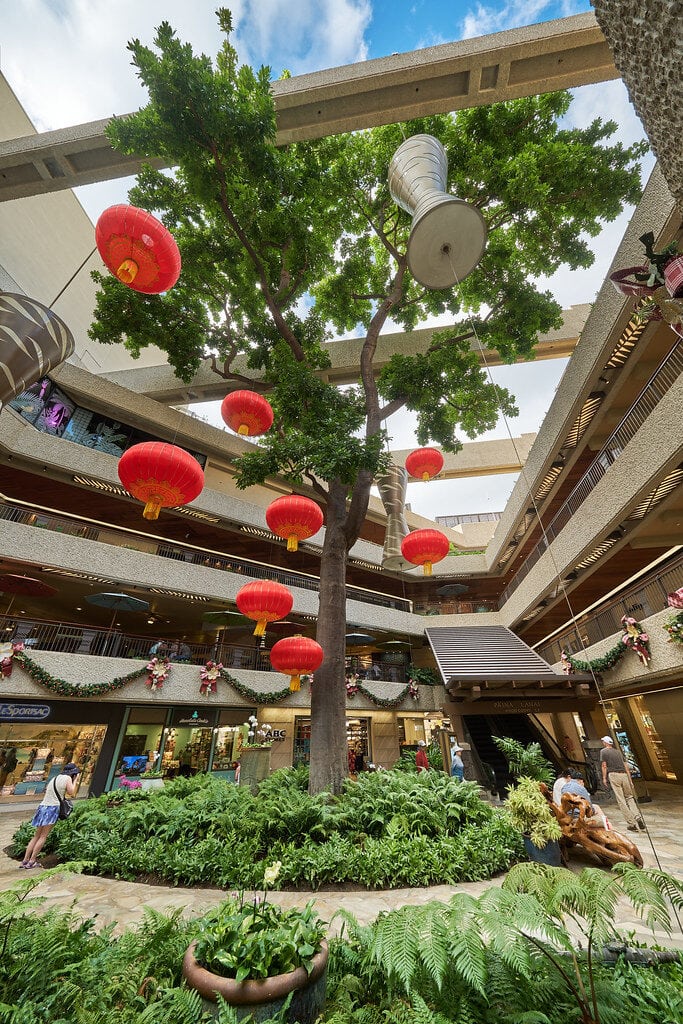
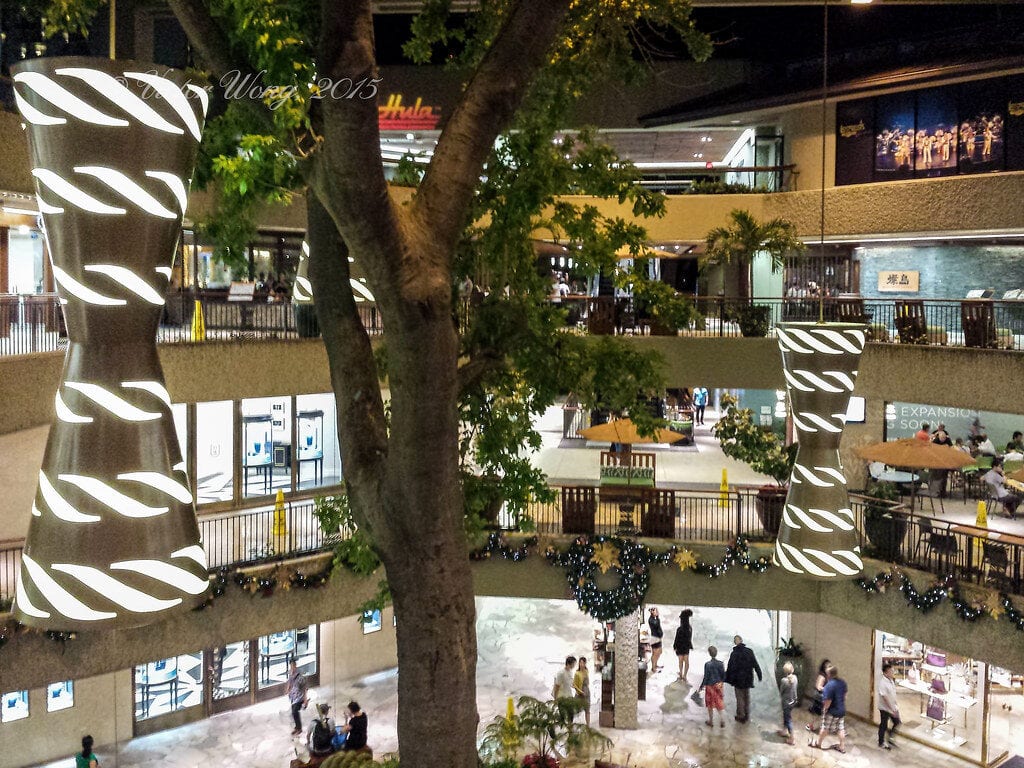
A new food court, Paina Lanai, went in on the second floor, and luxury tenants got street-facing storefronts with windows and lanais.
The name changed as well.
In February 2008 the Royal Hawaiian Shopping Center at 2201 Kalakaua Avenue in Waikiki, Honolulu, Hawaii, dropped "Shopping" from its name.
It became Royal Hawaiian Center, and it is still that today: an open-air complex of more than 90 shops and restaurants, with entertainment and cultural programs.
The new logo carried coconut trees.
The grand reopening ran from June 14 to June 20, 2008, with the Royal Hawaiian Band and the Makaha Sons on a schedule that also held ukulele lessons, hula classes, and lei making.
The whole rebuild cost $115 million. When the week was over, the cultural programs stayed on the center's regular calendar.
The new theater and Hilo Hattie's missing store
The rebuild also gave the fourth floor a new high-tech theater for a show called Waikiki Nei.
The showroom cost roughly $22 million, and its stage equipment, including an 8,900-pound movable projection structure, kept pushing the opening back.
Waikiki Nei finally opened in August 2008, in the middle of a deep tourism and economic downturn.
It stopped performing in early October and never came back.
The space got one more try. Heartbeat Hawaii opened on July 17, 2009, and closed on October 25.
Kamehameha Schools had filed in August to take the premises back, and on October 6 the showroom company filed for Chapter 11, which put the school's case on hold.
The bankruptcy case was later dismissed, and the lease ended by court order on September 20, 2010.
The nightclub still running on Level 4 closed with it.
The rebuild's other big promise never opened at all. Hilo Hattie had announced a flagship store during construction and delayed it again and again.
The retailer filed for bankruptcy in October 2008 and gave up the plan early in 2009 for lack of financing.
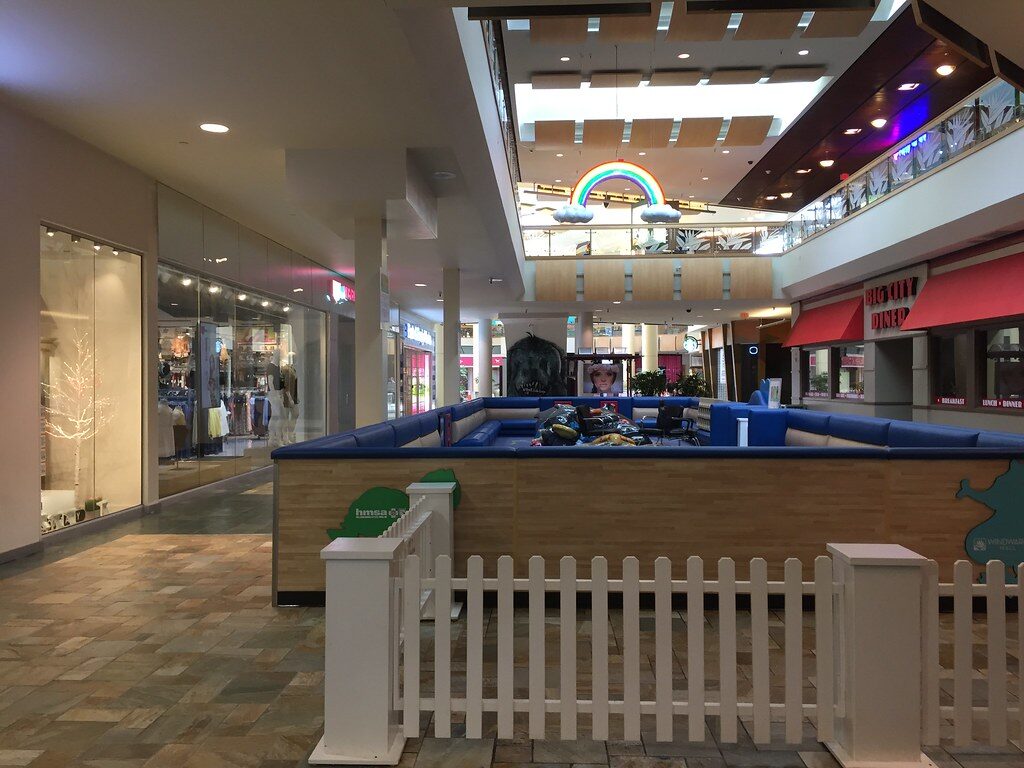
Forever 21 took the space and opened a three-level Waikiki flagship there on December 19, 2010.
Kamehameha Schools keeps the land, sells the rest
On June 6, 2014, Kamehameha Schools sold the buildings and other improvements to institutional investors advised by J.P. Morgan Asset Management and kept Helumoa.
The center has run on a long-term ground lease ever since.
The school owns the land, RHC Property Holdings LLC owns the buildings, and The Festival Companies still manages the place.
Tenants kept turning over under the new owners. Forever 21 is gone.
Apple, which had opened in September 2008, closed its store on January 20, 2024, after more than 15 years, and about 57 employees were offered jobs at Apple's two other Honolulu stores.
The fourth-floor theater found a lasting show in the end: Rock-A-Hula has played the 750-seat room for more than 15 years.
Restaurant Suntory has outlasted all of them.
It opened at the center on September 15, 1980, a quarter century before the bridges came down, and it is still there in Building B. A $2 million renovation that began in fall 2021 rebuilt its dining room, which reopened on March 27, 2022, with a separate sushi concept, Tokiwa.
The Royal Grove has stayed in use too.
Since 2010, rotating halau have performed traditional hula there in a program called Hula Kahiko Ma Helumoa, and in 2026 they are still dancing in the grove.
Independent Publisher Notice
BestAttractions is an independent editorial publisher. We are not affiliated with, endorsed by, or acting on behalf of any location, business, property owner, manager, government agency, or organization described in this article.
Comments posted on this page are not forwarded to, reviewed by, or acted upon by any entity mentioned in the article.
For official inquiries, complaints, applications, bookings, or other requests, please contact the relevant entity directly through its official website or other verified channels.