
In October 1969, two anti-pollution campaigners entered Inland Center with petitions.
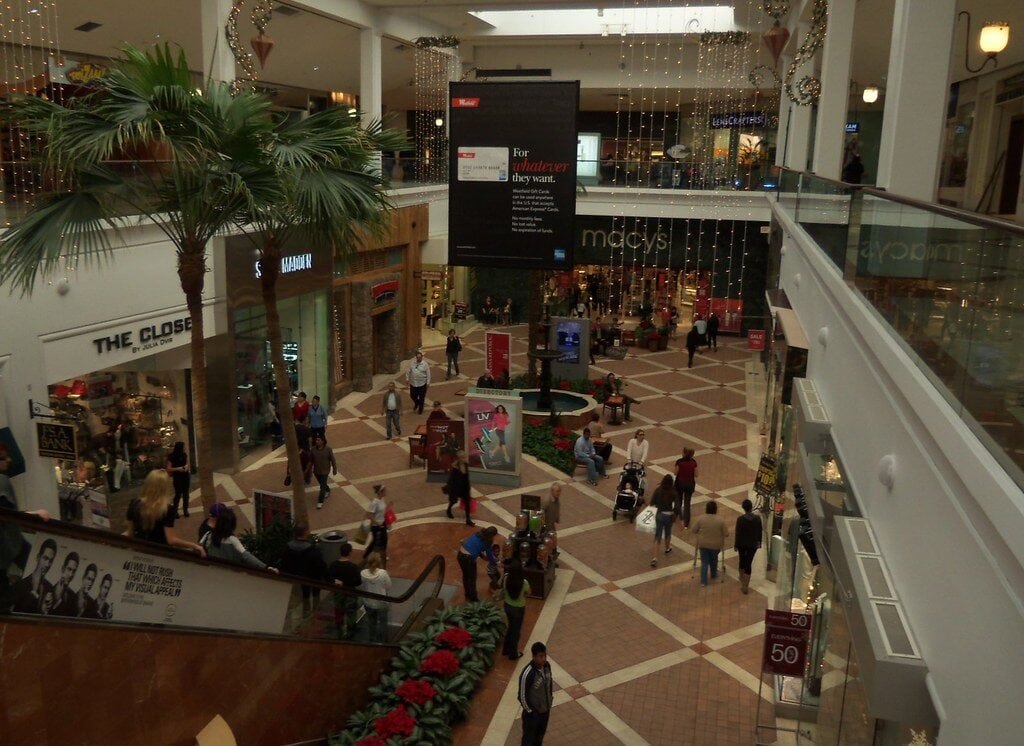
The mall was privately owned, but it looked and worked like a public indoor street. It had wide walkways, benches, music, open doors, and thousands of daily visitors.
Security stopped the campaigners from collecting signatures.
The dispute later became Diamond v. Bland, a California Supreme Court case about free speech in shopping centers.
The petition dispute exposed a tension that ran through Inland Center's history.
The mall was built to sell goods, but it also became a meeting place, an alternative to downtown, and a space for public activity.
It survived as traditional department stores closed and its tenant mix changed.
Before the mall
The land in southern San Bernardino had been a public gathering place before it became a mall.
Urbita Springs Park occupied the present Inland Center site.
People could reach the park by public transport.
It had a boating lake, picnic areas, a carousel, outdoor concerts, and a dance hall.
Pacific Electric later sold the land to Ernest Pickering.
He improved the property, which then continued as Pickering Park.
Urbita Springs Park occupied the same general site as the later mall.
The exact relationship between the old lake, park buildings, and present mall footprint remains uncertain.
A recreation area connected to public transport became a shopping area designed for cars.
Both places attracted visitors from outside the nearby neighborhood, but they organized movement in different ways.
Urbita Springs invited people into open parkland.
Inland Center guided them through parking lots and an air-conditioned indoor space.
A new indoor city in 1966
Homart Development Company, a shopping-center business created by Sears, developed Inland Center during the postwar mall-building boom.
The main department stores were connected by an enclosed walkway, though each occupied its own multistory building.
The Broadway opened first, followed by May Company and Sears.
The indoor mall opened on October 12, 1966, with about 70 smaller stores and parking for around 5,000 cars.
The city describes Inland Center as San Bernardino's first mall under one roof.
Its design helped make it successful.
A low, one-level shopping area connected several department stores with more than one floor.
Large parking lots surrounded the buildings.
The freeway beside the mall, now Interstate 215, made it easy to reach from San Bernardino, Colton, Loma Linda, Redlands, and other nearby communities.
By 1970, Inland Center had Sears, The Broadway, May Company, and 72 other businesses.
About 25,000 people visited on an average day.
Customers came from an area with about one million residents, including places up to 75 miles away.
These numbers describe the mall's early years, not its current performance.
They show how quickly Inland Center became important across the region.
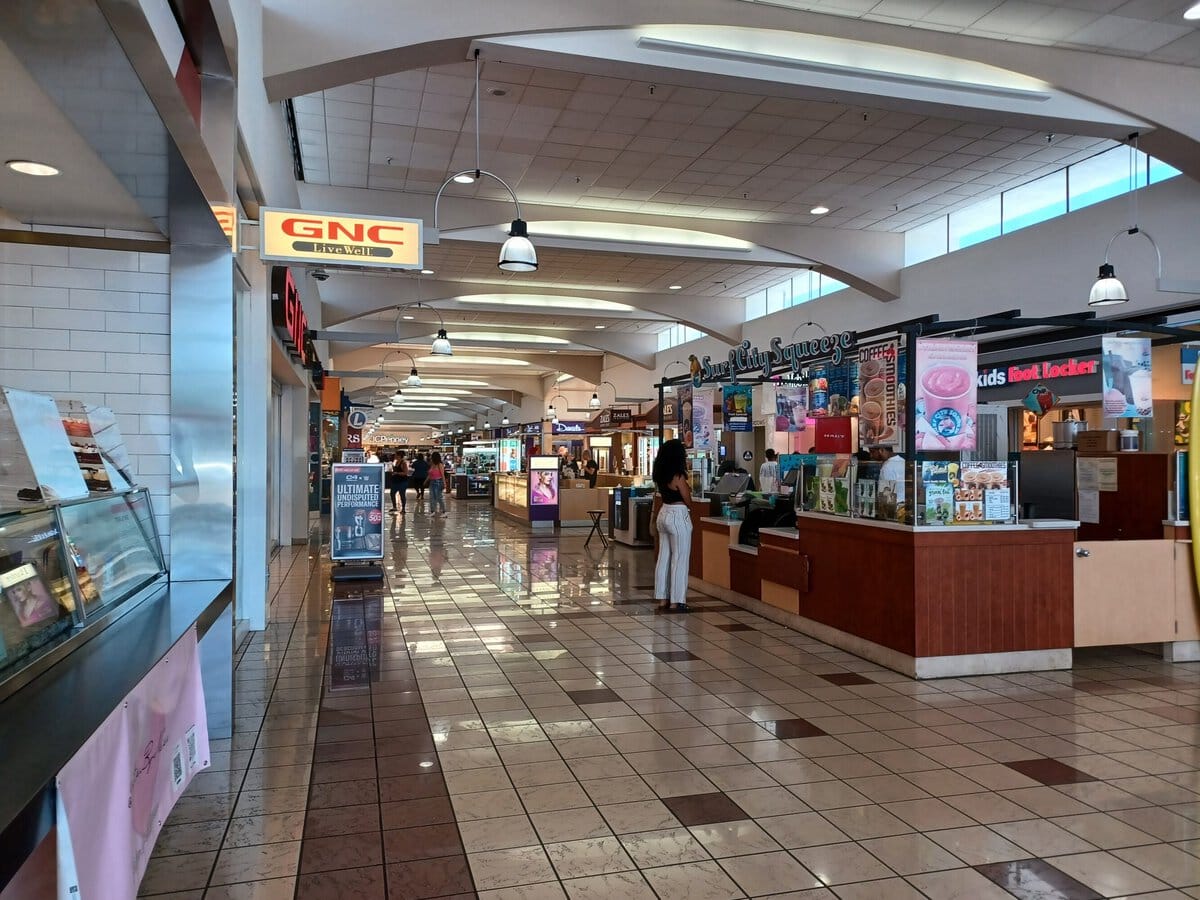
The indoor walkway connected the department stores and smaller shops.
Its benches, promotions, and open circulation also made it part of the mall's social life.
The move away from downtown
When Inland Center opened, downtown San Bernardino still had major stores and busy shopping streets.
Central City Mall opened downtown six years later.
This gave the city two enclosed malls located fairly close to each other.
Inland Center had several advantages.
It was near the freeway, had large parking areas, and had department stores designed for customers arriving by car from across the region.
Inland Center and Central City Mall competed within the same city after the downtown mall opened in 1972.
Inland Center's freeway access, large parking areas, and regional department stores shifted more shopping activity toward southern San Bernardino.
Freeway construction, suburban growth, later development choices, job changes, and competition across the Inland Empire also contributed to downtown decline.
Inland Center allowed regional visitors to shop in southern San Bernardino without entering the older downtown street system.
A private place with public functions
The Diamond v. Bland case made Inland Center part of a long California debate about speech in privately owned shopping centers.
In 1970, the California Supreme Court supported the campaigners' right to collect signatures at the mall.
The court reversed that decision in 1974 after a federal ruling changed the legal situation.
Later, in Robins v. Pruneyard Shopping Center, the California Supreme Court ruled that the state constitution protected reasonable speech and petitioning in shopping centers.
Fashion Valley Mall v. NLRB later applied that protection to speech asking customers to boycott a mall business.
Mall owners controlled the property, selected tenants, managed events, and set reasonable rules for public activity.
California courts also had to decide whether shopping centers that had absorbed functions of downtown public space must allow reasonable speech and petitioning.
That conflict still exists in quieter forms.
Current mall events include children's programs, seasonal activities, and community gatherings.
County job services and a city police presence have also operated at the center.
Inland Center is still privately owned, but these uses make it part of the city's social and public-service system.
Growth, costs, and plans that were never finished
San Bernardino continued to view Inland Center as an important economic property.
In 1996, the City Council approved a major expansion plan after reviewing an environmental impact report.
The plan allowed hundreds of thousands of extra square feet.
The city admitted that the project would cause serious negative effects, including some that could not be fully reduced.
The council approved the project after deciding that the expected economic, social, and cultural benefits outweighed those effects.
Only part of the expansion was built. A new Robinsons-May store and a parking structure opened on the west side in 1998.
Later stages, including more department-store space and an upper level, were never completed.
The unbuilt phases left Inland Center smaller than the expansion approved in 1996.
The department stores changed
The mall's large department-store buildings show how American retail changed over time.
The Broadway became Macy's. Macy's later moved into the newer building that had once been Robinsons-May.
May Company became Gottschalks. After standing empty, the building reopened as JCPenney in 2016.
The old Broadway building passed through Macy's ownership and an unfinished Mervyn's plan.
Forever 21 then took a large space there in 2009.
Urban Planet opened in the building in April 2026.
Sears was the last original department store to remain open without interruption.
It closed in early 2020.
This left a two-level building once reported at 264,700 square feet without a permanent new tenant.
Macerich bought the former Sears property in May 2024 for $5.4 million.
This placed the large northern part of the site under the mall owner's control.
Inland Center had 895,000 square feet of reported gross leasable area as of March 31, 2026, including department-store areas.
The vacant Sears building is the mall's largest unresolved space.
Earlier anchor replacements used the old buildings differently.
Urban Planet uses a former department-store building for large-scale clothing sales.
JCPenney uses only part of the former May Company building.
What Inland Center is now
As of July 2026, Inland Center remains open.
Its official directory lists Macy's, JCPenney, Urban Planet, H&M, JD Sports, Vans, Tillys, BoxLunch, Bath & Body Works, jewelry stores, phone shops, food-court businesses, clothing stores, and entertainment uses.
Newer businesses include an indoor children's playground, an arcade, collectible shops, a discount store, and a locally owned clothing store.
Inland Center remains active, and its tenant mix now extends beyond the department-store system that created it.
The complex retains its 1966 mall structure while operating with a changed mix of anchors, smaller retailers, entertainment, and services.
The site's strongest continuing role is as a gathering place.
The land changed from springs, picnic grounds, and public transport trips to a freeway mall.
It later became a retail interior that also hosts services and community events.
The physical form changed from open recreation land to controlled commercial space.
The rules of social use changed as well.
Inland Center's history follows San Bernardino's movement from open recreation grounds to car-oriented retail and then to a mall that combines shopping, services, and community activity.
The mall remains open on the former Urbita Springs site, with active stores, community uses, and the vacant Sears building occupying different parts of the same property.
Sources and further reading
- Resolution No. 96-84 and Inland Center Mall Expansion Documents - City of San Bernardino, April 1, 1996. Documents the environmental review, approved expansion framework, mitigation requirements, and the city's statement of overriding considerations.
- Diamond v. Bland, 3 Cal.3d 653 - California Supreme Court, December 16, 1970. Describes the 1969 petition dispute, the mall's early scale, and the court's original decision concerning signature gathering at Inland Center.
- Diamond v. Bland, 11 Cal.3d 331 - California Supreme Court, April 25, 1974. Explains the court's reconsideration of the Inland Center case following the U.S. Supreme Court's decision in Lloyd Corp. v. Tanner.
- Robins v. Pruneyard Shopping Center, 23 Cal.3d 899 - California Supreme Court, March 30, 1979. Provides later legal context for speech and petitioning rights at privately owned shopping centers under the California Constitution.
- 2025 Form 10-K - Macerich, fiscal year ended December 31, 2025. Reports the May 2024 acquisition of the former Sears parcel, the purchase price, ownership information, and year-end property data.
- First Quarter 2026 Supplemental Information - Macerich, data as of March 31, 2026. Reports Inland Center's total gross leasable area and other current property information.
- Inland Center Store Directory - Inland Center, accessed July 25, 2026. Lists current department stores, specialty retailers, services, food businesses, entertainment uses, and Urban Planet.
- San Bernardino Water Officials Perplexed by Underground Springs - Los Angeles Times, May 20, 1985. Provides independent historical context about Urbita Springs, former lakes and ponds, and the area's recurring artesian water.
Independent Publisher Notice
BestAttractions is an independent editorial publisher. We are not affiliated with, endorsed by, or acting on behalf of any location, business, property owner, manager, government agency, or organization described in this article.
Comments posted on this page are not forwarded to, reviewed by, or acted upon by any entity mentioned in the article.
For official inquiries, complaints, applications, bookings, or other requests, please contact the relevant entity directly through its official website or other verified channels.