
The Maine Mall is in South Portland, though it is closely tied to Portland.
South Portland helped assemble the site, build roads and sewers, and turn its wet western area into a major shopping center. More than fifty years later, the mall is still active.
At the same time, its huge parking areas, rerouted stream, and former department-store spaces are now part of plans to make the area feel more like a connected neighborhood.
Inside, the mall is mainly a one-level path between large stores, restaurants, services, and entertainment. Outside, wide parking lots and internal roads separate the building from public streets.
The car-oriented design supported the mall's long success. It brought shoppers from Greater Portland together under one roof and made arrival by car easy.
Today, the same land is also expected to support walking, public transport, housing, environmental repair, and new kinds of businesses.
A city development project
South Portland's involvement began before the first department store opened.
Bernal B. Allen became city manager in 1957.
He supported business and industrial growth to create jobs and make South Portland more self-sufficient.
In 1965, the South Portland Board of Industry bought about 150 acres on the west side of the city for a regional shopping center.
The board sold the development land for $30,000.
Private developers also bought nearby land and prepared the project.
By late 1967, South Portland was planning about $1 million in road and sewer work for a project expected to cost around $20 million.
Early plans described a shopping center of about 600,000 square feet.
Jordan Marsh was expected to use about one-third of the space.
These numbers came from the planning period.
They should not be confused with the final size of the mall after later expansions.
The claim that the enclosed mall replaced Charlie Dwyer's pig farm is geographically inaccurate.
Dwyer's pig and waste business stood across the road from the mall.
Hotels and other businesses were later built there.
The mall itself was built mainly on undeveloped wetland.
The farm was part of the nearby development area.
The enclosed mall occupied a different site.
Two openings, not one
The mall opened in two main stages.
Jordan Marsh opened a separate South Portland store in August 1969.
The building was about 200,000 square feet and was the company's first store in Maine.
It began attracting shoppers before the enclosed mall existed.
The connected Maine Mall opened on August 16, 1971.
Sears opened as another main store in October.
Jordan Marsh and Sears stood at opposite ends of the original mall.
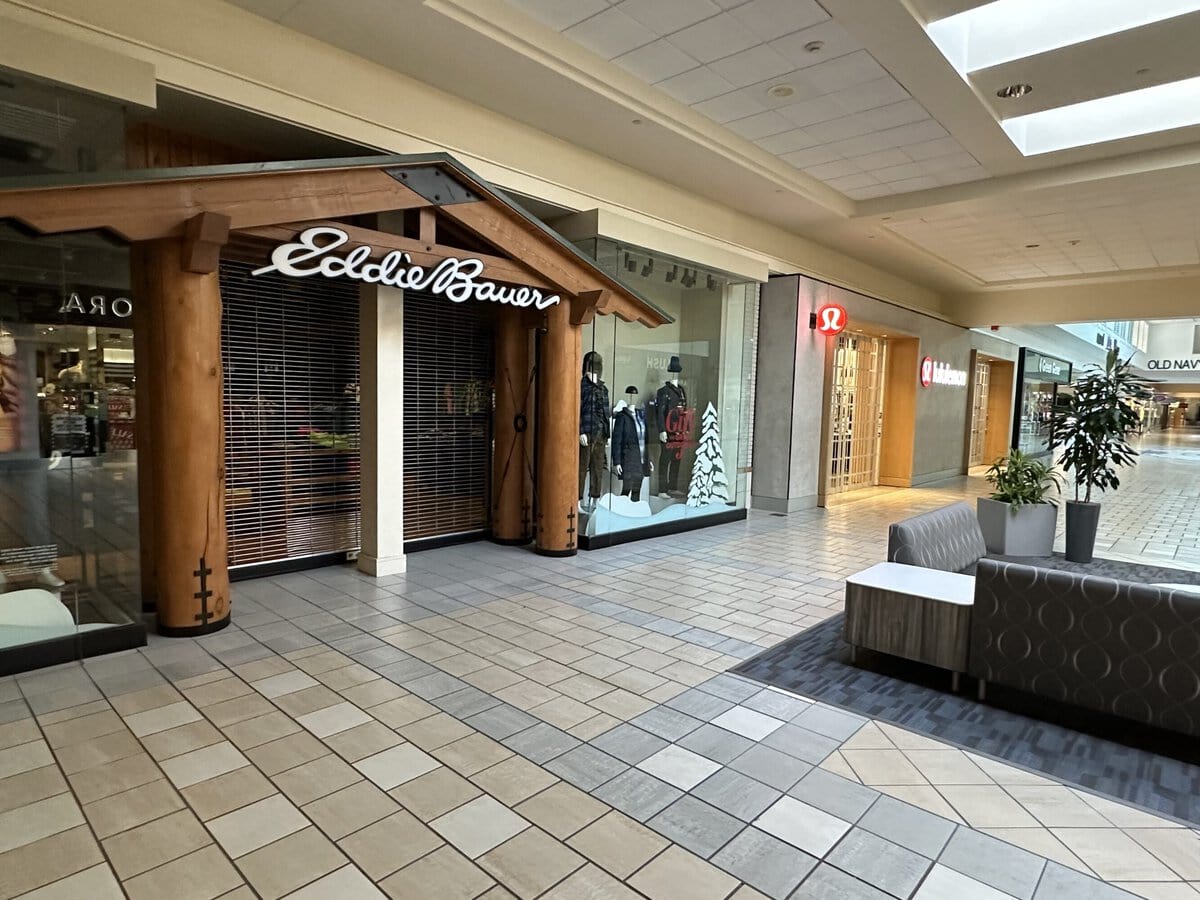
Smaller shops were placed along a one-level indoor hallway.
The department stores had much larger spaces, though only Jordan Marsh used multiple retail floors.
Bernal Allen left city government in 1971 and became the mall's general manager.
This move created a direct link between South Portland's development program and the operation of the new shopping center.
By 1972, the mall generated an estimated $7.5 million in taxable sales each month.
It employed about 2,000 people and had an estimated yearly payroll of nearly $10 million.
In 1973, 45 of its 50 shop spaces were occupied.
The 1972 sales, employment, and payroll figures are estimates.
Expansion and daily life
The mall's biggest physical change came in 1983.
The owners had announced an addition of about 400,000 square feet in 1979.
The expanded mall held its grand opening on August 5, 1983.
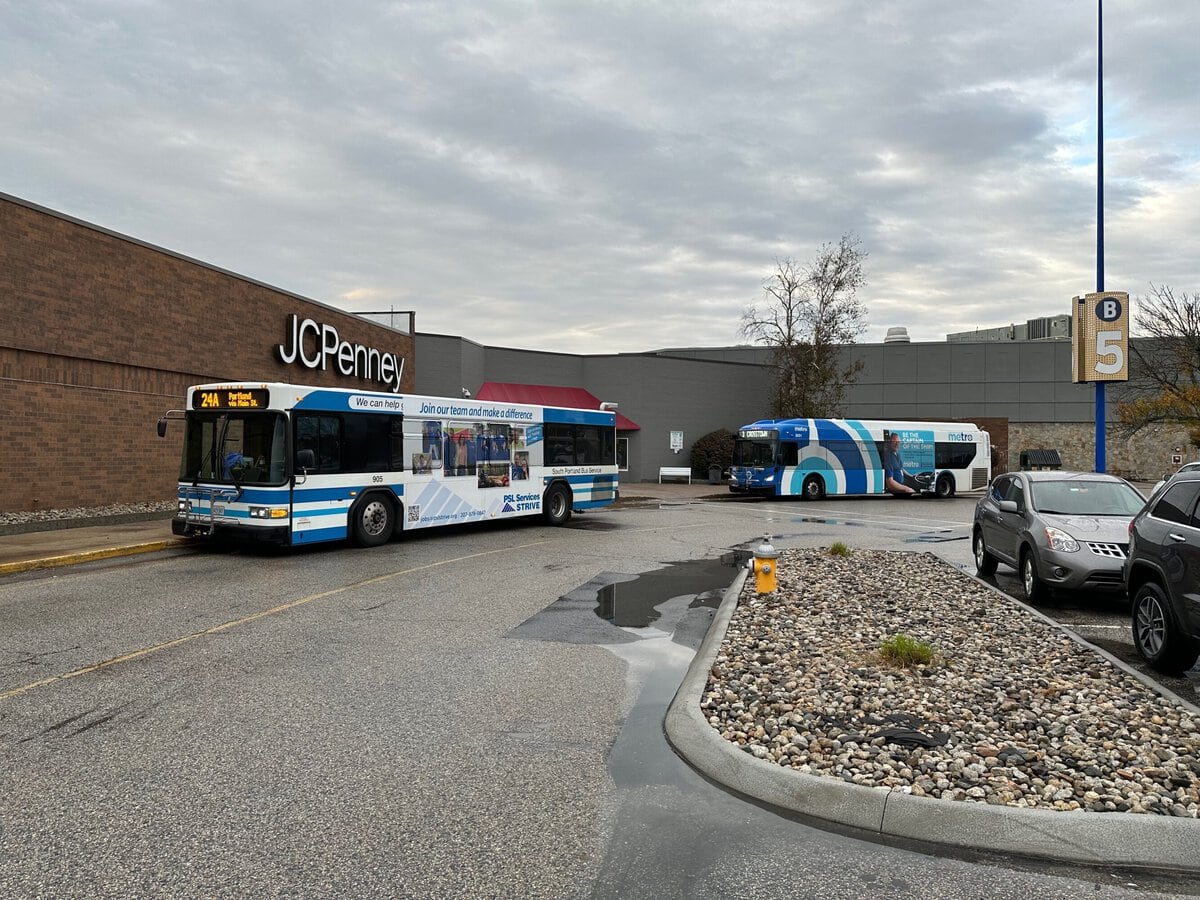
JCPenney, Filene's, and the Portland company Porteous joined Jordan Marsh and Sears.
This created a mall with five major department stores and almost 1 million square feet of space.
A ceremony marked the start of construction on May 27, 1982.
The 1983 expansion added a food court. A 1994 renovation later enlarged and remodeled it.
By the 1980s, the mall hosted events and entertainment.
Stephen King held a book signing at Waldenbooks in 1983, the Dream Machine arcade operated there, and Up with People performed in 1984.
The mall's indoor space accommodated public events and entertainment alongside shopping.
The cost of a mall built around parking
The mall's main regional advantage was easy highway access and free parking.
Its location near the Maine Turnpike and Interstate 295 helped department stores attract customers from across southern Maine.
Hotels, restaurants, offices, car dealers, and other stores later spread along Maine Mall Road, Gorham Road, Western Avenue, and Running Hill Road.
This growth moved some shopping activity away from downtown Portland.
Highway construction, suburban housing, growing car ownership, city rebuilding projects in Portland, department-store business decisions, later big-box stores, and changes in national retail companies also affected downtown retail.
The environmental costs are especially clear in the Long Creek area.
A planning study from 2018 to 2020 examined about 90 acres around the mall.
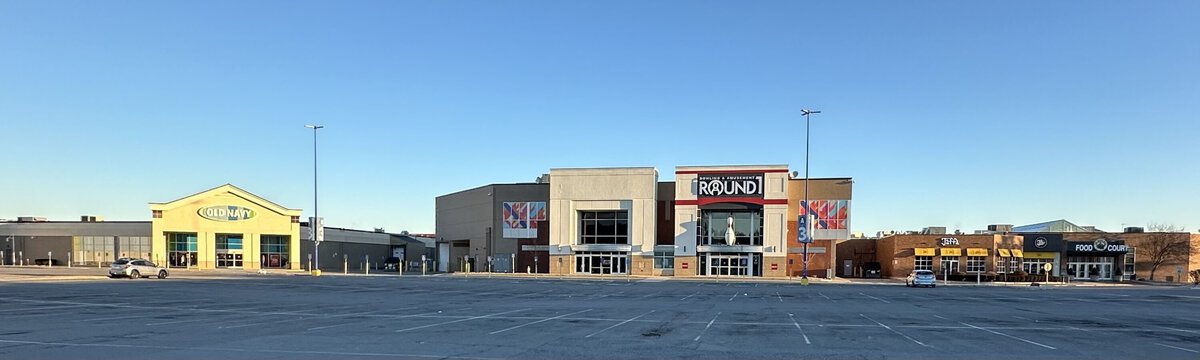
This included about 63 acres of internal roads and surface parking, 24 acres of buildings, and only about 3 acres of trees or planted land.
This larger planning area is different from commercial property listings that describe about 1.01 million square feet of buildings on 55.19 acres.
The two sets of numbers use different borders and measurements.
Rain and melting snow run off roofs, roads, and parking lots.
This water carries road salt and other pollution into Long Creek.
The South Branch near the mall has been greatly changed.
Winter treatment of paved areas also adds high levels of chloride, a part of road salt, to the water.
The parking lots supported a business system built for easy driving.
They occupied most of the site and contributed to a long-term environmental problem.
Major stores change, and the building finds new uses
The mall's original department-store system has changed over time.
Jordan Marsh became Macy's in 1996. Porteous closed in 1994, and its space was later split between other businesses.
Filene's closed in 2006. Bon-Ton used the former Filene's space from 2013 to 2017.
Jordan's Furniture opened there in July 2020.
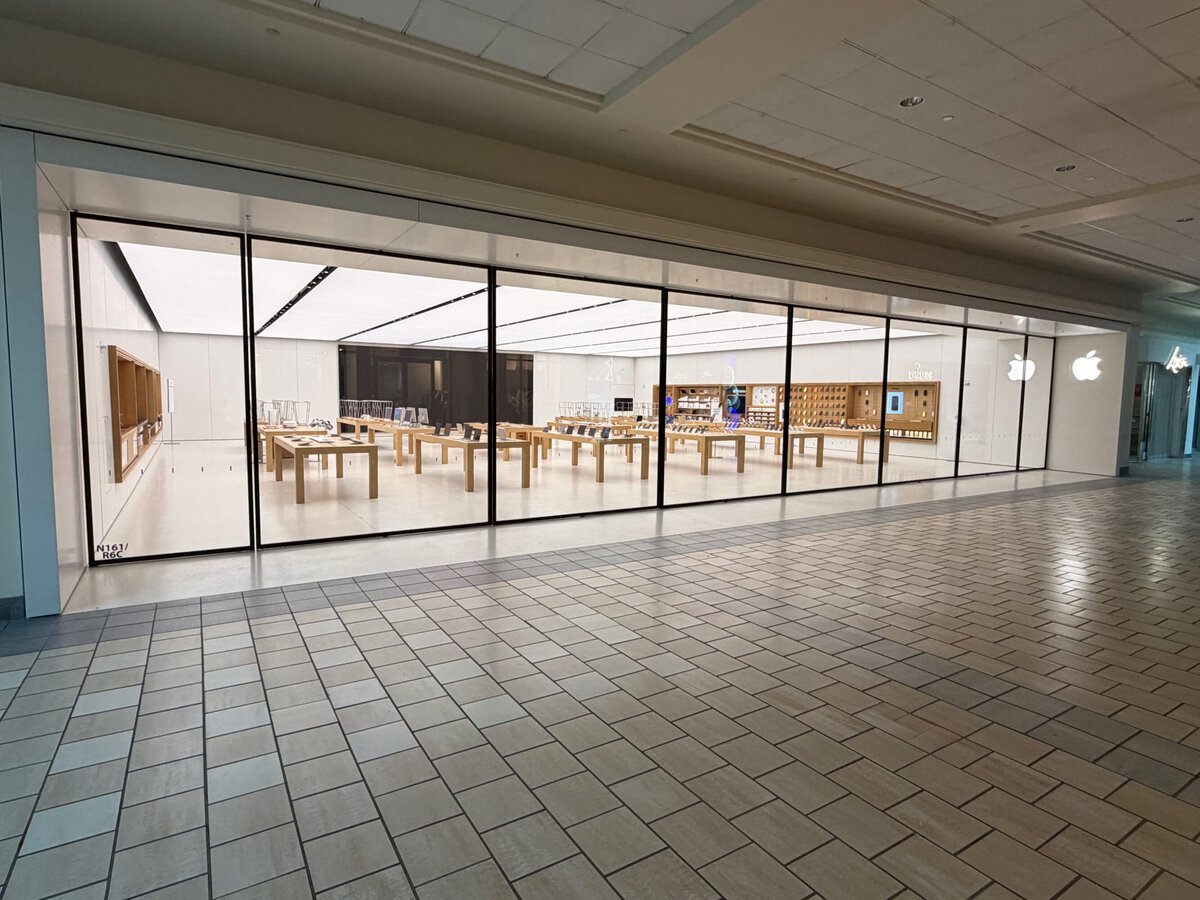
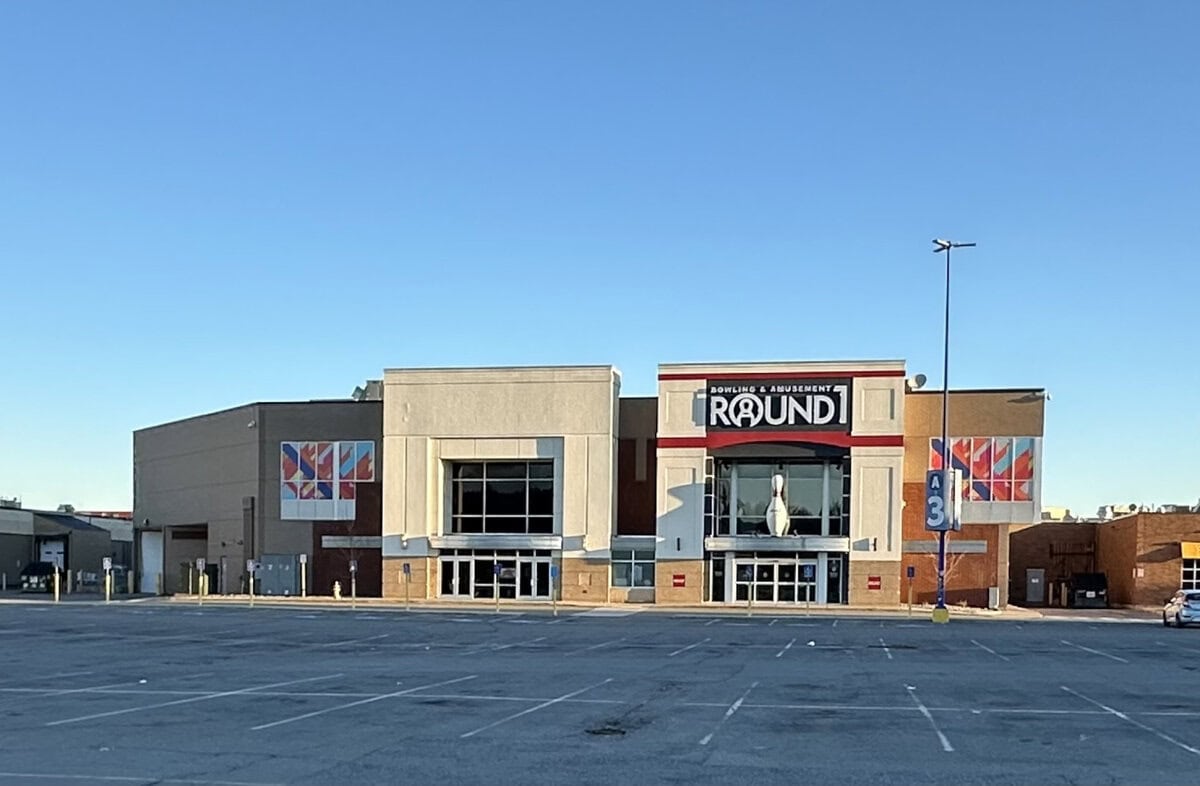
Round1 Bowling & Arcade took over the upper floor of another former department-store space.
It replaced traditional shopping with bowling, games, karaoke, and other activities.
Sears closed on September 13, 2020, after almost 49 years.
Sears owned its building and the connected land.
That ownership prevented the mall operator from renting the space to another company.
Dick's Sporting Goods confirmed the purchase of the former Sears property in February 2025.
By 2026, plans called for a Dick's House of Sport on the site.
In 2026, Dick's still listed 385 Gorham Road as its current South Portland location.
No opening date had been announced for the House of Sport, although construction was expected to begin.
The mall's ownership is also complex. General Growth Properties bought the mall in 2003.
Brookfield bought General Growth Properties in 2018.
A 2025 federal court order named GGP-Maine Mall LLC as the owner of the real estate and Brookfield Properties Retail Inc. as the operator.
The public mall website still carried GGP links and a GGP Services copyright in 2026.
The main mall, department-store buildings, separate business sites, and nearby properties have multiple owners.
Redeveloping them as one project would require agreements among those owners.
From shopping center to a possible mixed-use district
South Portland and regional planners began studying public transport and development around the mall in 2018.
They presented a plan in 2020.
The plan included a connected street system, housing, offices, parks, a transport center, parking garages, and repair of parts of the South Branch of Long Creek.
New buildings would slowly replace parts of the surface parking areas.
The enclosed mall would continue to operate.
The plan was a general guide, not an approved construction program for the whole mall.
It covered land owned by several groups.
Future development would still require new zoning rules, engineering work, money, permits, and agreements between property owners.
In April 2026, South Portland approved a city plan that identified the mall and Sable Oaks as special areas for strong growth.
The city wanted to support mixed-use development and different kinds of housing.
The city plan did not authorize construction of the full mall plan.
Development is currently happening through smaller projects.
A Chick-fil-A was under construction on part of Macy's surplus parking lot in 2026.
Nearby, Mall Plaza received approval for a project with two hotels.
Some small businesses in the area faced relocation.
The district is changing through separate projects with their own approvals.
Replacement of the enclosed mall is outside their scope.
The Maine Mall remains open.
It includes Macy's, JCPenney, Jordan's Furniture, Best Buy, Round1, and many smaller businesses.
Its history can be seen in the long distance between its doors and public roads, in old department-store buildings that have been reused one section at a time, and in the creek beside a landscape designed for parking.
South Portland once used land policy and public infrastructure to create a regional shopping destination.
Its next challenge is to add streets, homes, public transport, and environmental repair while recognizing that the mall is still an active place.
Sources and further reading
- The Maine Mall: From Pig Farm to Shopping Mecca - South Portland Historical Society, April 11, 2025. Reviews the city's early land assembly, the 1967 infrastructure plan, Jordan Marsh's opening, and the development of the enclosed mall.
- Maine Mall expansion grand opening, 1983 - Portland Public Library Special Collections and Archives, August 5, 1983. Archival metadata documents the major 1983 expansion, its new department stores, and the food court.
- Maine Mall Transit-Oriented Development Concept Plan - City of South Portland and Greater Portland Council of Governments, February 2020. Defines the study area's land use, documents Long Creek conditions, and presents the non-prescriptive mixed-use development vision.
- Long Creek Residual Designation - U.S. Environmental Protection Agency, updated June 8, 2026. Provides the federal record for additional stormwater permitting in the Long Creek watershed.
- City Council Meeting Summary - April 21, 2026 - City of South Portland, April 24, 2026. Records adoption of the 2040 Comprehensive Plan and the high-growth designation for the Maine Mall and Sable Oaks areas.
- Mission Working Dogs et al. v. Brookfield Properties Retail Inc. et al. - Order on Summary Judgment - U.S. District Court for the District of Maine, March 7, 2025. Identifies GGP-Maine Mall LLC as the owner of the mall real estate and Brookfield Properties Retail Inc. as its operator.
- The Maine Mall directory - The Maine Mall, current directory checked July 25, 2026. Shows the mall's current stores, services, dining, and entertainment businesses.
- Dick's Sporting Goods buys old Sears store at Maine Mall - WGME, February 13, 2025. Reports Dick's confirmation that it purchased the former Sears property.
Independent Publisher Notice
BestAttractions is an independent editorial publisher. We are not affiliated with, endorsed by, or acting on behalf of any location, business, property owner, manager, government agency, or organization described in this article. Comments posted on this page are not forwarded to, reviewed by, or acted upon by any entity mentioned in the article. For official inquiries, complaints, applications, bookings, or other requests, please contact the relevant entity directly through its official website or other verified channels.
Adding housing and parks will help the mall?
I think adding housing and parks could bring more life to the mall area.