
Trolley Square is a shopping, dining and fitness complex in Salt Lake City's Central City neighborhood, six blocks east of Main Street, built around the car barns of the old Utah Light and Railway streetcar system.
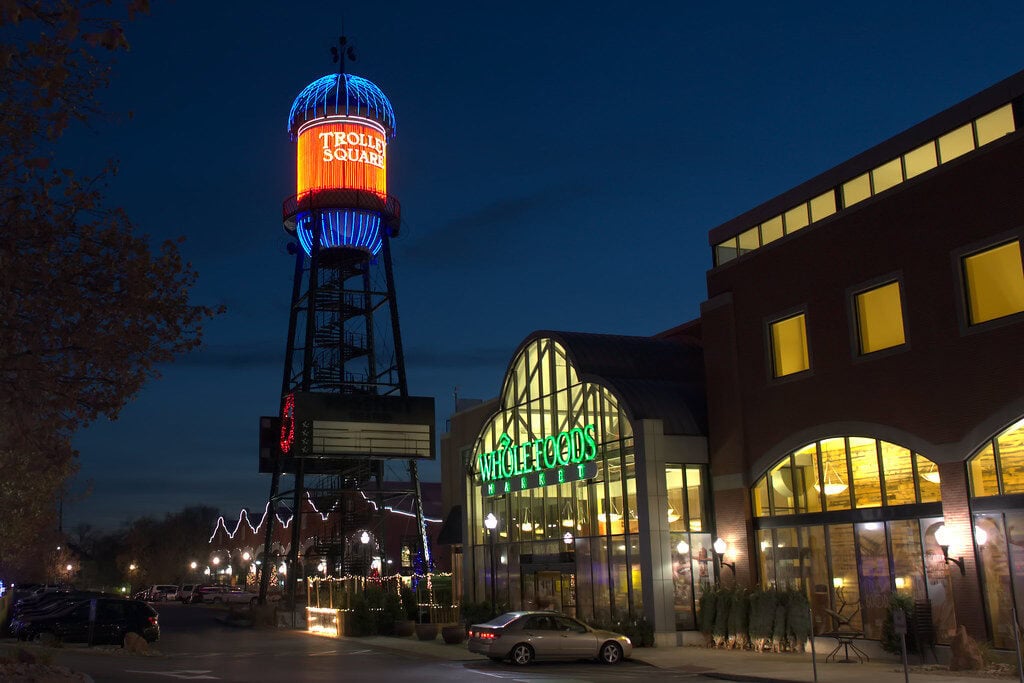
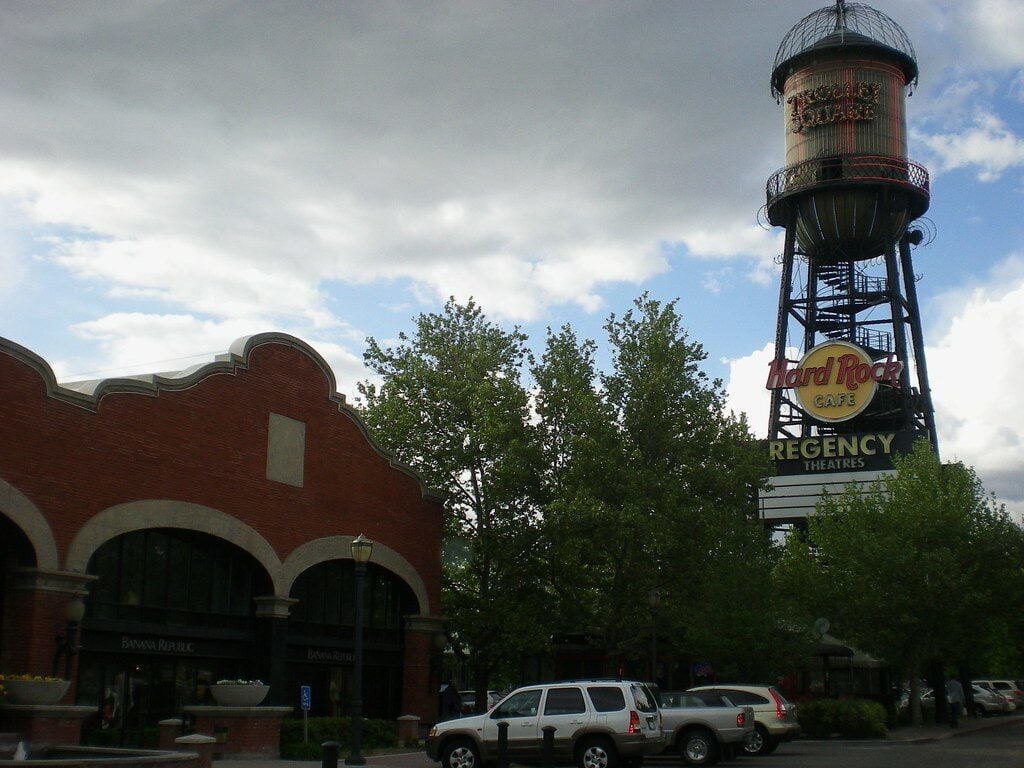
The 97-foot water tower is the part everyone knows. It went up between 1908 and 1910 holding 50,000 gallons for fire protection, and in the 1970s it got thousands of small lights. The main barn parked 144 double-truck streetcars on 16 tracks.
Salt Lake's last streetcar ran in 1945, buses used the buildings until 1970, and demolition was live by 1969.
Wally Wright and a group of private investors opened the barns as a shopping center in June 1972 for about $7 million.
The $60 million rebuild was still underway during the recession, and occupancy fell from about 96 percent to a little over half by 2013.
Whole Foods has anchored the east side since 2011, in a building that didn't exist when the mall opened.
These buildings keep taking on a new business without losing their shape, and the current owner is working on the next one.
The man who tried to sell a public square
In February 1888 Alma H. Winn moved to take possession of the Tenth Ward Square in Salt Lake City and advertise it for sale. He didn't own it.
The 10-acre block had been public ground since 1849, and the attempt pushed the city to sell it first, to the Deseret Agricultural and Manufacturing Society on March 7, 1888.
That block, bounded by 500 South, 600 South, 600 East and 700 East in Central City, six blocks east of downtown, is now Trolley Square, a shopping, dining and fitness complex inside a set of old streetcar buildings.
The society wanted fairgrounds. A design competition for the exposition hall went to Richard K. A. Kletting, who entered under the name "Monday".
His building opened on October 3, 1888, and Utah held its first state fair after statehood there in 1896.
Then the fair outgrew it. The property went back to the city in 1902, and mining businessman David Keith bought the tract for $45,000 to build houses.
He never did. The exposition building was down by 1904 and its bricks were reused elsewhere in the city.
144 streetcars under one roof
Electric streetcars had run in Salt Lake since August 1889, and after a decade of competing companies, Utah Light and Railway came out as a principal operator.
In 1906 Edward H. Harriman, president of the Union Pacific, took a controlling interest and spent on the local system at a scale it hadn't seen.
About $3.5 million went into the system, including this site.
The old fairground became the plant where the streetcars parked and got fixed.
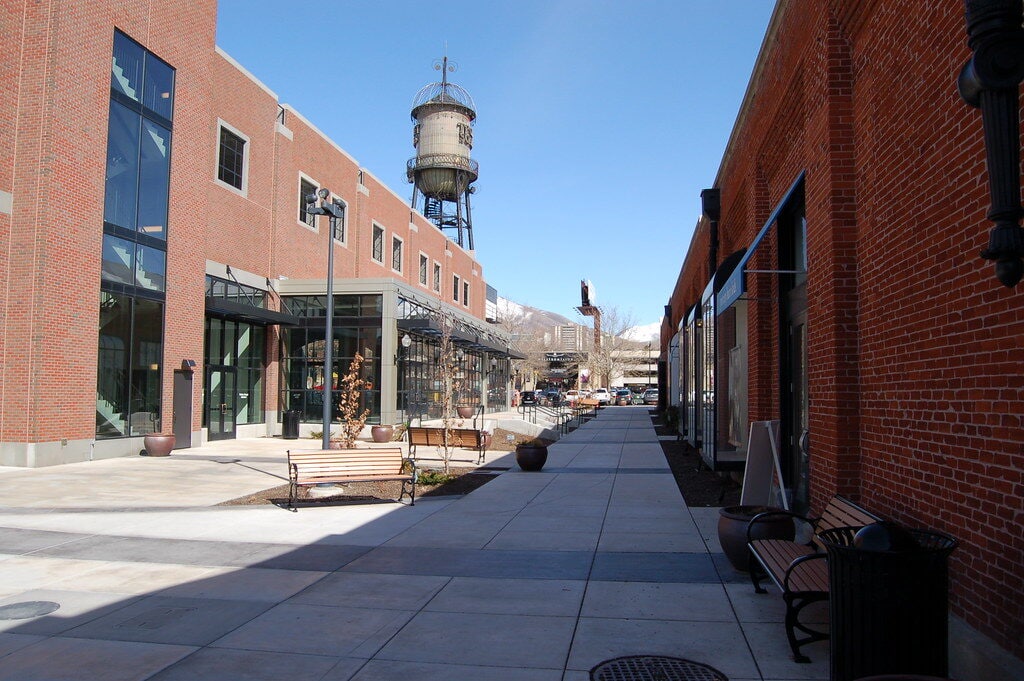
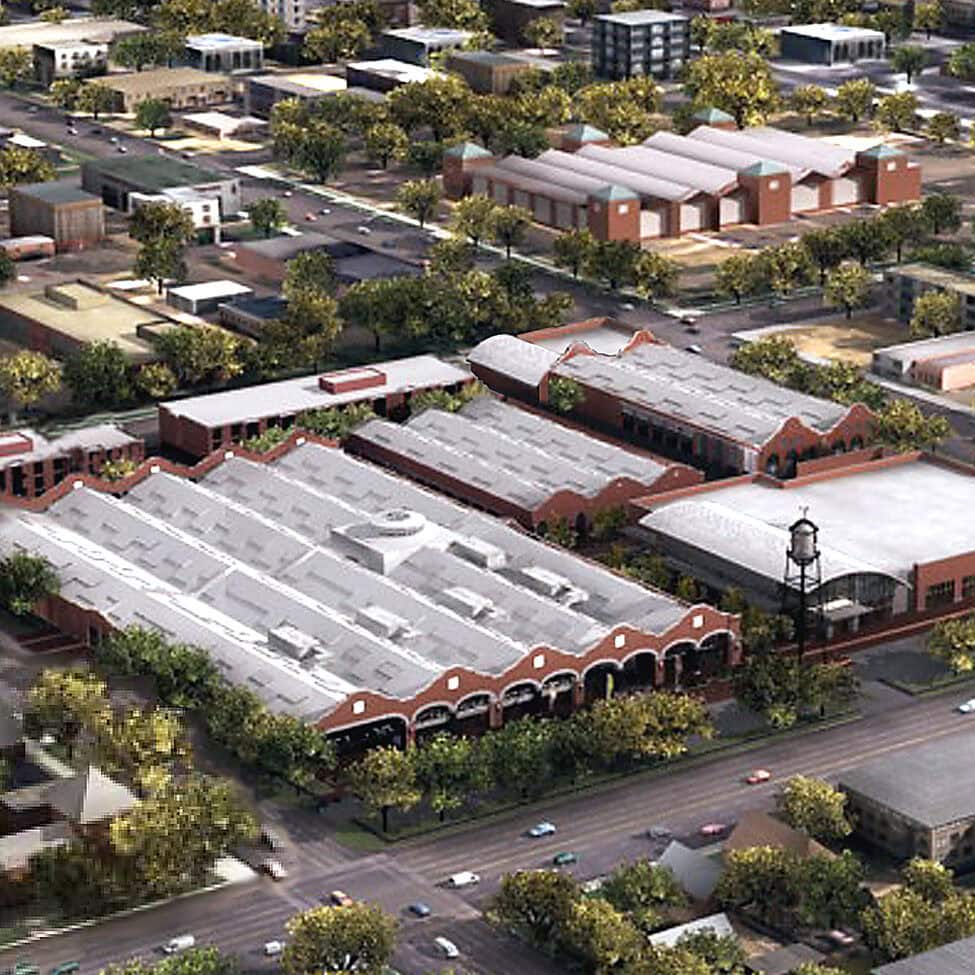
Built from 1908 through 1910 in mission style, the main barn held 144 double-truck streetcars, four tracks in each of four bays, every bay about 57 feet wide.
More than 200 skylights did the lighting.
Around it stood the machine shop, known as the rip shop, a paint and carpentry building, and a sand house for traction sand.
The 97-foot water tower held 50,000 gallons for fire protection.
Track ran in through the doors and parts were made on site.
The brick, the repeating bays, the skylights and the tower are what a shopping center would sell itself on 60 years later.
When the last car ran
The company became Utah Light and Traction in 1914, and at its largest the network reached Sugar House, Holladay, Bountiful and Centerville.
Buses started taking routes in the late 1920s because they cost less and could be rerouted.
A last streetcar run was made before World War II.
Then wartime equipment shortages brought rail service back for a while, and the final electric streetcar in Salt Lake City ran on August 19, 1945.
The barns kept working in transit anyway.
City buses were stored inside them until 1970, and the buildings were painted for the job, structures intact.
By the late 1960s the place had gone to seed.
Wally Wright, the developer who took it on, found a bus barn and junkyard with discarded vehicles and deteriorated buildings.
Demolition was live by 1969.
Trolley Square opens in June 1972
Wallace A. "Wally" Wright Jr. liked old buildings and salvaged materials, and his plan was to leave the barns standing.
His model was Ghirardelli Square in San Francisco, another obsolete industrial complex turned into a dinner destination.
Financing came from businessman Izzy Wagner and other local investors, all of it private money.
Work was underway in 1971, and the center opened in June 1972 at a cost of about $7 million.
He cut the giant floors into shops and restaurants, connected by stairs, interior bridges and changes in level.
He also brought in salvage from demolitions elsewhere: pieces of the Culmer and Dinwoody mansion, hardware from mining properties near Tooele, old streetlights turned into interior lighting, ironwork and staircases.
Some railing supports were shaped like streetcar cowcatchers.
The machine shop became entertainment and restaurant space, a movie theater and steakhouse in roughly 20,000 square feet.
The sand house became a drive-through bank in 1973. The water tower got thousands of small lights and an observation deck.
Trolley Gas Station opened first.
Early tenants included The Old Spaghetti Factory, The Pub, Payne Anthony, Chalk Garden, Corn Dog Trolley and Trolley Theatres.
Utah recognized the property as a historic site in 1973.
A mall with no department store
Trolley Square had no department store at the end of a corridor pulling traffic through, so it ran on small tenants and on dinner.
Restaurants and bars took the evening trade, and the theaters and the building gave people a reason to come without buying anything.
The Pub became Desert Edge Brewery. The Old Spaghetti Factory settled upstairs and stayed.
Wright sold most of his interest in 1986 to a partnership that included Melvin Simon & Associates, the Indianapolis company that became Simon Property Group.
National chains arrived while the format stayed: Banana Republic, Brookstone, Talbots, Williams Sonoma, The Gap.
By September 1996 the center had about 68 tenants and little vacancy, with sales through July running 7 percent ahead of the year before.
A second-level food court closed and became a video arcade that took more room than its business justified.
By 2003 the mix leaned to home furnishings and dining: Pottery Barn, Restoration Hardware, Hard Rock Cafe, Rodizio Grill.
Two private clubs served alcohol, unusual in a Salt Lake shopping center then.
Summer brought a concert series called Tuesdays at Trolley, and the south atrium was rented for dancing several nights a week.
Small storefronts turned over the whole time.
A $38.6 million sale, then a $60 million rebuild
Simon sold on August 3, 2006 to ScanlanKemperBard, a Portland company, for $38.6 million: 13.5 acres and roughly 239,000 square feet of shops.
The new owner planned a reconstruction immediately: $26 million for the old buildings, $54 million for new ones, and 150 condominiums that were later dropped.
Then February 12, 2007. A gunman opened fire inside the mall that evening.
Five people died that night, four others were wounded, and police ended the attack.
The mall closed and reopened on February 14, each business setting its own schedule. Cabin Fever stayed closed longer than most of the center.
Construction ran from April 2007 into 2011 and cost about $60 million.
A west-side parking terrace came down for three new buildings over an underground garage.
The sand house, already heavily altered by its bank conversion, was demolished.
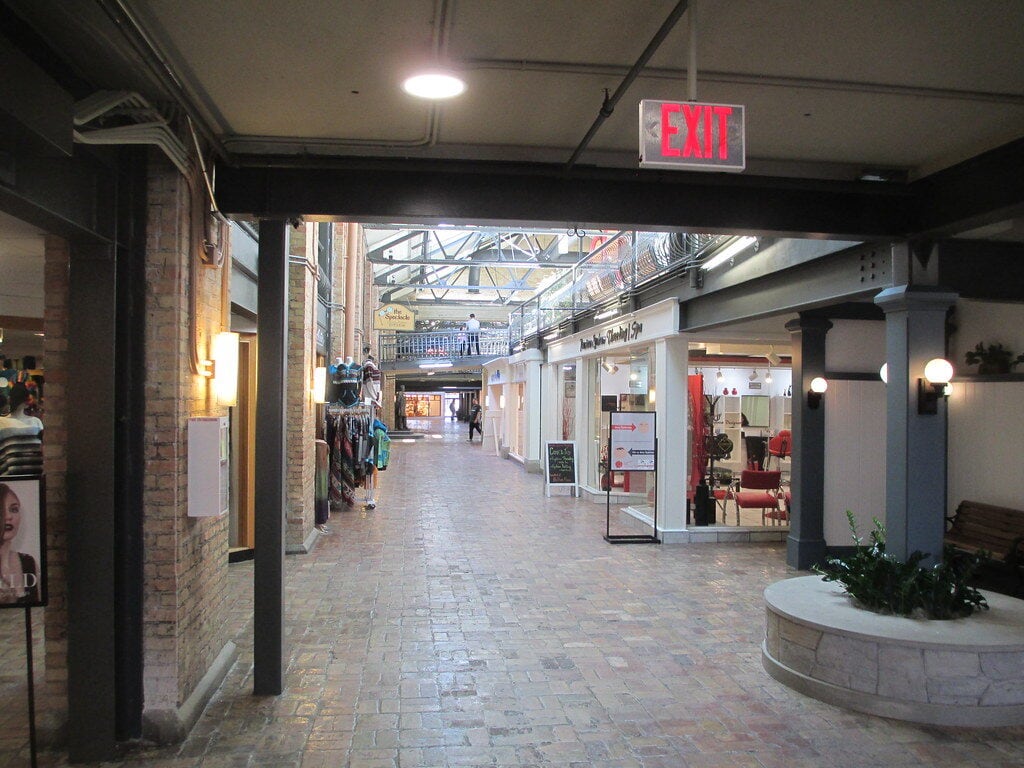
Inside the barns, mechanical equipment was moved so the skylights read again, a glass elevator went into the center court, and the brick floors were stripped and repaired.
The grocery anchor arrived after a fight: negotiations with Whole Foods stalled in the recession, and the dispute included a $50 million lawsuit.
Work was underway by January 2010, and the 42,000-square-foot store opened on March 14, 2011 with parking on its roof.
From 96 percent full to barely half
Trolley Square was about 96 percent occupied when the redevelopment began. By April 2013 a little more than half the commercial space was leased.
Construction did the first part.
Tenants moved out, access was awkward for years, and a center whose appeal is the walk through it got hard to walk through.
The 2008 recession did the rest.
The financing failed with it.
Bank of America and other lenders said Trolley Square Associates owed $57 million and hadn't repaid loans that came due on June 1, 2012.
The bank sued for control of the mall's income, and in November 2012 a Utah court appointed a receiver.
The doors stayed open, with Pottery Barn, Whole Foods and Desert Edge Brewery trading while the small storefronts sat dark.
A Utah businessman ended the receivership by buying the debt from Bank of America, announced April 19, 2013 through S.K. Hart Properties: 318,600 square feet on 13.5 acres, about 52 percent occupied.
Repairs started at $1 million and grew into several million for the buildings, tenant spaces and lighting.
The water tower was repaired and re-lit with LEDs.
What's open now, and what's still on paper
Leasing changed again after 2024, with the owner's son in a central management role.
By March 2025 the mall was on a leasing upswing, and grouped the new tenants by type.
Design Row has Pottery Barn, Williams Sonoma, West Elm, Kohler and Rejuvenation, whose 4,900-square-foot store opened on October 17, 2025, the chain's first in Utah.
Athletics Row has CorePower Yoga, Orangetheory Fitness and Momentum, which fill big spaces small shops can't use.
The housing is still paper.
The plan for the land south of 600 South allows as many as 350 homes in seven buildings on 3.8 acres, and it has been in preservation review for a decade.
The Historic Landmark Commission granted a time extension on July 9, 2026 for moving a house at 632 South 700 East. No start date has been announced.
The name is in court now.
On July 23, 2026 Trolley Square Ventures sued Trolley Corners Center, the property across 700 East that has used "Trolley" for decades, for trademark infringement.
Whole Foods trades at 544 South 700 East.
The old barns hold Weller Book Works on two levels, Tabula Rasa, Cabin Fever, Payne Anthony Creative Jewelers and a popcorn shop, with Salt & Straw listed as coming.
And The Old Spaghetti Factory is still upstairs, more than 50 years in.
Independent Publisher Notice
BestAttractions is an independent editorial publisher. We are not affiliated with, endorsed by, or acting on behalf of any location, business, property owner, manager, government agency, or organization described in this article. Comments posted on this page are not forwarded to, reviewed by, or acted upon by any entity mentioned in the article. For official inquiries, complaints, applications, bookings, or other requests, please contact the relevant entity directly through its official website or other verified channels.