
Countryside Mall Arrives in North Pinellas
Countryside Mall opened on September 8, 1975, at the southwest corner of U.S. Highway 19 and State Road 580 in Clearwater.
The location placed it beside the main north-south commercial road in Pinellas County and near the growing communities of Dunedin, Safety Harbor, Palm Harbor, and northern Clearwater.
It formed the commercial center of the larger Countryside development planned by U.S. Home Corporation, which combined neighborhoods, golf courses, recreation, and business sites in one suburban district.
The original mall covered about 1.1 million square feet and was built for roughly 100 stores. Maas Brothers and Sears were ready first.
JCPenney came next, and J.W. Robinson's arrived in 1976, completing a four-anchor lineup that made Countryside one of the largest enclosed shopping centers in the Tampa Bay area.
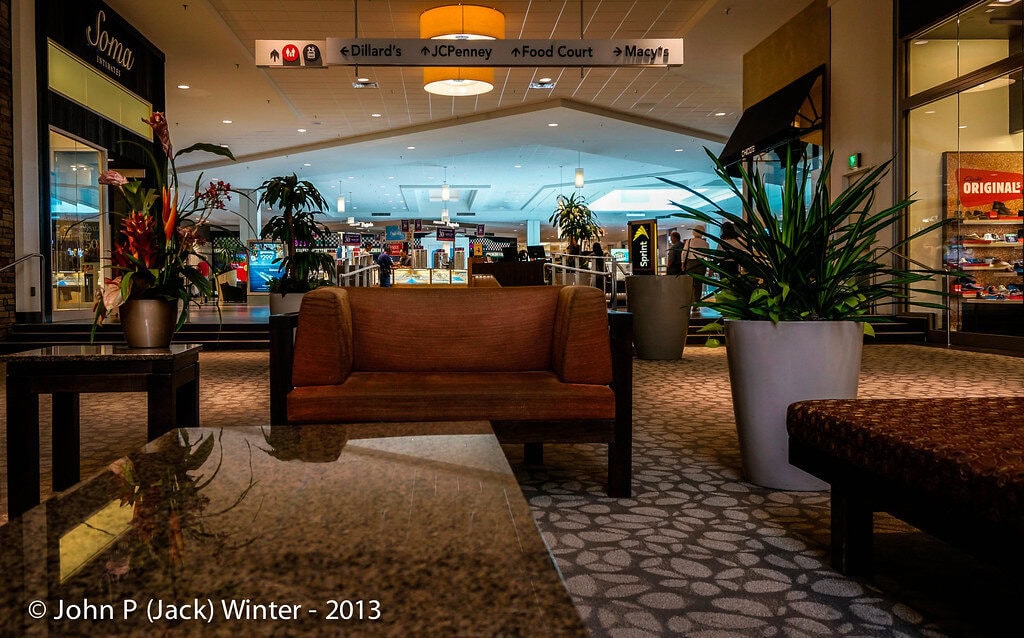
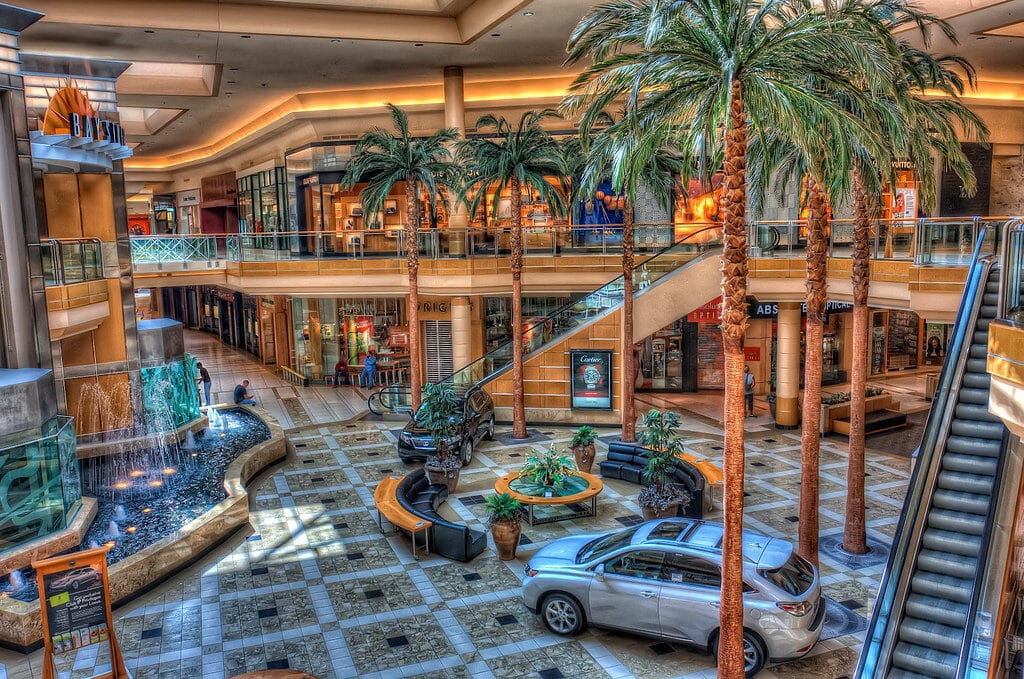
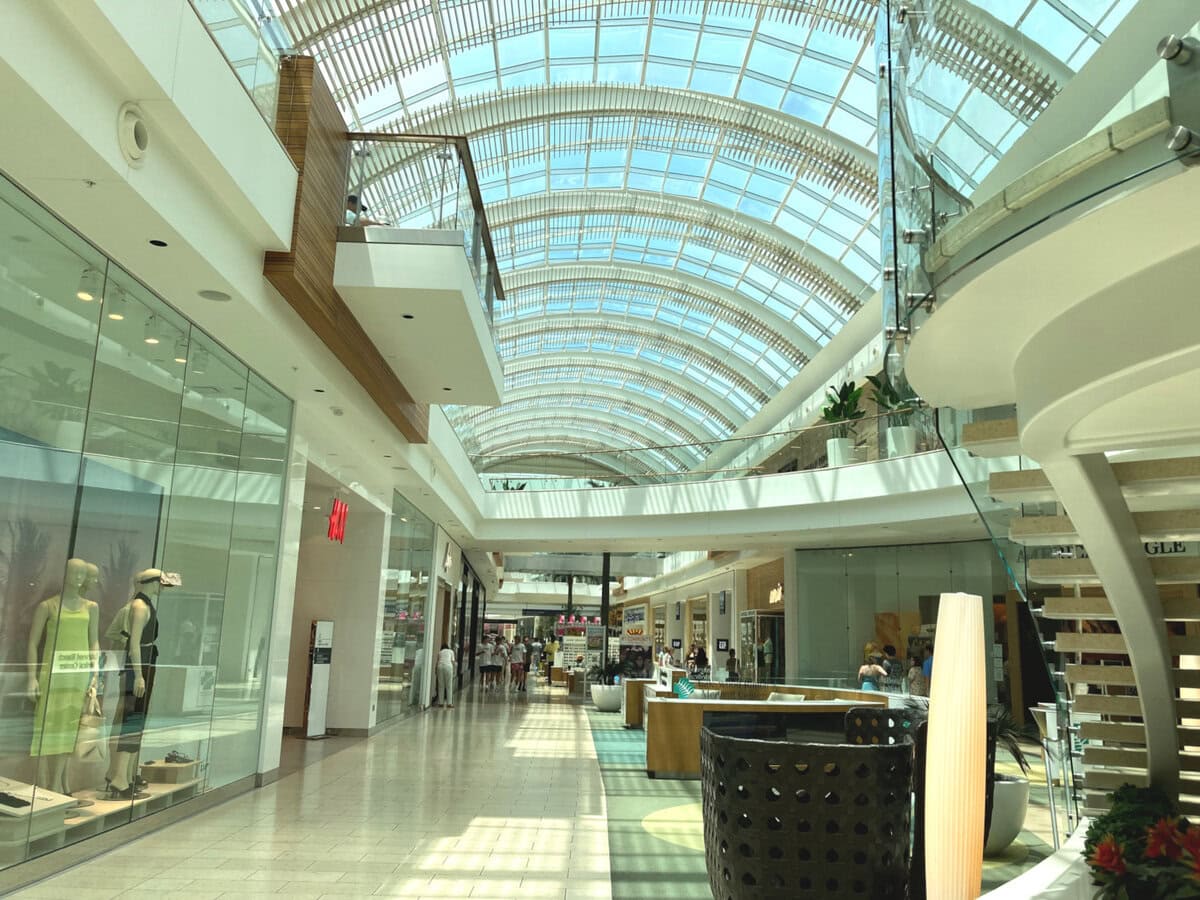
Its two retail levels gave the interior a scale that differed from the strip centers and single-level malls then common in Pinellas County.
Escalators, stairs, upper-level storefronts, and long views across the concourses shaped the experience from the beginning.
A detached six-screen theater near JCPenney joined the complex in 1976.
Stores, restaurants, services, and entertainment made the site useful for errands and family outings alongside department-store shopping.
The building's scale allowed many of those routines to take place under one roof as northern Pinellas developed around it.
An Ice Rink Changes the Mall's Center
The feature most closely associated with Countryside arrived in 1978, three years after opening.
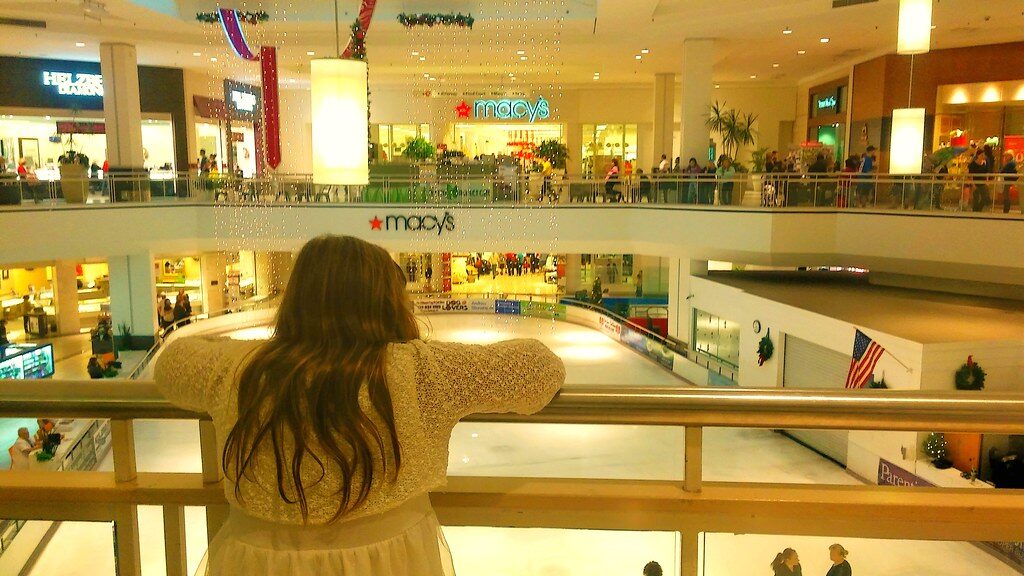
The mall added an indoor ice rink in its central concourse.
Construction took place while the surrounding mall remained in operation.
The project altered the original corridor pattern and turned the center of the building into a public viewing space.
Shoppers on both levels could stop at the railings and watch figure skaters, lessons, birthday parties, and public sessions below.
The rink gave families another reason to visit and made the central court visibly different from a standard retail concourse.
Its value came from repeated use: children learned to skate there, teams practiced there, and passersby could watch from the upper floor during an ordinary shopping trip.
The rink survived several periods of uncertainty.
It closed for roughly a year during a major late-1980s renovation and entered another lease and renovation transition in 1999.
Later operators continued the facility under Tampa Bay Skating Academy and Tampa Bay Ice branding.
Countryside placed skating shows and related events at the center of its 50th-anniversary program in September 2025.
That documented anniversary use shows how the rink remained the mall's clearest link between its 1970s design and its present operation.
Department Stores Change Their Names
Countryside's anchor buildings remained recognizable while the department-store names changed through mergers and regional-chain consolidation.
Maas Brothers, the Tampa-based chain that opened with the mall, became Burdines in 1991.
Burdines expanded the Clearwater store around 1999 and 2000 as the chain prepared to leave Clearwater Mall.
The store briefly carried the Burdines-Macy's name before becoming Macy's in 2005.
J.W. Robinson's followed a similar succession.
The Florida stores were sold in 1987 and renamed Maison Blanche in 1988.
Dillard's acquired the Countryside store in 1991, giving the mall the anchor it still has today.
Dillard's also operated at nearby Clearwater Mall, then closed those locations and expanded at Countryside near the end of the 1990s.
JCPenney is the original anchor that still operates under its 1976 name.
It remained through the disappearance of several regional department-store brands, the arrival of newer malls, the growth of online shopping, and Countryside's later financial trouble.
The anchor history gives the building a visible record of Florida retail consolidation.
Maas Brothers, Burdines, J.W. Robinson's, and Maison Blanche disappeared as operating names, while their former spaces continued as Macy's and Dillard's.
The physical anchor pattern therefore outlasted most of the companies that created it.
Westfield Gives the Interior a Reset
Corporate Property Investors owned Countryside for about 17 years before selling it to Rodamco at the end of 1996.
Westfield acquired the property in 2002 during the division of Rodamco North America's mall portfolio.
The company first used the name Westfield Shoppingtown Countryside and shortened it to Westfield Countryside in 2005.
By that point, the mall retained major anchors and a large regional footprint, although its common areas showed the accumulated changes of three decades.
Westfield began a $12 million renovation in April 2009 and completed it in November.
The project moved escalators, installed new flooring and ceilings, added skylights, enlarged the children's play area, and rebuilt the food court.
Crews also removed decorative planters and false columns.
The work refreshed circulation and finishes while preserving the two-level plan and central rink.
Visitors still moved through the long enclosed corridors and could look down onto the ice, but the surrounding surfaces reflected Westfield's newer design language.
Two years later, a separate expansion added a 12-screen theater, extending visits beyond conventional shopping.
This phase preserved the mall's most distinctive physical feature and updated the spaces around it.
The result was a building where the 1970s structure remained legible beneath later floors, ceilings, escalators, storefronts, and dining areas.
Movies and Restaurants Extend the Day
A 12-screen Cobb cinema opened on the second level in December 2011.
It restored a movie use to the property after the detached six-screen theater near JCPenney had closed in 2000.
The new cinema brought customers directly into the upper level and later became part of CMX Cinemas.
Westfield followed with Restaurant Row during 2012 and 2013.
BJ's Restaurant and Brewhouse, Red Robin, Grimaldi's, Bar Louie, and P.F. Chang's were among the early additions.
Exterior entrances and later operating hours brought evening activity to the edge of the mall.
The project also changed the exterior appearance by placing visible dining destinations along areas previously dominated by department-store walls and parking.
The cinema and restaurants broadened the property's daily role.
A visit could include skating, a movie, dinner, shopping, or several of those activities in sequence.
Launch Family Entertainment later added bowling, trampolines, arcade games, and obstacle-course activities near the cinema.
Crunch Fitness reused the former detached theater building.
These additions supported continued use during a period when department stores and specialty chains were reducing locations nationwide.
They also extended a pattern established by the rink: Countryside used recreation and social activities to keep large portions of the complex active alongside conventional retail.
Sears Shrinks, Then Leaves for Good
Sears opened with Countryside in 1975 and remained for nearly 43 years.
During the 2010s, the chain began leasing parts of its large real-estate holdings to other tenants.
At Countryside, that process divided the anchor property before the department store ended operations.
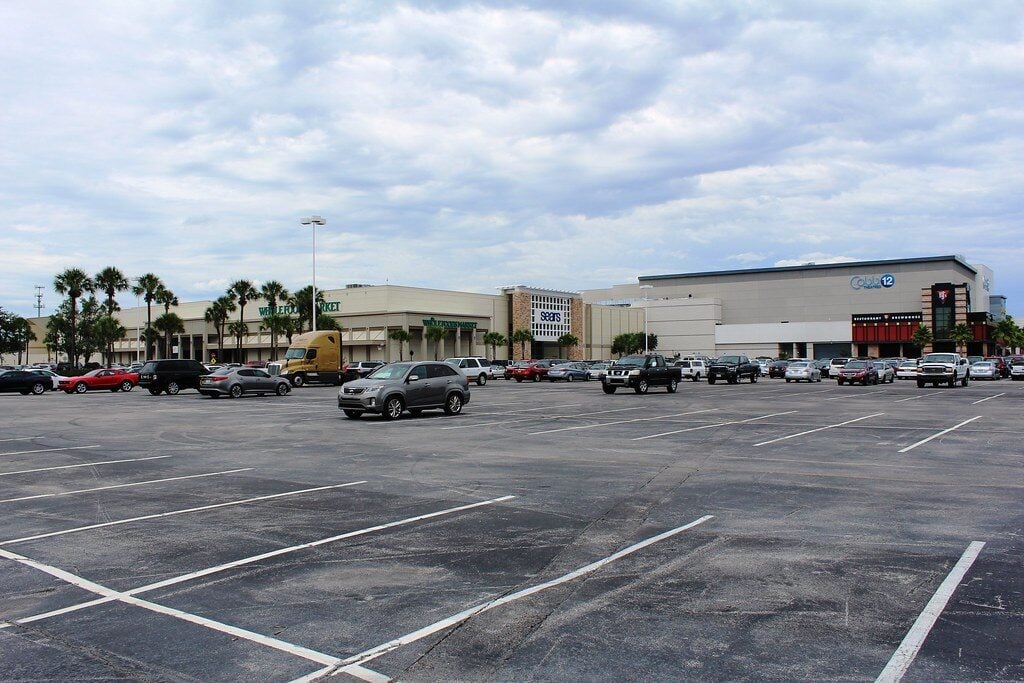
Whole Foods Market opened in part of the lower Sears space on September 24, 2014.
It was the chain's first store in Pinellas County and added grocery shopping to the complex.
Nordstrom Rack followed in fall 2015, occupying a separate two-level building created from the former Sears Auto Center near the northern entrance.
Sears continued in the remaining department-store space until July 2018.
Its closure left the largest vacancy at Countryside, while Whole Foods and Nordstrom Rack kept substantial portions of the northern tract in use.
Ownership of the former Sears property had already passed to Seritage Growth Properties through the 2015 separation of Sears real estate.
The divided tract demonstrated one form of anchor reuse.
Grocery and off-price retail occupied parts of the old Sears-controlled property before the full-line store closed.
The largest remaining section stayed vacant for years and later became the site of a planned two-story Target of about 138,000 square feet.
Mall Operations Continue Through Foreclosure
Countryside's ownership entity borrowed against the property in 2013, when the collateral was valued at about $270 million.
Mortgage payments stopped in May 2020 as the pandemic disrupted rent collections and mall traffic.
The lender filed a foreclosure lawsuit on December 29, seeking more than $149.7 million in outstanding principal, plus interest and other costs.
Later appraisals reduced the estimated value sharply.
An August 2020 appraisal placed it at $91.5 million.
A receiver was appointed, and JLL assumed management and leasing functions.
The Westfield name disappeared, and the center returned to the Countryside Mall identity.
The visible shopping complex contains several ownership and control arrangements.
Separate agreements and property boundaries govern Dillard's, Macy's, JCPenney, the former Sears tract, restaurants, and other parcels.
This division explains why financial reports may describe a property much smaller than the entire 1.26-million-square-foot complex seen by visitors.
The mall remained in operation throughout the foreclosure and receivership.
Department stores, the rink, cinema, restaurants, and specialty tenants continued operating during the legal and financial process.
As of July 2026, JLL continued to manage the center.
A Planned Target Reuses the Sears Space
The former Sears tract followed a separate ownership path.
In December 2025, Benderson Development acquired the 14.5-acre Clearwater Shoppes property from Seritage.
The tract includes Whole Foods, Nordstrom Rack, and the remaining former Sears space.
It adjoins Countryside and functions as part of the same shopping destination, although it is a separate real-estate asset from the main enclosed mall.
Target has confirmed a future Clearwater Countryside store of about 138,000 square feet.
Plans place the two-story store in the former Sears area.
Target's official upcoming-store page listed no opening date as of July 18, 2026.
The pending project would replace the mall's largest long-standing anchor vacancy while preserving retail use on the northern tract.
Countryside remained active with Dillard's, JCPenney, Macy's, CMX Cinemas, the ice rink, restaurants, fitness and recreation businesses, national chains, and local merchants.
Clearwater's planning framework permits denser mixed-use development around the property, but the city presents that possibility as a long-term redevelopment opportunity rather than an approved plan to demolish the main enclosed building.
The present complex carries several eras at once.
Its original anchor positions still frame the corridors, the rink continues in the central court, and newer entertainment uses occupy former retail and theater spaces.
Preparations for Target continue the same pattern of adaptation on the Sears tract.
Countryside's history remains visible through the parts that survived and the new uses fitted into them.
Independent Publisher Notice
BestAttractions is an independent editorial publisher. We are not affiliated with, endorsed by, or acting on behalf of any location, business, property owner, manager, government agency, or organization described in this article.
Comments posted on this page are not forwarded to, reviewed by, or acted upon by any entity mentioned in the article.
For official inquiries, complaints, applications, bookings, or other requests, please contact the relevant entity directly through its official website or other verified channels.