
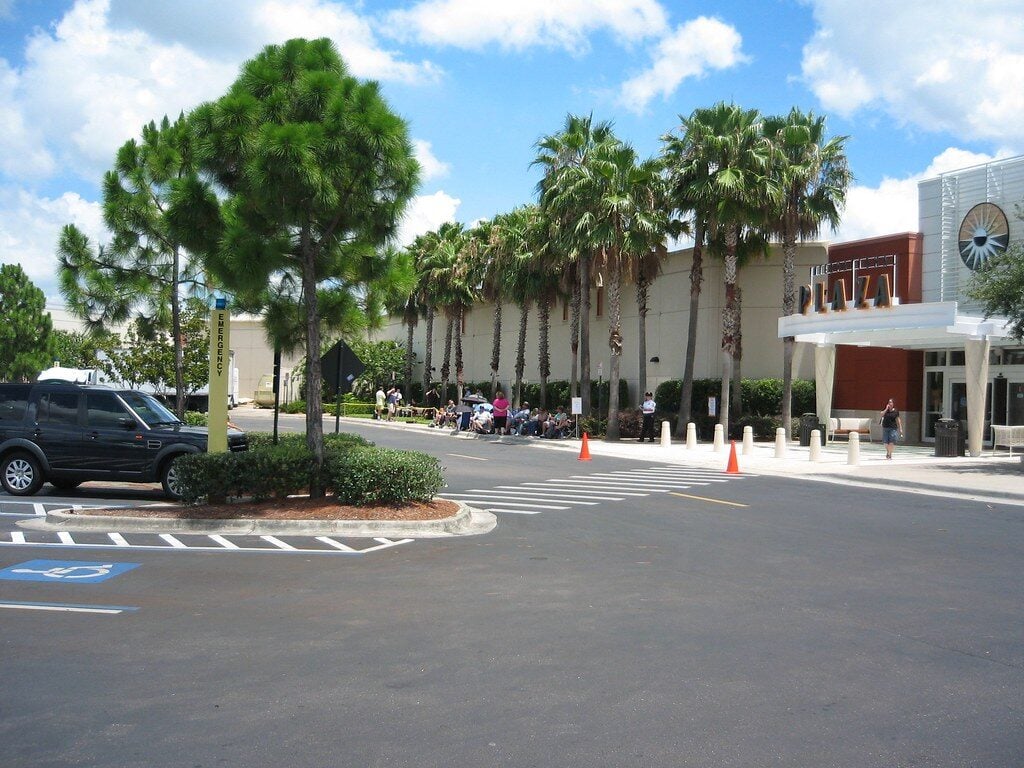
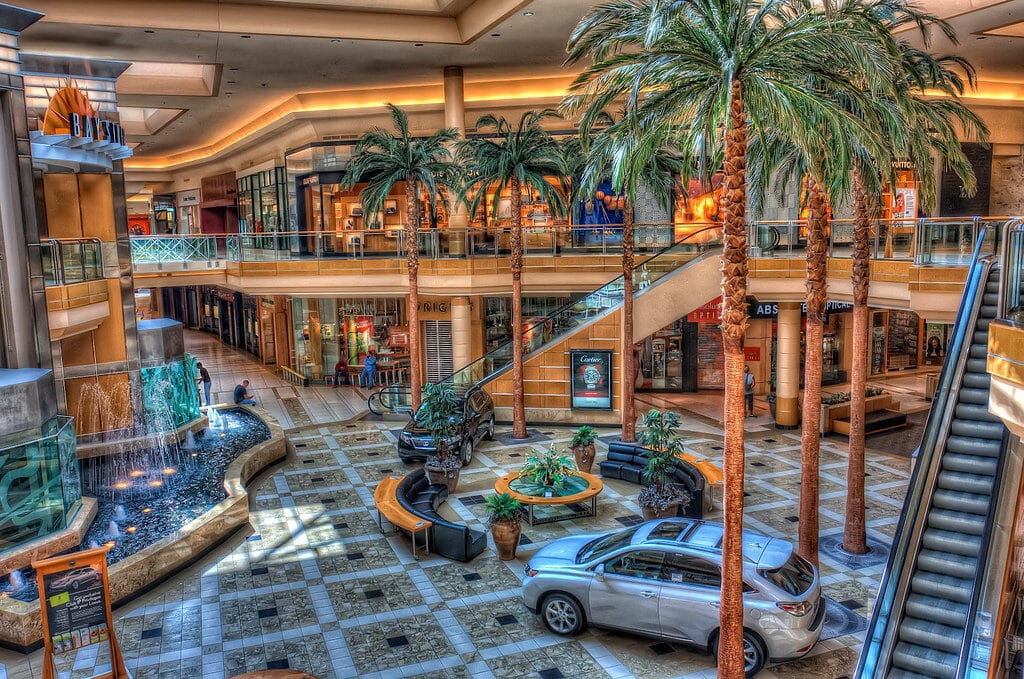
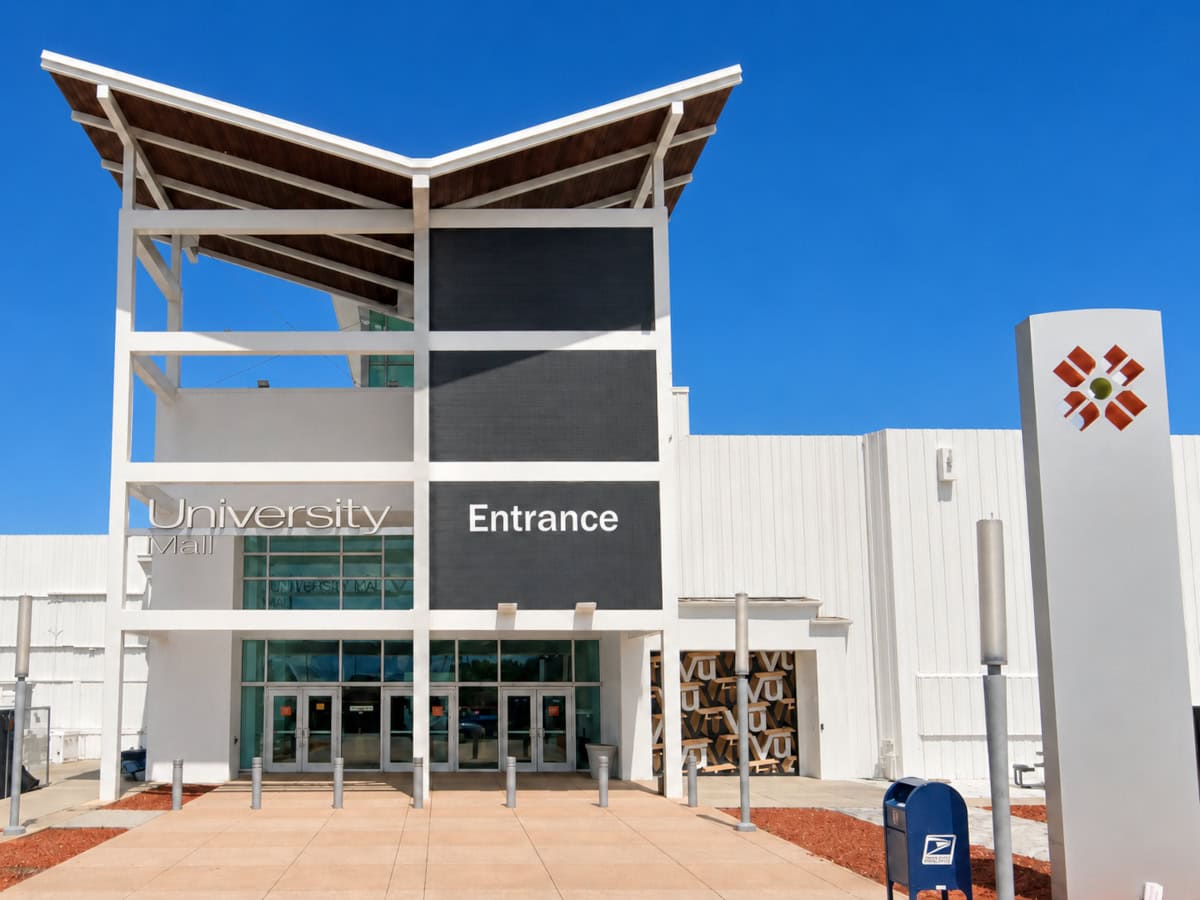
International Plaza and Bay Street is a two-level enclosed mall with an open-air restaurant street attached, at Westshore and Boy Scout Boulevards in Tampa, FL, right beside Tampa International Airport.
Its opening was scheduled for September 11, 2001.
The doors opened on the 14th instead, with Apple's first Florida store among the 200 tenants inside.
Nordstrom, Neiman Marcus, and Dillard's anchored it then and anchor it now.
Lord & Taylor, the fourth original anchor, left in 2004, and its box has cycled through a furniture showroom with a cooking school, a Life Time gym, and, since 2024, a Dick's House of Sport with a rock wall.
Taubman built and ran the mall for two decades. Simon Property Group paid $3.4 billion for control of Taubman Realty Group in 2020 and took full ownership in late 2025.
Three months after that, Simon announced a 50,000-square-foot open-air expansion, with construction expected to start in 2026.
The inline stores sell $1,539 per square foot a year. Here's how a mall on rented airport land got to that point.
A golf course beside the runways
Before the mall, the land was a golf course.
The 150 acres at Westshore Boulevard and Boy Scout Boulevard in Tampa, Florida, that now hold International Plaza and Bay Street sit immediately southeast of Tampa International Airport, and over the years the parcel held a motel, tennis courts, the Hall of Fame Golf Course, and a training facility for the Tampa Bay Buccaneers.
All of it on public land owned by the Hillsborough County Aviation Authority.
Developer Dick Corbett wanted a shopping center there and pursued it for years, first through International Plaza Ltd. and later through Concorde Companies.
In 1985, the partnership holding lease rights to the land, then called Sunhil Investors, renamed itself International Plaza.
The name existed 16 years before the building did.
Public land, private mall, leased until 2080
The deal that made construction possible was signed on May 5, 1994.
The aviation authority leased the parcel to Concorde through December 31, 2080, with Concorde owning whatever it built for the length of the term.
The authority's commercial real estate office manages the county's non-airline land, from hangars to raw parcels, and this lease turned one piece of that portfolio into a private, for-profit project on public ground.
The rent came in layers: at least $1 million a year after 1998, land rent of $200,000 a year that rises 5 percent every 10 years, and extra rent tied to how much floor space went up.
None of it touched store sales. However well the stores performed, the rent did not rise or fall with tenant revenue.
That same year, Concorde signed a second, private agreement with Tampa Westshore Associates Limited Partnership, the arrangement that brought mall developer Taubman Centers into the project.
Four anchors signed before the doors opened
The anchors were announced in 1998: Lord & Taylor and Nordstrom first, then Neiman Marcus, then Dillard's as the fourth before the year ended.
It was a department-store combination no older Tampa mall had.
The plan also carried a large office component for the land next door.
Construction moved in 1999, with Sordoni Skanska, a U.S. subsidiary of Skanska, building it.
By early 2001, the first 100 stores had signed leases, many of them brands new to the Tampa market.
A mile away, WestShore Plaza had long been the established mall. It was about to get a neighbor.
International Plaza opens three days late
The opening was set for September 11, 2001.
After that morning's attacks, the doors stayed closed until September 14, when International Plaza opened to the public.
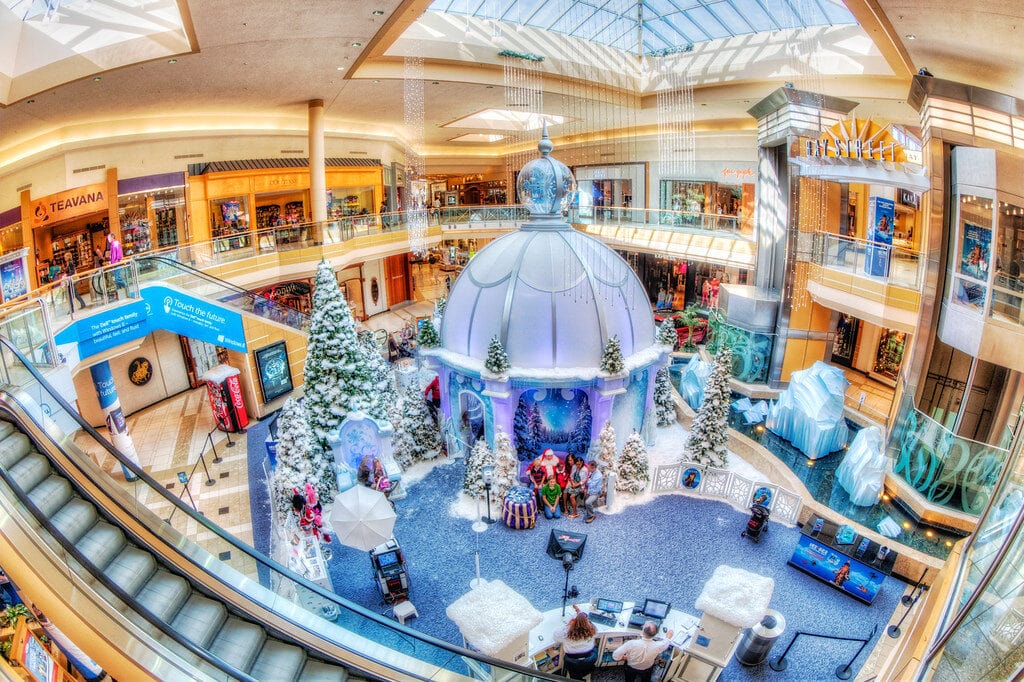
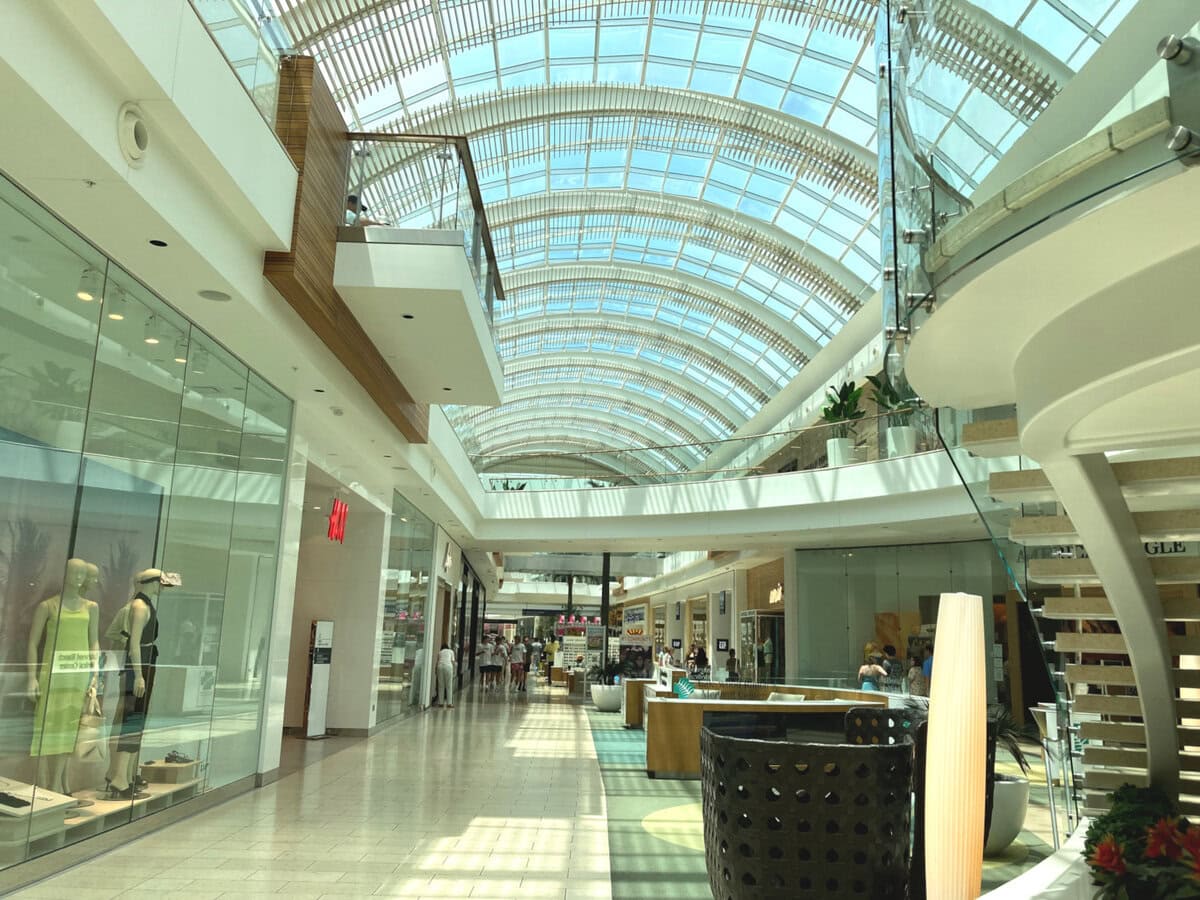
It opened at full size: 1.26 million square feet, 200 stores and restaurants, two shopping levels, and a three-level Dillard's.
Apple picked the mall for its first store in Florida and opened it that same day.
Bay Street set the project apart from Tampa's older malls.
The 150,000-square-foot open-air street of restaurants and patios ran alongside the enclosed mall and kept serving after the shops inside closed for the night.
The Cheesecake Factory took 11,000 square feet of it, and California Pizza Kitchen was in the early lineup too.
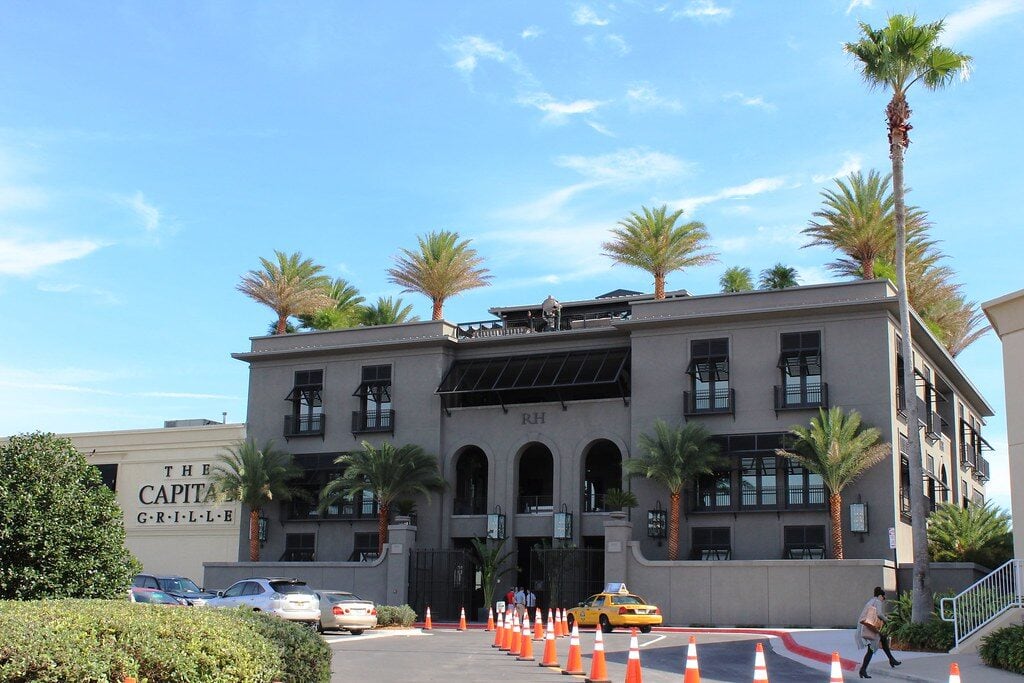
The Capital Grille arrived a few years later.
Even the walls were a production: 262,000 square feet of veneer plaster inside, 182,100 square feet of stucco outside, another 130,700 square feet of stucco in four textures at Bay Street, and construction-industry awards for the work in 2002 and 2003.
The newspaper that sued to see the deal
Weekly Planet, a Tampa newspaper, wanted to know whether taxpayers had gotten a fair deal on all that public land.
It asked to see the private development agreement between Concorde and Tampa Westshore, received a redacted copy, and sued for the full version.
Even the airport authority, the landlord itself, held only the redacted one.
In 2002, a Florida appeals court said no.
The land lease was a public record anyone could read; the private development papers were not, because the authority had leased raw land for a for-profit project rather than handing a government function to a developer.
One judge agreed with the outcome but wrote separately that the authority had left the public without a real way to check the deal.
The mall was never in danger from the case.
The full terms of the private agreement never became public.
One anchor out, one hotel in
Lord & Taylor lasted three years.
Its parent, May Company, was pulling back across Florida, and the International Plaza store closed in July 2004, leaving a two-level anchor box empty before the mall's third anniversary.
A month later, the property gained something few enclosed malls have.
The Renaissance Tampa International Plaza Hotel opened in August 2004 with 293 rooms and 12,500 square feet of meeting space, connected directly to Bay Street and its restaurants.
A cooking school inside a department store
The empty box got an unlikely second tenant.
Robb & Stucky, a Florida furniture retailer, took 120,000 square feet on two levels and spent more than $2.5 million turning a department store into the biggest showroom in its chain: marble and hardwood floors, design studios, a community room, a cafe, and a cooking school.
The company liked the spot because the box opened to both the parking lot and the mall corridor, with strong anchors on either side.
It closed its smaller Clearwater store, moved the staff over, and opened the showroom in 2005. Six years was all it got.
Robb & Stucky filed for bankruptcy in February 2011, and the store closed, emptying the box a second time.
The rest of the mall kept churning.
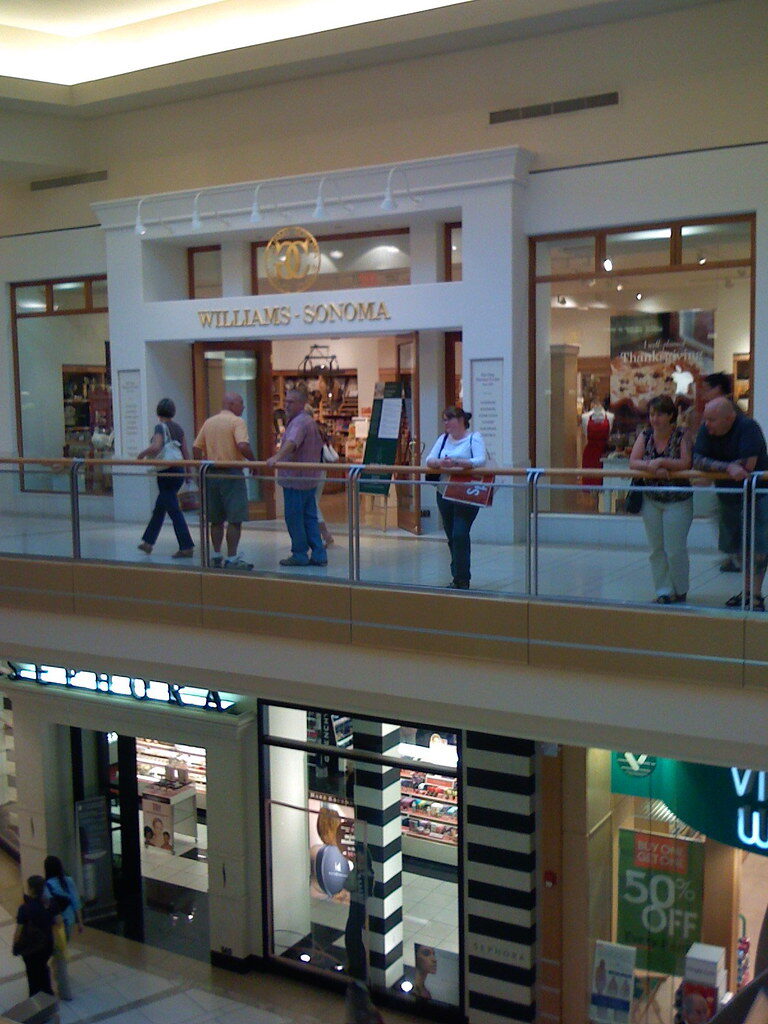
That year, Adrenalina was gone, Gap was moving over from WestShore Plaza, and H&M opened in November as fast-fashion chains spread through American malls.
A $437 million buyout, then a gym
Taubman had operated the mall since opening day without fully owning it.
In December 2012, it paid $437 million, $275 million of that in cash, for the 49.9 percent stake it didn't hold, taking its ownership to 100 percent 11 years after the doors opened.
The old Lord & Taylor space found tenant number three in April 2014.
Life Time Athletic opened a 55,000-square-foot health club there, with its own outdoor entrance between Nordstrom and Dillard's, studios for yoga, cycling, and Pilates, kids' programming, a spa, and a cafe.
It was the chain's 110th club in the U.S. and Canada, and it held a ribbon-cutting for founding members two days before letting everyone else in on April 12.
Nine years later, Life Time left too, closing the club in 2023 and opening a new one on Harbour Island the next year.
Simon arrives with $3.4 billion
The bigger ownership change came at the end of 2020.
Simon Property Group closed on 80 percent of Taubman Realty Group on December 29, paying $43 a share for Taubman Centers stock, $3.4 billion in all, with the Taubman family keeping a minority piece of the partnership.
At the mall, little was visibly different.
The Taubman identity stayed on the property for five more years, and Nordstrom, Neiman Marcus, and Dillard's kept doing what they'd done since 2001.
Dick's House of Sport takes the south side
The Lord & Taylor box found its fourth life in October 2024.
Dick's House of Sport opened on the mall's south side on October 11: more than 100,000 square feet of sporting goods built around things to do, with a rock wall, a multi-sport cage, golf services, equipment services, and event space.
Simon counts it as a department-store anchor.
That puts a climbing wall in the same anchor lineup as Neiman Marcus.
Shoppers spending $1,539 per square foot
By 2025, the smaller stores between the anchors were ringing up $1,539 in sales per square foot a year.
On November 3 of that year, Simon announced it had bought the last 12 percent of Taubman Realty Group, giving it full ownership of TRG and putting International Plaza under the Simon banner.
By late December, the mall carried a new $551 million loan in place of a $477 million mortgage.
And the 1994 deal keeps paying out under its old formula: the airport authority still collects ground rent on part of the property, with 54 years left on the lease.
The 2026 plan: 50,000 square feet, outdoors
Three months after taking full ownership, Simon announced what it wants the mall to become.
On February 4, 2026, it laid out a 50,000-square-foot open-air expansion on the exterior, storefront space for global brands, a rebuilt Bay Street with more outdoor dining and gathering room, and new finishes and amenities inside the existing center.
Construction is expected to start before the end of 2026, with tenant announcements to follow.
The budget is pooled: more than $250 million across three Simon properties, this one plus The Mall at Green Hills in Nashville and Cherry Creek Shopping Center in Denver, with no Tampa-only figure disclosed.
A mile away, the district's other mall is headed somewhere else entirely.
WestShore Plaza has an approved redevelopment concept built on demolition, replacing the mall with shopping, apartments, offices, and medical space, and officials have discussed upgrading West Shore Boulevard as a connector between the two properties.
One is expanding. One is waiting to come down.
What's at International Plaza now
In July 2026, the mall counts more than 170 stores.
Dillard's, Neiman Marcus, and Nordstrom are still the anchors they were on opening day, joined now by Dick's House of Sport.
The luxury corridor holds Louis Vuitton, Gucci, Chanel's beauty boutique, Tiffany & Co., and Versace, with Aritzia, Zara, and lululemon in the fashion mix, and buildout permits already issued for a 12,400-square-foot Pottery Barn and a 6,500-square-foot Pottery Barn Kids on the second level.
Bay Street still does what it was built for.
The Cheesecake Factory has been serving there since the beginning, The Capital Grille joined in 2005, and Shake Shack, Rocco's Tacos, and Doc B's fill out the street now.
Inside, the food court sits on the upper level by the Bay Street entrance.
Elsewhere in the mall, a children's play area gives families another reason to linger.
Next door, the three office buildings of Corporate Center at International Plaza keep office workers within walking distance of the stores.
The everyday routines hold.
Mall walkers get in before the stores unlock, hotel guests wander over from the Renaissance, HART buses stop at International Plaza, and valet runs every day.
On September 14, the mall turns 25, with the expansion expected to break ground the same year.
Independent Publisher Notice
BestAttractions is an independent editorial publisher. We are not affiliated with, endorsed by, or acting on behalf of any location, business, property owner, manager, government agency, or organization described in this article. Comments posted on this page are not forwarded to, reviewed by, or acted upon by any entity mentioned in the article. For official inquiries, complaints, applications, bookings, or other requests, please contact the relevant entity directly through its official website or other verified channels.