
At Santa Rosa Plaza, Fourth Street no longer works like a normal downtown street.
The route between Railroad Square and the older business center passes through or beside a two-level indoor mall.
Its doors, hallways, escalators, and parking structures control how people move through the area. Santa Rosa backed the mall to keep regional shopping downtown.
However, the route through the privately managed property weakened the open street connection between the eastern and western parts of downtown.
The Plaza is still active in 2026. It includes Macy's, Dave & Buster's, and many smaller businesses.
Because the mall remains open, its history is still part of everyday life.
People shop, work, eat, play games, cross the property, and watch as plans for the old Sears site remain unsettled.
The mall's history can be seen in daily activity, in Fourth Street's interrupted route, and in landmarks that survived after they were moved away.
Downtown changed before the mall
Santa Rosa's downtown redevelopment program began many years before the Plaza opened.
The City Council created an Urban Renewal Agency in 1958.
A redevelopment plan adopted in 1961 covered a large area in and around downtown.
Earthquakes in October 1969 damaged older brick and stone buildings and increased support for demolition.
However, the earthquakes did not create the redevelopment policy.
That policy was already in place.
Across the Phase II redevelopment area, officials counted 89 buildings.
The city eventually said more than 75 required demolition.
These numbers describe that phase of redevelopment.
They do not show exactly how many buildings were removed only for the mall.
By the early 1970s, city officials wanted a private developer that could attract department stores and finance a large regional shopping center.
Santa Rosa selected Ernest W. Hahn's company in March 1972.
Hahn's plan depended on a large indoor shopping center, shared parking, major department stores, and a controlled shopping route inside the building.
The project expanded to include blocks with Sears, a Ford dealership, and the California Theater.
Environmental studies and court cases delayed the project.
The California Theater became the center of a local preservation campaign called Save the Cal.
The campaign failed, and the theater was demolished.
The 1910 federal post office survived through a much more unusual agreement.
Preservation groups secured official historic recognition for the building.
In 1979, workers moved the building, which weighed about 1,700 tons, from Fifth and A streets to Seventh Street.
This allowed redevelopment to continue.
The building later became the Museum of Sonoma County.
It is both a success for historic preservation and clear physical evidence of how much the mall project changed the existing city.
Building a regional shopping center in the city grid
A formal construction ceremony took place near Fourth and B streets on March 15, 1978.
Workers and planners had to manage public utilities, streets, department store buildings, parking areas, and indoor walkways.
Public agencies and private companies had to coordinate all this work.
Macy's opened in 1981, before the mall's shared indoor areas were complete.
Santa Rosa Plaza opened to the public on March 4, 1982.
Macy's, Sears, and Mervyn's were its three main department stores.
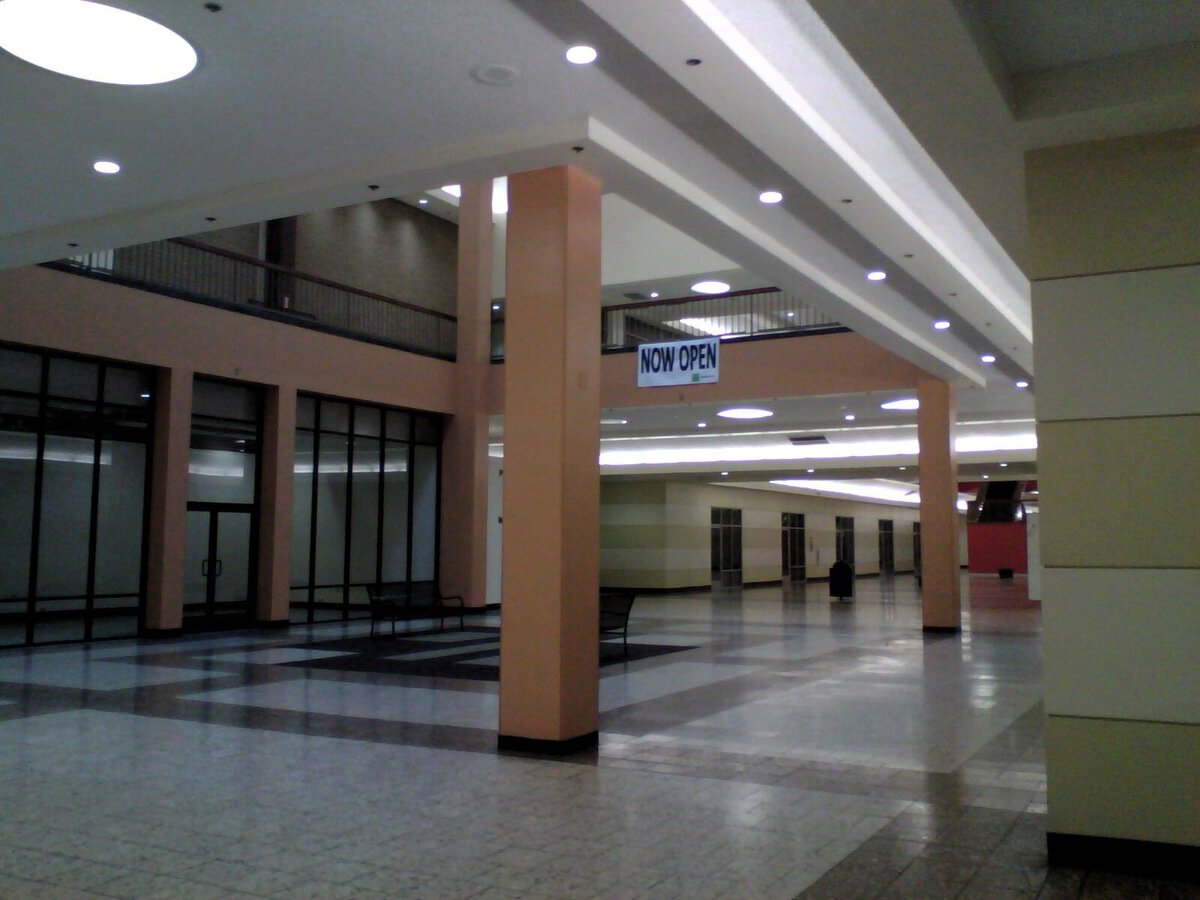
The finished mall had two indoor shopping levels.
Macy's had three levels.
Shoppers could arrive by car, enter from a parking area, and walk through a protected indoor space.
They could visit the three department stores and many smaller shops without going back outside.
The mall gave local and regional shoppers a comfortable indoor place to shop and spend time together.
Photographs from opening day show crowded hallways.
From the beginning, the mall supported both shopping and social activity.
This activity was also central to the mall's business plan.
The large department stores attracted visitors.
Smaller stores paid for space near that customer traffic.
Parking made the mall easy to reach by car.
The indoor setting let people visit several stores without returning outside.
Santa Rosa Plaza successfully created a major shopping destination in the center of the city.
However, much of that activity stayed inside the mall instead of spreading into Railroad Square or nearby downtown streets.
The physical division
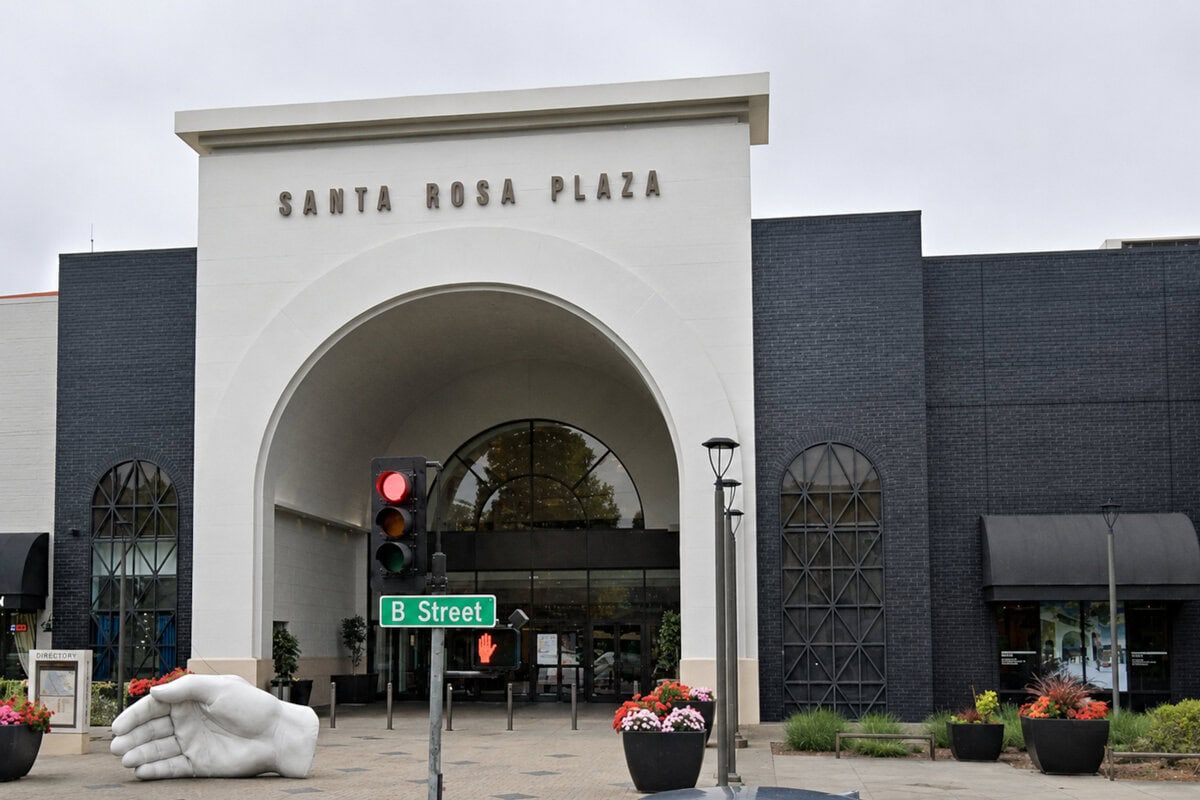
The Plaza stands in an important location between Old Courthouse Square and Railroad Square.
It is close to Highway 101, the downtown SMART station, and the city's public transportation system.
Third Street passes under part of the mall.
The Fourth Street connection became a controlled walking route instead of a normal open business street across the full property.
Between B Street and Railroad Square, the mall's large walls, parking structures, and Highway 101 interrupt clear views and direct movement.
Santa Rosa Plaza is the main shopping property in a downtown divided into eastern and western sections.
The complex is commonly listed at about 826,000 square feet, while its gross leasable area is about 692,000 square feet.
The figures use different measures.
The city has made several attempts to reduce the division.
In 2002, it completed a lighted walking route between the Plaza and Railroad Square.
The project improved safety and made the route easier to follow, but it did not restore the old street system.
Later plans continued to call for a stronger east-west route for people walking and riding bicycles through the mall property.
Better lighting and signs improved the connection.
However, the large enclosed block still breaks the smaller street network that once existed there.
From three department stores to an uncertain future
The original system of three major department stores lasted for many years.
Each closure changed the balance of the mall.
Mervyn's closed in December 2008. Forever 21 opened in the former Mervyn's building in 2010 and closed in January 2024.
Sears was one of the stores affected by the company's 2018 bankruptcy.
Its Santa Rosa location closed on January 6, 2019.
Macy's is now the only original department store name still operating at the mall.
The former Sears property became a test of how an empty department store building could be reused in a downtown mall.
In July 2021, Sonoma County selected the site as its preferred location for a new government center.
A proposed purchase of $20.75 million included 7.24 acres, the former Sears store and auto building, and 779 parking spaces.
The plan could have brought many county workers downtown.
However, high projected financing costs, unresolved parking agreements, and a lack of enough votes ended the purchase effort in 2022.
Later ideas for the site included a convention center and hotel, or housing with a grocery store and other retail.
These were separate proposals from different groups.
They depended on different land agreements and sources of money.
As of July 2026, there was no approved and fully funded plan for the entire former Sears property.
The former Mervyn's and Forever 21 building was reused sooner.
Dave & Buster's opened a 40,000-square-foot location there on January 26, 2026.
It turned part of the old department store into a place for food, games, and watching sports.
The new business added 170 jobs.
Apple moved from the Plaza to Montgomery Village during the same month.
Montgomery Village is an outdoor shopping center about two miles east of the mall.
Memories moved away from the site
Public memory of Santa Rosa Plaza is strongly connected to physical objects.
The old post office survives as a museum on Seventh Street.
The California Theater was demolished.
Agraria, a huge handmade piece of Carrara marble by artist Larry Kirkland, was placed near the B Street entrance in 1996.
On May 2, 2025, workers transported the 18,250-pound sculpture to the Geyserville Sculpture Trail.
The mall entrance lost a major landmark that had stood there for almost 30 years.
The mall itself is still open.
Old photographs preserve images of the opening crowds and the buildings that disappeared during redevelopment.
An active place with an unfinished history
In July 2026, Santa Rosa Plaza remains an operating mall shaped by its 1980s design and by continuing efforts to redevelop parts of the property.
Simon still operates the mall. Macy's remains open.
Dave & Buster's provides a new entertainment center, and events still bring people into the building.
At the same time, the former Sears property has no final long-term use.
Apple has moved away, and the city is still reconsidering the B Street side of the mall.
Santa Rosa Plaza kept a large regional shopping center downtown.
It also created an indoor route between major department stores.
However, construction removed older buildings, placed part of the Fourth Street connection under private control, and weakened the open route between Railroad Square and the older business center.
Today, people still pass through or beside the operating mall to travel between these areas.
Santa Rosa still does not have a fully restored east-west street connection or a final long-term plan for the former Sears property.
Sources and further reading
- Draft Subsequent EIR for the Downtown Mixed-Use Project - City of Santa Rosa, November 2003. Provides municipal background on urban renewal, displacement, Highway 101, and the development of Santa Rosa Plaza.
- Historic 1910 Santa Rosa Post Office and Federal Building - Museum of Sonoma County, publication date not stated. Documents the building's historic designation, 1979 relocation, and conversion into a museum.
- Acquisition of Sears Site at Santa Rosa Plaza, File 2022-0101 - County of Sonoma, March 1, 2022. Records the proposed purchase price, property area, buildings, parking capacity, and acquisition conditions.
- Sonoma County Scraps Plan for Government Headquarters in Downtown Santa Rosa - The Press Democrat, April 9, 2022. Independently reports the financial and voting concerns that stopped the county proposal.
- Economic Growth Highlights: New Businesses, New Jobs, and Community Investments - City of Santa Rosa, February 24, 2026. Reports the opening of Dave & Buster's, the associated jobs, and new retail activity at Montgomery Village.
- Active Transportation Plan - Appendix A: Plan Review - City of Santa Rosa, February 11, 2025. Summarizes city policies calling for stronger east-west connections between Old Courthouse Square and Railroad Square.
- About Santa Rosa Plaza - Simon Property Group, page date not stated, accessed July 25, 2026. Provides current operator information, location details, transportation access, and the Macy's anchor.
- Two Visions Surface for Long-Dormant Sears Site - The Press Democrat, 2024. Describes the preliminary convention-center, hotel, housing, grocery, and retail concepts considered for the former Sears property.
- Ernest W. Hahn, Inc. v. Codding, 615 F.2d 830 - U.S. Court of Appeals for the Ninth Circuit, March 20, 1980. The decision recounts the 1961 urban renewal plan, Hahn's selection as developer, and litigation surrounding the proposed shopping center.
Independent Publisher Notice
BestAttractions is an independent editorial publisher. We are not affiliated with, endorsed by, or acting on behalf of any location, business, property owner, manager, government agency, or organization described in this article. Comments posted on this page are not forwarded to, reviewed by, or acted upon by any entity mentioned in the article. For official inquiries, complaints, applications, bookings, or other requests, please contact the relevant entity directly through its official website or other verified channels.