
The plan for Columbia Mall's first phase called for about 513,000 square feet. A bad winter left about 350,000 ready, and about 50,000 people came anyway on the first day.
By 1987 the mall had all four of its big stores. Parkade, the center JCPenney had left, had fewer than 10 of its 25 spaces leased.
In the 2010s the numbers turned. About 96 percent of the mall was leased in 2014, about 86 percent in 2018. That July, Sears, the first store to open, closed. A large space MC Sports had held sat empty as well.
Shoppers there pay an extra half-cent on every purchase through 2044 for a wider Stadium Boulevard. The answer to how many stores trade under that roof now, 41 years after opening, starts with the two biggest rooms that emptied in the late 2010s.
A mall site in Cosmopolitan Park, voted down
In October 1979 the Columbia City Council voted 4-3 to take Cosmopolitan Park off the list of possible homes for the city's regional mall.
The plan would have put a shopping center on about 50 acres of the park, on the corner where Stadium Boulevard meets Interstate 70, and the money from selling that land could have paid for park improvements around Columbia.
The park was one of 12 sites a local task force had weighed, and the vote took both the site and that sale money off the table.
The council also adopted a freeze on rezoning, new building permits, and any extension of city services to land that might hold a mall, to last while its legal and planning questions were sorted out.
By 1980 the contest had moved onto private land.
General Growth was chasing a site in northwest Columbia, while May Company wanted land south of the city.
That June the Missouri Department of Natural Resources asked Boone County to turn down May Company's request to rezone 123 acres there, or at least hold off until runoff, erosion, sewage, and lighting had been studied.
Pasture and a ravine become the mall site
A house and duplex stood on the future mall tract near Stadium Boulevard and Interstate 70, where cattle grazed around a ravine that crossed the property.
General Growth, which had been weighing Columbia since at least 1976, eventually bought most of the land.
In January 1984, after about six years of discussion, the company announced its mall: 71 acres along Stadium north of Biscayne Mall, open since 1972, against the 123 May Company had sought to the south.
It planned about 550,000 square feet at an estimated $25 million, with Sears, which had agreed years earlier to relocate there, and Dillard's as anchors.
Before the land could hold a mall, it needed streets and drainage.
The city committed to completing the Ash, Worley, Fairview, and Bernadette street system, with General Growth carrying a large share of the street costs.
The developer paid for intersection work on Stadium and on Worley west of Stadium, plus half the cost of the traffic signals at Worley and Bernadette.
It also removed a highway maintenance building from the future path of Bernadette Drive and built Columbia's first stormwater detention system.
Construction began in summer 1984.
Columbia Mall opens with its first phase cut short
Sears had its doors open by August 1985, several weeks ahead of the rest.
On October 9, Columbia Mall, an enclosed shopping mall on the west side of Columbia, Missouri, at 2300 Bernadette Drive near Stadium Boulevard and Interstate 70, celebrated its grand opening, and Dillard's and about 50 other stores opened with it.
The mayor took part in the ribbon-cutting, and about 50,000 people came through on the first day.
The crowd walked into a building that bad winter weather had held back: of the roughly 513,000 square feet meant for the first phase, about 350,000 were ready in October.
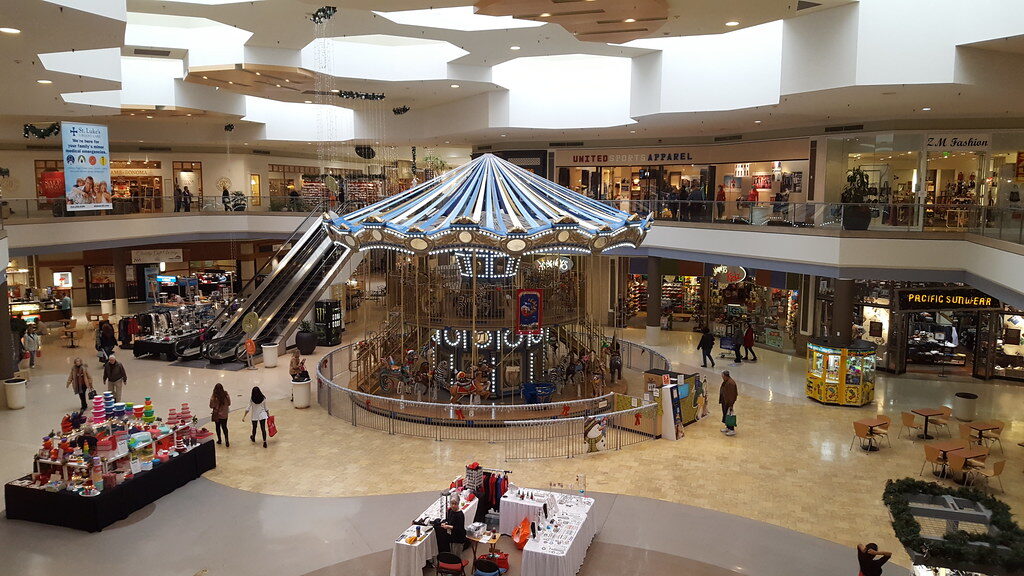
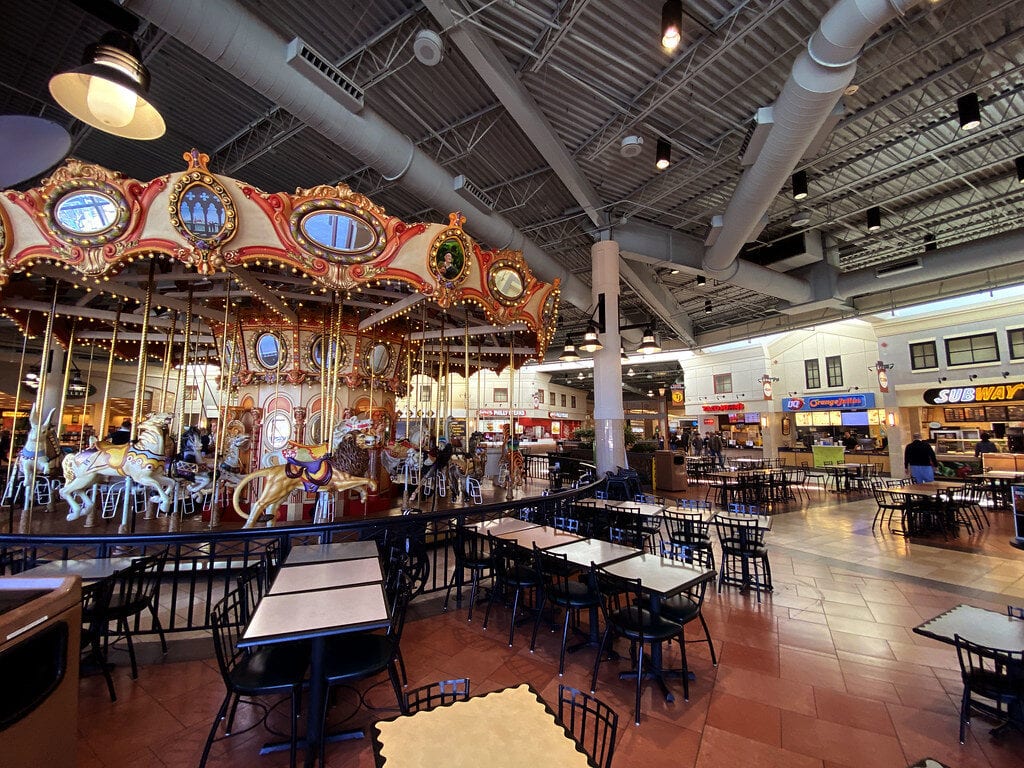
What had opened had skylights, a patterned tile floor, and a park-like interior.
The Cafe Court and a share of the shops were pushed into a second phase.
That phase opened in February 1986: the Cafe Court, the delayed shops, and the four-screen Mall 4 cinema.
Target joined the mall that summer as its third big store.
JCPenney leaves Parkade for the new mall
Columbia Mall was pulling business away from older shopping districts before all of it was open.
Parkade Plaza, there since 1965, had at least three tenants commit to the new center while another shut down.
Downtown merchants answered with money and parking: their business groups more than doubled the 1986 advertising budget, from about $32,000 to $72,000, and pushed ahead with a roughly $2.5 million garage at Eighth and Walnut.
Of about 400 spaces, only about 100 were ready for the 1985 Christmas season.
At Forum Shopping Center, Roth's announced in December that it would close after the new mall added to its sales problems.
Parkade's biggest departure came in summer 1987, when JCPenney ended a roughly 20-year run there and filled Columbia Mall's fourth anchor spot.
Parkade was down to fewer than 10 leased spaces out of 25 by fall.
A $6 million attempt to sell the center found no immediate buyer, and the property eventually shifted toward a mix of retail, offices, and other uses.
The Mall 4 cinema becomes a Barnes & Noble
The Mall 4 shut in 2000.
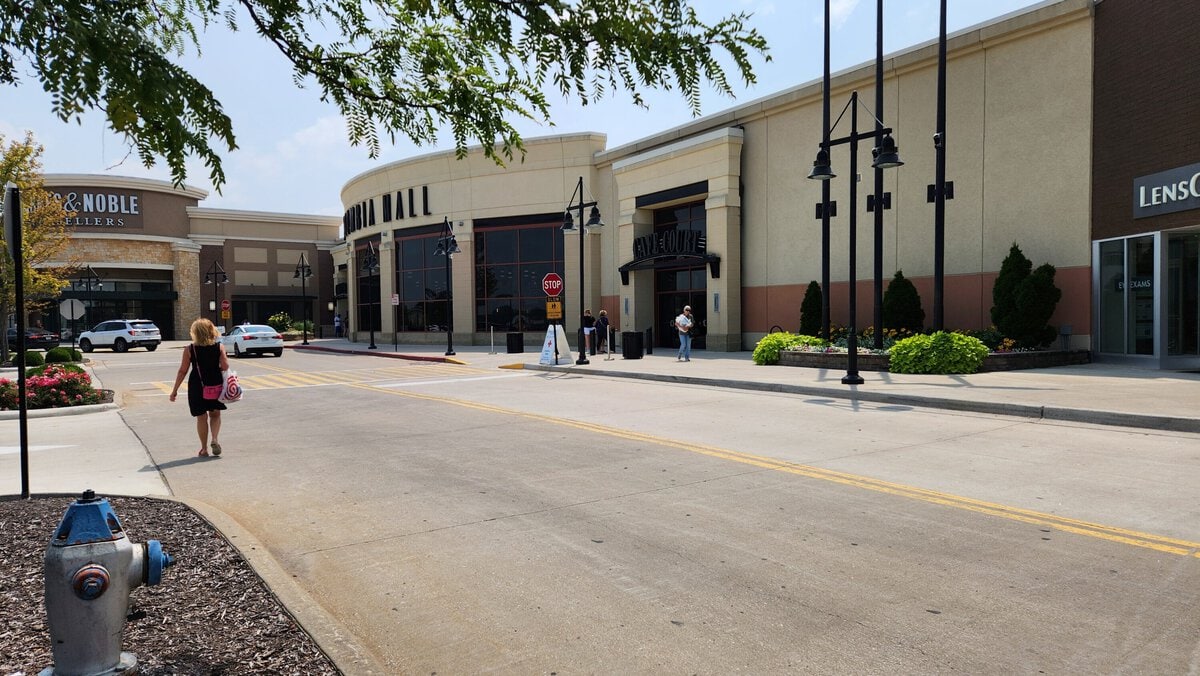
That October the City Council took up a revised plan to turn the theater into a Barnes & Noble, adding about 9,000 square feet, part of it pushed out past the food court.
The extra floor area meant moving the ring road that circles the mall and giving up 23 parking spaces.
Even without them, the site held 324 spaces more than the city required.
At the hearing the Central Missouri Green Party objected that a single large bookseller would dominate the local market.
The city handled the plan as a land-use decision, and the council approved it unanimously.
Barnes & Noble, the leading candidate for the space, had not yet signed its lease. It moved into the enlarged space by 2001.
The mall's parking lot rebuilt for a wider road
Stadium Boulevard was widened from four lanes to six between Broadway and Interstate 70, and the mall's edge was rebuilt along with it.
The Bernadette entrance was rearranged, parking on the west side was torn out and laid again, and the intersections at Worley and Ash were reworked.
Shoppers helped pay for it.
The Columbia Mall Transportation Development District, formed in August 2006, collected an extra half-cent sales tax on purchases at the mall.
The road project, priced in 2008 at almost $20 million, drew about $9 million from the state transportation department and about $10.8 million from the districts covering the mall and the stores around it.
About $935,000 of the total went to the work on the mall's west side.
In 2014 the city agreed to repay the mall's district $1.4 million for rebuilding its parking.
H&M arrives and Sears closes
In March 2014 the mall was about 96 percent leased.
That September H&M opened, hiring about 30 workers, full-time and part-time, from around mid-Missouri. The share of leased space did not hold.
By March 2018 it had dropped to about 86 percent, and MC Sports also left a large space inside the mall.
Sears, the mall's first store, closed in July 2018, and its anchor building, one of the two the mall started with, sat without a tenant.
In August, Brookfield Property Partners completed its purchase of GGP, the company that had begun as General Growth and built the mall.
The mall was not sold to another operator in the deal; GGP's American retail business went on under the Brookfield Properties name.
Dillard's moves into the old Sears
The former MC Sports space was the first to fill. In November 2019 Level Up Entertainment opened in its roughly 30,000 square feet.
The one-story Sears building, on roughly two acres plus its parking, took longer.
Columbia Mall L.L.C., the company holding the property, split the parcel off and sold it to Dillard's, which rebuilt the interior as a second store beside its original one.
It opened on February 22, 2020, and held its grand opening on February 26.
The new store took the men's, home, and children's departments, while the first kept women's clothing, shoes, and accessories.
With about 85,000 square feet added, the chain held about 185,000 square feet at the mall.
Columbia Mall at 41, every anchor building in use
The mall marked its 40th anniversary in October 2025 with a celebration in H&M Court, and that fall more than 90 percent of it was occupied.
It is open, with more than 80 retailers.
Both Dillard's stores trade, one of them in the old Sears building, along with JCPenney, Target, Barnes & Noble, H&M, and Level Up in the old MC Sports space.
Smaller spaces keep turning over: Pandora opened this year in a remodeled space.
The tenants also include an escape-room operator, an Irish dance school, a post office, and a Columbia Public Schools space.
There is no cinema. The owner's retail business went back to the GGP name in 2026, and the mall is in its portfolio.
In January 2022 a court extended the district's half-cent sales tax for 15 years, through September 2044, so shoppers are still paying for the finished road project and the district's own running costs.
On Saturdays from May through October, a farmers market sets up in the Dillard's parking lot near Stadium Boulevard.
In 1984 General Growth announced a mall of about 550,000 square feet.
Columbia Mall covers more than 700,000 square feet on a single level, and walkers come through its doors at 6 a.m., hours before any store opens.
Independent Publisher Notice
BestAttractions is an independent editorial publisher. We are not affiliated with, endorsed by, or acting on behalf of any location, business, property owner, manager, government agency, or organization described in this article.
Comments posted on this page are not forwarded to, reviewed by, or acted upon by any entity mentioned in the article.
For official inquiries, complaints, applications, bookings, or other requests, please contact the relevant entity directly through its official website or other verified channels.