
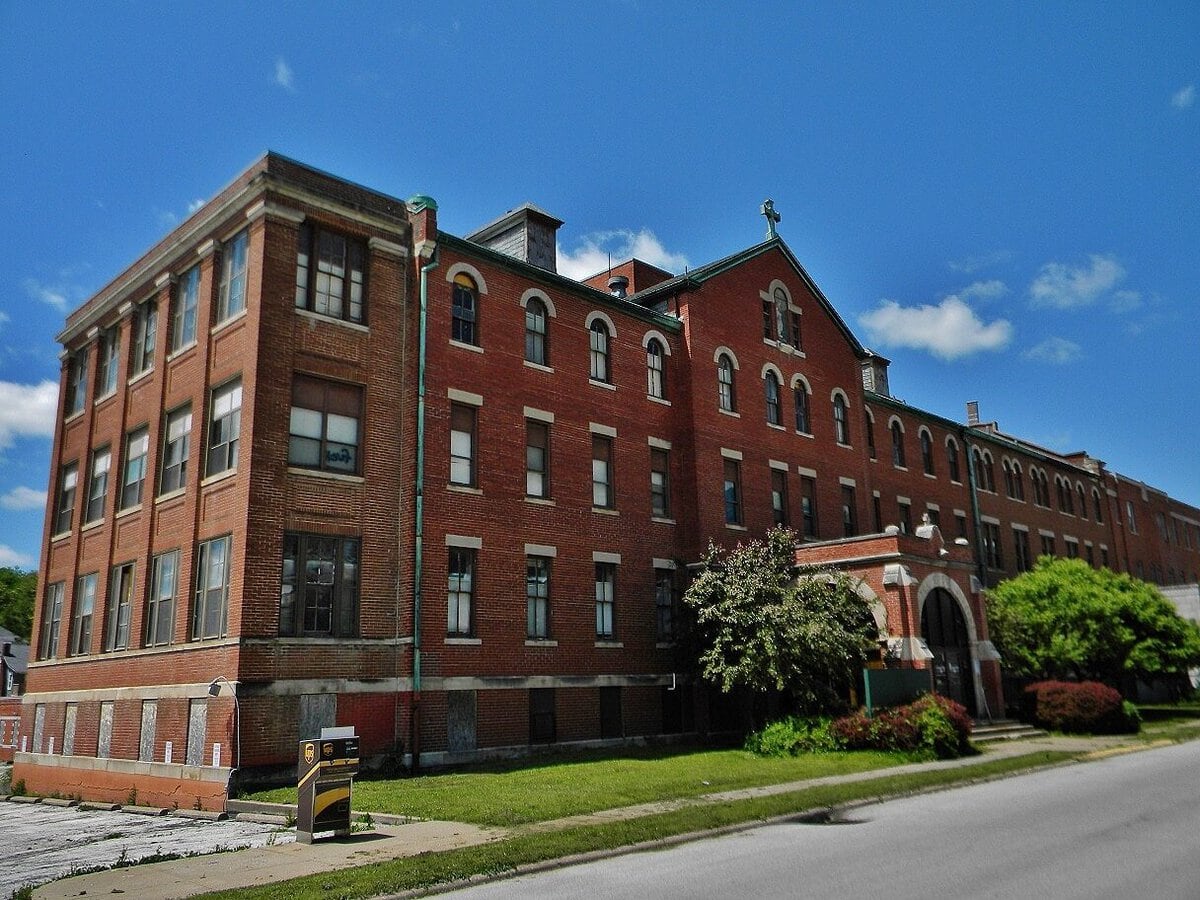
Standing on Virginia Street in central Hannibal, Missouri, sits a red-brick complex that opened as a Catholic hospital and is now being demolished.
The Sisters of St. Francis opened it in 1915 with 35 beds. Five additions followed. The last, a six-level wing finished in 1973, rose well above the older brick front.
Hospital care ended in 1993, when Hannibal Regional moved to a new campus near U.S. Route 36. Offices and college classes filled parts of the building after that. By 2009, the building was empty.
Crews are inside now in protective equipment, pulling out asbestos and lead paint. Structural demolition is set for the second half of August 2026. Virginia Street closes for a stretch when the religious statue comes off the 1915 facade.
St. Elizabeth opened with 35 beds in 1915
In the fall of 1913, the Sisters of St. Francis of Maryville bought land in central Hannibal, Missouri.
Reverend Mother M. Augustine, who founded the order, led it.
The plans came from Oklahoma City architect C. L. Monnot: red brick, three stories over a raised basement, 12 bays facing Virginia Street.
Stonework above the entrance arch read ST. ELIZABETH HOSPITAL, under a niche holding a religious statue.
Eight nursing sisters came to run it. The first patients arrived in the summer of 1915, into 35 beds.
The dedication came on July 18. St. Elizabeth recorded 412 admissions in its first year.
The 1928 addition nearly doubled the place
Demand outran the building fast.
In 1922, a narrow one-bay addition went up at the south end, giving every floor a sunroom, back when daylight and fresh air counted as treatment.
The 1928 work was bigger. Six bays north along Virginia Street, about $85,000, roughly 20,000 square feet added to an original 29,800.
It bought operating rooms, an obstetrical department, and a nursery. Admissions reached 1,400 by 1929.
In 1940, a chapel wing pushed west, Romanesque where the front was Renaissance Revival: round-arched windows, stained glass, limestone crosses.
A residence for the Sisters went up with it, which freed patient space inside the older building.
170 beds and an eight-story smokestack
By 1952, the hospital logged 5,600 admissions a year, and the buildings couldn't hold them. Ground broke in 1954.
The addition finished in 1956 added 33,800 square feet, running north along Virginia Street and then turning west in a 16-bay wing.
Three stories, flat roof, almost no ornament. Capacity went to 170 beds.
Inside were new laboratories, a children's playroom, a cystoscopic room for kidney procedures, and an iron lung from the polio years.
Out on Magnolia Avenue, a new boiler house carried a brick smokestack roughly eight stories tall, standing over the houses around it.
St. Elizabeth was handling about 550 admissions a month.
The 1973 wing that opened with two floors to spare
The Sisters administered the hospital for 50 years. In 1965, that ended and a lay board took over.
The last expansion opened in 1973: a six-level west wing, steel frame with brick piers and stucco panels, rising well above everything built before it.
Patient rooms came with private bathrooms. Coronary care, physical therapy, and geriatrics all got more room.
Two floors were left unused on purpose, so the hospital could grow again without putting up another building.
The lower level met Magnolia Avenue near grade, which is where ambulances and physicians started coming in.
U.S. Representative William Hungate spoke at the dedication.
St. Elizabeth loses its name in 1988
Hannibal had supported two hospitals since 1915, after Levering opened with 26 beds in 1903.
In July 1987, the two boards signed an affiliation agreement, and in 1988 they merged as Hannibal Regional Hospital.
Acute care concentrated on Virginia Street, so the complex kept working as the city's main hospital under a name that was no longer its own.
In 1993, Hannibal Regional opened a new campus near U.S. Route 36 and moved the beds out.
Six construction campaigns had left corridors built for several eras of medicine, and Hannibal had outgrown what the old hospitals could handle.
Hospital care had run at 109 Virginia Street for 78 years.
Community college classrooms, then nothing
Offices and small tenants stayed through the 1990s, including a marketing and design business in the old gift-shop space.
In 2000, Moberly Area Community College opened a Hannibal campus here.
The college had to move out after the property changed hands, and later built a permanent campus elsewhere in town.
Chapel Hill Commercial Group bought the complex in 2007, and operations ended in 2009 after financial trouble.
On August 14, 2012, the property went onto the National Register of Historic Places.
The lobby still had its porcelain tile, marble stair, and iron balustrade. The listing came with no money for a roof.
3 senior-housing plans, none built
By 2017, asbestos had become the cost that decided everything.
Hannibal took the deed at no charge that year to qualify for a $200,000 asbestos-removal grant.
Senior housing every time: about 55 units at roughly $7 million in 2017.
Then 54 affordable apartments in 2018, with one-bedrooms proposed at $385 a month.
Then 60 units in a $12 million rehabilitation, denied its tax credits in December 2021.
A judge had already ordered it secured. The city paid $50,000 in back taxes and kept paying for security as windows broke.
Hannibal donated the complex to NECAC and its development partner in May 2023 and set a July 1, 2024 financing deadline.
None of the plans got fully financed.
Crews in respirators, then the statue comes off
The city's 2025 capital plan held a $4.7 million placeholder for demolition.
Federal money would have triggered historic review because of the listing, so in May 2025 the council dropped that route.
Bids then came in low: three contracts awarded on June 2, 2026 totaled just over $1.7 million.
Crews went in during July in protective equipment, pulling out roughly 33,700 square feet of asbestos flooring and mastics, along with lead paint.
Neighbors have warned the city about rodents pushed out of a building empty this long.
Structural demolition is set for the second half of August, with lane closures on Virginia Street and a short full closure when the statue comes off the 1915 facade.
No long-term use has been announced for the cleared site.
Independent Publisher Notice
BestAttractions is an independent editorial publisher. We are not affiliated with, endorsed by, or acting on behalf of any location, business, property owner, manager, government agency, or organization described in this article.
Comments posted on this page are not forwarded to, reviewed by, or acted upon by any entity mentioned in the article.
For official inquiries, complaints, applications, bookings, or other requests, please contact the relevant entity directly through its official website or other verified channels.