
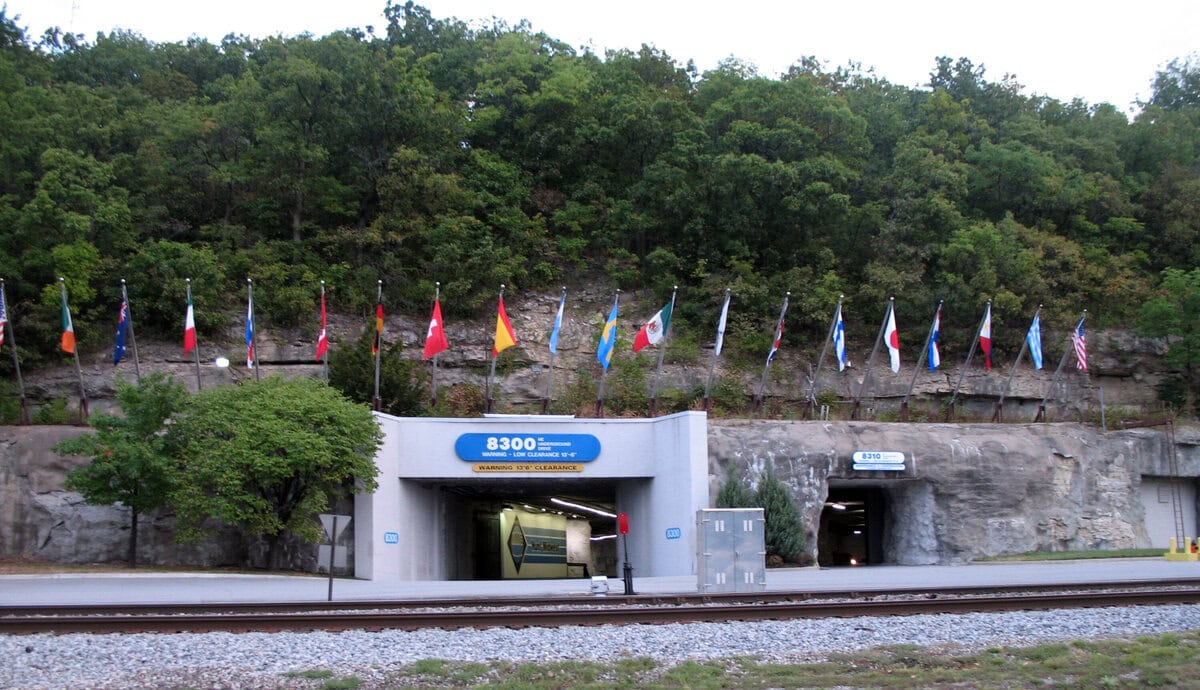
SubTropolis is an underground business complex inside a limestone mine in the bluffs of northeast Kansas City, Missouri, off NE Underground Drive. Trucks and cars reach it through drive-in portals.
The mine was dug for road stone, and its emptied rooms were later rented out for storage. The rock overhead and the pillars left standing gave tenants a roof and supports they didn't have to build.
Storage gave way to real construction inside the rock: walled rooms, a vehicle plant, a data center, and a federal records center, all fitted around the limestone pillars that hold up the roof.
Today more than 55 tenants lease space in the mine, and more than 2,500 people work for them. Hunt Midwest, which runs the complex, still has mined rooms waiting to be built out.
Limestone first, storage second
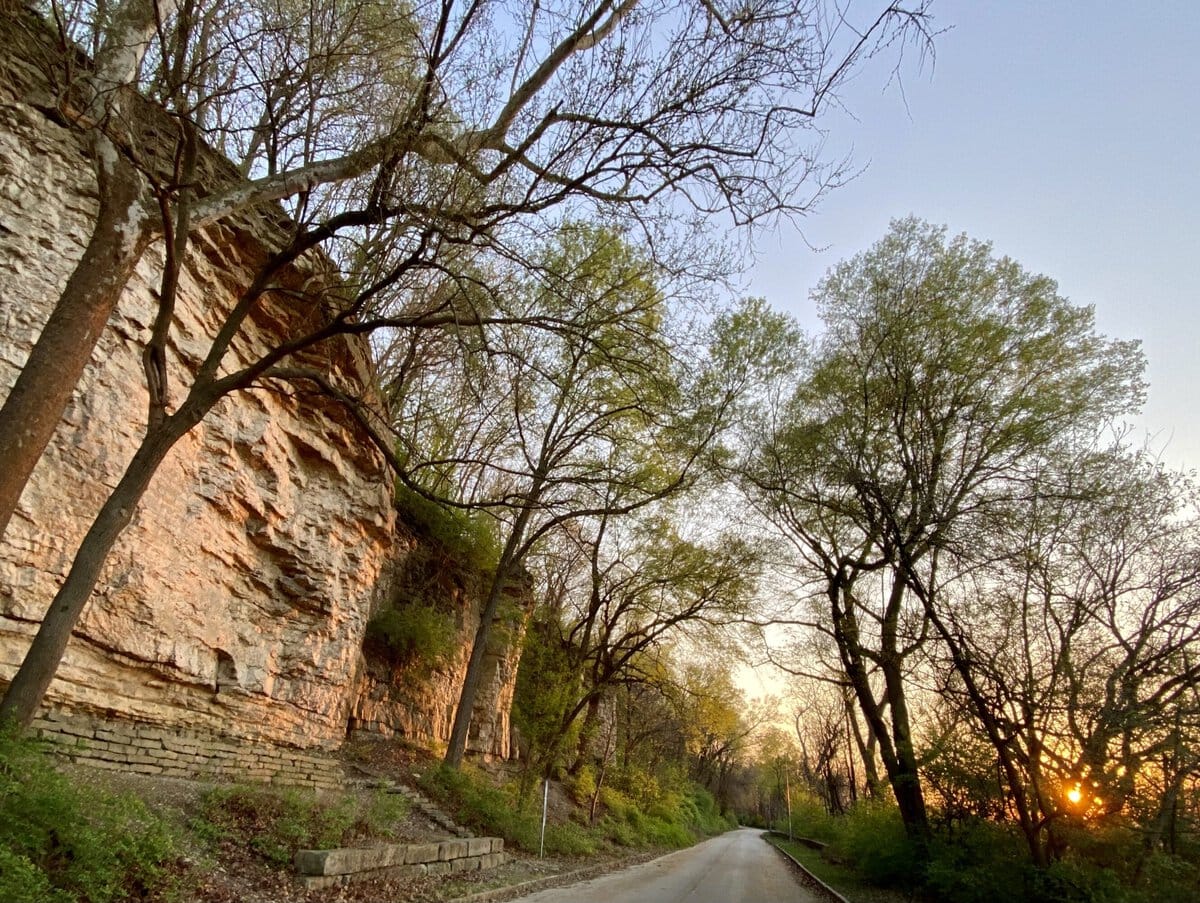
In 1945 Midwest Precote began mining sideways into the bluffs of Clay County, east of what is now Interstate 435.
The company had sold asphalt-treated aggregates since 1931, and the rock it went after here was Bethany Falls limestone.
The stone was the product, bound for Kansas City road and construction work, airport and highway projects among them.
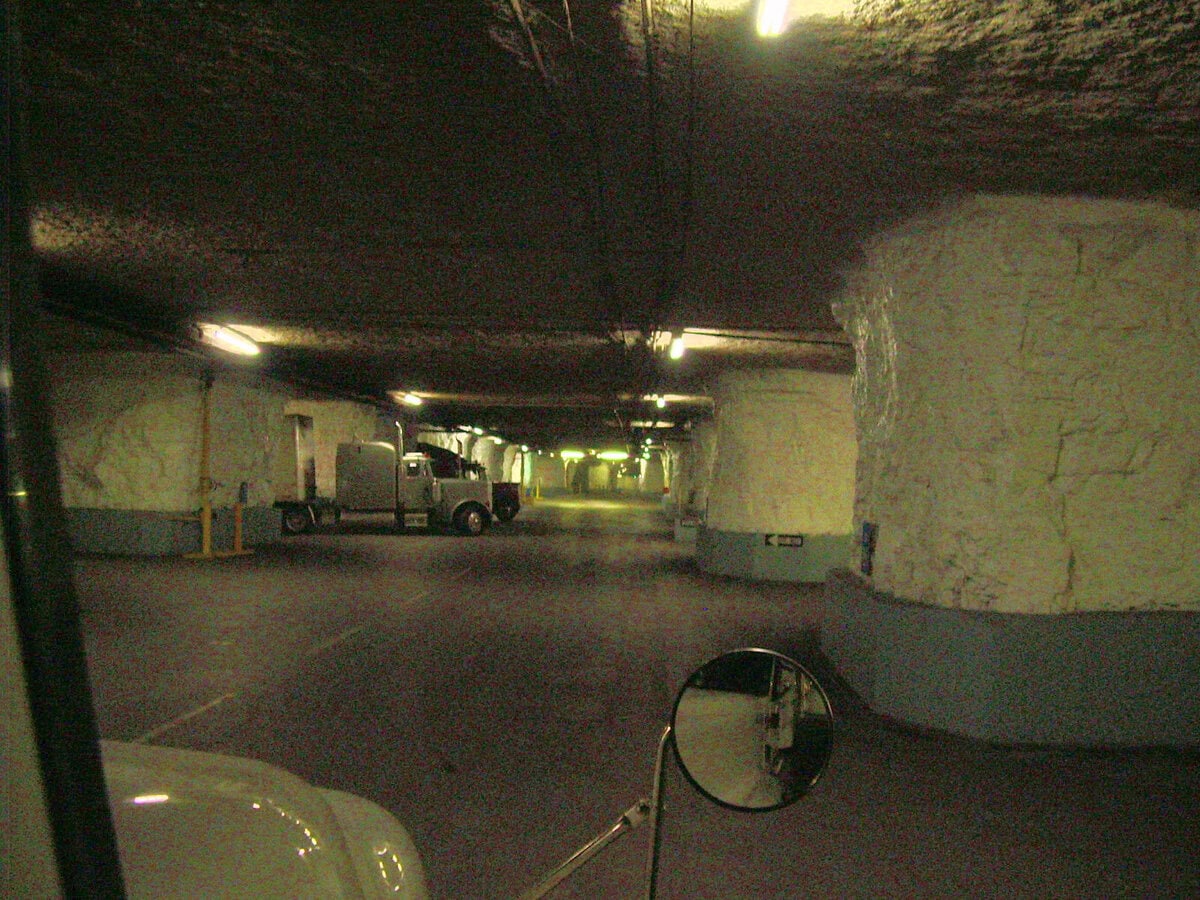
The crews worked by room and pillar, taking out broad rectangular rooms and leaving square limestone columns to carry the roof.
Early mining was less regular in places, so some older rooms kept uneven pillar spacing and roof lines.
Once the stone was gone, what remained was a network of rooms large enough to drive into, with the roof already overhead.
In 1964 an underground storage company was formed to lease those rooms.
That was the start of commercial leasing in the mine that Hunt Midwest now runs as SubTropolis, an underground industrial and commercial complex in northeast Kansas City, Missouri.
Ford, Pillsbury, and Russell Stover were among the first tenants, and a local construction company parked its equipment there through the winter.
None of them had to put up a building, because the roof and the columns were already there.
Stone was still being cut from the mine when they moved in.
Stamps under the bluff
In 1970 Great Midwest Corporation, with Lamar Hunt among its major shareholders, took control of Midwest Precote.
The company was bigger than the mine. It invested in the underground storage business and held undeveloped land around Kansas City to build on later.
In 1982 the United States Postal Service moved its Stamp Fulfillment Center into more than 300,000 square feet of the mine.
Stamps shipped all over the country sat at the mine's steady temperature and humidity, out of reach of severe weather.
The Postal Service was paying for the mine's climate and security along with its roof.
By 1983, 3 million square feet underground had been developed for commercial use.
A city road plan and a stone joint venture
Great Midwest was combined with another Hunt company in 1985 to form Hunt Midwest Enterprises.
The business under the new name was the same: a mined room became real estate once access, utilities, lighting, floors, and walls went in.
Access and utilities became a public matter on December 14, 2000, when Kansas City approved the Parvin Road Corridor plan.
It set out to provide roads, sewers, traffic signals, and water lines for the expansion of SubTropolis and of the Hunt Midwest business park on the surface.
Its boundary ran below ground as well as above: 1,334 acres on the surface and 507 underground.
In June 2001 the plan was amended to take in the land needed to widen Arlington Road, and within five years of the plan's approval crews were widening the road to the mine entrance.
At the end of 2004, Hunt Midwest and Martin Marietta announced Hunt Martin Materials, a joint venture for most of their Kansas City-area aggregate operations.
The stone side went largely into the venture, while Hunt Midwest kept leasing and building out the underground.
A new east entrance and the National Archives
Reaching more of the mine got easier in 2012 with the opening of the Derrough Drive portal on the east side.
The entrance honored Lee Derrough, Hunt Midwest's longtime president and chief executive, and opened the way to another 9 million square feet of leasable underground space.
By 2013 the developed area had reached 5 million.
The first project north of the new entrance was a federal records center, which the National Archives opened in 2012.
The agency had first used underground records centers elsewhere in the Kansas City region in the late 1990s, and SubTropolis became its fourth cave location.
More than 1.6 million pounds of steel shelving went into the first phase, spread across two 45,000-square-foot storage pods.
Building inside the pillar grid
Every build-out had to be fitted to the mine.
Crews took their floor elevation from the rock overhead, sometimes cut down through about four feet of shale to the limestone below, then built the floor back up before laying the walls.
Masons fitted the blockwork around whatever shape the pillars and ceiling gave them.
Lighting and ductwork hung from anchors drilled into the stone above.
In the regular sections the pillars stood 25 feet square on 65-foot centers, with about 40 feet of clear space between them and ceilings near 16 or 17 feet.
That grid shaped the roads and the building bays, and it shaped the data-center rooms and vehicle assembly lines that came into the mine.
LightEdge announced in October 2013 that it would anchor a data-center campus inside the mine and open its first underground operation there in 2014.
In November 2017 Dejana Truck & Utility Equipment opened a 90,000-square-foot plant underground, with two assembly lines and room for more than 300 vehicles indoors.
The plant was built to take in Ford Transit and F-150 vehicles from Ford's assembly plant in nearby Claycomo, fit them with commercial van interiors and other equipment, and send them back out for distribution.
A Grainger warehouse and 13 miles of roads
Grainger began running a 1.46-million-square-foot distribution center underground in 2026, the largest warehouse ever built at SubTropolis for a single tenant.
Space was still open elsewhere in the mine, with three bays listed for lease in September 2026, the smallest at 62,200 square feet and the largest at 199,400.
The underground still depends on the city's road and utility decisions.
On September 3, 2026, the Kansas City Council approved the sixteenth amendment to the Parvin Road plan.
Developed space now totals 10 million square feet, and Hunt Midwest plans another 4 million in rooms that are already mined.
Inside the bluff, 13 miles of lighted, paved roads lead to the tenants' entrances.
Independent Publisher Notice
BestAttractions is an independent editorial publisher. We are not affiliated with, endorsed by, or acting on behalf of any location, business, property owner, manager, government agency, or organization described in this article. Comments posted on this page are not forwarded to, reviewed by, or acted upon by any entity mentioned in the article. For official inquiries, complaints, applications, bookings, or other requests, please contact the relevant entity directly through its official website or other verified channels.