
For years Simi Valley's shoppers drove to Thousand Oaks and Northridge, and the city kept looking for a place to build a mall of its own. It dropped two sites before it settled on a third.
When Simi Valley Town Center opened in 2005, two high-school marching bands played, and more than 15,000 people came to a $5 charity preview.
Later its owners lent empty storefronts to a VFW post and the YMCA, and a therapy room for children opened between two shops. In 2019 part of the center was auctioned off outside the county government building.
Today neither department-store building has a store in it. Homes have been drawn onto this land twice before, and none were built. The third plan is already further along than either.
Three sites and a plan for five department stores
In 1972 Simi Valley's General Plan called for a regional shopping center.
Residents drove to Thousand Oaks, Northridge, and Canoga Park to shop, and the city wanted that spending, and the sales tax on it, kept at home.
The first site was about 70 acres at the corner of Los Angeles Avenue and Madera Road.
It was dropped because it had no direct access to Route 118 and could not be seen from it.
A 1980 update moved the search to Cochran Street and Sycamore Drive.
A post office, Farmers Insurance, and the Mervyn's Center took up land there, and the freeway was still hard to reach.
In 1985 the City Council ordered a fresh start, and eight sites were studied.
The one chosen in 1988 was 129 acres on the north side of Route 118, between First Street and Erringer Road, with an interchange at each end.
In 1991 the city adopted a plan for a 980,000-square-foot mall built around as many as five department stores.
The recession already underway ended it: the developers, Melvin Simon & Associates and Homart Development, let their options on the land expire and withdrew.
Smaller, open-air, and planned with apartments
When the mall came back in the mid-1990s, it was smaller.
About 750,000 square feet of mall was judged supportable in 1995, against the 980,000 approved in 1991.
The Corti-Gilchrist Partnership optioned the land that year and redrew the project as a town center, with big-box stores, offices, a hotel, and housing around the mall.
The homes were added partly to make the whole project pay, and a 500-unit apartment district was set on the higher ground just north of the mall, developed separately from the shops.
The September 2003 development agreement required at least two major department stores, and the plan on paper still called for a mostly enclosed mall.
F+A Architects designed it instead as a one-level, open-air center in the style of an Italian hillside village.
Its signs on Route 118 were kept modest.
The city and Corti-Gilchrist expected large ones to meet resistance, and talks with the Neighborhood Councils confirmed the choice.
Construction began in June 2004, with Forest City developing the mall alongside Corti-Gilchrist and the Finley Group, on a town center priced at about $300 million in all.
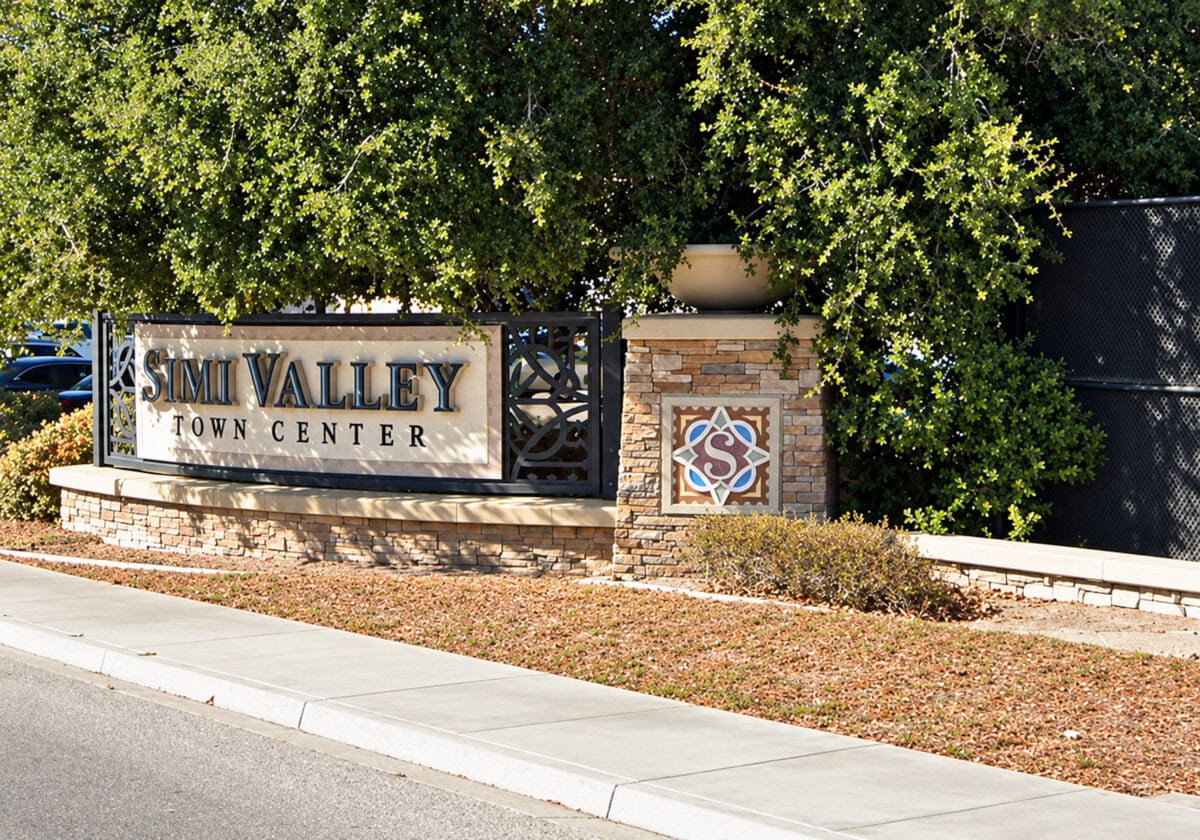
Opening week at Simi Valley Town Center
Marching bands from Simi Valley High School and Royal High School played on October 26, 2005, as Robinsons-May and Macy's cut their ribbons.
Robinsons-May had sold its preview day through local charities at $5 a ticket.
More than 15,000 people came, and local groups took in more than $120,000.
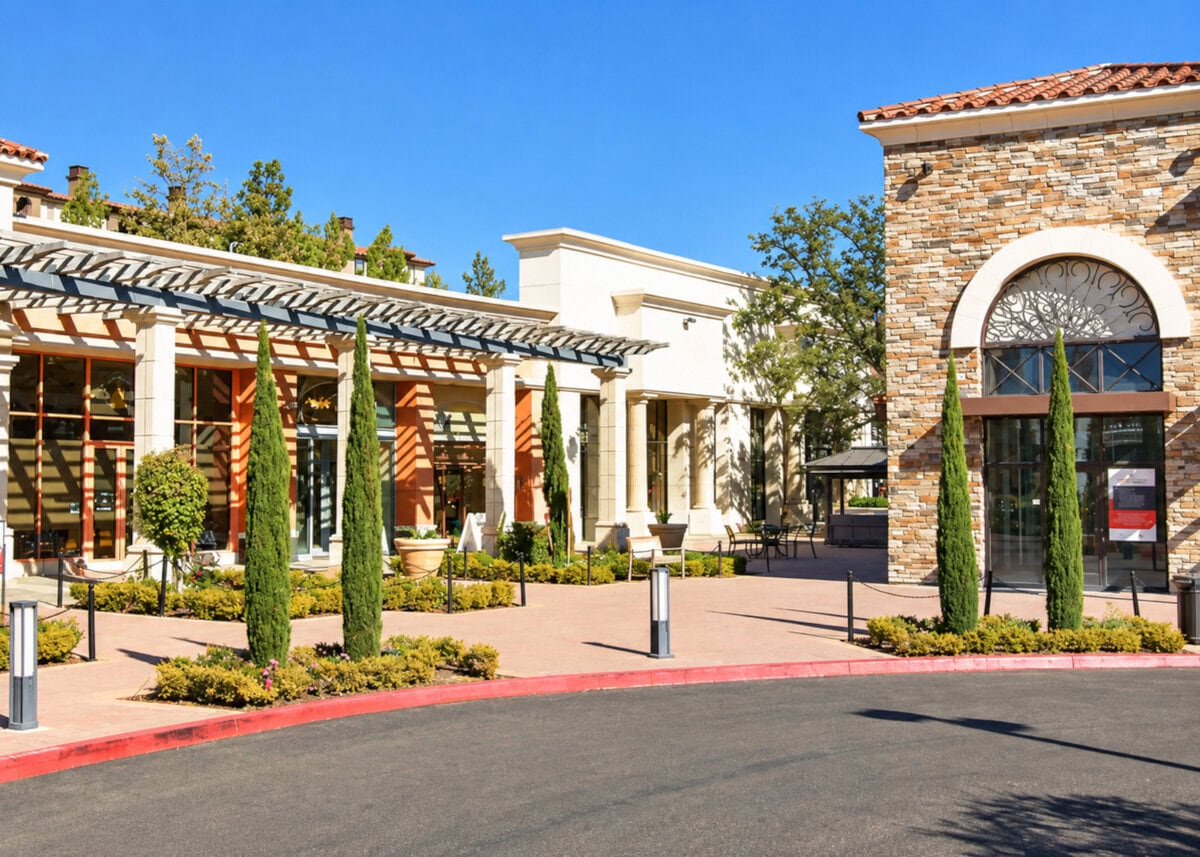
Simi Valley Town Center opened the next day, October 27, 2005, in Simi Valley, California, as a one-level, open-air shopping center.
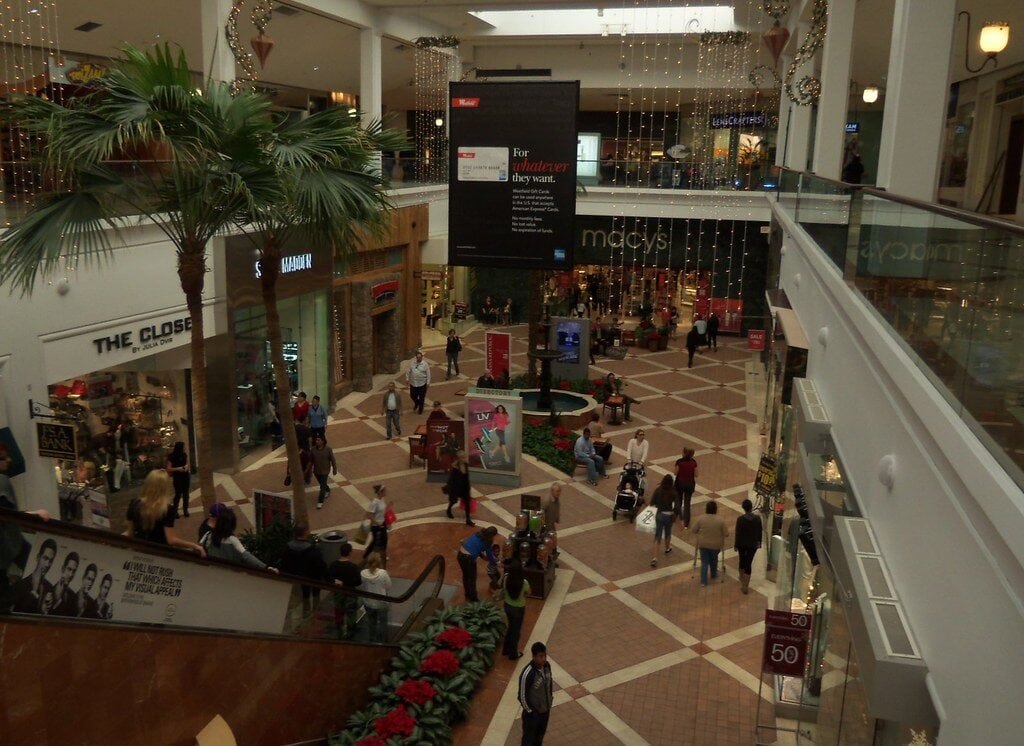
A courtyard sat at the center, while trellises and covered sections broke up the walk and fountains and a fireplace marked the route.
More than 120 shops were planned, and roughly 70 percent of them were due to open in time for the first weekend.
Hollister and Coldwater Creek were among the chains with no other store in Ventura County, and American Eagle and Abercrombie & Fitch had signed on too.
At the two ends stood two department-store names, Robinsons-May to the east and a new Macy's to the west.
Macy's at both ends
The new Macy's at the west end, 107,000 square feet, went on a sale list in August 2005, before its doors had opened.
Federated Department Stores, the parent of Macy's, had completed its purchase of May Department Stores, the owner of Robinsons-May, that year, which put both of the mall's department stores under one company.
The list held the California stores where the two chains duplicated each other, and Federated announced that it would open the Simi Valley store and keep it running until a buyer came along.
No other department store came to the mall.
Federated kept the west Macy's, and in September 2006 Robinsons-May at the east end became Macy's Men's/Home/Kids.
Less than a year after opening, the mall had one department-store name at both ends, with the merchandise split between the two buildings.
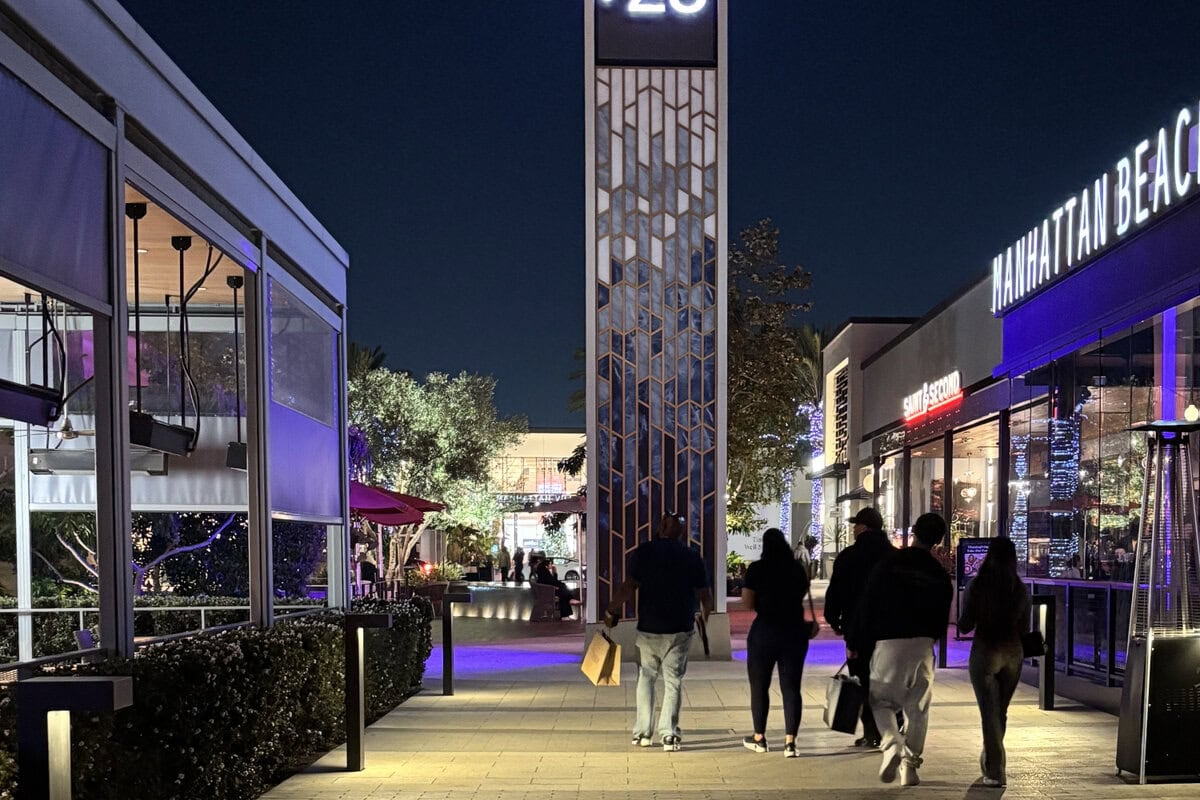
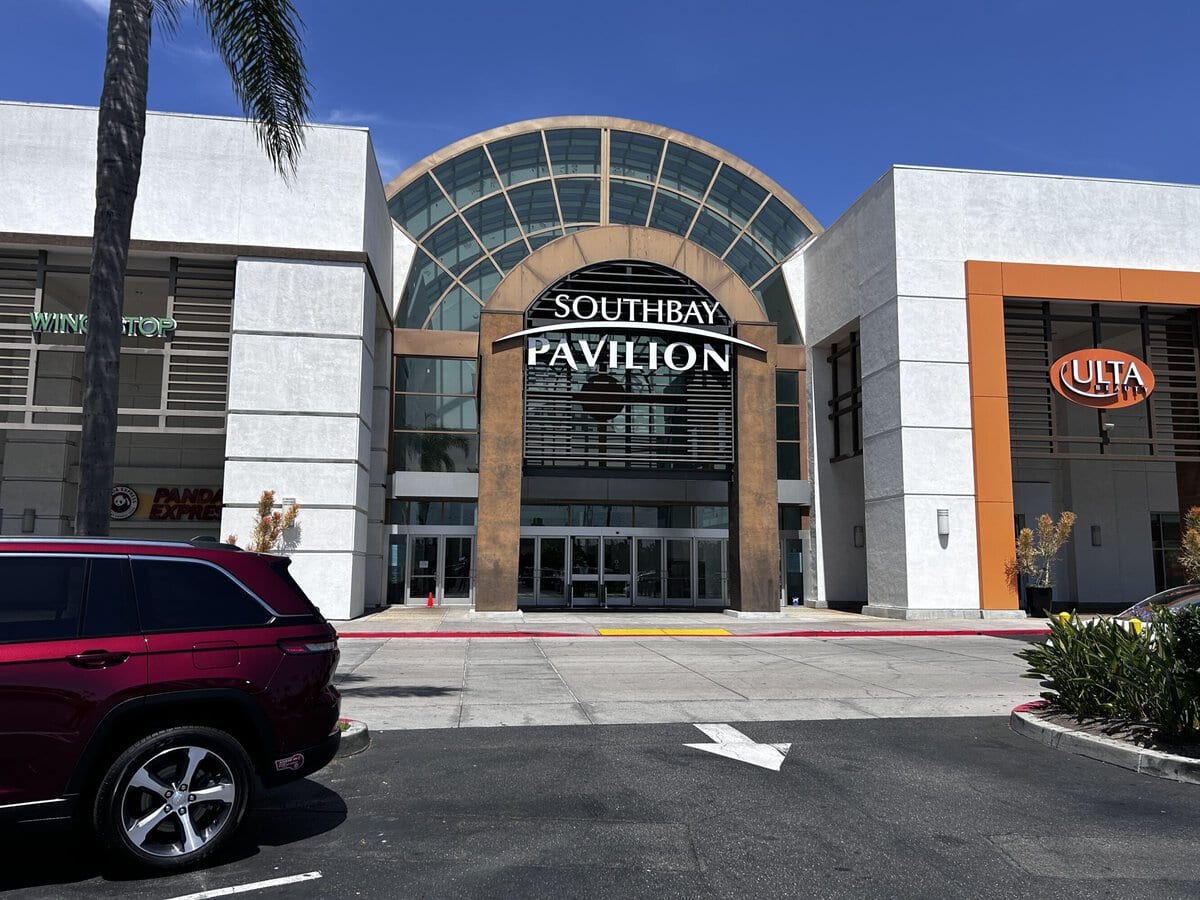
Forest City writes down the mall and sells
In 2008 The Oaks, the mall in Thousand Oaks, finished a major expansion.
Thousand Oaks was one of the towns Simi Valley shoppers had driven to before their own mall opened, and Apple ran stores at both centers.
The recession had begun late the year before. At Simi Valley Town Center, occupancy and cash flow fell during 2010.
The center went on the market that June, 86 percent occupied, with Anthropologie, Forever 21, and Victoria's Secret among its tenants.
It wrote the property's value down by $77 million and sold it.
Walton Street Capital bought the center in December 2010 and brought in Alberta Development Partners as its development partner.
Empty storefronts while the plan was redrawn
By 2013 Coach, Abercrombie & Fitch, American Eagle, and Forever 21 had left the mall.
Some of the empty space went to local groups: in 2012 the new owners lent storefronts for short stretches to the YMCA, the Boys & Girls Club, an American Legion post, and a VFW post.
That September, Easter Seals opened a therapy room between Aldo and Anthropologie and began seeing about 15 children by appointment.
Other storefronts were empty on purpose.
Walton Street and Alberta were moving tenants to free sections for rebuilding, and by November 2012 they had worked through more than 50 drafts of the plan.
Completion was being discussed for 2014, and the date kept slipping.
The freeway signs came back up in the same years.
The city, which had kept the original signs on Route 118 modest, was by then working with the owners on large ones.
Its code did not allow freestanding signs aimed at the freeway, so in 2013 the two sides set out to change the Specific Plan.
A dine-in cinema and two freeway signs
Demolition started in March 2015.
Crews took down the building that had held Sliders Bar and Grill, closed since 2013, along with part of an archway, and the cleared ground became a small parking lot with its own vehicle entrance and valet drop-off for a dine-in cinema.
Buffalo Wild Wings opened in September.
Studio Movie Grill, the cinema the lot was built for, opened in October 2015 with nine auditoriums and 963 seats.
The work was part of an $87 million renovation.
Walton Street and Alberta carried it on through 2016, putting two pylon signs on Route 118, the kind of large freeway sign the original design had avoided.
Starbucks left its spot inside the mall for the old Union Bank building out in the parking lot and added a drive-through window, and space was remodeled for Marshalls and Ulta Beauty.
Both stores were open by January 2017.
An empty east end and a plan for 332 apartments
Macy's announced in January 2017 that its Men's/Home/Kids store at the east end, with just over 100 workers, would close later that year.
The west Macy's stayed open. Apple, which had opened at the mall in May 2006, closed its store that September.
In 2018 Walton Street and Alberta brought the city a plan for the empty east building, priced at about $70 million to $80 million.
It called for tearing down the old Macy's, building 332 apartments, adding a park, and cutting back the retail.
The owners pulled the application about an hour before the City Council was due to take it up.
The plan did not come back in that form, and the east building stayed empty.
Foreclosure, then one owner for the whole site
Walton Street's loan on the center went into default. The notice came in January 2019, when about half of the space stood empty.
In May 2019 the center was auctioned outside the Ventura County Government Center.
Bayside SVTC, a partner of The Festival Companies, bought it for $27.5 million, with more than $41.7 million in debt unpaid.
Early in 2020 a Festival affiliate bought the west Macy's building, with Macy's staying on as its tenant, and that March the mall's main parcels passed to a Festival company as well.
In July 2021 another Festival affiliate bought the empty east Macy's parcel.
The mall and both department-store buildings, about 600,000 square feet of retail, belonged to one ownership group, and that year the group put forward a concept with apartments on about five acres and a site for a hotel.
No department store and a plan for homes
Macy's announced in January 2024 that it would close its remaining store at the mall, and the store closed that spring.
None of Festival's apartments or hotel had been built when SteelWave and Steerpoint Capital bought the center for about $38 million in the fall of 2024.
The new owners asked the city in 2025 to let homes replace part of the mall.
The request covered 15.8 acres: the east and west parking areas, the empty east department-store building, and retail along the north side.
The owners proposed removing about 312,000 of the roughly 593,000 square feet of retail, adding about 42,000 square feet of new commercial space, and building 291 to 375 homes.
In May 2025 the City Council voted 4 to 1 to let the request proceed as a formal General Plan amendment.
The vote did not approve demolition or construction.
The owners held a public meeting at the mall in July 2025.
The plan is still being worked out by the city and the owners, with prospective partners, and nothing has been approved for construction.
In the meantime the open-air mall is doing business, with Ulta Beauty and Five Below among its tenants. A bakery-cafe opened there in July 2026.
In 1991 the city approved a mall with room for up to five department stores.
Marshalls and the dine-in cinema trade between the two department-store buildings it eventually got. Neither building holds a store.
Independent Publisher Notice
BestAttractions is an independent editorial publisher. We are not affiliated with, endorsed by, or acting on behalf of any location, business, property owner, manager, government agency, or organization described in this article.
Comments posted on this page are not forwarded to, reviewed by, or acted upon by any entity mentioned in the article.
For official inquiries, complaints, applications, bookings, or other requests, please contact the relevant entity directly through its official website or other verified channels.