
They named it for the country's third century.
Planning ran through the U.S. Bicentennial, so the West Mifflin mall southeast of Pittsburgh got the name Century III, a clean break from the slag heap it was built on.
Century III Mall opened at 3075 Clairton Road in 1979 and 1980 with Kaufmann's, JCPenney, Montgomery Ward, Gimbels, and Sears.
The Sears alone ran 231,000 square feet with a 24-bay auto center.
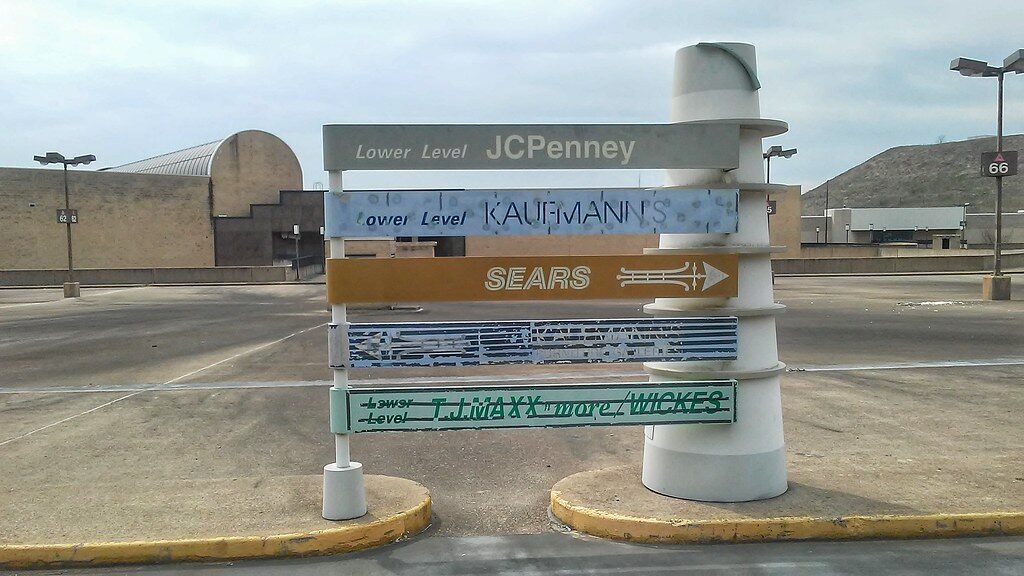
At its peak, the place topped 200 stores. Forty years later, a judge signed off on tearing it down.
After the heat failed and the sprinkler pipes burst in 2019, the mall closed; a fire drew 100 firefighters in 2023, and a teenager fell through the roof.
In 2025, a state court called it a public nuisance and cleared it for demolition. The future didn't last.
A shopping mall built on a mountain of steel mill slag
In October 1978, crews set the first steel beams on a reshaped hill in West Mifflin, Pennsylvania, about eight miles southeast of downtown Pittsburgh.
The ground under those beams was not natural.
It was a man-made landform, packed and graded out of the leftovers of the steel industry.
The hill was called Brown's Dump.
For more than 50 years, the Union Railroad hauled molten slag from the mills and tipped it onto Brown's Dump along Lewis Run.
Load by load, decade by decade, the slag built into a mound 200 feet high.
By the time dumping stopped in the late 1960s, it covered 410 acres and held 70 million cubic yards of waste.
A mountain made of what nobody wanted.
Moving 15 million cubic yards to make room for stores
U.S. Steel's real estate arm started hunting for a use for the land in 1969.
The problem was the land itself.
You can't just pour a department store foundation onto a slag pile sitting over old coal shafts.
So they dug.
Crews hauled out roughly 5 million cubic yards of slag, prepared a 25-acre commercial strip along Route 51, then filled the mined-out tunnels underneath to keep the ground from giving way.
The full mall job dwarfed that.
In 1976, U.S. Steel partnered with the Edward J. DeBartolo Corporation, one of the busiest mall builders in the country, and together they moved roughly 15 million cubic yards of slag, soil, and rock.
The mall's price tag was $100 million.
The name they chose had nothing to do with a dump.
Why they called it Century III
Planning ran through the U.S. Bicentennial.
The country was about to start its third century, so the mall got the name Century III.
Clean, forward-looking, no slag attached.
The first major construction permits went out on June 18, 1978, for a two-level JCPenney valued at $2.8 million.
Four months later the steel went up.
The plan called for five department stores, around 190 inline shops, and 6,000 parking spaces, with early plans even penciling in a racquetball court and a skateboard park.
This was going to be one of the biggest enclosed malls in America.
Doors open in 1979 with two anchors
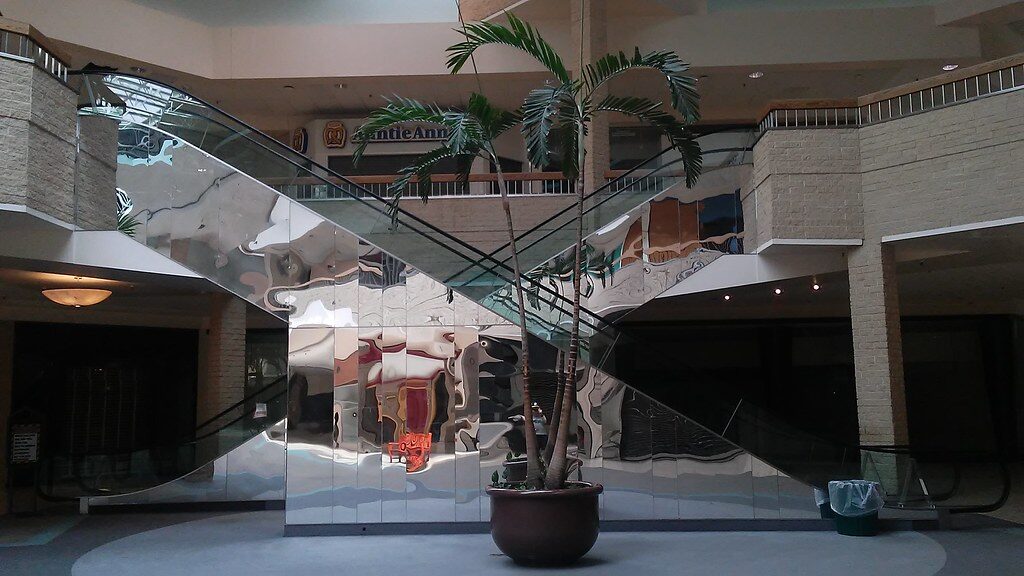
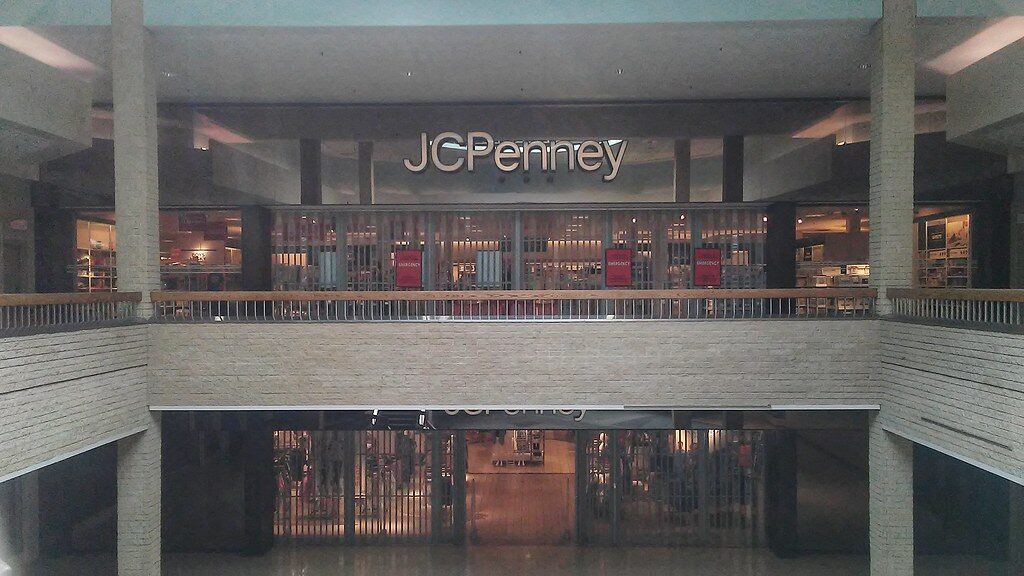
The first phase was dedicated on October 24, 1979, with about 75 stores and two anchors: Kaufmann's and JCPenney.
Edward J. DeBartolo himself showed up for the dedication, alongside local officials.
Kaufmann's mattered locally.
The two-level, 121,300-square-foot store was the Pittsburgh chain's first mall anchor in the region.
JCPenney went bigger, at 173,200 square feet across two floors.
But the mall wasn't finished. Three more anchors and a whole food court were still coming.
The food court and the fake old Pittsburgh street
Phase two opened on March 12, 1980, adding 46 stores and Montgomery Ward.
It also brought the two pieces people would remember longest.
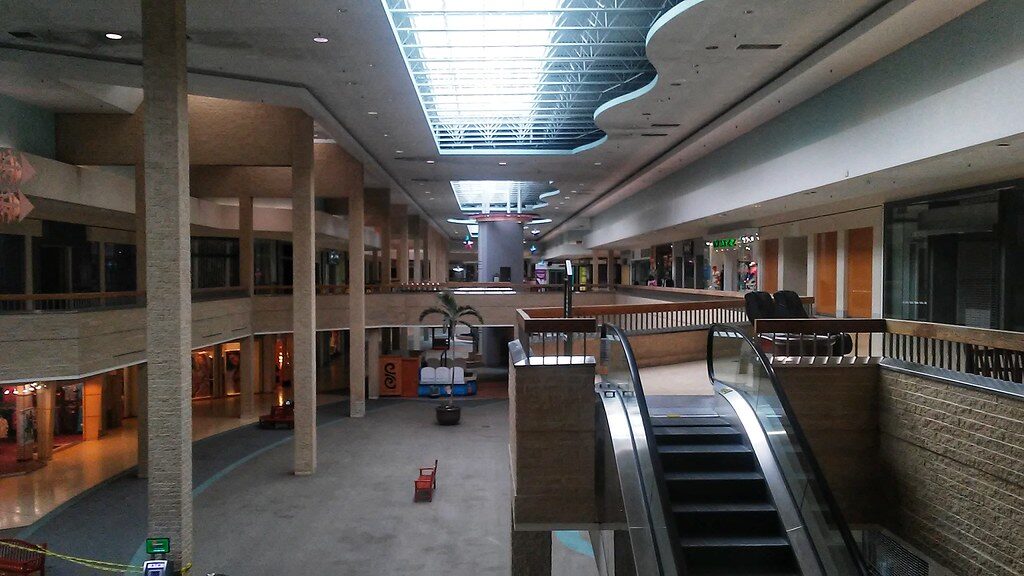
One was The Courtyard, a food court with 19 bays packed into a single eating area, back when mall food courts were still a newer idea.
The other was Olde Pittsburgh, an interior stretch with cobblestone-style paving and benches, built to feel like an older city street.
A locally made sculpture called "Pittsburgh Reflections" went in during the opening.
The whole place ran three retail levels in parts, with ramps, escalators, fountains, and mirrors softening the sheer size of it.
Five anchors, and the biggest was Sears
Gimbels opened in August 1980, in a 126,000-square-foot space first meant for Horne's.
Then Sears arrived on October 6, 1980, and Sears was the giant.
The two-level Sears ran 231,000 square feet and came with a 24-bay auto center, a beauty salon, an optical department, a photo studio, and a key shop.
By the end of 1980, Century III had its five anchors and roughly 170 stores.
It would later push past 200.
Early tenants read like a time capsule: B. Dalton, Camelot Music, Chess King, Merry-Go-Round, National Record Mart, Herman's World of Sporting Goods, Morrow's Nut House.
For a while, the place was packed.
Then the anchors started leaving.
The anchor names that kept changing
Montgomery Ward closed first, in December 1985.
The space got an $11 million renovation and reopened as Horne's on October 30, 1986.
Gimbels left in January 1986 when the chain pulled out of Pittsburgh, briefly reopened that June, then closed again in January 1988.
That building got carved up: T.J. Maxx on one level, Marshalls on another, later Wickes Furniture, and eventually Dick's Sporting Goods.
Horne's became Lazarus in 1994.
Lazarus left in October 1999, and the space slid into furniture-gallery use, first Kaufmann's, then Macy's after the 2006 rebrand.
That furniture store closed in early 2009.
Keeping track required a scorecard.
A movie theater, a facelift, and a quiet peak
A 12-screen theater opened on the property in 1990, stretching the mall past pure shopping.
In 1996, the same year Simon Property Group absorbed DeBartolo's portfolio in a $3 billion deal that added 49 regional malls, Century III got an $8 million facelift.
New interior, fresh look, finished by that December.
It was the last good stretch.
The mall's assessed value hit $150 million in 2006, and that number turned out to be the high-water mark.
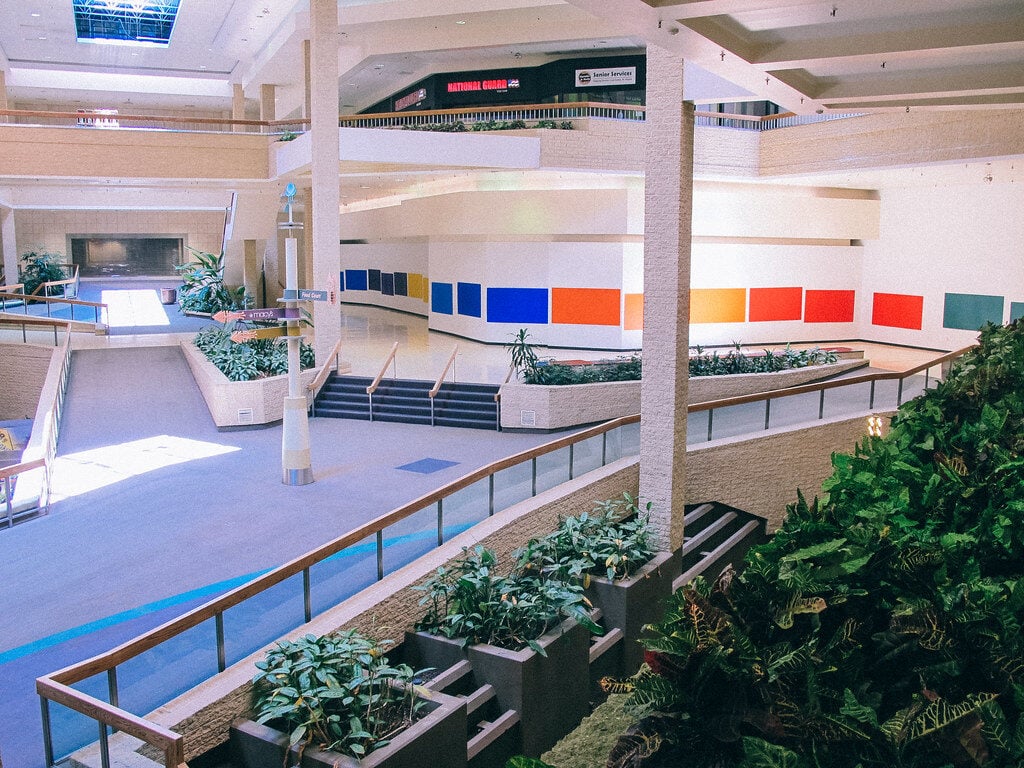
When the value collapsed
Six years later, the same property was worth $27 million.
A drop from $150 million to $27 million in six years tells you everything about where retail was heading.
Simon defaulted on a $79 million loan tied to the mall in 2011.
Two years after that, in 2013, Century III Mall PA LLC bought the whole thing for $10.5 million, less than the $11 million renovation that had turned one anchor into Horne's decades earlier.
The new owner talked about reviving it. The stores kept closing anyway.
Eighty percent empty, with a Netflix crew inside
By 2018, the mall was more than 80% vacant.
Near the end of that year, it advertised just 14 stores in a building that once held more than 200.
The emptiness found one odd use.
A Netflix crew filmed scenes for the series "Mindhunter" in the old Macy's Furniture Gallery, turning an empty anchor into a set.
Meanwhile, Sears had closed in 2014, affecting 88 employees, and Macy's shut its department store in 2016 with about 100 employees.
The building itself was about to make the decision for everyone.
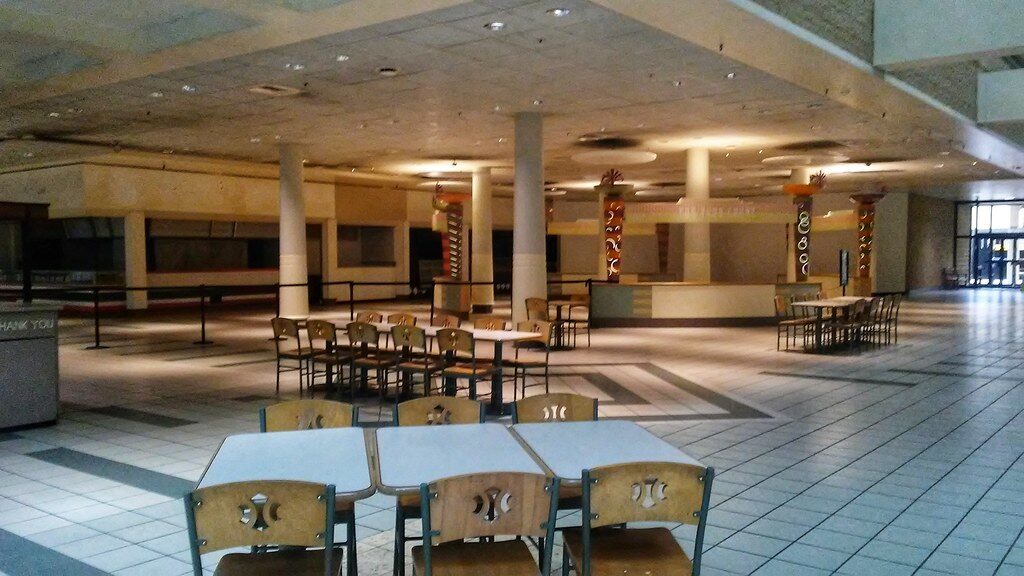
The winter the pipes burst
In February 2018, sprinkler pipes burst in a section where the heat had been shut off.
A year later, in February 2019, the main mall's pipes froze and burst after the heat failed across the building.
West Mifflin closed the enclosed mall. No heat, no working fire suppression, no public allowed inside.
Only Dick's Sporting Goods and JCPenney, with their own safety systems and outside access, could stay open.
Dick's Sporting Goods closed in 2019 after a bankruptcy judge let the owner reject its lease.
That left JCPenney, which had an exterior entrance, as the last store standing.
It closed for good on October 26, 2020. After 41 years, the shopping was over.
A fire, a fall through the roof, and a condemnation
What was left deteriorated in public view along Route 51.
Police logged 177 calls to the property after the 2019 closing, mostly trespassing, vandalism, and destruction.
In April 2023, a fire pulled in more than 100 firefighters, who backed out of parts of the structure when cracks opened in the roof.
That June, a teenager fell through a roof area and was seriously injured.
An engineer inspected the building days later and found sections close to collapse.
West Mifflin's council voted to condemn the mall as a public nuisance.
The owner fought it, arguing the building could be fixed.
On June 11, 2025, the Pennsylvania Commonwealth Court sided with the borough, clearing the way to tear the structure down.
What stands on the old site now
Demolition started in 2024, beginning with the parking decks.
By the spring of 2026, about 90% of the mall was gone, the rubble being crushed and processed right on the site.
The last major piece left standing was the old Sears, the building that had once been the biggest of them all.
Its demolition was pegged at $1.7 million.
As of 2026, Century III is roughly 90 acres of cleared and clearing ground, marketed for redevelopment.
A buyer has shown early interest, and the pitch describes a possible mix of retail, restaurants, housing, and medical use across about 10 parcels.
No completed sale was confirmed in the public sources reviewed for this June 2026 update.
For now, it's open land, waiting for the next thing.
Independent Publisher Notice
BestAttractions is an independent editorial publisher. We are not affiliated with, endorsed by, or acting on behalf of any location, business, property owner, manager, government agency, or organization described in this article. Comments posted on this page are not forwarded to, reviewed by, or acted upon by any entity mentioned in the article. For official inquiries, complaints, applications, bookings, or other requests, please contact the relevant entity directly through its official website or other verified channels.
Really interesting coverage of this monument to capital failure. Thanks for the look! I recall this mall from years ago when it was all the rage. Sic transit gloria mundi.
Thank you for your comment. It's always interesting to reflect on the rise and fall of such iconic places. Thanks for sharing your memories of Century III Mall.
Very interesting article about the rise and fall of America's malls. It is just sad that these malls cannot survive in today's economy. I was just telling coworkers that I would much rather go to a mall instead of an "outlet". So many memories of this particular mall and other malls. Those days are only memories now, but I sure wish they would revitalize them. Make it more affordable for businesses and customers!
I completely agree with you. Malls hold so many memories, and it’s a shame they’re fading. Thanks for your comment!
With the plane crashing into itwas just a foreshadowing of its future. Breaks of water system and such sped up the end.
I would think that a developer would have better sense than to build anything on a former landfill.
As the trash decomposes, and shifts evermore slightly whatever is built upon it , the mere fact that it is a landfill would seem to deter anything from being built there.
The ground shifts slightly more and more with no regularity and though one area does not shift along with rest of any other shifts, that area is also compromised and made unstable. .
Would you build your house on a landfill? As well as the ground shiftings and the perennial, decomposing of rotten food, flowers and everything else that goes into a landfill, you also have to deal with the various gasses that come from the stuff decomposing.
It should never have been built there.
Thanks for sharing your thoughts! The history of Century III Mall is indeed troubling. Your concerns about the practicality and safety of such developments are very valid. It's a reminder of the importance of considering long-term environmental impacts in construction projects.
This will be a rubble filled hole. Nothing successful will ever fill this space
Thank you for your input. While it seems bleak now, I hope there’s still a chance for a successful future for the space.
Dale, I’m not sure what you are talking about. Century III never had a plane crash into it, and it’s not built on a landfill (Parkway Center Mall was built on one, though). It’s built partially on a slag dump, but the ground at the mall is stable. To be frank, that’s probably one of the most stable pieces of ground in the Pittsburgh area, being solid metal on top of heavily compacted ground. Visit the Gabe’s on top of the hill above the mall and look at how defined the cliff edge is, and realize it’s been the same since Gabe’s was built. The area where the road and the Sears section of the parking deck were so deeply buried under slag that the ladle car that’s adjacent to the mall was reportedly found buried in the slag.
People like to point at the condition of the mall road and parking lot when referencing ground stability, but the blacktop was instead damaged from freeze/thaw, heat, salt usage, and lack of upkeep. Salt usage is also what deteriorated the parking deck to the point that portions had to be reinforced before ultimately being blocked off.
Spencer, I would like to thank you for including one of my demolition videos in your article. I plan to continue filming demolition until the mall is completely gone. I usually upload a video once per week, depending on progress by the crew. Going to be interesting trying to get footage of the remaining parking deck.
Thanks for setting the record straight, Tim!
Your knowledge about the area is impressive. It’s always good to have the facts. It’s great that you’re documenting the demolition process. I’m sure your weekly updates will be fascinating to watch.
P.S. Sorry for delay with comment moderation.
Sorry, Dale. Century III Mall was not built on a landfill. It’s a slag dump, which is basically solid metal with some impurities in it. Where the mall sits was so heavily compacted that the ground is not moving. Even Walmart and Gabe’s on top of the hill have a very defined edge beyond the fences that showcase the ground’s stability here. That steep of a hill would’ve slid almost immediately if it was made of anything else.