
Vallco Shopping Mall stood on 51 acres at Wolfe Road and Stevens Creek Boulevard in Cupertino, California, from 1976 until the excavators came for it.
Locals knew it as the mall with the glass bridge over the road and the ice rink that outlasted the mall around it. It opened as Vallco Fashion Park with Sears, Bullock's and I. Magnin; JCPenney followed in 1977.
Bullock's became Emporium, then Macy's, and closed. A construction crane punched through the roof in 2006. Occupancy hit 24 percent.
Sand Hill Property Company bought the entire site for $320 million in 2014, and all three anchors were gone by April 2016.
Then came a decade of plans, votes, lawsuits and revisions. Two ballot measures failed in November 2016. Four referendum petitions followed, and three forced the city to repeal its own plan in 2019.
A judge rejected the remaining lawsuit in 2020, and the west mall was already coming down.
The mall that once generated nearly a quarter of Cupertino's sales-tax revenue is now a construction site, with 2,669 homes approved.
Here is how the city got from three department stores to nearly 51 acres being rebuilt.
The night Vallco opened with a 900-pound cake
At 6 p.m. on September 1, 1976, Cupertino opened the only regional shopping mall it would ever have.
The party had a 900-pound cake shaped like the building, cut for 4,000 people.
The San Jose Symphony played for 75 minutes, and Winnie the Pooh made the rounds for the children.
Vallco Fashion Park covered 51 acres at North Wolfe Road and Stevens Creek Boulevard in Cupertino, California, tucked in under Interstate 280.
Bullock's and JCPenney anchored the west side, while Sears sat across Wolfe Road on the east side. I. Magnin ran a smaller prestige store.
Wolfe Road cut straight through the property, so the developers built over it.
A glass bridge carried shoppers over the traffic, and from inside the mall, it read as one building.
The interior had planted gardens with fountains and seating, named De Anza Park, Orchard Park and Electronics Park, for Cupertino's Spanish past, its orchards and its new electronics industry.
It also had a year-round ice rink, the Ice Capades Chalet.
The name came from the farmers.
In the early 1960s, 17 Cupertino landowners pooled their property into the VALLCO Business and Industrial Park, the letters taken from Varian Associates and the Leonard, Lester, Craft and Orlando families.
The city picked their land for its one mall in 1973.
The $20 million level nobody could see
In 1986 an Australian company, Westfield Holdings, paid $70 million for the mall. No single property in Santa Clara County had ever sold for more.
The timing was rough.
A few miles east, Valley Fair was enclosing and expanding into a stronger center, and Stanford Shopping Center was already strong to the northwest.
Vallco sat between them.
Westfield's answer was a $20 million expansion.
Crews ran a second shopping level through the western half of the building and added 50 to 60 stores, opening in August 1988 and pushing the advertised count from 140 to 190.
The new level sat below the mall's original concourse, and it would become the floor owners closed when the vacancies spread.
The ice rink nearly went in the same decade.
A proposal would have torn it out for movie theaters, residents took the fight to the City Council, and the rink stayed.
In August 1990 the Tilt Family Entertainment Center opened downstairs in the old food court with video games, pinball and bumper cars, an early try at bringing people in for something other than shopping.
The names on the anchor stores kept changing
Bullock's changed hands in 1984, when Carter Hawley Hale took over Federated's interest, and the store reopened that November as Emporium-Capwell, shortened to Emporium in 1989.
In March 1996 it closed for good.
Dillard's wanted the empty building. Federated would not hand it over and opened a Macy's Clearance Center there in July 1997.
Cupertino asked the California attorney general whether a competitor was being shut out. An inquiry opened, and Macy's stayed.
I. Magnin had already gone in 1992, its space broken up for smaller tenants and, at the bottom, Dynasty Seafood.
The city felt every closure in its own accounts.
Vallco produced 22.5 percent of Cupertino's sales-tax revenue in the mid-1990s, and the annual payment slid from $1.82 million to $1.56 million in two years.
Fixing the building was harder than it looked.
Under agreements dating to 1975, the department stores controlled their own pieces of the mall and held approval rights over changes to the shared areas.
Once the shops emptied, the old paperwork became another problem to solve.
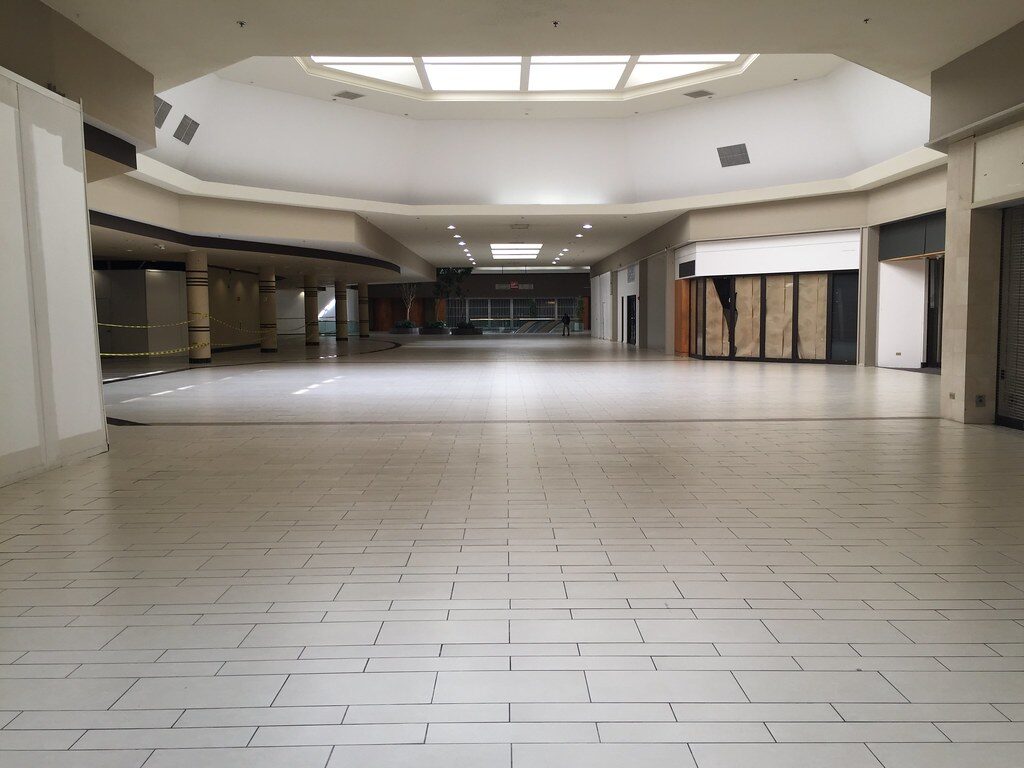
A 30-ton crane punches through the roof
A plan to add two more department stores, a cinema, two hotels and a 2,000-space garage went into environmental review in 1999 and never got built.
The mall kept emptying out. The owner defaulted.
A court-appointed receiver ran Vallco from August 2002 until June 2003, when a group of local investors bought the mall for $67 million.
Their idea was a center built on Asian restaurants, specialty shops and entertainment.
Most of the lower level closed in 2005 so the surviving tenants could be pushed together on the main floor.
Then, on February 27, 2006, high winds toppled a 30-ton construction crane onto the roof. It tore a hole in the building and let the water in.
That year occupancy hit 24 percent, the worst of any comparable regional mall. Voters made it worse.
A referendum overturned the condominium rezoning on a neighboring 5.2-acre Vallco parcel, and the land sale that was supposed to help pay for the mall work went with it.
Two years as Cupertino Square
A $195 million loan arrived in 2006.
In July 2007 Orbit Resources put in $33 million for an 85 percent stake, changed the mall's name to Cupertino Square and brought in new managers.
For a while it looked like it was working. A 16-screen AMC opened above the middle of the mall on April 27, 2007.
Strike Bowling opened downstairs on July 20. Two parking garages were finished by 2009.
The rest never happened.
The street-facing shops, the hotels and the beer hall stayed on paper, and in September 2008 the owners filed for Chapter 11 protection to stop a foreclosure.
Son Son Company bought the property out of that in September 2009, paying $64 million in cash, and put the Vallco name back up.
Bay Club moved into part of the Sears building in 2012.
The anchors kept selling, quietly, to their own customers.
JCPenney rang up $32 million in 2005 and $22 million in 2012, in a store where only 130,000 square feet was actual selling floor.
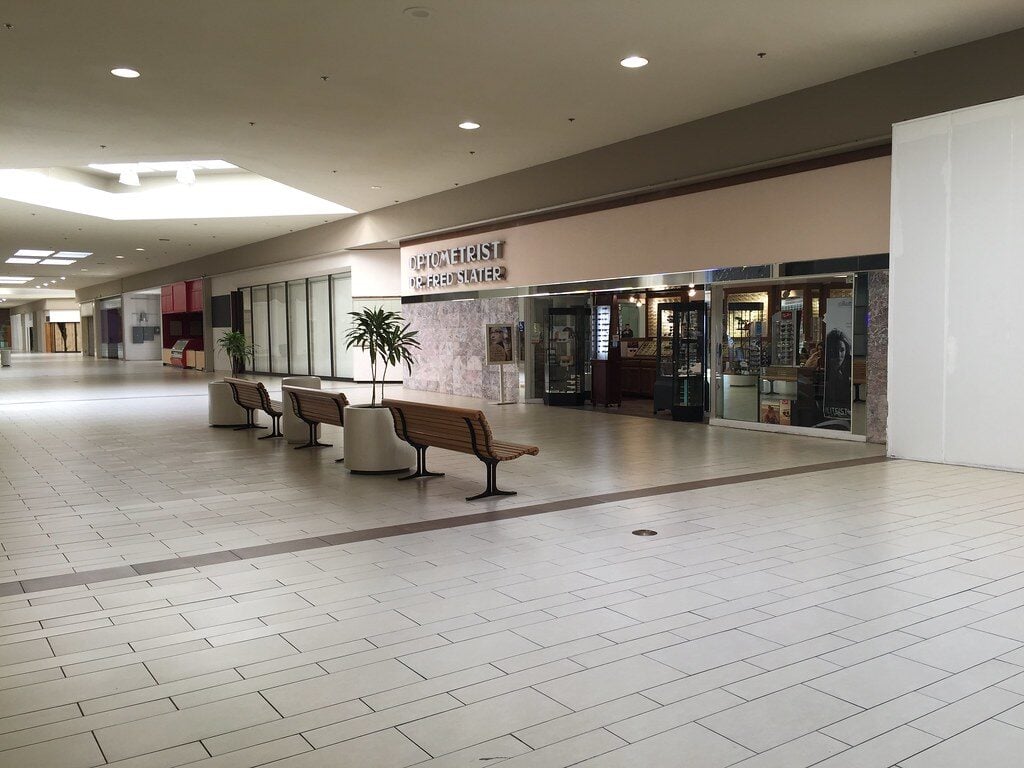
One owner buys everything, then the anchors close
In October and November 2014, Sand Hill Property Company took control of the Macy's, Sears and JCPenney sites and then bought the interior mall, spending $320 million.
For the first time since 1976, one owner held all of it.
The anchors emptied fast. Macy's closed on March 15, 2015. Sears followed on October 4.
JCPenney locked its doors on April 8, 2016, and Vallco had no department store left.
The replacement plan, The Hills at Vallco, landed in September 2015: 800 homes, 2 million square feet of offices, and a planted roof covering 30 acres above the buildings.
The landscaping called for 372 trees removed and 1,282 planted.
Cupertino put the site to a vote on November 8, 2016. Measure C would have kept it commercial.
Measure D would have approved the developer's town center. Both lost, with 60.9 percent voting no on C and 54.8 percent voting no on D.
One of Vallco's last ordinary rituals packed up seven weeks later.
The farmers' market behind JCPenney held its final Friday at Vallco on December 30, 2016, then reopened at Creekside Park the next spring.
When the bridge came down
On March 27, 2018 the owner filed under a state law called SB 35, which forces cities behind on housing production to approve qualifying projects without the usual hearings.
Cupertino approved it that September: 2,402 homes, half of them affordable, plus shops and offices.
The city's own separate plan collapsed.
Four referendum petitions were filed that October and qualified in December, and rather than hold another election, the council repealed the plan on May 7, 2019.
Demolition did not wait for any of it. AMC had closed on March 22, 2018.
A parking garage came down that October, and on August 12, 2019 crews started tearing out the west mall itself, the old Macy's, JCPenney and the enclosed shops between them.
The bridge over Wolfe Road stood alone for months.
Crews took it apart between March 30 and April 8, 2020, while the pandemic kept the road nearly empty.
A Santa Clara County judge upheld the SB 35 approval in a 62-page decision that May.
The east end is still standing.
The ice rink, the bowling alley and Benihana all had doors to the outside, so they could keep operating without the mall.
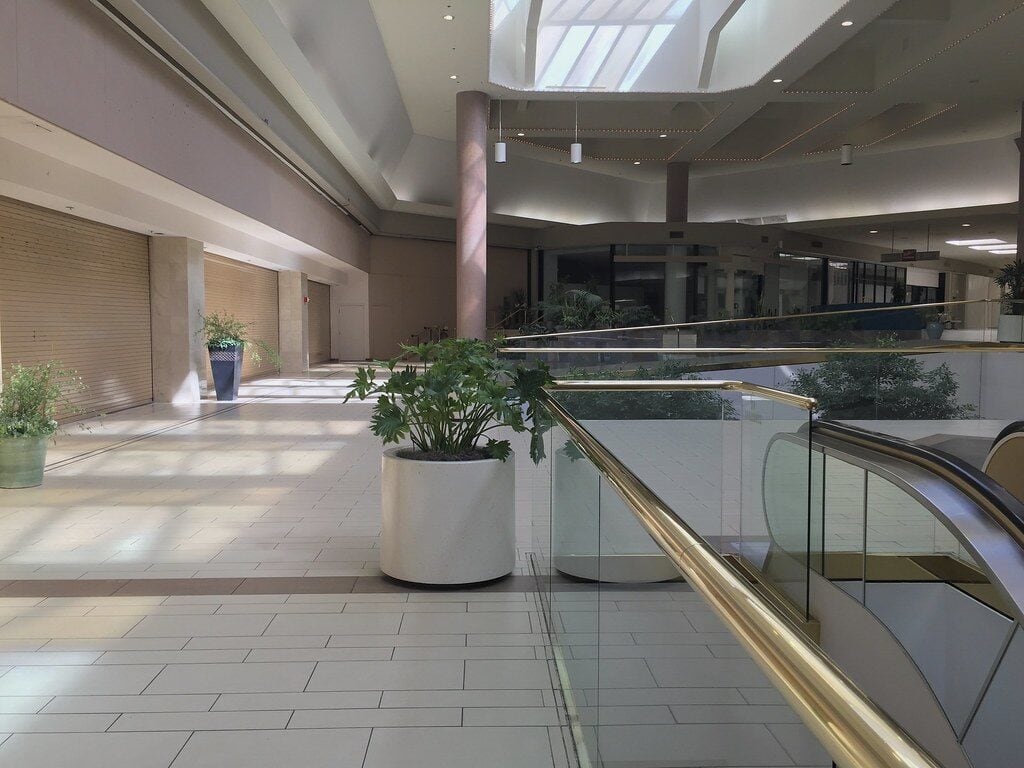
What stands on the 51 acres now
Most of the work since has been underground. Sears and JCPenney had run auto centers, and their buried tanks came out in 1994 and 1999.
Affected soil started leaving the west side by truck on May 22, 2023, and by June 2025 more than 200,000 cubic yards of clean soil had been hauled in for roads, utilities and building pads.
The project is called The Rise now: 2,669 homes across 16 blocks, 226,600 square feet of shops, and offices cut to 1,474,900 square feet after demand for workspace fell.
Cupertino approved that version on February 27, 2026.
The affordable count dropped from 890 homes to 356, because a change in state law cut the requirement from 50 percent to 20 percent of the same 1,779-home base.
The argument that reached the 2016 ballot box started up again.
The first phase, Town Square West, covers eight blocks: 1,369 homes, 201,900 square feet of shops and more than 3 acres of public parkland.
Residents are due in 2028, with the retail buildings following in 2029.
Until then, the only piece of the old mall a person can walk into sits on the east side of Wolfe Road, where the Cupertino Ice Center, the bowling alley and Benihana are still open.
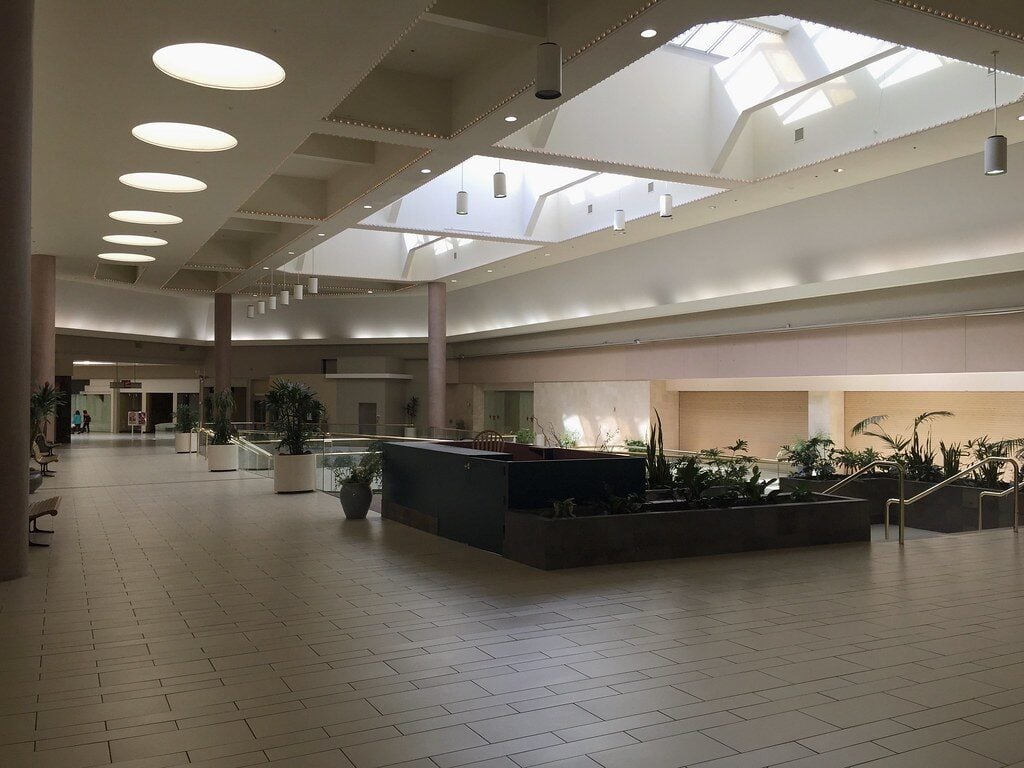
Sources and further reading
- The Rise - Official Project Website - The Rise. The official project website provides the current project identity and public update portal.
- The Rise/Vallco SB 35 Application - City of Cupertino, information current through February 27, 2026. Provides the approved project totals, affordable housing count, land area, commercial space and municipal review history.
- 2016 City Offices and Ballot Measures - California Secretary of State, 2016. Records the official Cupertino vote totals for Measures C and D, both of which failed.
- Vallco Referendum - City of Cupertino. Documents the four referendum petitions and the City Council's May 7, 2019 repeal of three Vallco approvals.
- Court's Order Denying Petition for Writ of Mandate - Santa Clara County Superior Court, May 6, 2020. Provides the 62-page decision denying the petition challenging the SB 35 approval.
- Grand Opening of Vallco Fashion Park - Calisphere, archival record dated 1976. Documents the 1976 grand opening and the mall-shaped celebration cake.
- Australian Firm Buys Cupertino Fashion Park - Los Angeles Times, April 6, 1986. Reports Westfield's $70 million acquisition and provides a contemporary description of the shopping center.
- Sand Hill Property Completes Purchase of Entire Vallco Mall for Total of $320MM - The Registry, November 12, 2014. Reports Sand Hill Property Company's acquisition of the entire mall for a combined $320 million.
- 'It isn't working': Bay Area town's housing plan takes major hit - SFGATE, March 30, 2026. Provides independent reporting on the 2,669-home plan, the revised affordable housing count, current tenants and projected move-in timing.
Current information last reviewed: August 1, 2026
Independent Publisher Notice
BestAttractions is an independent editorial publisher. We are not affiliated with, endorsed by, or acting on behalf of any location, business, property owner, manager, government agency, or organization described in this article. Comments posted on this page are not forwarded to, reviewed by, or acted upon by any entity mentioned in the article. For official inquiries, complaints, applications, bookings, or other requests, please contact the relevant entity directly through its official website or other verified channels.