Five heritage redwoods stand in a 1-acre square in downtown Sunnyvale, California, on the site of Sunnyvale Town Center. They were planted on the old City Hall grounds between 1930 and 1945.
The City Hall went in the 1970s, along with several downtown blocks, when the city cleared the ground for an enclosed shopping mall. Residents petitioned to keep the trees, so the mall was redrawn with an open courtyard around them.
The mall opened in 1979 and closed its interior in 2003. The last of the buildings came down in 2021. The trees stayed.
The square around them was rebuilt as Redwood Square, with two 12-story apartment buildings on one side and restored streets through the rest of the block. The retail under the apartments is still being leased.
The blocks that came down in 1977
Demolition started in 1977 in the middle of downtown Sunnyvale.
Houses came down, and businesses, the old town hall, and Sunnyvale Plaza, a shopping center about two decades old.
The city had adopted its downtown redevelopment plan in November 1975 and voted the following June to go ahead with a shopping center of its own.
By 1978 the redevelopment agency was using eminent domain and direct purchases to finish assembling the land between Washington, Mathilda, Iowa, and Sunnyvale avenues, and it handed 24 acres to a private developer.
The streets that had crossed those blocks came out with the buildings.
One stand of trees inside the clearance area survived the plan.
The grove stood around the old City Hall, where two mayors had planted redwoods in the late 1920s and early 1930s, during years when the city had no money for ordinary grounds work.
The Sunnyvale Women's Club donated a cedar in 1939.
Fern Ohrt, a longtime resident, led a citizen campaign to keep the grove, and the plan was redrawn to leave open ground around it.
At the 1978 ceremony marking the start of construction, the city's oldest resident, Manuel Vargas, planted one more redwood among them.
Town Center opened one anchor short
Sunnyvale Town Center opened in 1979. Macy's held its grand opening on September 27 and had children press their handprints into fresh concrete.
Montgomery Ward opened the same year. The center had been drawn around three department stores, and the third position was empty on opening day.
The missing anchor was not the only assumption to fail.
In June 1978, California voters approved Proposition 13, shrinking the property-tax stream that fed Sunnyvale's redevelopment financing.
The grove stayed where it was, in the middle of the building.
Two retail levels enclosed an outdoor courtyard that held the trees, with picnic tables among them, and the passenger elevator was out there too, so anyone taking it between floors crossed the old civic ground to do it.
By 1990 the directory listed about 125 stores and services and still marked the empty east side as future expansion.
JCPenney opened there in 1992, 13 years after the mall did, finally giving Town Center the three department stores it had been planned for.
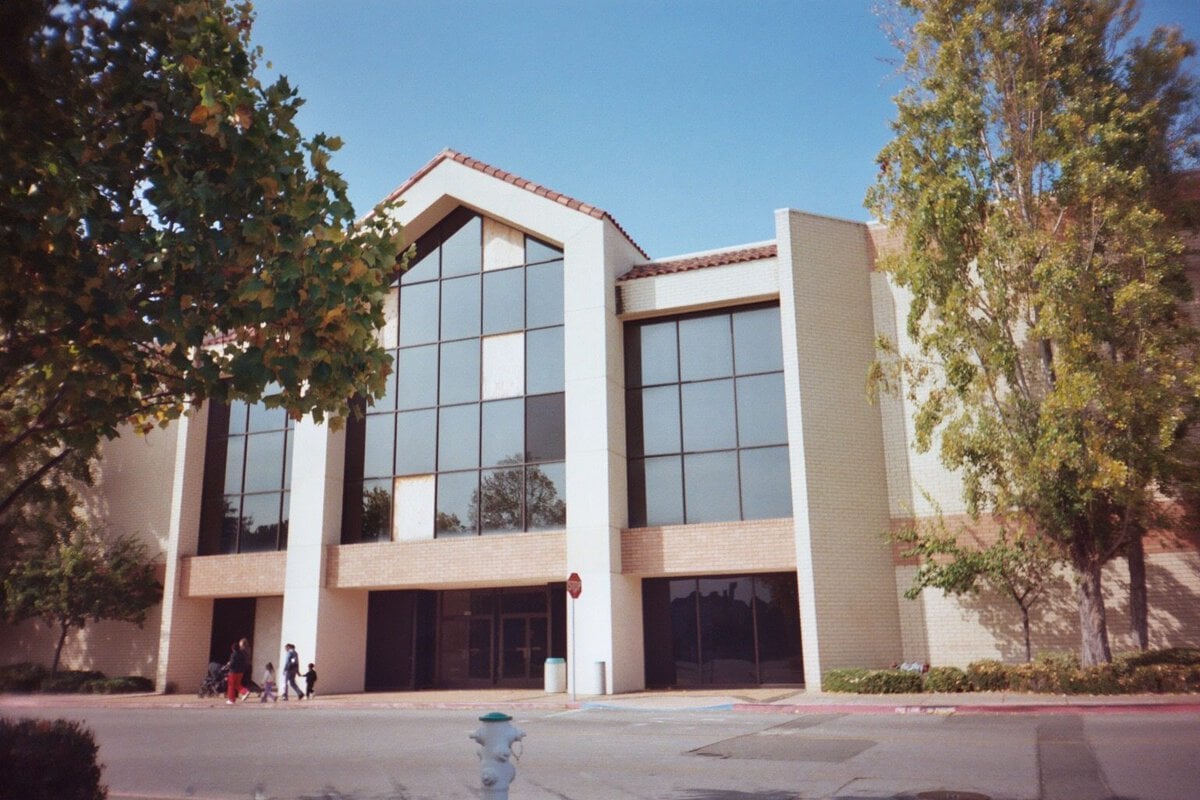
The WAVE years and the last day inside
A new owner bought the mall from the developer's company in 1998 and brought a renovation plan big enough to change what the place was: a cinema with 20 screens, plus about 205,000 square feet of retail, restaurant, and entertainment space, much of it arranged outdoors.
The city approved it. None of it was built, and the owner went into bankruptcy in 2002.
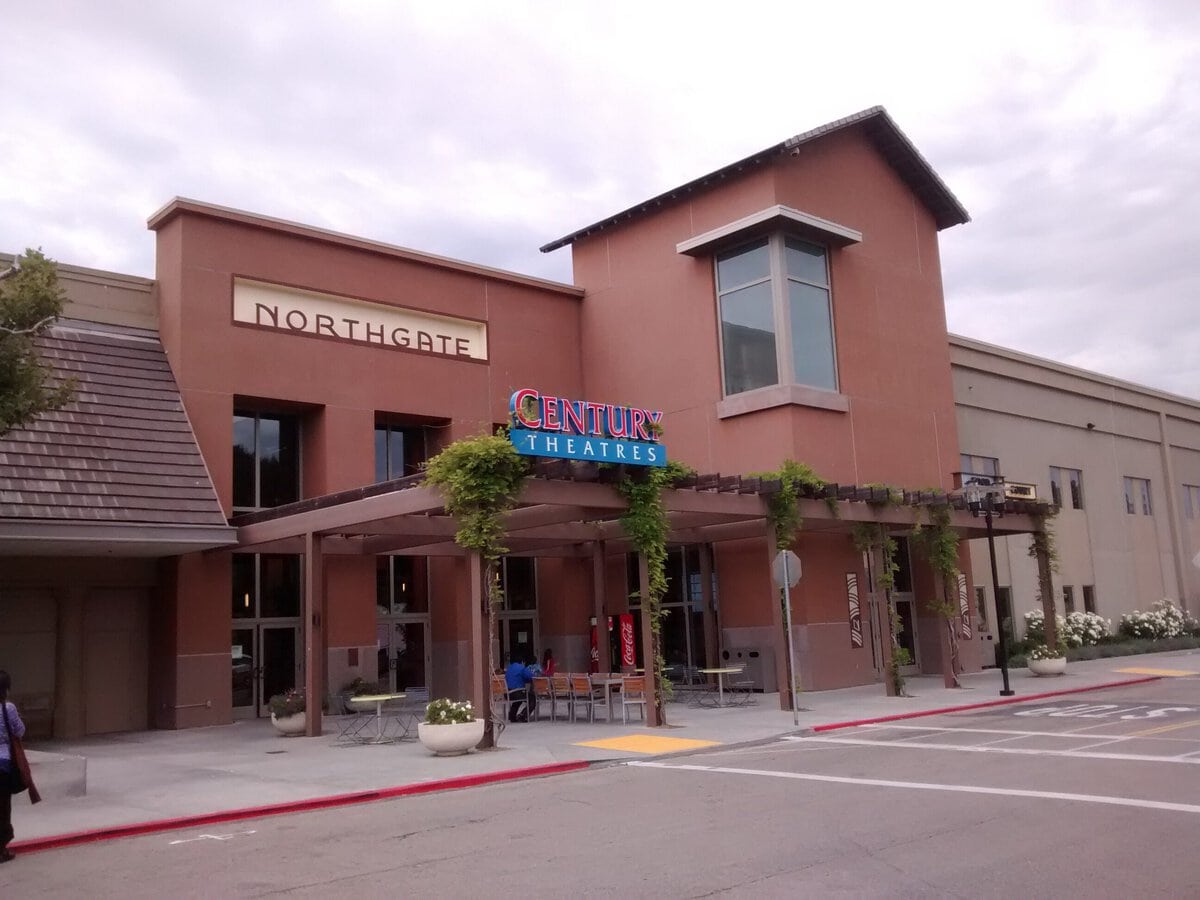
The mall's own six-screen theater had closed in September 2000, so the building went from six screens to 20 on paper to none at all.
By 2002 the center was trading as the WAVE, short for Walking and Village Entertainment.
The city was already considering a physical reversal of the mall itself: keep the anchor buildings, remove the roof, and bring pedestrians in from Murphy Avenue.
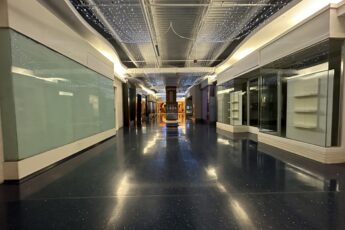
A contemporary account found brown tile underfoot and shut gates across much of the interior. That concept wasn't built either.
The 2003 update of the Downtown Specific Plan called for restoring streets through the property.
The interior closed on August 31, 2003. On August 16, a visitor found closeout sales across many of the independent stores.
Carl's Jr. and Cinnabon had already closed; Hallmark was still there.
Sunnyvale Town Center comes down
Part of the parking structure came out in 2005, and the large west-side garage was gone by the end of that year. JCPenney closed the same year.
Demolition of the enclosed center picked up in May 2007 under a new development team, and the plan they were building ran McKinley, Murphy, and Taaffe back through the site with a public square at the center of it.
Target took down the old Montgomery Ward building and put up a new two-level store on the same ground, which opened on November 15, 2009.
By then everything else had stopped.
The project entities had borrowed $108.8 million in August 2007, the credit market closed behind them, and a notice of default went on the record in August 2009.
A receiver took control that October, with the roughly $750 million redevelopment about 40 percent built.
Wells Fargo foreclosed in August 2011, and litigation over the project ran until 2015.
What stood on the block through those years was housing and retail shells along Washington and McKinley, sealed and empty, and bare steel where Redwood Square was supposed to be.
Two office buildings on Mathilda were finished and occupied in 2011 and 2012. Macy's traded through all of it.
Six redwoods in the square, then five
September 2016 brought a new ownership group, a roughly $100 million closing, and a new name: CityLine Sunnyvale.
The middle of the block became open space before it became new construction.
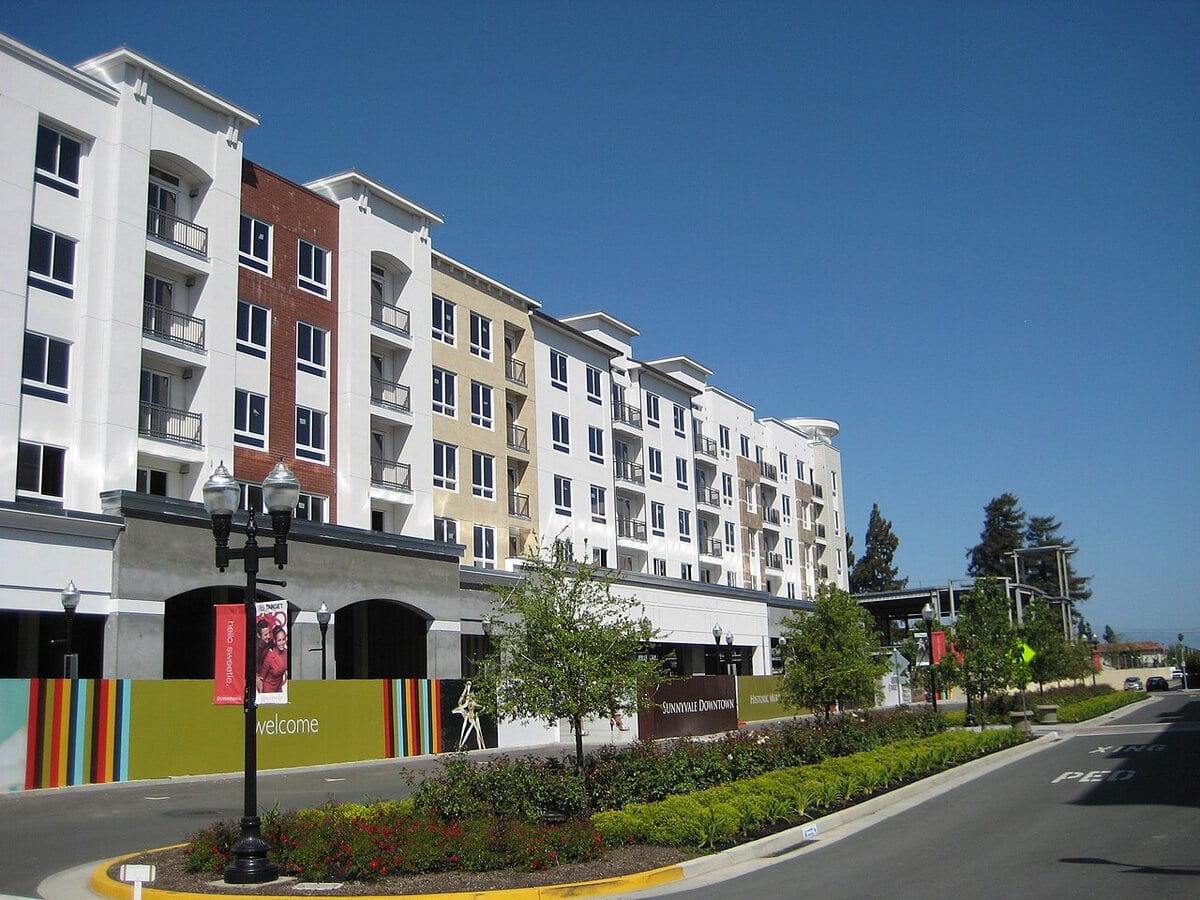
Steel for the unfinished two-story retail scheme was removed, and the old courtyard ground reopened as a temporary landscaped Redwood Square in 2017.
The Flats was completed in 2018.
Whole Foods Market and a 12-screen AMC opened in one new building at Murphy and McKinley in October 2020, and Flats West was completed in 2021.
Macy's had stayed in its 1979 building through the demolition and the empty years.
The company announced a final clearance sale in January 2019, closed the store that spring after about 40 years, and the building came down in 2021.
The plan for that ground put two 12-story residential buildings and underground parking around an enlarged Redwood Square.
Six redwoods were still standing there. The northernmost was the 1978 tree dedicated to Manuel Vargas.
Keeping it would complicate the garage and construction around the other five, while an arborist found no safe bet in moving it alive.
On August 11, 2020 the City Council certified the environmental review and accepted the tree loss as significant and unavoidable.
The removal permit followed that November. The developer said the wood could go to the Vargas family after the tree was milled.
CityLine fills the old mall block
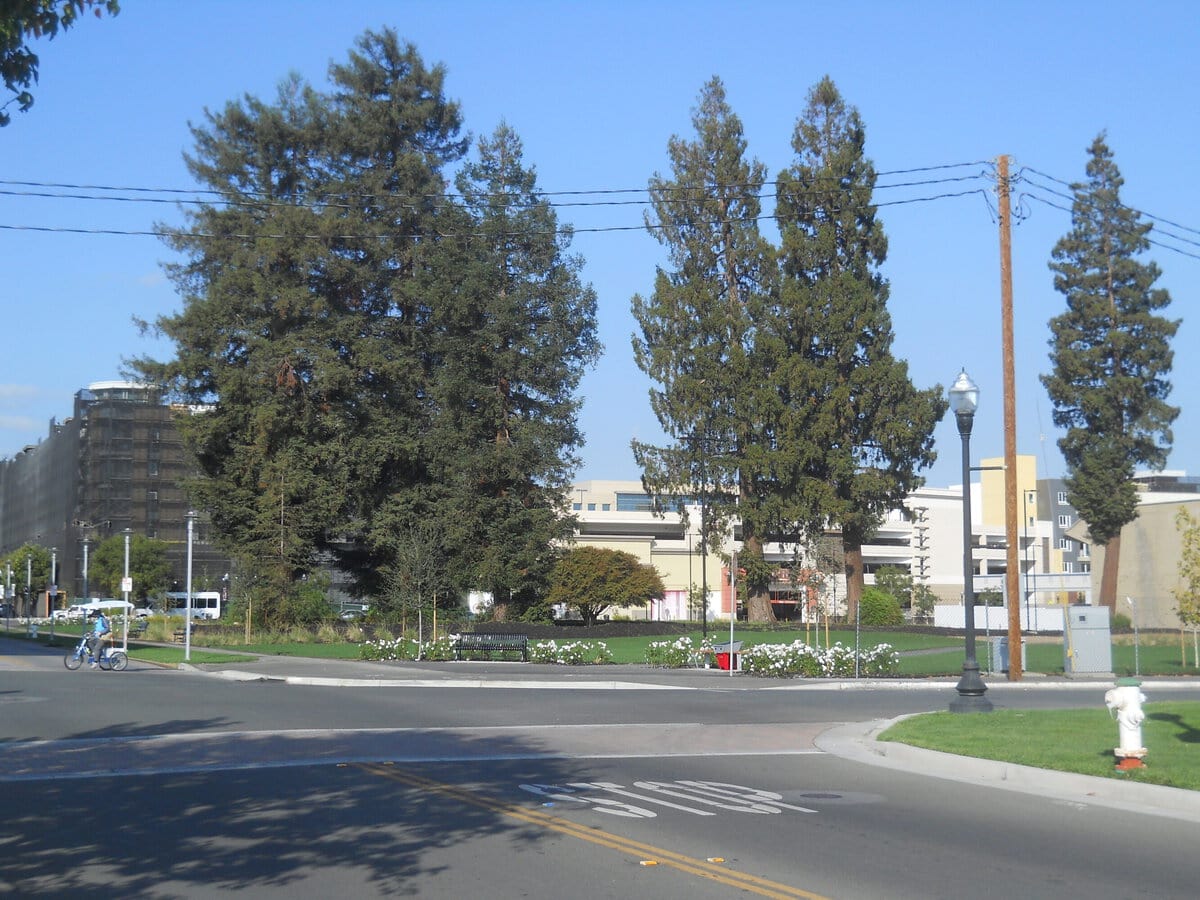
Sunnyvale Town Center opened in 1979 as an enclosed two-level mall on about 36 acres of downtown Sunnyvale, California, and the block now operates as CityLine Sunnyvale, a mixed-use district of separate blocks and street-facing buildings.
Murphy Avenue runs into it from the north. McKinley and Taaffe cross it.
Redwood Square sits about where the courtyard did, roughly an acre of it, with the five heritage redwoods still in the ground.
The Flats, Flats West, and The Martin hold 752 apartments between them, 87 of those below market rate, on land that used to be one enclosed shopping mall.
Target, Whole Foods, the AMC, and a line of restaurants trade along the new streets, and more than 2,800 public parking spaces sit in four garages.
The block isn't finished.
Phase 3, a 155,000-square-foot office building with 10,000 square feet of retail at 300 Mathilda and a mixed-use block with another public park, is still listed as future work.
A leasing team put about 66,000 square feet of retail on the market in March 2026.
The storefronts under the apartments are still filling, and the people living above them come out onto Murphy Avenue.
Independent Publisher Notice
BestAttractions is an independent editorial publisher. We are not affiliated with, endorsed by, or acting on behalf of any location, business, property owner, manager, government agency, or organization described in this article.
Comments posted on this page are not forwarded to, reviewed by, or acted upon by any entity mentioned in the article.
For official inquiries, complaints, applications, bookings, or other requests, please contact the relevant entity directly through its official website or other verified channels.