
Japan Center opened in 1968 as a showroom for a whole country. Visitors came to look at Datsuns and Hitachi electronics and Kinokuniya opened its first U.S. bookstore upstairs.
Once Americans knew Japanese cars and electronics, the corporations moved out. Noodle houses, a ramen shop, groceries, and gifts took their place.
When the malls were sold in 2006, about 14,000 people signed a petition, and the buyer had to keep them Japanese and hold on to them for at least 15 years. Those years ran out in 2021.
The plaza between the malls had its own trouble. It sat on a deck over a parking garage, and within a few years of the opening its pools were leaking into it. In 2024 crews took it all up, down to the slab. The reopening was planned for early 2026, and the fences are still up.
The shops behind the fences are open, Kinokuniya sells manga downstairs, and crews are finishing the last surfaces. But what future awaits the Japan Center malls once the reconstruction is done?
A merchants' idea on cleared blocks
The block between Post and Geary, Buchanan and Webster was already in play by 1953.
That year a planning committee of Northern California's Japanese Chamber of Commerce proposed studying a tourist shopping center for Japanese goods.
The proposal grew inside a far larger program.
The San Francisco Redevelopment Agency was buying up the Western Addition A-1 area, and by 1960 roughly half the older core of Japantown was gone.
About 50 businesses and 1,500 residents occupied the future center blocks, lined with rowhouses from the late 1800s and shops on the ground floor.
Redevelopment cleared them all.
The new center went to investors from outside the neighborhood. The agency chose National-Braemar, backed by San Francisco and Hawaii money.
Kintetsu Enterprises Company of America, an investment arm of Kinki Nippon Railway, came in during 1962.
Construction began in 1965. The project was meant to bring in Japanese capital and tourists.
A trade center opens with its pagoda unfinished
On March 28, 1968, a procession of Shinto priests opened the Japanese Cultural and Trade Center in the Japantown neighborhood of San Francisco, California.
Japan Airlines had carried a flame from Sumiyoshi Taisha in Osaka to light the eternal flame in Peace Plaza, and three days of Cherry Blossom Festival events followed the dedication.
The center had taken seven years of planning and building, and its centerpiece was not finished.
The Peace Pagoda was still under construction, with its tiered roofs going on that July while the bronze spire had yet to be cast.
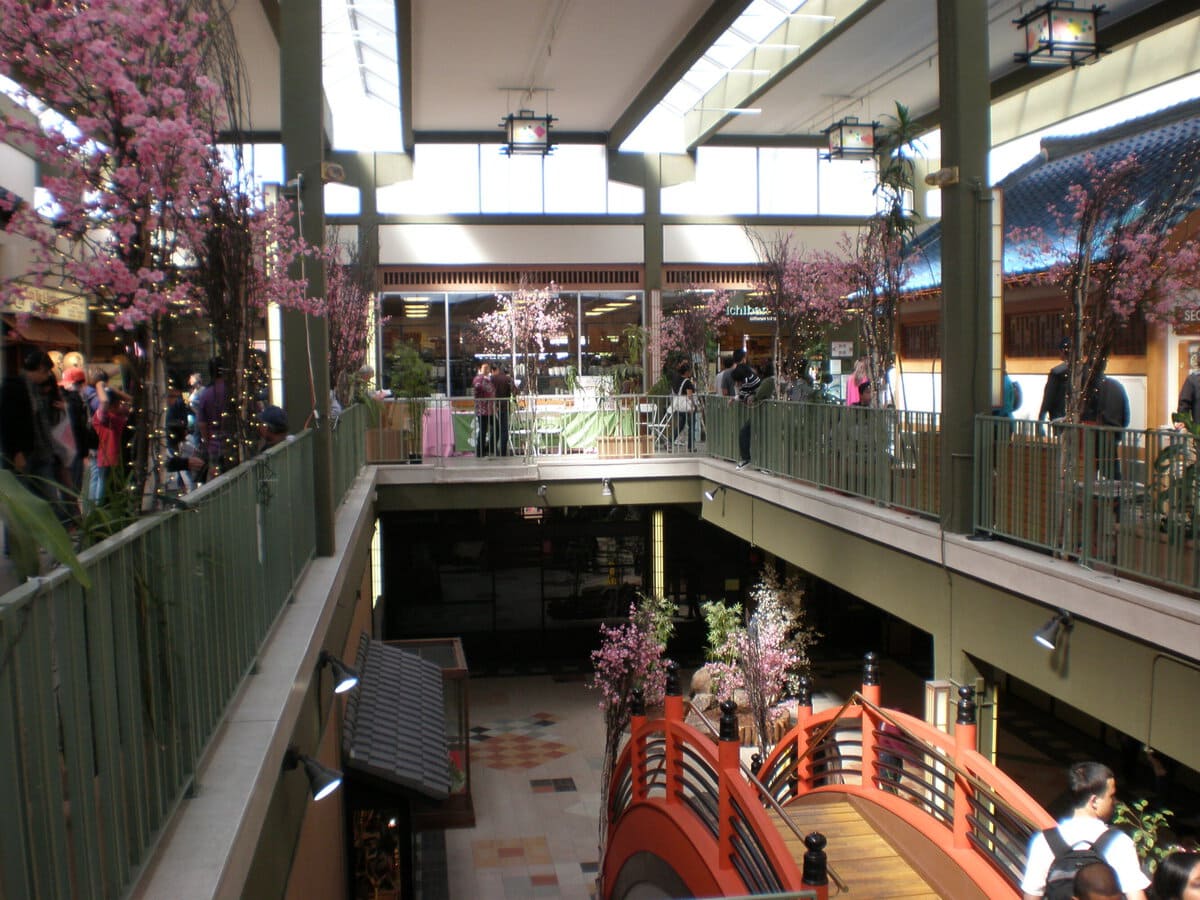
The malls and covered walkways led to the Bridge of Shops, a row of stores crossing Webster Street.
The tenants included Japanese companies and institutions: Nissan with a Datsun showroom, Hitachi with a showroom of its own, the Mitsubishi Exhibition Center, the Bank of Tokyo, Kikkoman with a cooking center, and a branch of the Japan National Tourist Organization.
Cars, electronics, food, and travel went on display for visitors in spaces built for demonstrations.
The reflecting pools leak into the garage
Peace Plaza was the work of the Japanese architect Yoshiro Taniguchi, who also designed the pagoda: a five-tier concrete cylinder, a gift linked to Osaka, the city's sister city.
Around it he set Japanese gardens and two reflecting pools, including a shallow pool shaped like a keyhole that circled the pagoda, crossed by a granite bridge.
The eternal flame burned on a square pedestal in the water north of the pagoda, with stones brought from Japan in the same pool.
All of it sat on a deck over the parking garage, which opened with room for 800 cars. Leaks started almost at once.
Water from the pools and garden irrigation found its way into the garage below, and by 1971 the pools were sometimes left empty.
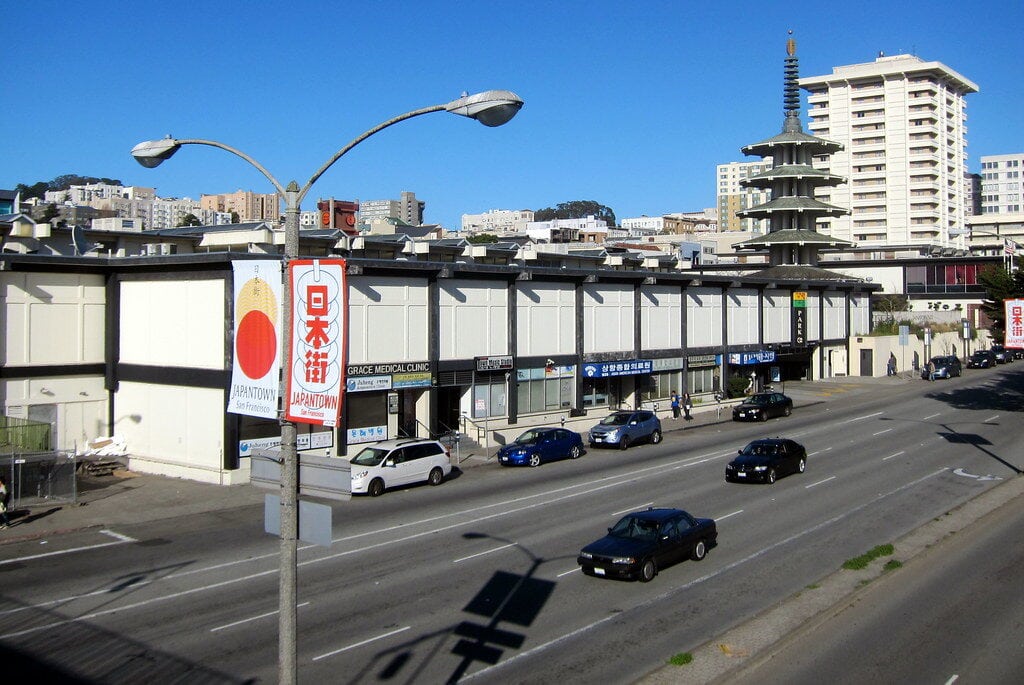
Showrooms give way to noodle shops
By 1970 the complex was commonly called Japan Center.
A year earlier Kinokuniya had opened a bookstore on its second floor, the first Kinokuniya in the United States.
The corporate showrooms did not last.
Once Japanese cars and electronics were familiar to American buyers, they no longer needed a special center to demonstrate them, and by the mid-1970s the big corporate tenants had mostly made way for small independent stores.
Their owners were at first often Japanese nationals and later Korean immigrants.
Restaurants came with them. Sapporo-ya Ramen opened in 1976, and by 1981 Mifune and Misono Restaurant shared the address 1737 Post Street.
The mall's Japanese character came to rest on restaurants, groceries, books, gifts, and jewelry instead of company exhibits.
A fight over who owned the plaza
When Manoa Finance Co., National-Braemar's parent company in Hawaii, went through bankruptcy in the mid-1980s, National-Braemar sold its interest in Japan Center.
Part of Peace Plaza went with it: the land was still in private hands.
The new owners considered putting an 8,500-square-foot commercial building on the plaza, covering the stage used for community performances.
In June 1985 the Board of Supervisors passed a resolution urging that the plaza stay permanent open space, and the mayor signed it.
Later that month the Redevelopment Agency Commission adopted a resolution of its own.
A later commission could reverse that policy, so the community pressed for public ownership.
The owner still wanted to keep a piece of the plaza for development.
In 1987 the Recreation and Park Commission voted to support acquisition through eminent domain.
Two years later the city's parks department bought Peace Plaza and made it permanent open space.
Dry pools, then pastel pavers
Public ownership did nothing about the water reaching the garage.
In 1990, during waterproofing work, the reflecting pools were drained for good and every plant on the plaza was removed.
By 1991 the plaza had bare planting beds, empty pools, and rainwater standing in places.
A community group, Friends of Japantown Peace Plaza, pushed through the 1990s for a new landscape.
In February 1995 the Board of Supervisors approved moving $600,000 in redevelopment money to the city for the job.
Engineers that year found water coming through drains, pipe openings, and cracks in the garage ceiling, and the plan had to be redone to cover waterproofing.
The rebuild came in 2000 and 2001, and it removed most of Taniguchi's design. The keyhole pool disappeared.
The eternal flame left its pedestal for a place in a waterfall wall, and two big boulders from the pool were moved.
Pastel multicolored pavers, planters, pine, bamboo, and cherry trees filled the plaza around a sunken area by the pagoda.
A sale with strings attached
In 2006 Kintetsu, an owner since the opening era, put its major Japantown holdings up for sale, including the two central malls, East and West.
The buyer lined up was 3D Investments, a real estate firm from Beverly Hills.
Community organizations fought a sale with no conditions.
A Save Japantown petition gathered about 14,000 signatures, supporters held a march and a rally, and the mayor and the district supervisor took part in negotiating protections.
The agreements that took effect in May 2006 bound the new owner, the 3D-linked partnership Japan Center West Associates, to keep the malls for at least 15 years, to keep their design and leasing Japanese or Japanese American, and to open the common areas to Japantown nonprofits.
The city was named a third-party beneficiary of the deal.
The new management had Japanese display pieces on order and planned exhibits from Japan's prefectures.
By October about 10 percent of the mall space was empty.
A rebuild priced around a new garage
After the purchase, 3D spent two years planning with the city and the community.
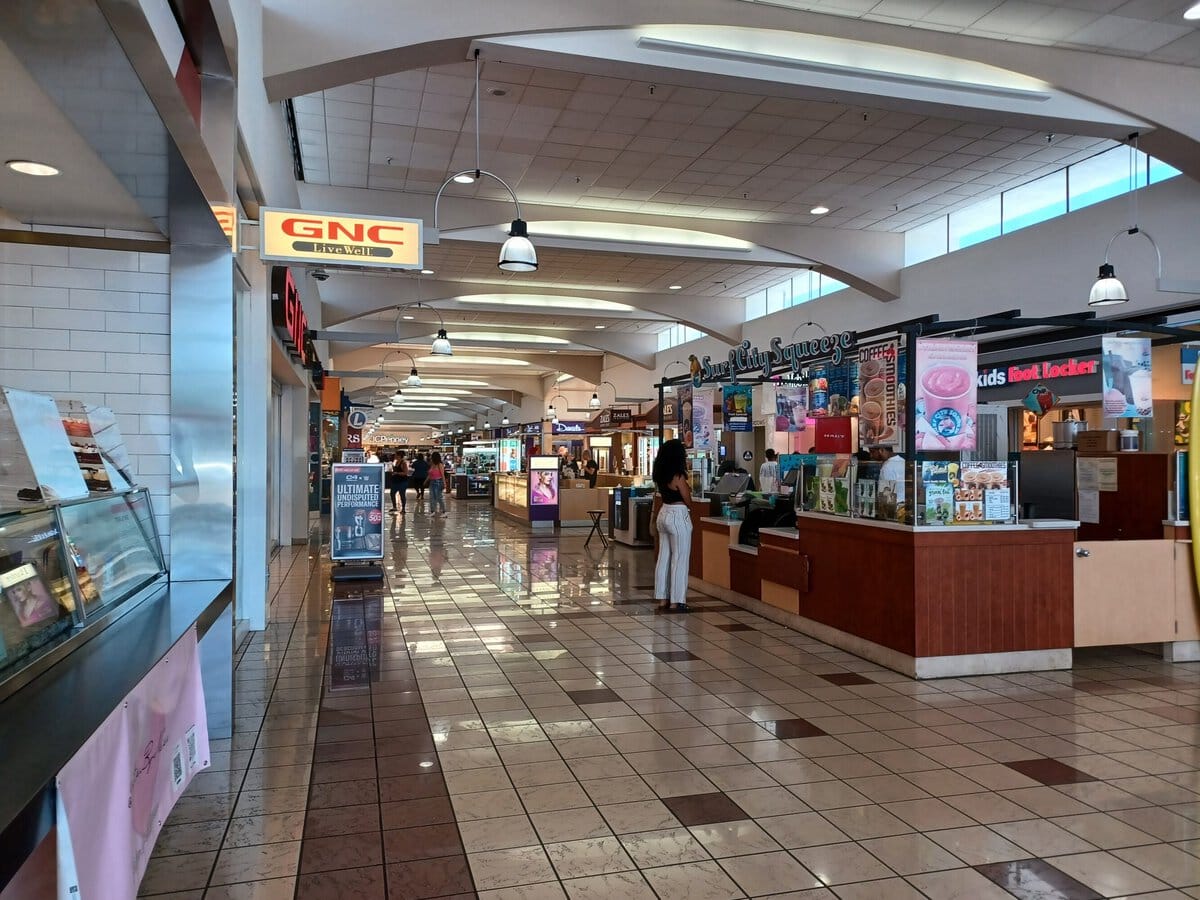
The malls turned inward, with long blank outside walls and weak links to the streets and to Peace Plaza.
The options ran from repairs to tearing them down for housing, shops, and offices.
A mall of shops alone did not work financially.
Plans with a lot of housing came closer, especially if buildings could rise past the 50-foot height limit. The harder problem lay underneath.
The garage ran below both malls and the plaza, and an early engineering study concluded that any major rebuild would probably mean replacing it entirely, at up to $45 million before a single new store or apartment went up.
By late 2008 the big plans were off the table. 3D said it would make smaller improvements instead, with no date for bringing the rebuild back.
Paint, murals, and a pandemic
The smaller improvements were laid out in 2019: repaint the malls, update the signs, add public art, and put in a visitor-center kiosk.
Leasing went after Japanese food, fashion, and gaming businesses that fit the covenants.
During the pandemic of 2020 and 2021, more than 10 businesses in Japantown, some of them in Japan Center spaces, closed for good.
PikaPika, a photo-sticker shop, shut after about 14 years. Takara, a long-running restaurant in the East Mall, closed in 2021 after a rent dispute.
The 15-year ownership hold ran out the same year, and the cultural covenants stayed in force with 3D keeping the malls.
New tenants filled the empty suites.
By 2024 the East Mall held the San Francisco Go Club, a Japantown visitor center, and Studio Gen, and both malls had added beauty and pop-culture shops.
Animon opened late in 2025 in the space that had belonged to Japan Video and Media.
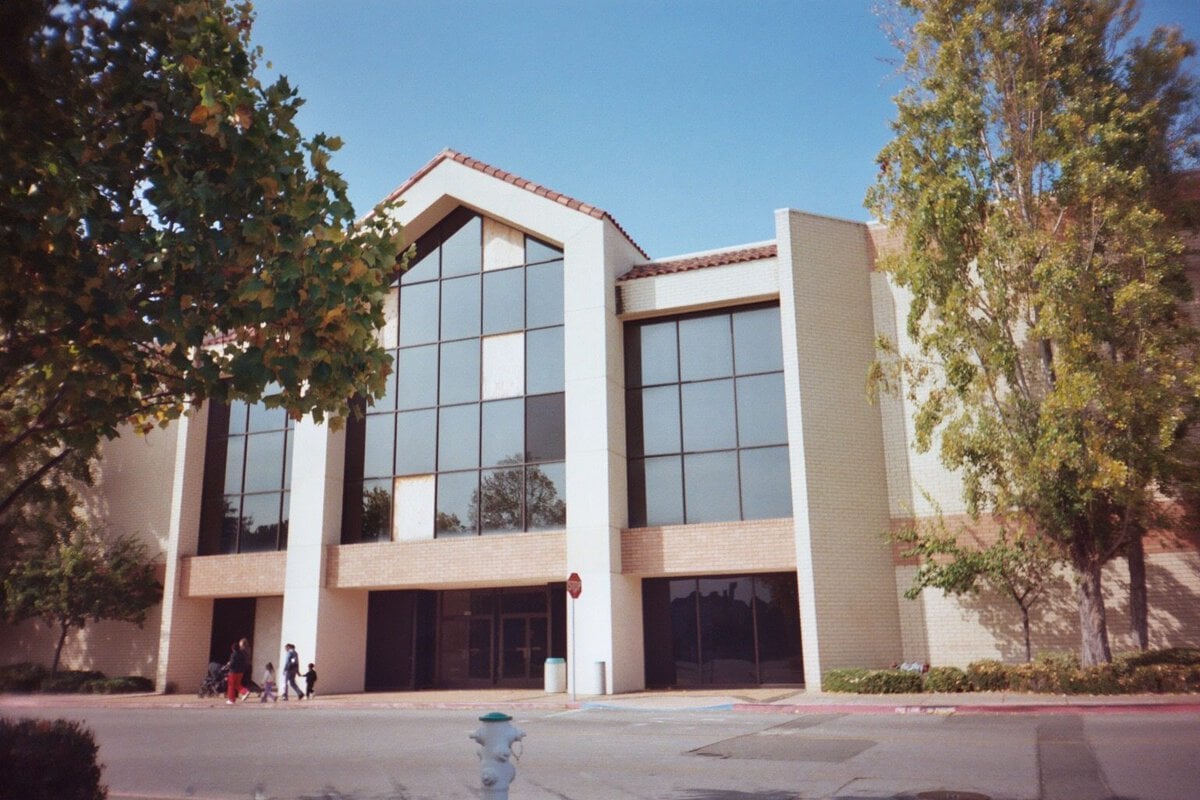
The plaza comes up again
On April 27, 2024, the city broke ground on another reconstruction of Peace Plaza, for the same reason the pools were drained in 1990: the waterproofing on the deck over the garage.
Crews pulled up the paving, planting, seating, and stage to reach the structural slab.
The pagoda was strengthened with tensioned steel tendons and given a new copper roof.
The budget rose to about $33 million from earlier estimates near $24 million, and the reopening planned for early 2026 passed with the work unfinished.
The plaza is still fenced.
Crews are finishing the ground around the pagoda and two seating nooks along Post Street, and most of the pagoda's new paint is on.
A week of night work in mid-October was planned to finish the surfaces at the East and West mall entrances.
Japan Center stays open through all of it.
Kinokuniya sells books on two floors, with an anime and manga section downstairs, near long-running grocery, restaurant, and jewelry tenants.
No plan to demolish or replace the malls has been approved, and a committee working with city partners is studying goals for the site's future.
The covenants bind 3D for as long as it owns the malls.
When the owner studied replacing the malls, rebuilding the garage beneath them was priced at up to $45 million on its own.
The malls are open on top of that garage, and shoppers coming from Geary Boulevard walk through it to get in.
Independent Publisher Notice
BestAttractions is an independent editorial publisher. We are not affiliated with, endorsed by, or acting on behalf of any location, business, property owner, manager, government agency, or organization described in this article.
Comments posted on this page are not forwarded to, reviewed by, or acted upon by any entity mentioned in the article.
For official inquiries, complaints, applications, bookings, or other requests, please contact the relevant entity directly through its official website or other verified channels.