
A carousel once turned above the stores at River Falls Mall.
Nearby, children drove bumper cars, played miniature golf, fed tokens into arcade machines, and disappeared into a movie theater while ordinary shopping continued one floor below.
The arrangement made the Clarksville, Indiana, property feel less like a standard suburban mall than an indoor fairground.
By the middle of the 2000s, nearly all of that interior world was gone.
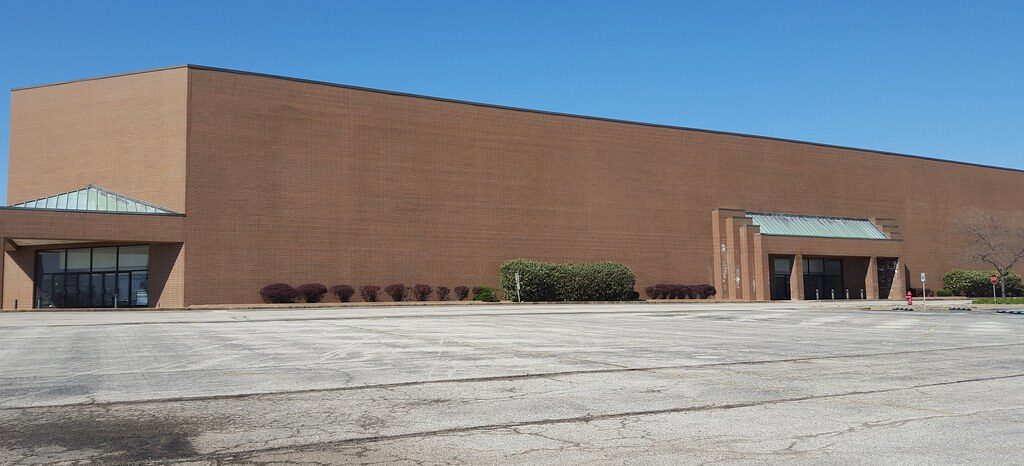
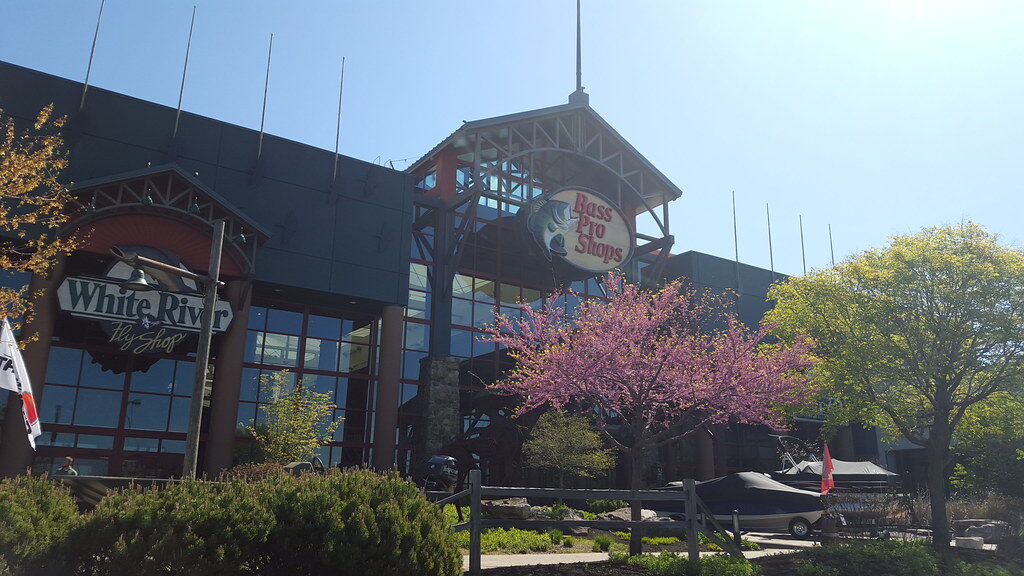
River Falls never overcame the stronger mall across the road, and Bass Pro Shops eventually absorbed most of the building.
The shell remained active, but the shared mall experience vanished inside it.
River Falls Mall Opens Across The Road
River Falls Mall opened in October 1990 at 951 East Lewis and Clark Parkway, a few miles north of downtown Louisville.
General Growth Properties developed the two-level center at a time when enclosed malls still appeared to offer a dependable formula: department stores at the ends, specialty shops in the corridors, a food court, a cinema, and acres of parking around everything.
The location immediately complicated that formula.
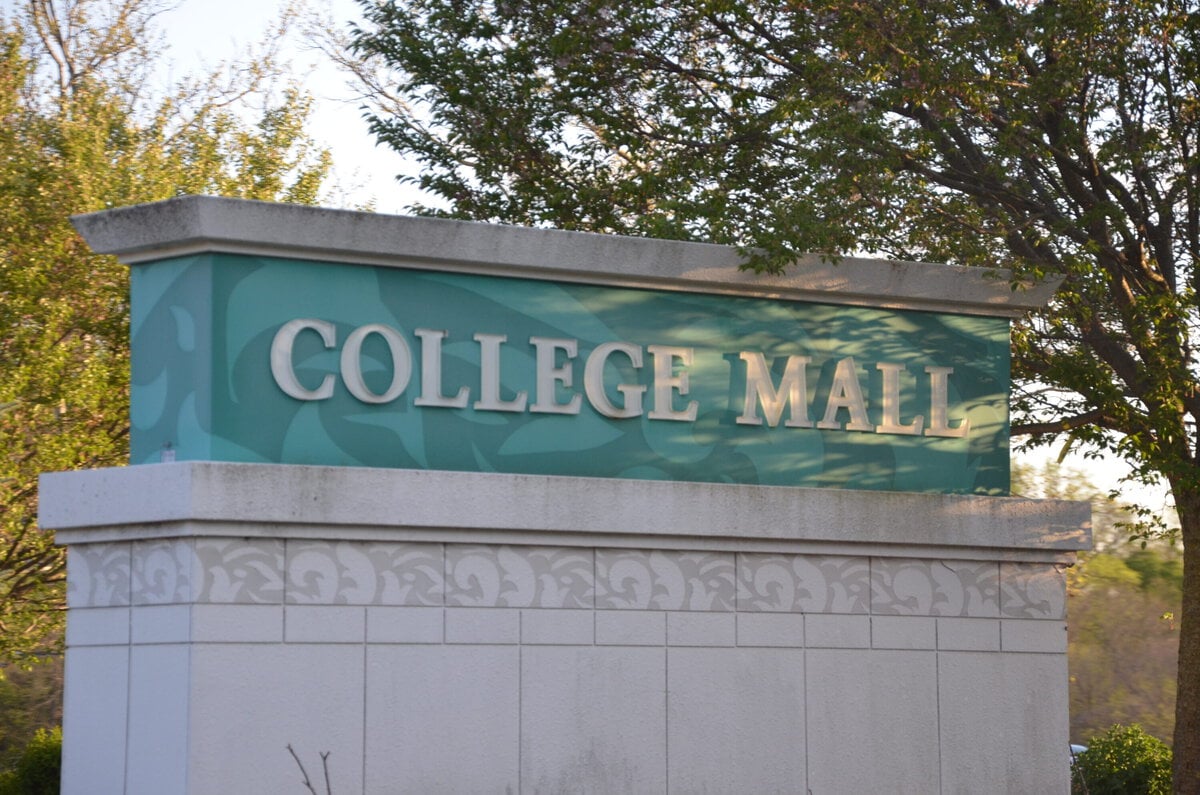
Green Tree Mall had operated across Lewis and Clark Parkway since the 1960s.
It already had established department stores, familiar tenants, and a customer base accustomed to shopping there.
River Falls entered the same corridor with many of the same kinds of stores and expected shoppers to support both.
Its early lineup included Walmart and Bacon's as principal anchors, along with Toys "R" Us, Dawahares, restaurants, smaller mall shops, and the upper-level River Fair entertainment area.
Bacon's moved from Jeffersonville to the new center, while Walmart gave River Falls a discount-store anchor that Green Tree lacked.
The original enclosed center is commonly described as about 762,000 square feet.
Later records used different totals because they counted the property and its leasable space in different ways.
What shoppers saw was simpler: Clarksville suddenly had two regional malls facing one another, and the newer one was betting that entertainment could distinguish it.
The Indoor Fair Above The Mall Stores
River Fair Family Fun Park occupied roughly 100,000 square feet on the upper level.
Its attractions included a full-size carousel, bumper cars, an 18-hole miniature-golf course, and a large arcade.
The original mall cinema sat beside River Fair on the same upper level.
The food court sat beside the park and cinema, allowing families to spend hours inside without treating shopping as the main event.
The carousel became the most durable image associated with River Falls.
Styled to resemble an antique carousel, it had painted horses and period details that gave the attraction a deliberately theatrical character.
Around it, neon lighting, game sounds, moving rides, and miniature-golf scenery created an atmosphere far removed from the restrained corridors found in many malls of the same period.
River Falls was an early example of "shoppertainment," a strategy that used recreation as a reason to visit and remain in a shopping center.
River Fair was not a small arcade beside the food court.
It was a major part of the building and one of the mall's central selling points.
That difference gave River Falls an identity separate from Green Tree's stronger department-store lineup.
The carousel, bumper cars, arcade, and upstairs rides became the most recognizable elements of River Fair, while many of the stores below changed or disappeared.
When River Falls Became A Classroom
River Falls also became a community space in ways that ordinary leasing records do not show.
During the 1996-97 school year, educator Walter F. Ryan created the "River Falls Mall Math Trails" project with help from mall administrators and tenants.
Groups of students used the building to practice measurement, pricing, geometry, estimation, and other mathematical skills.
The surviving project booklet includes detailed maps of both levels.
Those maps preserve the relationship between the lower retail corridors and the amusement floor above, along with stores such as Waldenbooks, Disc Jockey, DEB, Casual Corner, and Modern Trends.
They confirm that River Falls was still a functioning mall ecosystem in the late 1990s, not merely an amusement park attached to several large stores.
The school project also shows why malls became important public interiors.
River Falls offered climate control, predictable circulation, food, restrooms, visual landmarks, and enough variety to hold a large group for several hours.
Teachers could turn store shelves, floor tiles, prices, signs, and architectural features into lessons.
That role made the later conversion more consequential than a normal tenant change.
When the common corridors disappeared, Clarksville not only lost stores.
It lost a shared indoor environment where shopping, entertainment, education, and social life had once overlapped.
Entertainment Could Not Hold The Mall
River Fair attracted visitors, but memorable outings did not guarantee enough sales for the stores downstairs.
River Falls and Green Tree competed for many of the same mall chains across apparel, books, electronics, gifts, and other categories.
Green Tree retained the stronger conventional department-store position, while River Falls became increasingly dependent on entertainment and large destination tenants.
The imbalance became clearer after Dillard's acquired Mercantile Stores in 1998 and retired the Bacon's name.
Dillard's already operated at Green Tree, so it divided departments between the two malls.
Men's clothing, children's clothing, and housewares remained in the former Bacon's building for a period, while women's clothing stayed across the road.
The arrangement kept the River Falls anchor open, but it also reinforced Green Tree as Dillard's principal Clarksville location.
Dick's Sporting Goods arrived in 1999 during a broader leasing rebound that was expected to lift occupancy to about 92 percent.
The rebound did not last.
Retailers continued moving from River Falls to Green Tree as the gap between the properties widened.
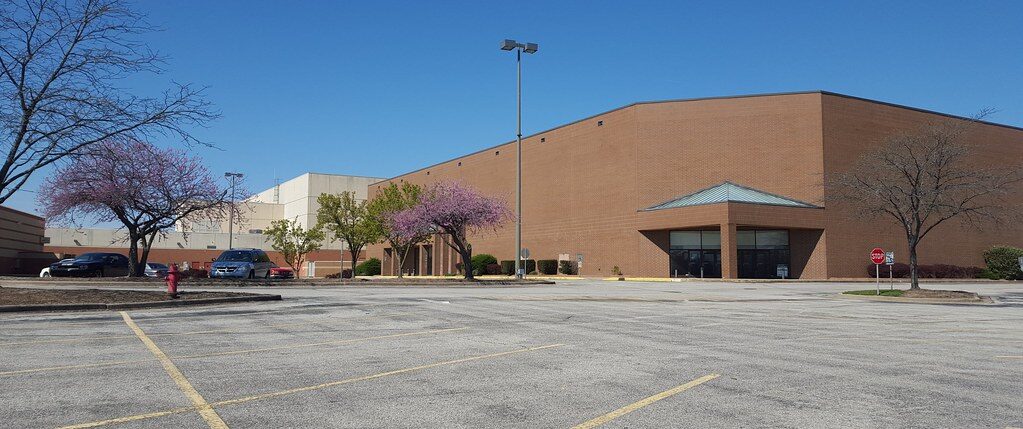
River Falls then lost several foundations of its original model.
Walmart moved to a newer Supercenter near Veterans Parkway.
Dillard's consolidated at Green Tree. The original Loews cinema closed in January 2004.
With fewer reasons to enter the shared concourses, the remaining interior stores had less traffic, and the enclosed format became increasingly difficult to sustain.
Bass Pro Takes Over Most Of The Mall
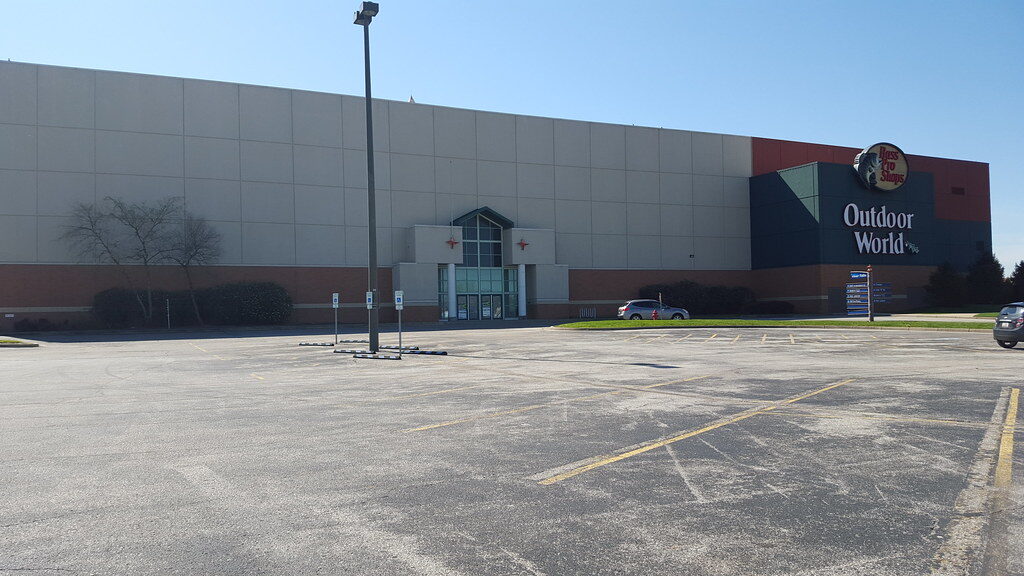
General Growth announced the Bass Pro Shops conversion in 2004.
The plan did not place Bass Pro inside one empty anchor box.
It gave the retailer approximately 280,000 square feet, equal to about seven acres and roughly 80 percent of the old mall's interior.
Bass Pro opened for regular business on November 15, 2005, after a preview the night before.
At the time, the Clarksville store was described as the company's second-largest location.
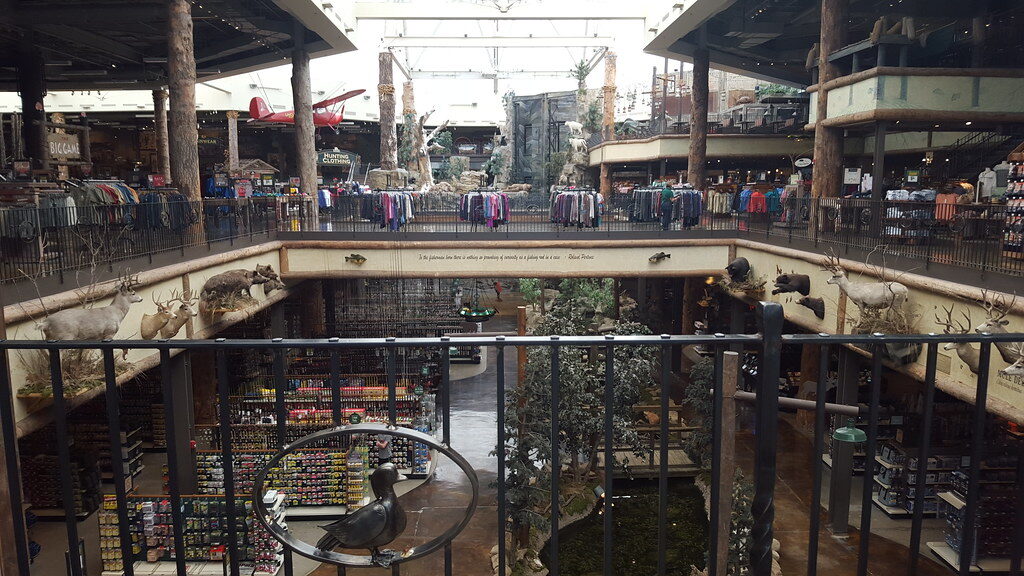
Inside were artificial rock formations, water displays, aquariums, boats, trees, hunting and fishing departments, an archery area, and other outdoor-themed installations.
The conversion removed the mall's shared circulation pattern.
Customers no longer entered a common concourse and passed dozens of small storefronts.
Bass Pro became a self-contained destination with its own entrance, while surviving portions of River Falls were divided into large boxes with exterior doors.
The building retained an entertainment-driven approach, but the beneficiary changed.
River Fair had used rides and games to support an entire shopping center.
Bass Pro used an immersive outdoor environment to support one enormous store.
By 2006, River Falls was operating as a power center rather than an enclosed mall.
A new freestanding Great Escape River Falls Stadium 12 opened behind the retail buildings that November, but it was separate from the original mall cinema and could not restore the lost interior street.
River Falls After The Enclosed Mall Era
The conversion kept a large commercial property in use, although it did not restore the economics of a regional mall.
General Growth later sold River Falls to Columbus Pacific Properties in December 2011 for about $11.1 million.
The transaction covered roughly 829,000 square feet on about 42 acres, with approximately 315,000 square feet available.
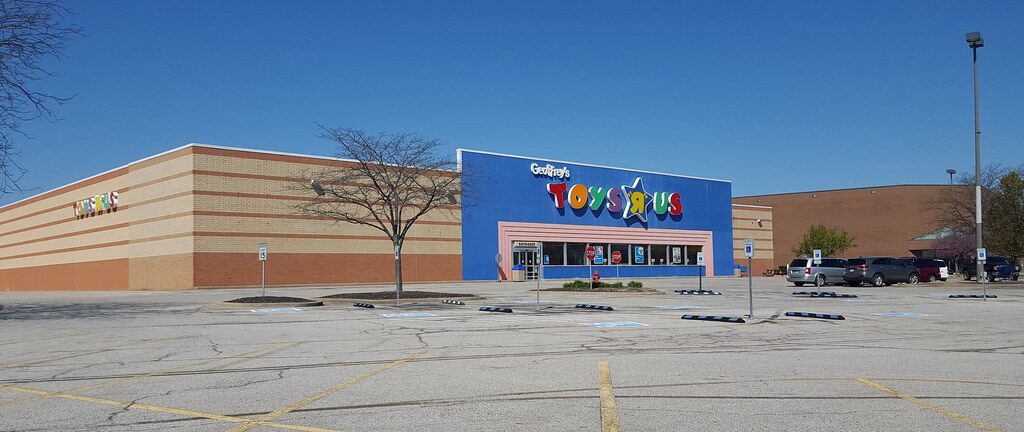
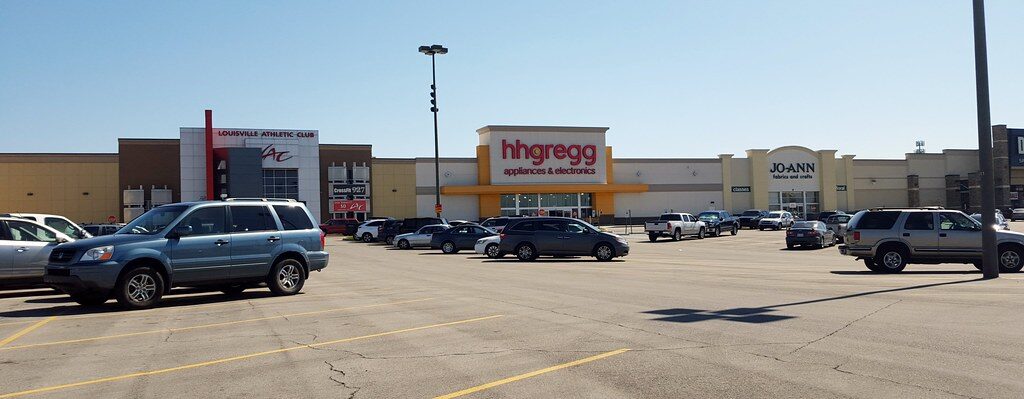
Bass Pro, Dick's Sporting Goods, Toys "R" Us, hhgregg, and Louisville Athletic Club were among the principal occupants at the time.
The vacancy figure and sale price showed how far the property had moved from its original position as a large regional shopping center.
National chain failures and tenant moves created additional empty space.
hhgregg closed in 2017, followed by Toys "R" Us in 2018.
Regal permanently closed the freestanding cinema in September 2021 after repeated pandemic-era shutdowns.
Joann had already left River Falls before its Clarksville store closed during the chain's 2025 liquidation.
Dick's left River Falls for Jeffersonville Town Center later that year.
Louisville Athletic Club remained in the former mall structure.
Gabe's, Harbor Freight, and Big Sandy Superstore later added active uses, while Old Time Pottery continued operating under its own name after Gabe's acquired the chain.
These businesses kept River Falls commercially active, but they functioned as separate destinations rather than parts of a common enclosed shopping route.
A Town Center Plan Around The Remains
Clarksville began treating River Falls as a district-planning problem rather than a single shopping-center problem.
In 2019, the town acquired about 65 acres within the complex for $4,999,625.
The purchase included the Bass Pro building subject to its lease, the former Dillard's space, the former Sonic parcel, and large parking areas.
Other buildings and parcels remained under private control.
The acquisition supported the Catapult Central Clarksville, or 3C, plan for the wider River Falls and Green Tree district.
The long-range concept called for housing, connected streets, pedestrian routes, parks, employment space, civic uses, and a more walkable town-center pattern.
It also identified River Falls as one possible location for a Southern Indiana convention center, though that idea remained a planning option rather than an approved construction project.
The most visible public work has been infrastructure.
Clarksville expanded a detention basin near Bass Pro and the former Regal cinema as part of a roughly $13 million stormwater project.
Crews removed 3,908 truckloads of soil and added a walking route around the basin.
River Falls remained active in July 2026, but its condition was uneven.
Bass Pro, Louisville Athletic Club, Harbor Freight, Gabe's, and Big Sandy Superstore operated at the complex.
A June 2026 leasing update listed two retail spaces with a reported total of 78,652 square feet, while the former Regal cinema was also available.
No confirmed project called for immediate demolition of the entire complex.
Active stores stood beside vacant boxes, public land, parking fields, and the enlarged basin.
The town-center plan described a possible future, not a completed redevelopment.
The building still draws customers, but the carousel, indoor fair, shared corridors, and upstairs movie outings belong to an earlier Clarksville.
River Falls remains physically present, while its former enclosed corridors, amusement floor, and upstairs cinema survive mainly in photographs, maps, and stories.
Independent Publisher Notice
BestAttractions is an independent editorial publisher. We are not affiliated with, endorsed by, or acting on behalf of any location, business, property owner, manager, government agency, or organization described in this article.
Comments posted on this page are not forwarded to, reviewed by, or acted upon by any entity mentioned in the article.
For official inquiries, complaints, applications, bookings, or other requests, please contact the relevant entity directly through its official website or other verified channels.