
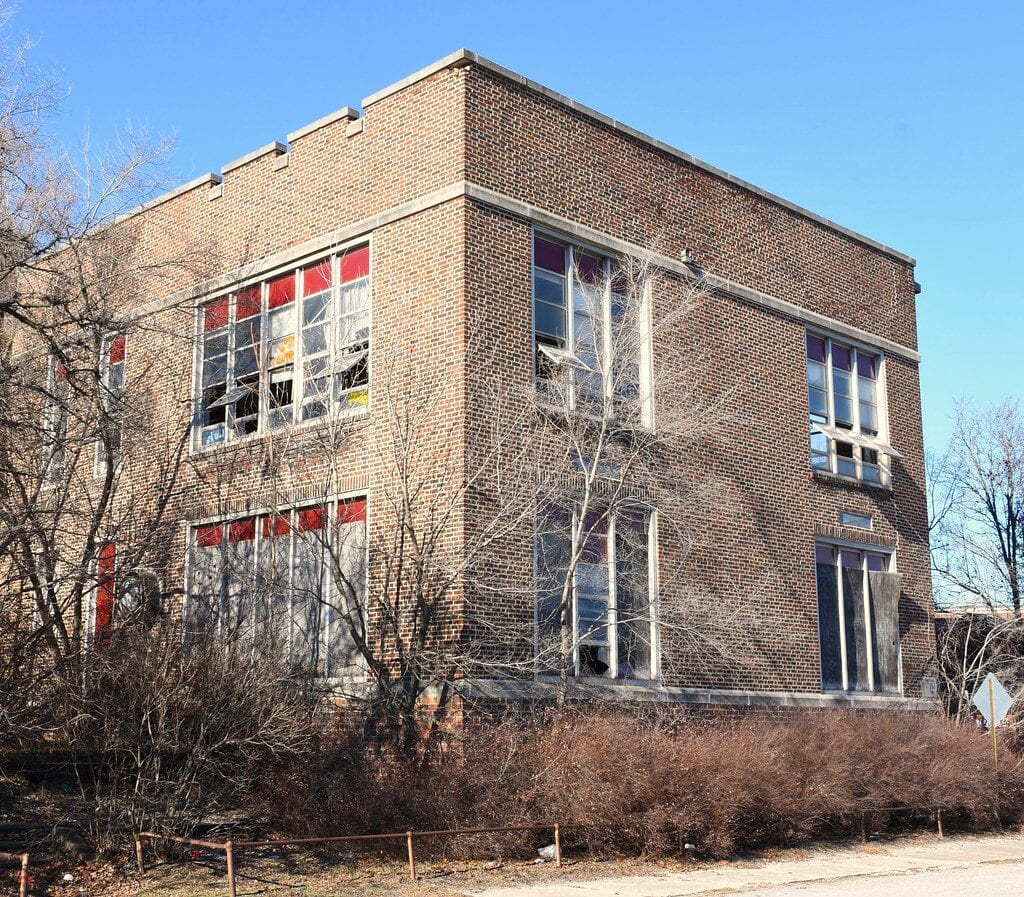
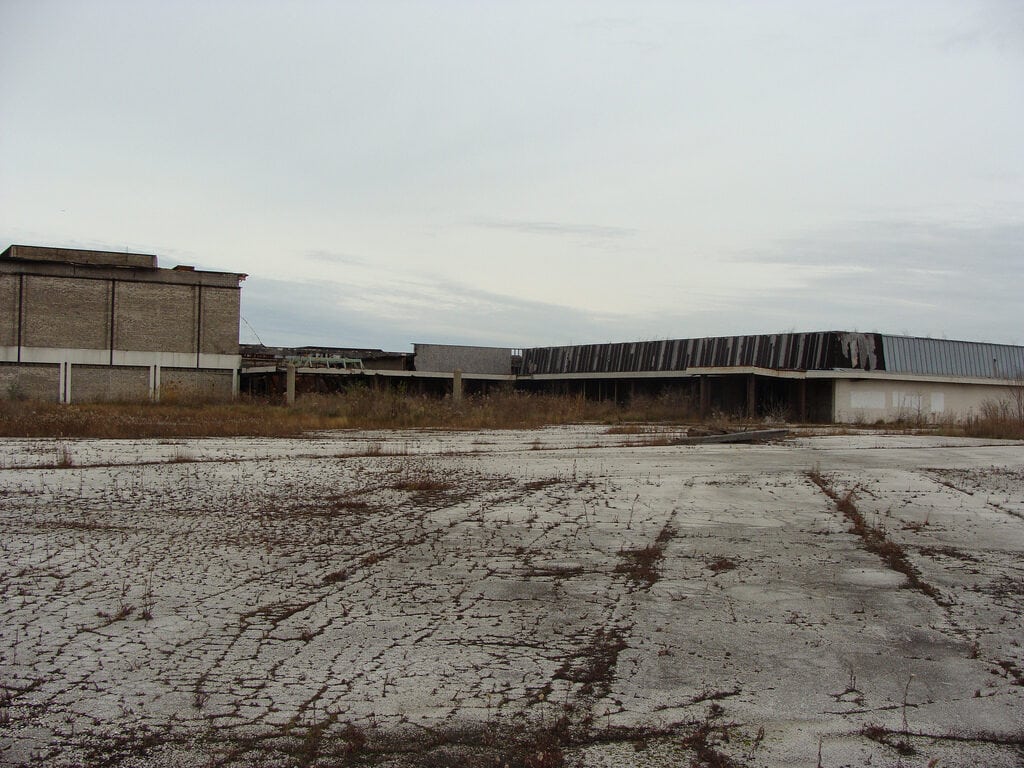
The windows are broken and the auditorium is gone at Horace Mann High School, a 1920s brick campus on Garfield Street in Gary, Indiana.
The school opened in 1918 with 45 pupils in two portable rooms. A $1 million campus replaced them by 1928. The grounds had a dredged pond, footbridges, and a bird sanctuary. By 1958 the pond was filled and paved for parking.
Enrollment was 546 by 2003, and the board closed the school in 2004. Arson took the auditorium in May 2017. The building burned again in 2019 and 2023.
The Gary Housing Authority has owned the property since late 2020. It proposed demolition in July 2025. Gary has since outlined mixed-use redevelopment for the site, though no detailed replacement project has been announced.
Horace Mann opened with 45 pupils in two portables
In 1918, 45 children moved out of Jefferson School and into two portable rooms at West 5th Avenue and Garfield Street, on the west side of Gary, Indiana.
That was the start of Horace Mann, later the city's third high school, named for the nineteenth-century education reformer.
The portables filled at once, and three more went up in 1919.
U.S. Steel had laid Gary out in 1906, and the mills pulled in families faster than the school corporation could build classrooms.
Superintendent William A. Wirt, hired in 1907, had an answer: students rotated through shops, labs, gyms, and pools instead of sitting in one room all day, so one building could teach far more children than it had seats for.
By 1920 the district accepted that portables wouldn't do.
Horace Mann's $1 million campus and Circus Night
Construction started in 1921 and came in pieces.
The east building opened in 1922, the west building in 1924, and the cornerstone of the central building was laid on November 8, 1926.
William B. Ittner drew the plans. The St. Louis architect had already done Emerson and Froebel for the city; Roosevelt and Lew Wallace would follow.
The complex cost $1 million.
The central building had 48 classrooms, two libraries, two gymnasiums, two swimming pools, and an auditorium; a printing shop sat in the east basement.
Crews reshaped the ravine crossing the property, dredged a pond, and added footbridges and a bird sanctuary.
The school was dedicated in 1928 with a party called Circus Night.
More than 2,000 students came for boxing, races, drills, clowns, and a homemade menagerie.
Rotating classes and a Heisman winner
The permanent school taught kindergarten through twelfth grade under one roof.
For the younger grades, academic work took part of the day, and the rest went to shops, labs, art, music, and the auditorium, with groups rotating so the expensive rooms never sat idle.
By the late 1920s more than 200 American cities had copied part of the Gary approach.
The building stayed busy after the last bell, with films and neighborhood meetings.
During the Depression, Gary College held evening classes in the same rooms and later grew into Indiana University Northwest.
The teams were the Horsemen.
Work started in 1930 on a 5,000-seat concrete stadium north of the school, and Tom Harmon went from Horace Mann to Michigan, where he won the 1940 Heisman Trophy.
The pond becomes a parking lot
Enrollment climbed with the mills: 870 students in 1929, 2,386 by 1937, and 2,597 by 1956, past what the buildings were meant to hold.
So in 1958 John H. Vohr Elementary School opened on the front lawn. The pond was drained, filled, and paved for parking.
Wirt ran the schools until 1938, and the rotation system came apart through the 1940s. In 1965 the board pulled the lower grades out.
Horace Mann had opened as a white school in a segregated system, and Roosevelt later became the high school for Black students.
Black seventh graders were bused in starting in 1964, and within a few years the neighborhood had changed enough that busing wasn't what integrated the place.
In its final year the school was 98 percent Black and 2 percent Latino.
A new gym in 1985 couldn't refill the halls
The board discussed closing Horace Mann in 1975, less than 20 years after it was too full to manage. It stayed open.
In 1985 the district spent on it again.
A modern gym went up behind the west building because the old gym could no longer host games, and the Horsemen had been playing only away games.
Enrollment that year was 1,226, with 55 teachers. It didn't bring students back.
By 1999 the auditorium, redecorated with burgundy seats in the 1980s, was kept locked most of the time against vandalism, and the rooms built for the auditorium program sat empty.
Enrollment fell to 546 in 2003, a fifth of the 1956 peak.
The 5-1 vote in April 2004
On April 13, 2004, the school board voted 5-1 to close Horace Mann along with a middle school and three elementary schools, part of a plan for 10 closures by 2006.
The district cited budget cuts and falling enrollment.
Parents lobbied against it, and opponents raised the possibility of a lawsuit. Students were reassigned to Roosevelt and Wirt for the fall.
Hundreds came back on June 9 for a farewell ceremony, and stones were set as a memorial.
The last student day was June 10, and the final class had 72 graduates. That ended 86 years of Horace Mann on the site, counting the portables.
Stripped pipes and a demolition notice
The school corporation looked at moving its own offices into 524 Garfield Street.
Inspectors found major structural and safety problems in August 2008 and judged the complex unfit to occupy.
In 2015 the preservation group Decay Devils offered to clean the buildings and run tours. The district said no, citing safety and liability.
Empty, the campus came apart. Pipe and conduit were pulled for scrap, water got in, and the 1985 gym floor warped.
Arson destroyed the auditorium in May 2017, and the building burned again in 2019 and 2023.
The Gary Housing Authority bought the parcel, school and Vohr together, in late December 2020 for $5,000.
In July 2025 it gave public notice that it wants both buildings down, calling them blighted.
Federal housing money brings a historic-preservation review first.
The buildings are still standing in the summer of 2026.
The blocks of 1920s Tudor Revival houses around them still go by the school's name, and the people living there have a demolition notice and a broad mixed-use concept for what replaces it.

Independent Publisher Notice
BestAttractions is an independent editorial publisher. We are not affiliated with, endorsed by, or acting on behalf of any location, business, property owner, manager, government agency, or organization described in this article. Comments posted on this page are not forwarded to, reviewed by, or acted upon by any entity mentioned in the article. For official inquiries, complaints, applications, bookings, or other requests, please contact the relevant entity directly through its official website or other verified channels.