
The first enclosed mall in Greater Milwaukee is still open, but the old department-store machine is gone. Brookfield Square now runs on books, movies, restaurants, games, JCPenney, and redevelopment land.
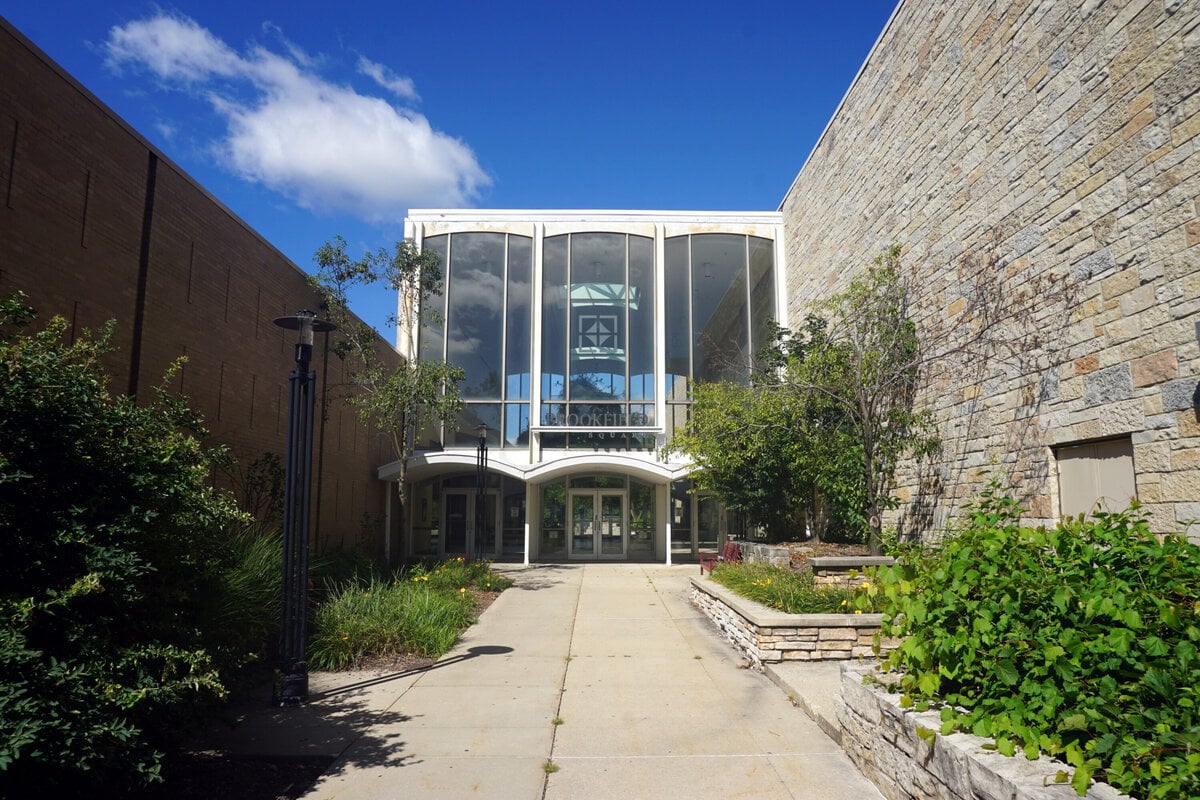
The 865,000-square-foot property stands at 95 North Moorland Road in Brookfield, near Interstate 94 and Bluemound Road, serving Milwaukee, Waukesha County, and the western suburbs.
Opened in phases in 1967 and 1968, it began with Boston Store, J. C. Penney, Sears, indoor courts, tropical plants, fountains, and a cinema.
Nearly 3.9 million annual visits still move through Brookfield Square. Its next piece is the planned Brookfield Public Market on the former Boston Store land.
Brookfield Square Was Built For The Suburban Shopping Boom
The Wonderfall moved inside Brookfield Square, a glycerine waterfall set among tropical plants, terrazzo walkways, and decorative courts.
Shoppers entered a climate-controlled retail world about nine miles west of downtown Milwaukee, at a time when suburban malls were pulling business away from older downtown shopping streets.
Planning began in 1963 on 141 acres. Construction began in June 1966.
Jacobs, Visconsi & Jacobs developed the project, with Peter S. Thomas & Associates, Neil & Wennland, and Baxter, Hadnell, Donnely & Preston tied to the original design.
The openings came in pieces. Boston Store opened on August 17, 1967. The enclosed mall and many smaller stores opened in October 1967. Sears opened on October 25, 1967. J. C. Penney opened on January 18, 1968.
The anchors gave the mall its weight. Sears held 224,000 square feet, J. C. Penney 201,500, and Boston Store 189,500. Together, the three stores controlled about 615,000 square feet.
Brookfield Square became Greater Milwaukee's first enclosed shopping center.
Fountains, Woolworth, And Kohl's Foods Made It More Than Apparel
The original enclosed concourse held about 60 stores and services. Early tenants included T. A. Chapman, F. W. Woolworth, Walgreens, Spencer Gifts, Bresler's 33 Flavors, House of Nine, and Kohl's Foods.
The mall was not only about clothing. Kohl's Foods added a supermarket. Woolworth gave shoppers a variety store. The cinema opened in November 1967 and gave people a reason to visit after normal shopping hours.
The building was planned for both walking and stopping. Department stores drew shoppers to the ends and the center.
Smaller stores ran along the inside walkways. The courts gave people places to pause, sit, look at the water, and then return to the concourse.
The mall's decoration did more than make the space look softer.
Fountains, restaurant areas, tropical plants, art pieces, terrazzo floors, and a hanging sculpture made the enclosed center feel like an indoor public room, with stores around the sides.
Brookfield Square also had the practical features that helped suburban malls succeed: freeway access, large parking lots, and a strong location in Waukesha County.
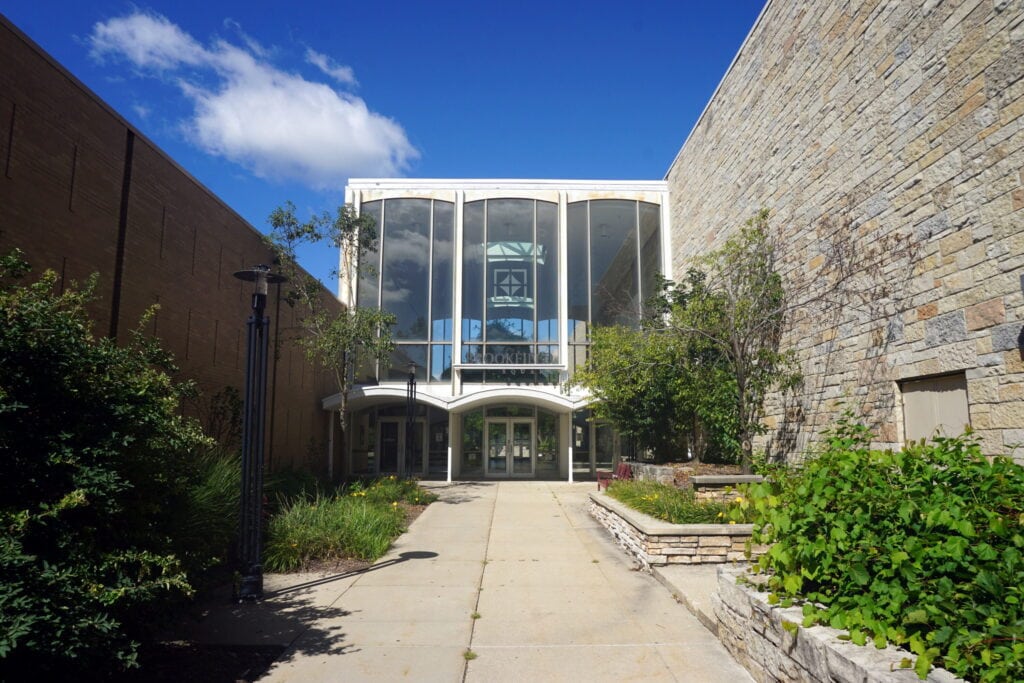
The Three-Anchor Mall Held Through The 1970s And 1980s
The old Brookfield Square could cover a full Saturday of errands and shopping.
Someone could start at Boston Store, cross the concourse to J. C. Penney, go on to Sears, stop at Woolworth, pick up groceries at Kohl's Foods, and still have a movie to see inside the mall.
That kind of lineup belonged to an earlier era of malls. Brookfield Square did not depend only on clothing chains or food-court traffic.
It had department stores, a variety store, a supermarket, restaurants, services, and a cinema all under the same enclosed roof.
Boston Store, J. C. Penney, and Sears carried the mall through the 1970s and 1980s.
Their placement helped pull shoppers through the mall instead of leaving them concentrated near one entrance. The smaller tenants depended on that steady movement.
Brookfield continued to grow around the mall. Restaurants, offices, hotels, and service businesses gathered near Moorland Road and Bluemound Road.
The mall became part of a larger commercial corridor instead of standing alone at the edge of town.
Capitol Court and Mayfair had already changed shopping in the Milwaukee area, and Southridge opened in 1970 as another competitor.
Brookfield Square had to keep shoppers from the western suburbs while other malls competed for the same Milwaukee-area customers.
The losses came gradually. T. A. Chapman closed in 1986. The original cinema closed in 1989. By the end of the 1980s, Brookfield Square still had Boston Store, J. C. Penney, and Sears.
Food Court Renovation Replaced An Older Retail Model
Boston Store expanded in 1992 and grew to 208,000 square feet. Woolworth closed in 1994, leaving a large older-format space inside the mall.
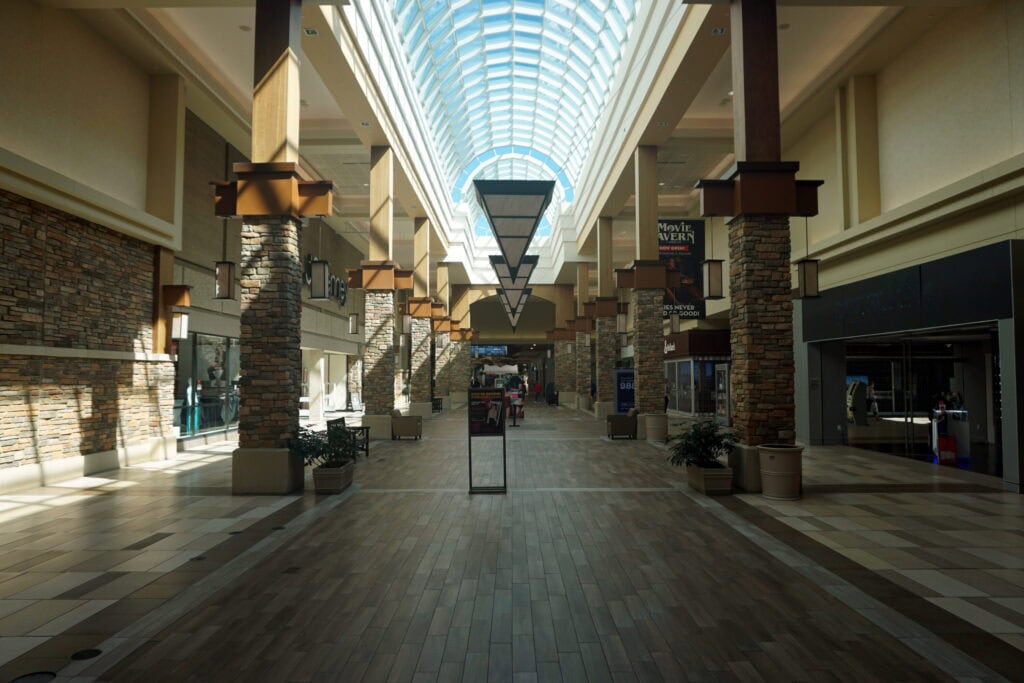
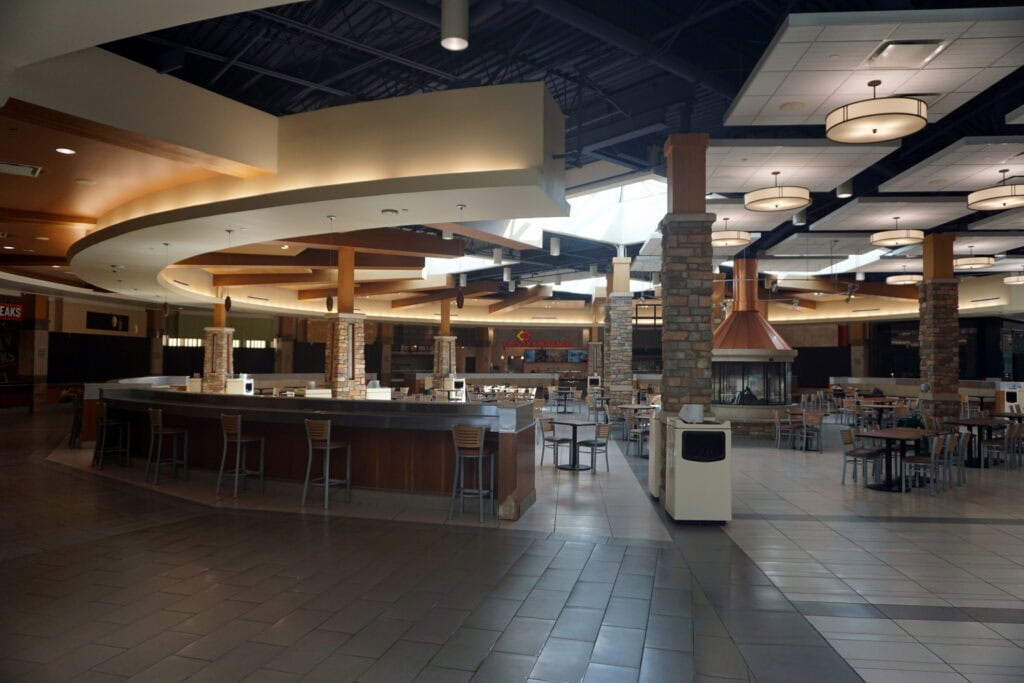
The 1995-1996 renovation turned the Woolworth area into a food court. Crews updated courts and concourses with new finishes, marble flooring, and a large barrel-vaulted skylight over the center court.
Older fountain elements were removed or replaced.
The change followed a national mall pattern. Variety stores were fading from enclosed malls, and food courts became the answer of the moment.
Brookfield Square kept its enclosed shape, but the interior no longer looked like the mid-century retail room that opened in 1967.
By the late 1990s, department stores still mattered, but specialty retail, food-court traffic, cleaner finishes, and a more current interior carried more of the daily activity.
Ownership changed in 2001. CBL acquired Brookfield Square as part of a larger deal involving former Richard E. Jacobs Group interests in 21 regional malls and two associated centers.
The package included 19.2 million square feet of property.
Brookfield Square entered the 2000s under a national mall operator.
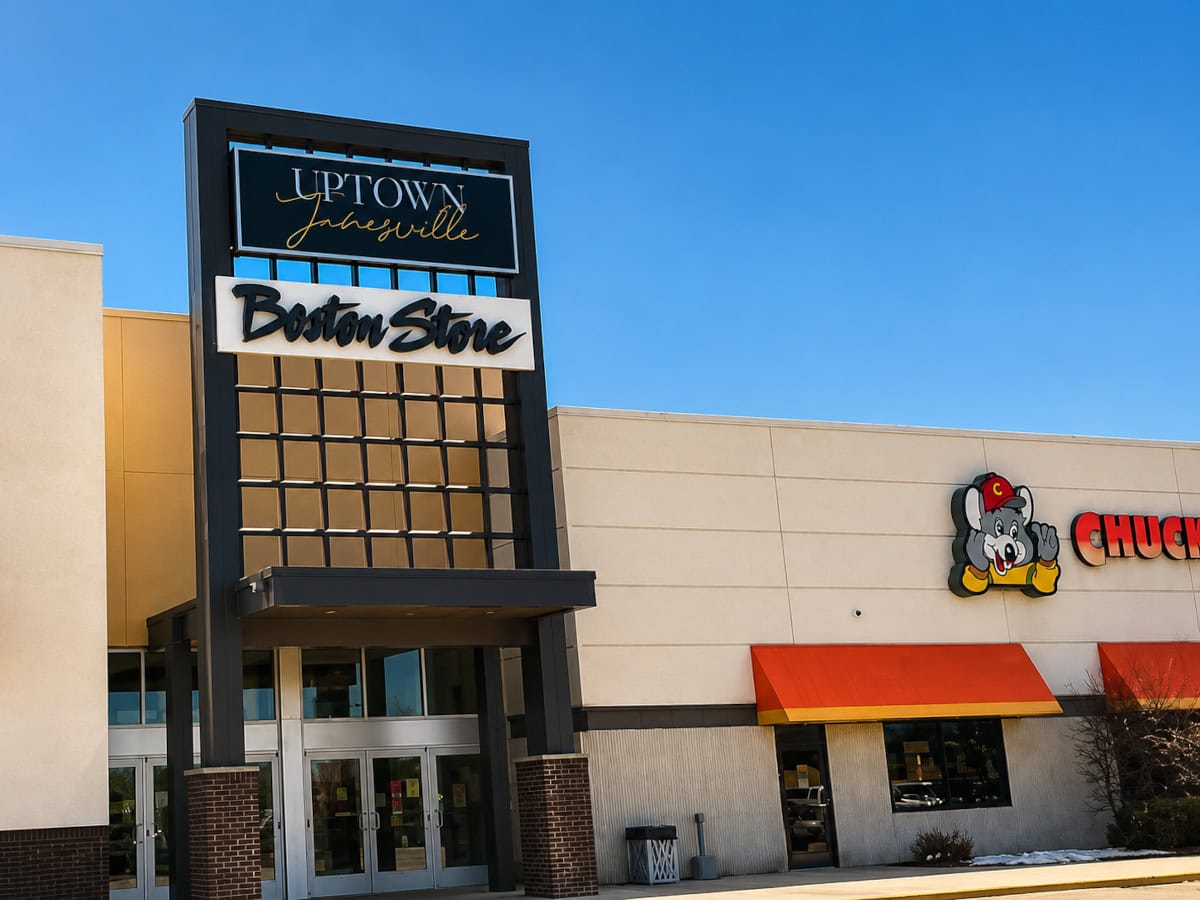
Restaurants And Barnes & Noble Pulled The Mall Outward
A planned southwest wing and Von Maur department store did not get built in the early 2000s. The completed work pushed Brookfield Square away from the old enclosed-only model.
The mall received exterior improvements, updated entrances, restaurant pads, and outward-facing commercial spaces.
A two-story Barnes & Noble opened in 2005 as part of the remodeling, giving the property a stronger public-facing entry.
Restaurants became a larger part of the district. Bravo, Mitchell's Fish Market, Fleming's, Stir Crazy, Claim Jumper, Ethan Allen, and other outparcel or exterior-facing tenants joined the Brookfield Square area.
By 2008, a year-long renovation of the 1.1-million-square-foot mall was complete. The project gave the property stronger exterior edges and more uses that did not require walking deep into the enclosed concourse.
Brookfield also placed the surrounding area into a formal redevelopment framework. Tax Increment District No. 3 was adopted in 2004 and certified in 2005 for the Brookfield Square and Executive Drive area.
The renovation and public planning bought time. They did not stop the anchor-store decline that reached Brookfield Square a decade later.
The 2018 Anchor Closures Broke The Original Formula
The Corners of Brookfield opened its first phase in 2017, west of Brookfield Square. The open-air mixed-use development gave the enclosed mall a newer nearby competitor.
Sears had already shown strain. The Brookfield Square store temporarily closed in 2015 after storm damage and roof-related flooding, then reopened.
The permanent closure arrived in 2018, with liquidation sales beginning in January and the store closing in March.
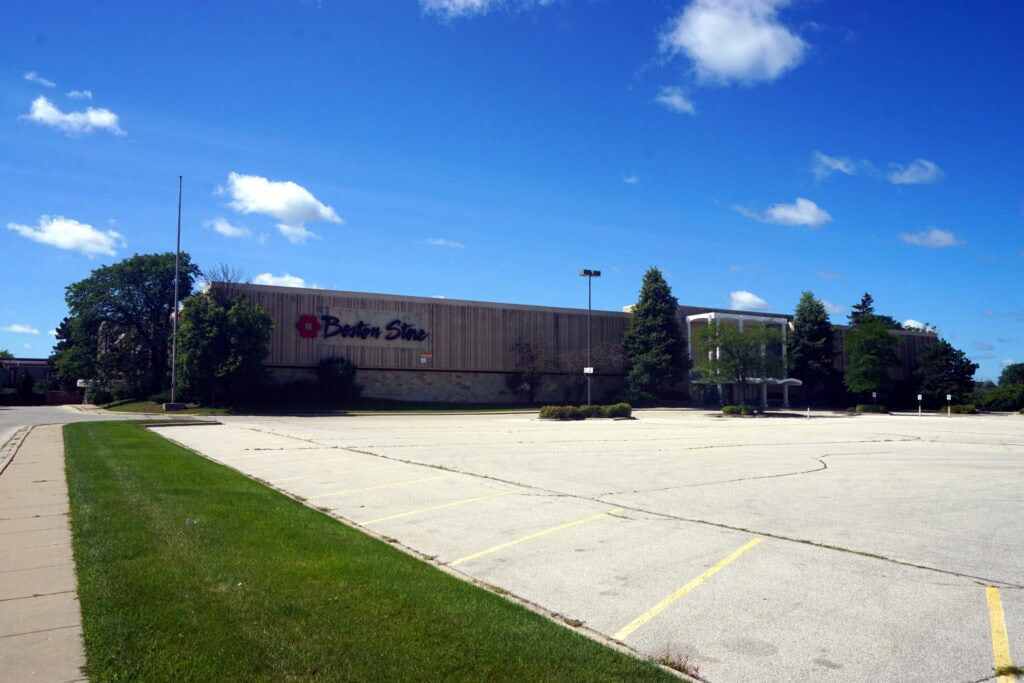
Boston Store closed in August 2018 after the bankruptcy and liquidation of its parent company. The closure left a nearly 217,000-square-foot empty anchor building at the north end.
The timing was brutal, but it was not unusual. Department-store chains were shrinking across the country, and enclosed malls were losing the anchors that had once supplied their daily traffic.
Brookfield Square lost two of its three original anchors within one year. JCPenney remained.
The old formula was clear in 1968: department stores at the ends, smaller stores in between, and shoppers moving through the concourse.
In 2018, that formula no longer worked at the north and south ends of the mall.
Boston Store and Sears both closed in 2018.
Sears Became Entertainment, Dining, Hotel, And Conference Space
The former Sears building and Sears Auto Center were removed for a south-end redevelopment.
The Sears retail and entertainment redevelopment was completed in 2019; the conference center project on the former Sears Auto Center site began in 2019 and was completed in 2020.
The replacement brought entertainment, dining, fitness, hospitality, and conference uses to land once held by a traditional department store.
Movie Tavern by Marcus opened in October 2019 with eight screens. WhirlyBall opened the same month with courts, bowling, laser tag, event spaces, and restaurant and bar space.
Movie Tavern and WhirlyBall were both the first Wisconsin locations.
The Brookfield Conference Center and attached Hilton Garden Inn changed the south side of the property again.
The conference center contains more than 40,000 square feet of clear-span function space. Its largest ballroom has 18,000 square feet, and another ballroom has 6,000 square feet.
The attached Hilton Garden Inn has 168 rooms and surface parking.
The south-end redevelopment also included restaurants and service tenants. Uncle Julio's, OrangeTheory Fitness, Club Champion, and other dining or service uses became part of the completed project.
A family trip that once meant Sears, Woolworth, Kohl's Foods, and the cinema could now mean dinner, an eight-screen movie theater, bowling, laser tag, WhirlyBall, a fitness class, or a hotel event.
Former Boston Store Site Became the Brookfield Public Market Plan
The north end took longer to turn. The former Boston Store site was acquired for redevelopment in 2021. The property covered 16.5 acres near Bluemound Road and Moorland Road.
The building lost value after Boston Store closed. Its taxable assessed value fell from $23.6 million in 2019 to $5.6 million in 2025.
Demolition permits came in 2024 after asbestos abatement and utility-disconnection work. Interior demolition came first, exterior demolition followed.
The former Boston Store building was demolished by January 2025, and rubble still marked the site on March 4, 2025.
The Brookfield Public Market became the central plan for the cleared north end. The market is planned for 2 acres of the former Boston Store site, with 45,000 square feet across two stories.
The design includes indoor and outdoor space, at least 12 merchant stalls, a bar, public seating, private-event space, and outdoor event space.
The outdoor area includes a retractable roof for year-round use.
The larger north-end private plan includes medical office space, first-to-market experiential retail, multi-tenant retail, parking, landscaping, public amenities, and connections to the surviving mall.
The full north-end program totals 222,000 square feet of new development.
Public Money And Private Plans Now Shape The North End
The north end's change was no longer only a private real-estate issue. Public money was now helping drive it.
A public incentive package of nearly $19.5 million moved forward in 2025 for the north-end redevelopment. It included a new Tax Increment District No. 9 and a change to the existing TID No. 8.
The Common Council approved the TID No. 9 project plan on September 2, 2025.
The district was called "The Brookfield Square North/Brookfield Public Market Redevelopment Area." Its base taxable-property value date was January 1, 2025.
Development financing agreements came next on October 7, 2025. One agreement allowed a grant of up to $14.1 million to Visit Brookfield for public-market project costs.
A separate agreement allowed up to $4.5 million to Hephaestus Development Partners for site and utility improvements.
Old reciprocal easement restrictions from 1965 also affect the site. They limit what can be built until they expire in 2032.
That deadline puts a time limit on parts of the redevelopment that the new TIDs and grants cannot override.
The target for starting public market construction was spring 2026, with completion targeted for summer 2027.
Brookfield Square Is Still Open, But Half Its Storefronts Went Dark
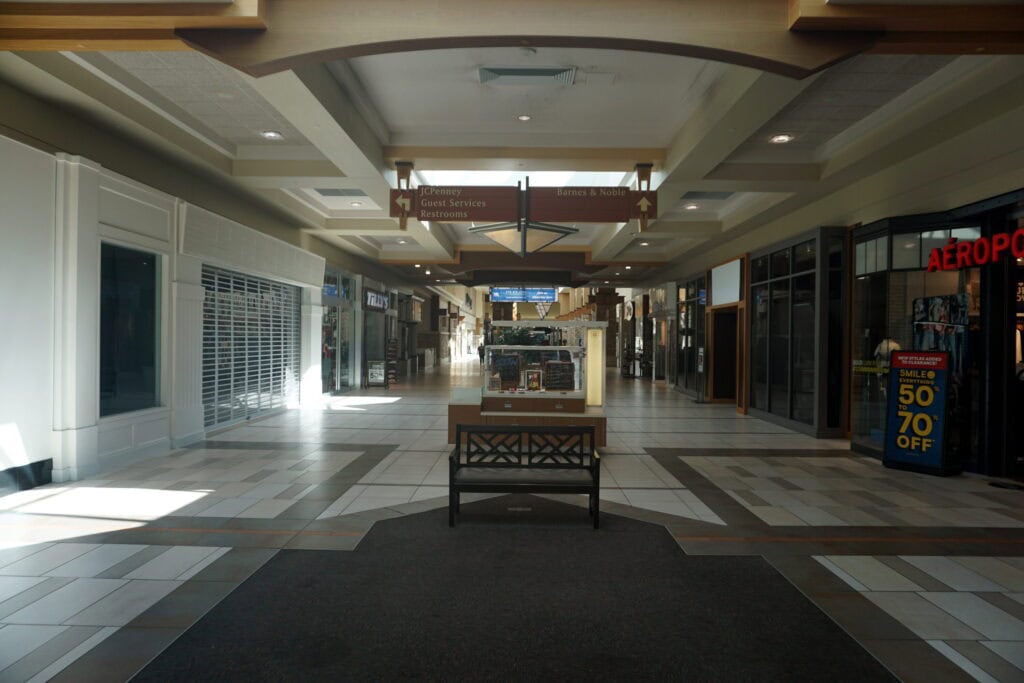
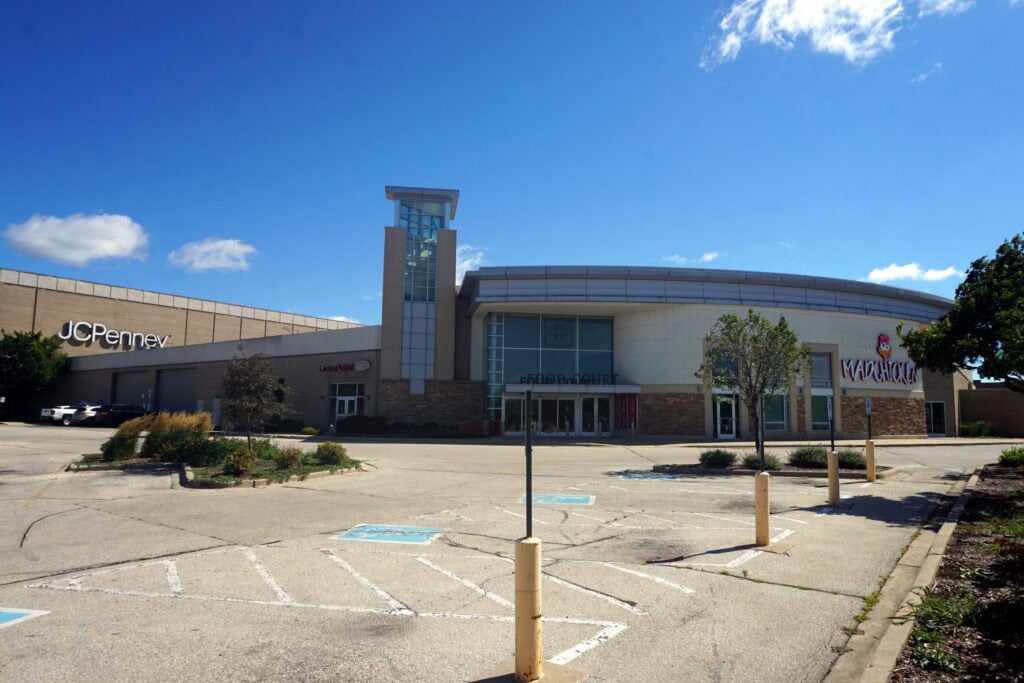
By 2025, more than half of Brookfield Square's storefronts were dark or empty. The mall was still operating, but its center of activity had changed.
More of it now sat with anchors, restaurants, entertainment, services, and land waiting for redevelopment.
The main users now include JCPenney, Barnes & Noble, H&M, Movie Tavern by Marcus, and WhirlyBall.
The restaurant list includes Cooper's Hawk, Uncle Julio's, Outback Steakhouse, Red Robin, Chick-fil-A, Bravo, Bar Louie, Fleming's, Lou Malnati's, Wasabi Sushi Lounge, and Naf Naf Grill.
The center still has 865,000 square feet, 65 stores, and 3.9 million annual visits. That keeps Brookfield Square from being a closed mall. Still, its old department-store pattern keeps coming apart piece by piece.
The public market has not replaced Boston Store yet. The project is still caught between financing, site work, design review, and the 2027 completion target.
Brookfield Square is not the fountain-filled mall of 1968 anymore. It is not a cleared redevelopment site either.
It is an operating mall with vacant storefronts, working restaurants, entertainment anchors, and a future still being built on the land where its old anchors stood.
Notable Milestones
Notable Milestones
1963 - Planning began for Brookfield Square on about 141 acres west of downtown Milwaukee.
June 1966 - Construction began on the enclosed regional mall.
August 17, 1967 - Boston Store opened.
October 1967 - The enclosed mall and many smaller stores opened.
October 25, 1967 - Sears opened.
November 1967 - The original mall cinema opened.
January 18, 1968 - J. C. Penney opened.
1970 - Southridge opened, adding another major regional competitor.
1986 - T. A. Chapman closed.
1989 - The original cinema closed.
1992 - Boston Store expanded to about 208,000 square feet.
1994 - Woolworth closed.
1995-1996 - The Woolworth space became a food court during a major interior renovation.
2001 - CBL acquired Brookfield Square as part of a larger regional mall portfolio deal.
2004-2005 - Brookfield created and certified Tax Increment District No. 3 for the mall area.
2005 - Barnes & Noble opened as part of the mall's remodeling.
2008 - A year-long renovation of the 1.1-million-square-foot mall was completed.
2015 - Sears temporarily closed after storm damage and roof-related flooding, then reopened.
2017 - The Corners of Brookfield opened nearby.
March 2018 - Sears closed permanently.
August 2018 - Boston Store closed.
2018-2019 - The former Sears building and Sears Auto Center were removed for south-end redevelopment.
October 2019 - Movie Tavern by Marcus and WhirlyBall opened.
2021 - The former Boston Store site was acquired for redevelopment.
2024 - Demolition work advanced on the former Boston Store building.
March 2025 - The former Boston Store building was demolished.
September 2, 2025 - Brookfield approved Tax Increment District No. 9 for the north-end redevelopment.
October 7, 2025 - Financing agreements were approved for the public market and related site work.
2025 - More than half of Brookfield Square's storefronts were dark or vacant.
Spring 2026 - Construction of the Brookfield Public Market was targeted to begin.
Summer 2027 - Completion of the Brookfield Public Market was targeted.
Independent Publisher Notice
BestAttractions is an independent editorial publisher. We are not affiliated with, endorsed by, or acting on behalf of any location, business, property owner, manager, government agency, or organization described in this article. Comments posted on this page are not forwarded to, reviewed by, or acted upon by any entity mentioned in the article. For official inquiries, complaints, applications, bookings, or other requests, please contact the relevant entity directly through its official website or other verified channels.