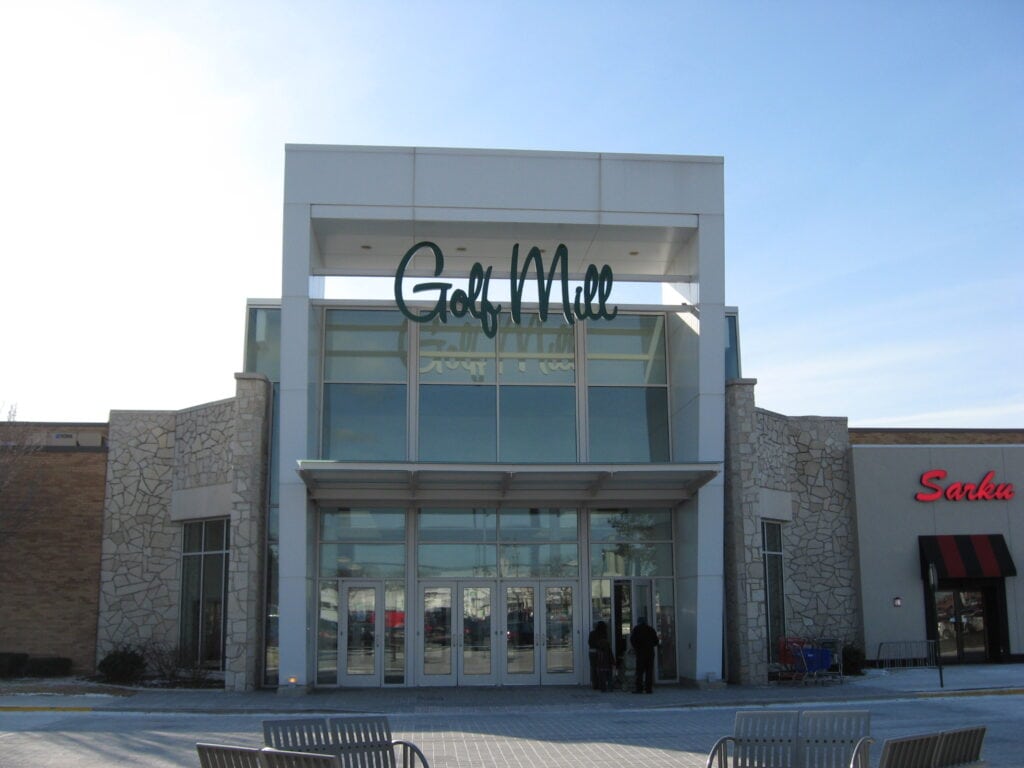
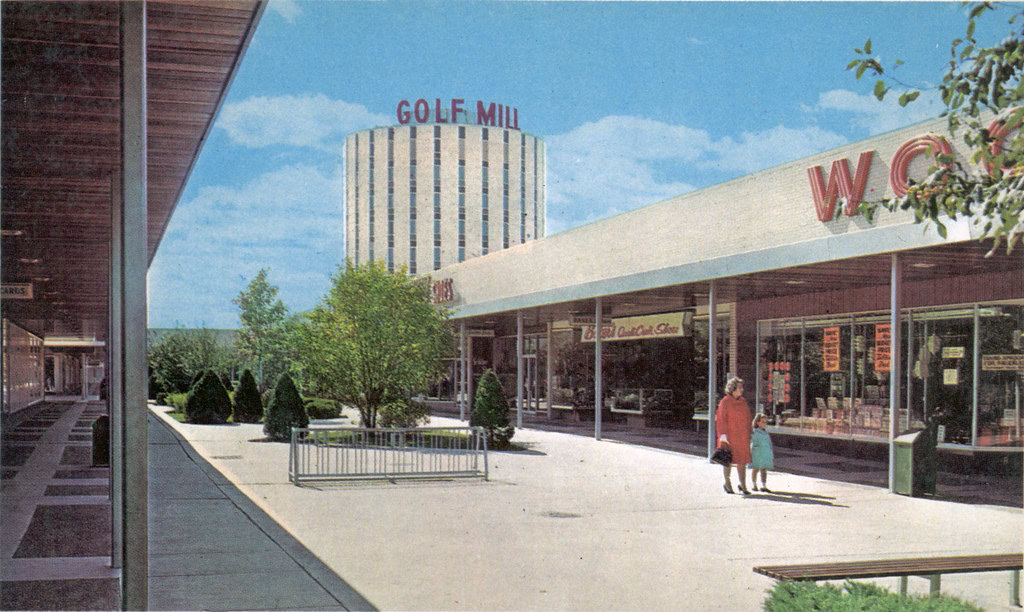
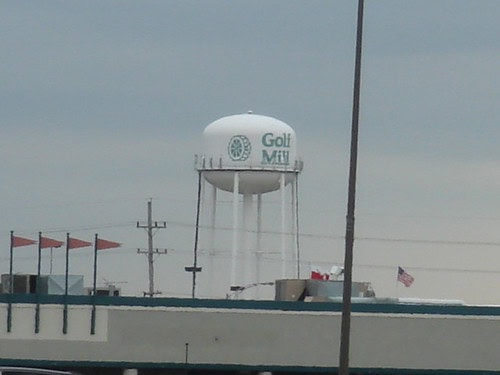
In October 1960, Golf Mill Mall opened at 239 Golf Mill Center in Niles, Illinois, at the meeting point of Golf Road and Milwaukee Avenue.
The property covered 88 acres and had parking for 7,000 cars. From the start, it leaned into a mill-themed "town center" look instead of a basic strip of stores.
Ponds and bridges shaped the walkways. A working waterwheel turned near "Mill Island," where people could sit outside by a koi pond.
The opening rolled out in steps. The first nine stores opened on October 12, 1960. The full public opening followed on October 13, with about 65 stores in the first phase.
In the middle, a two-level Sears of about 230,000 square feet stood like a wall and split the property into north and south sections.
Sears opened with a Garden Center, a 23-bay Auto Center, an optical department, a Coffee House Cafe, and the Lyric Beauty Salon.
Early tenants also included a Woolworth's 5&10, along with grocery, drug, and other everyday shops that gave the place enough to fill a full Saturday.
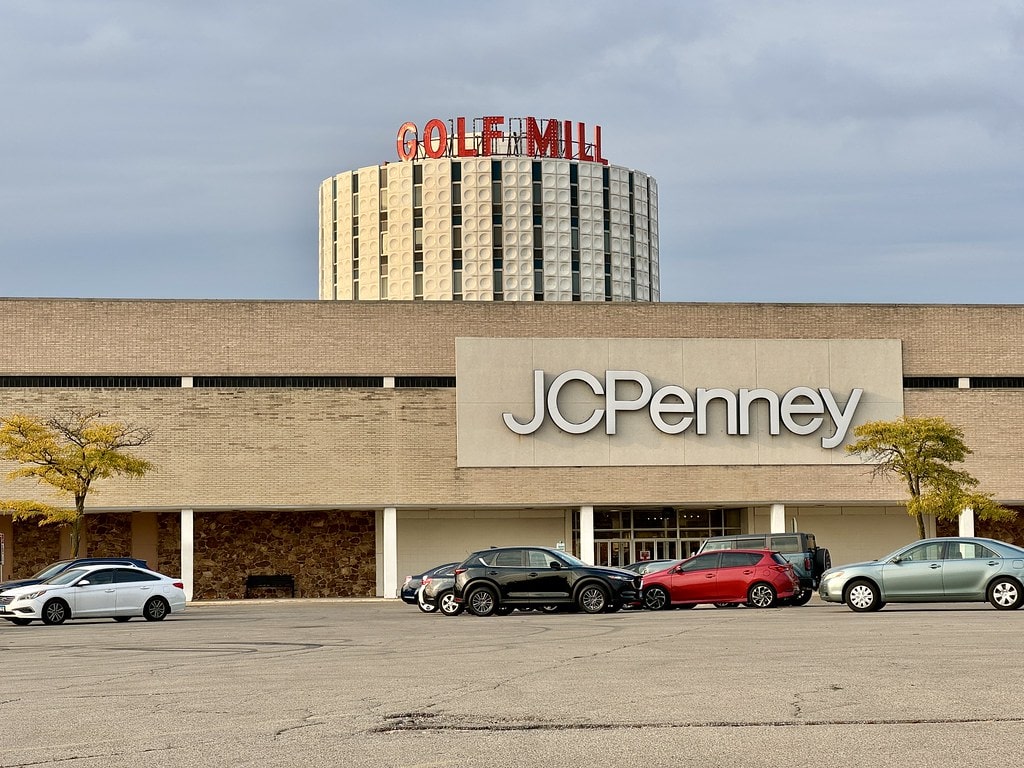
Rising above it all was the Golf Mill Office Tower, a technical anchor from 1963, designed by architect Edo Belli to resemble the top of a golf ball.
Early years add Lord's, theater, playhouse
The early 1960s added more reasons to come back. On October 18, 1961, Evanston-based Lord's opened a 50,000 square foot branch at the south end.
That same year, Golf Mill Theatre opened on December 29, 1961, as a single-screen outparcel.
The theater later expanded to Golf Mill Theatres I & II in 1969, then 1-2-3 in 1973, before closing in 2000.
In 1960, Golf Mill also gained a social spot called the Swanky Millionaires Club, a restaurant and lounge that stayed until 1980, when declining membership ended the run.
By mid-1965, the mall added a much bigger draw: the Mill Run Playhouse. It opened on July 2, 1965, after rain delayed the schedule from June.
It seated about 1,600 people in a "theatre-in-the-round" setup and pulled in major acts over the years, including Sammy Davis Jr., Lou Rawls, Ray Charles, Johnny Mathis, Frankie Valli, Dolly Parton, Miles Davis, The Supremes, Tom Jones, and George Carlin.
In 1972, it staged a run of the musical "Hair."
JCPenney arrives, and the wings fill out
Lord's did not last long at Golf Mill. It closed by 1965, and the empty one-level space quickly became the mall's next major change.
JCPenney moved in, redid the interior to make it a larger two-level store, and opened on October 20, 1966.
The JCPenney location measured about 184,700 square feet across two levels and included an Auto Center.
The mall still felt like two separate halves, and where you started depended on which entrance you used. By 1967, Golf Mill had about 68 stores spread across both wings, with Sears still in the middle.
The tenant mix stayed practical and familiar. North Mall tenants included Lytton's, Walgreen Drug, Henry M. Goodman, and Hillman's supermarket.
South Mall tenants included Karroll's Men's Wear, Baker's Shoes, Richman Brothers Men's Wear, F.W. Woolworth 5 & 10, and National Food Stores supermarket.
The name "Golf Mill" matched its location at a busy crossroads, and it served shoppers in an area that already had big shopping centers like Old Orchard, which opened in 1956, and Randhurst, which opened in 1962.
More competition came later with Woodfield in 1971 and Northbrook Court in 1976.
1984 rebuild seals it in and adds food
By the mid-1980s, Golf Mill started changing in a big, physical way. A major renovation began in August 1984 with a $40 million price tag, and the goal was a fully enclosed, climate-controlled mall.
That same month, the Mill Run Playhouse closed. It was demolished as part of the rebuild, and the spot later became part of the south parking lot.
At the same time, the North Mall was reworked, and new construction created an enclosed concourse that changed how people moved from store to store.
As the new layout took shape, the anchor lineup shifted too. In November 1985, a 70,000 square foot MainStreet department store opened in the redeveloped north wing.
Inside the mall, another major change followed in the space people knew best by its old tenant.
The former Woolworth's was rebuilt into an 18-bay food court. The area was divided into inline stores, and the food court was added on the east side, giving the mall a new hub for quick meals and breaks.
By late 1986, the enclosure was complete. Golf Mill was air-conditioned and fully indoor, built for shopping in any season. On November 19, 1986, the mall was formally rededicated in its new format.
After that, the store count rose to more than 150, and the place settled into its role as a year-round indoor spot to walk, eat, and spend time.
Kohl's, Target, and the late-mall mix
Anchor names shifted again in the late 1980s and 1990s. In March 1989, MainStreet was rebranded as Kohl's.
Management also changed hands later, with General Growth Properties running the mall from 1994 until bankruptcy in 2009, when Milwaukee Golf Management took over.
Target joined the lineup in a big way. A 103,000 square foot Target was built on the north side and opened on October 11, 1998.
With Sears, JCPenney, Kohl's, and Target, Golf Mill had the classic multi-anchor setup that defined the era.
Some features that felt permanent in one decade became temporary in the next. The original Golf Mill Theatre, which opened in 1961, had expanded over time, but it closed in 2000, ending that long run.
Other retail and outparcel activity continued to cycle. Circuit City opened outside the mall in 1990, then closed in early 2004. The space later became Lucky McGee's sports bar, which closed in January 2016.
Through these years, Golf Mill kept operating as a large suburban retail hub, even as competition and changing shopping patterns kept raising the bar.
The property's scale stayed significant, and by the late 1990s, it was still drawing traffic as a familiar indoor stop in the northwest suburban mix.
2006 theater boom and an $8M remodel
The mid-2000s brought a fresh wave of construction and upgrades. In 2006, Golf Mill opened a 12-screen Kerasotes ShowPlace multiplex.
The theater showed its first features on November 17, 2006, and it later became AMC Niles 12 after AMC acquired Kerasotes in 2010.
An $8 million interior remodel was completed in 2007 and updated the shopping areas with new flooring, lighting, seating, an improved food court entrance, and an exterior facelift.
Retail additions also shifted the footprint. Value City Furniture opened in 2005 in a 40,400 square foot space near the northeast side, replacing some inline space and an entrance area.
Gordon Food Service opened as a standalone grocery option at 50 Golf Mill Center, with a ribbon-cutting set for October 18, 2011, at 10:00 a.m.
Ross Dress for Less opened in 2012, adding a discount draw inside the mall.
Later additions expanded the everyday mix. Panera Bread and Ulta Beauty opened in 2017. Chase Bank opened in 2020. Chick-fil-A opened in 2021.
Burlington also arrived in 2021, replacing Kohl's after Kohl's closed on Halloween 2020 and relocated to Morton Grove.
By 2007, Golf Mill measured about 1,067,000 square feet, with about 120 stores and parking for 5,500 cars.
Sterling acquires Golf Mill in 2014
In August 2014, the Cuneo family sold 912,400 square feet of Golf Mill, plus its office tower, to Sterling Organization for $60 million through a private equity fund.
Sterling Retail Services took over management.
At the time, the anchor and large-tenant lineup included Target, Kohl's, AMC's 12-screen theater, Ross, JCPenney, Sears, XSport, Shop-N-Save, Gordon Food Service, and Value City.
The center took on the redevelopment project name "Golf Mill Town Center" to match a mixed-use direction and to present the site as more than a traditional enclosed mall.
That name proposal landed in a period when many older malls were under pressure and trying to find a new identity without losing the tenants that still worked.
Even with stores still open and some new ones added, the property kept struggling because of bigger changes in shopping habits.
Other shopping choices nearby had increased for years, and online shopping made it harder for average indoor malls to stay as important as they used to be.
By the early 2020s, Golf Mill was still open and encouraging people to shop there, while also making bigger plans to rebuild most of the old mall into a new kind of center.
Sears and Kohl's close and redevelopment agreement follows
The biggest break in Golf Mill's old layout came at the end of 2018. Sears, an anchor since the beginning, closed after a liquidation sale, with the store shutting around December 16, 2018.
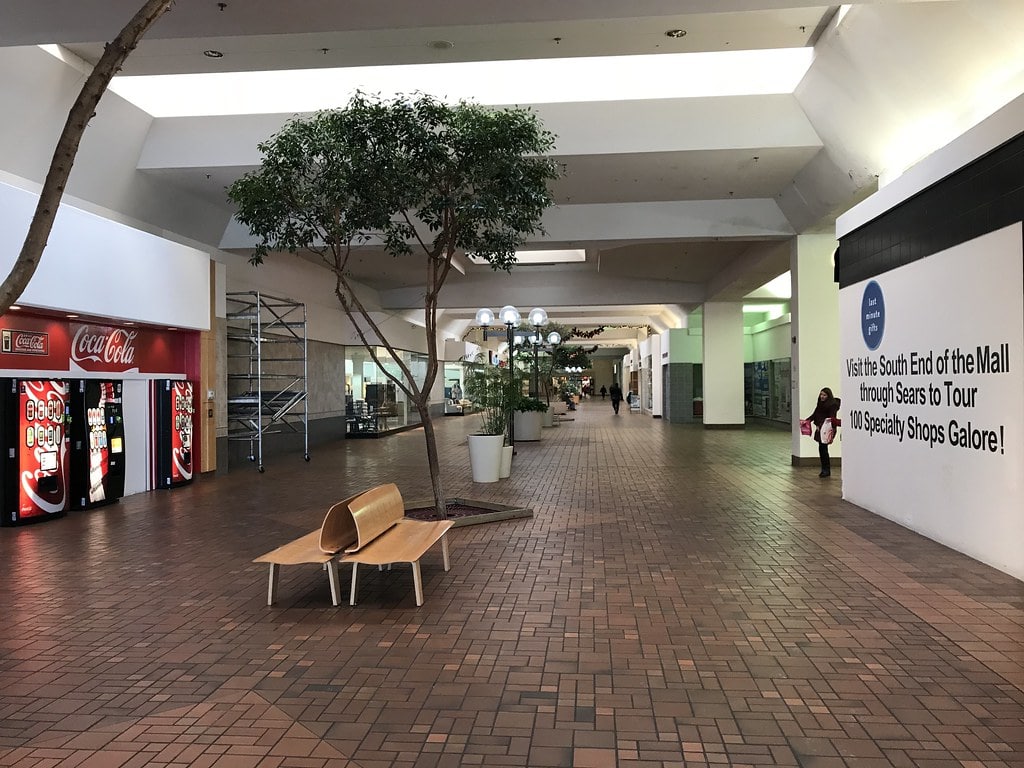
Its closure also cut off the mall's central passage between the north and south wings, because Sears had long been the piece that sat between them.
Kohl's closed in 2020 and relocated to Morton Grove, adding another large vacancy to the site.
These closures helped push Golf Mill into a harder stretch, with the mall operating but showing clear signs of decline and empty space.
Sterling and the Village of Niles moved forward with a full redevelopment plan. In January 2022, plans and renderings were unveiled for a mixed-use "live-work-play" Golf Mill Town Center.
In September 2023, the Niles Board approved a non-binding $440 million term sheet with Sterling outlining the project.
The plan called for retail and restaurants, hotel and medical offices, housing and entertainment, and the return of the iconic water wheel.
In June 2024, the village scheduled a Board vote on the redevelopment agreement for the June 25, 2024, meeting, and the deal was finalized and signed shortly after.
The project includes up to $96 million in pay-as-you-go tax increment financing, with the Milwaukee-Dempster TIF District set to expire in 2041.
Golf Mill Town Center plan meets sale talk
As of early 2026, Golf Mill is still open. At the same time, it is sitting inside a redevelopment plan that has already been approved, but still has to survive the market.
The master plan breaks the work into multiple phases and swaps out most of the old enclosed mall.
In its place, it calls for new outdoor retail and restaurants, public plazas, a pedestrian promenade, landscaped gathering spaces, and a central water feature with a new water wheel.
It also includes about 300 luxury apartments, plus office or hotel space, with medical offices saved for a future phase.
The plan keeps some of the current lineup in the picture. Key existing tenants expected to remain include Target, JCPenney, Burlington, Ross, Panera, and Ulta.
The mall has also been pushing the timeline on its own, advertising "Golf Mill Town Center - COMING 2027."
The nuts-and-bolts details matter here. The redevelopment is set up in phases, with demolition and construction planned so people can still get to the stores that stay open.
Public support is already on the record, with a 2022 referendum showing 75% voter support for the redevelopment direction.
The property itself spans about 80 acres, in a dense trade area, and below-market anchor rents have been used as part of the redevelopment pitch.
Then, in May 2025, Sterling brought in JLL to market the property for sale as a value-add opportunity, pointing to flexibility in the redevelopment agreement.
That is the big wildcard. A new owner could keep the plan moving, change it, or slow it down, even with an approved framework already in place.