Mall St. Matthews on the day it debuted
The mall opened on March 21, 1962, at 5000 Shelbyville Road in St. Matthews, Kentucky. The site covered 67 acres and sat about 7 miles east of downtown Louisville.
The location was adjacent to the Watterson Expressway (Interstate 264), which had recently expanded and become accessible to the Shelbyville Road corridor in the early 1960s.
At opening, the property was called "The Mall." It was Kentucky's first enclosed, climate-controlled suburban shopping center. The James W. Rouse Company developed the project.
A dedication ceremony was held to mark the opening. The lieutenant governor, the president of Kaufman's of Kentucky, and James W. Rouse were in attendance. The Waggener High School band performed during the event.
The original building was a single-level structure with 370,000 leasable square feet. It contained 39 stores and services. The interior was organized around two court areas.
An oversized chess set was installed near the Kaufman-Straus corner as part of the opening features.
In later years, the mall helped establish the Shelbyville Road corridor as a major east-side retail destination.
Nearby centers such as Shelbyville Road Plaza and Bluegrass Manor Shopping Center were developed in the same area.
Potatoes, incorporation, and the new road
Before the mall, St. Matthews was still a working agricultural area. Potato farming was a major local industry.
The community was known as a leading shipping point for Irish Cobbler potatoes, and the St. Matthews Potato Exchange became the second-largest potato shipper in the nation.
The exchange closed in 1946, ending a long-running piece of the local economy.
In 1946, Louisville's Board of Aldermen attempted to annex St. Matthews' business district. The area continued to resist annexation.
On March 22, 1950, St. Matthews incorporated as a sixth-class city. The original city limits covered three square blocks.
At the time, St. Matthews was believed to be the most populous unincorporated community in the United States.
The boundaries expanded through annexations between 1950 and 1954. By June 1954, St. Matthews had become a fourth-class city. The city added two distinct geographic areas and grew to about 6,500 residents.
Road construction set up the next phase. Early sections of the Watterson Expressway opened in 1948. The Shelbyville Road interchange was constructed by 1961.
In the mid-1960s, the expressway was extended from Shelbyville Road to Brownsboro Road and provided the access that made large commercial development possible along the corridor.
Courts, fountains, and the first store list
The mall was developed by the James W. Rouse Company, led by James W. Rouse.
In 1958, the company completed Harundale Mall in Glen Burnie, Maryland, one of the early enclosed shopping centers in the United States.
In that same period, Rouse used the term "shopping mall" while promoting his enclosed centers. His developments were designed to function as indoor public spaces as well as retail sites.
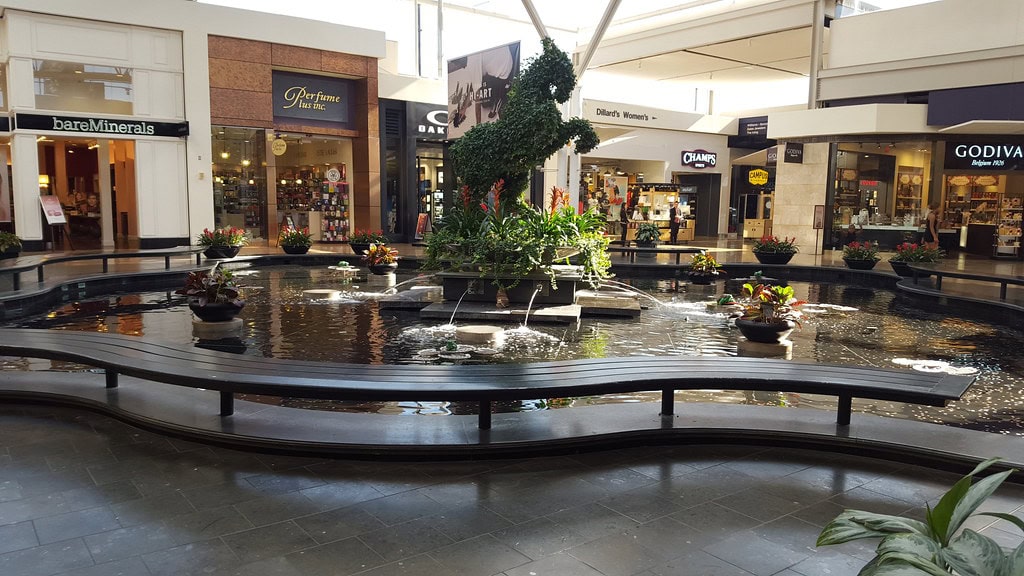
At the opening in St. Matthews, the interior plan was arranged around two court areas. The West Court included a fountain and a stairway to a small upper level.
That upper level held public restrooms and a community room and provided access to the second floor of the anchor store.
An oversized chess set was placed near the Kaufman-Straus area as part of the opening features.
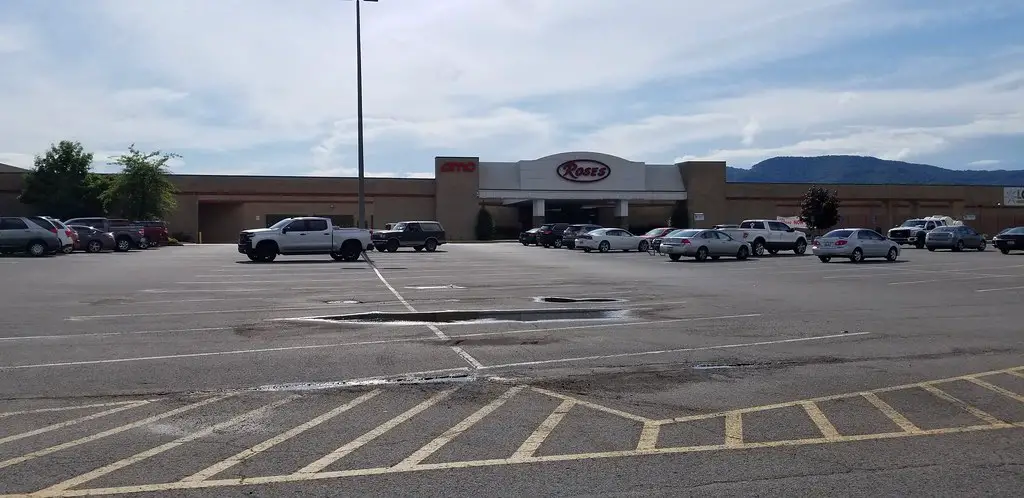
The East Court sat in front of Rose's. It included a waterfall, a tropical garden, and a bird aviary.
These features gave the enclosed mall a landscaped interior and defined the court as a destination space rather than a hallway.
The opening anchors were Kaufman's of Kentucky, Rose's 5 and Dime, and an A&P Supermarket.
Kaufman's occupied 78,000 square feet across two levels. Rose's occupied 46,000 square feet on one level. A&P occupied 20,000 square feet.
Other early tenants included: Taylor Drug, Rodes Men Wear, Davidson's, Bond Clothes, Benton's Tweed Shop, Maud Muller Candies, Baker Shoes, Bell Shoes, Sutcliff's Sporting Goods, the Blue Boar Cafeteria, and record stores.
Stewart's arrives, JCPenney follows, 1970
The mall began expanding soon after it opened. Kaufman's of Kentucky had been the original department store anchor. The Kaufman's business traced back to 1879, when Henry Kaufman opened a retail store in Louisville.
In 1960, the mall store was rebranded as "Kaufman's." By 1966, Kaufman's had closed its location, and the department store space at the mall was prepared for a new tenant.
Stewart's Dry Goods was a Louisville-based department store chain whose downtown flagship opened on April 15, 1907, in the Stewart Dry Goods Company Building at 501 S. 4th Street.
By the early 1900s, the chain was owned by the New York dry-goods conglomerate H.B. Claflin & Company. Stewart's later expanded into suburban shopping centers.
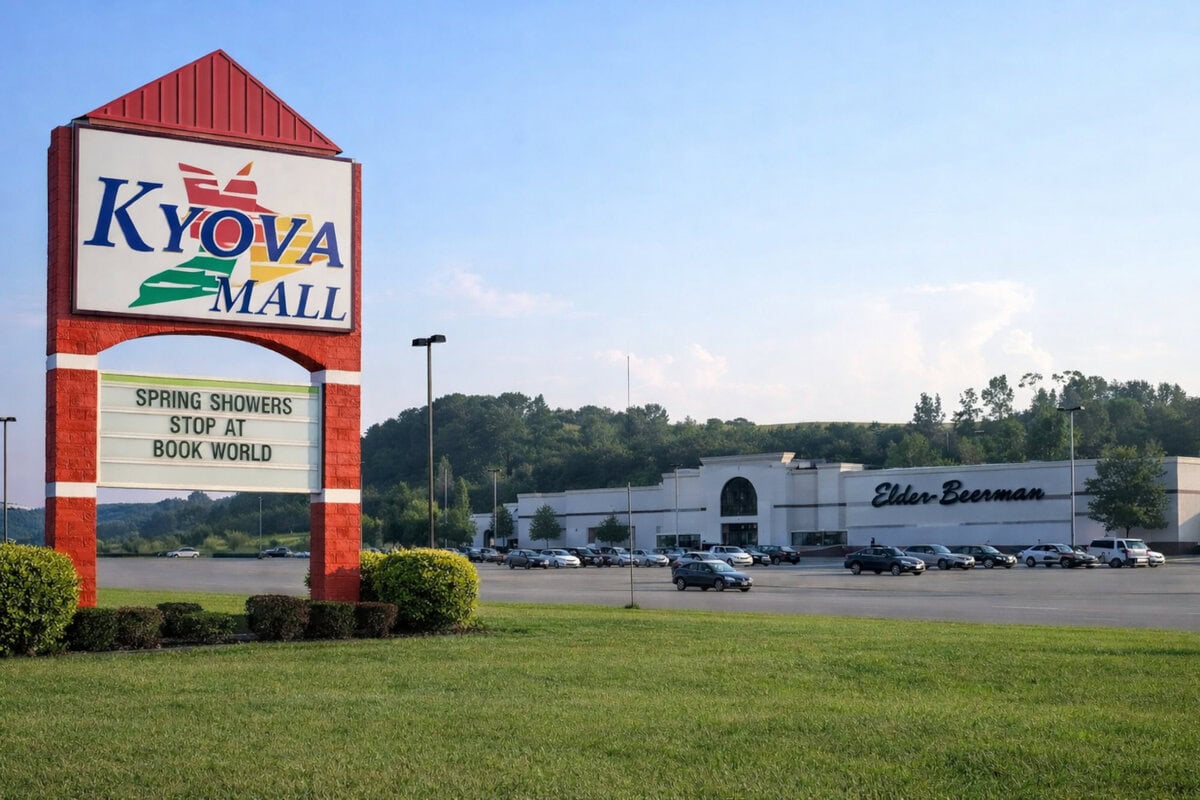
In October 1966, Stewart's Dry Goods relocated to Mall St. Matthews and took over the former Kaufman's space.
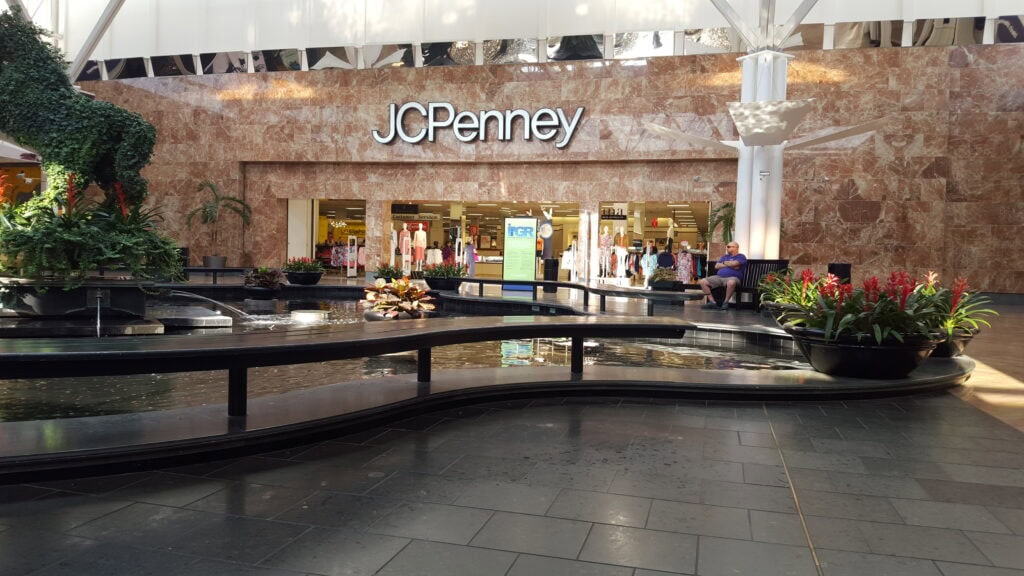
Construction expanded the footprint at the same time. The next major anchor arrived on January 8, 1970, when a two-level, 178,000-square-foot JCPenney opened.
After the JCPenney addition, the mall reached 552,000 square feet of gross leasable area and operated as a larger regional shopping destination.
Oxmoor pressure, Bacon's rescue, late 1980s
Oxmoor Center opened on February 8, 1971, on the opposite side of the Watterson Expressway from Mall St. Matthews. It was larger and newer. It opened with Shillito's and Stewart's as anchors.
Its location placed two regional malls within direct view across the highway, and competition increased as retail options expanded in the area.
By the mid-1980s, more malls had opened across Kentucky, and the St. Matthews property adjusted its identity. It was renamed "The Mall in St. Matthews" to distinguish it from other centers.
The mall also faced anchor turnover. On November 1, 1985, the mall's Stewart's store was converted/rebranded into L.S. Ayres, an Indianapolis-based department store chain.
The L.S. Ayres location later ceased operating at the mall, and the space was redeveloped.
During the same period, the mall added entertainment retail. Chuck-E-Cheese's Pizza Time Theatre opened in 1984.
It became a major family destination and drew heavy traffic. The location was so busy that it reportedly reduced business at the chain's Preston Highway site.
The mall began a major renovation and expansion cycle from 1987 to 1989. The former Stewart's and L.S. Ayres space was enlarged with a second westward addition and rebuilt into a 195,000-square-foot department store.
Bacon's opened in that space in September 1988 after relocating from 3937 Shelbyville Road. Rose's, an opening-day anchor, was reconfigured into a 10-bay food court.
During the renovation period, the mall shortened its name to "Mall St. Matthews." A dedication ceremony for the renovated areas was held on November 16, 1989.
Early 1990s refresh and the Dillard's-era expansion
The mall entered the 1990s after the late-1980s renovation with new anchors and a rebuilt interior, but it continued to adjust to regional competition.
In December 1991, Chuck-E-Cheese's Pizza Time Theatre closed permanently. After the closure, demolition began at the north end of the mall as management prepared another round of changes.
A new renovation initiative followed in 1992. As part of the project, a 25,000-square-foot Limited Express Superplex opened.
The work included new landscaping and updated exterior features. On November 6, 1992, about 20 new stores opened, bringing a concentrated wave of new tenants into the property.
Further expansion began in early 1994. The Rouse Company started a larger project that added a new south wing and a third anchor department store.
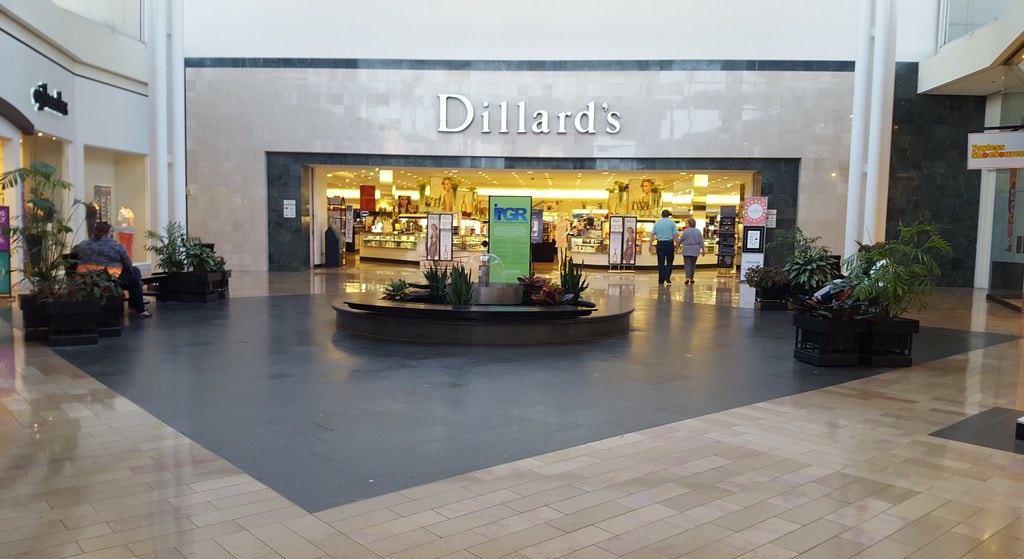
On March 26, 1995, a three-level, 230,000-square-foot Dillard's opened. The new store increased the mall's scale and added another national department store presence.
In 1997, Lord & Taylor opened at the mall, adding an upscale department store to the tenant mix.
The next major milestone came on October 21, 1998, when a dedication ceremony marked the completion of a two-level, 120,000-square-foot Lord & Taylor expansion and a multi-level parking garage.
After this fifth major expansion, Mall St. Matthews reached 1.1 million square feet and became Kentucky's largest shopping mall.
Closures, a lost Nordstrom, and tiled fountains
After the Bacon's chain merged with Dillard's in 1998, Mall St. Matthews adjusted its department store layout.
The former Bacon's location was rebranded on August 15, 1999, as Dillard's Men's, Children's and Home. The change created two Dillard's locations at the mall, with separate merchandise focuses.
In the early 2000s, plans were announced for Nordstrom to open at Mall St. Matthews. The proposed deal did not move forward. It fell through in 2001 before a final contract was signed, and the store was never built.
A major anchor closed soon after. Lord & Taylor shut down at the mall on February 6, 2004.
Dawahares, a regional junior department store chain, occupied part of the former Lord & Taylor space for a brief period through early 2007.
Later, Dillard's men's and home departments moved into the former Lord & Taylor building, and the old Bacon's/Dillard's box became vacant.
In 2007, the mall altered its interior features that had been part of the shopping environment.
Two water features were removed, one in the food court area and another in front of Kay Jewelers and Starbucks. The fountains were replaced with floor tiles, along with new tables and seating.
Forever 21, Cinemark, and the new play
In the 2010s, the mall continued to refill former department store space and add tenants tied to fashion and entertainment.
On February 12, 2011, Forever 21 opened in the partially vacant former Bacon's space.
The store occupied about 110,000 square feet across two floors and became a large apparel tenant in the building. In 2017, Forever 21 reduced its footprint.
It moved to the first floor only and downsized to about 30,000 to 45,000 square feet.
A major entertainment tenant opened two years later. On May 16, 2013, a 10-screen Cinemark multiplex debuted at the mall with the company's NextGen Cinema Design Concept.
Each auditorium was built with wall-to-wall and floor-to-ceiling screens.
The theater is physically attached to the mall but is separately owned. It does not have direct pedestrian access from the mall's main interior.
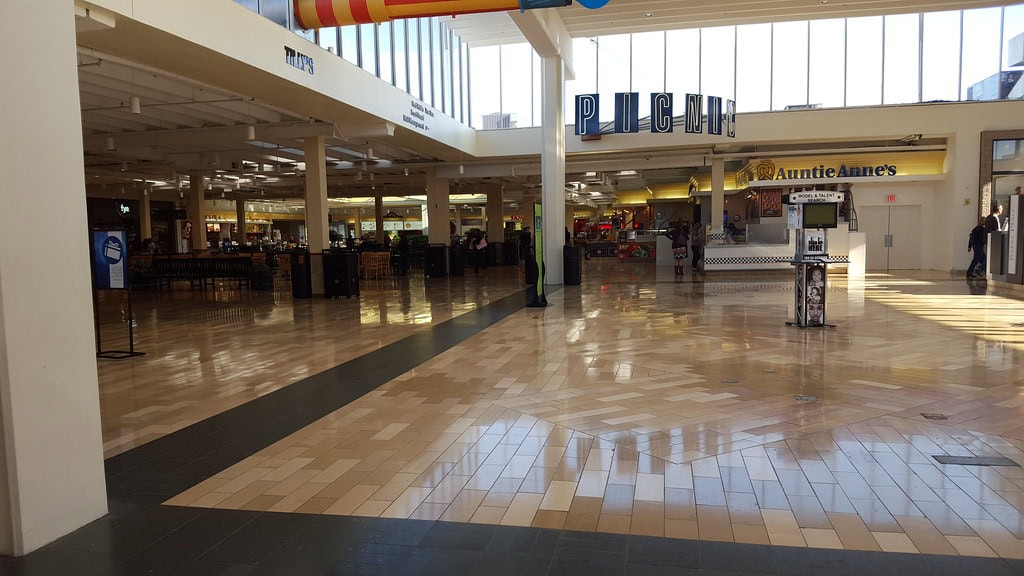
In mid-2017, plans were announced for a food court renovation. The project called for new floor tiles and furniture, removal of the railing and elevated platform seating, new furnishings, and upgraded restrooms.
In 2019, Dave & Buster's opened on the second floor of the Forever 21 building. Ulta Beauty opened on the remainder of the first floor, adding a large beauty retailer to the mall's mix.
Brookfield era: Zappos, vendors, desserts
On December 26, 2015, a disturbance involving up to 2,000 people, mostly teens, led to fights, harassment, and disorderly conduct from 7 pm.
St. Matthews Police, Jeffersontown Police, Louisville Metro Police, and the Jefferson County Sheriff's Department responded - 50 officers, with K-9s and helicopter support.
It was under control at 9:30 pm, though the mall closed early at 8 pm Afterward, visitors ages 17 and under were temporarily required to be accompanied by someone at least 21 after 4 pm on Fridays and Saturdays.
Police speculated social media helped.
In August 2018, Brookfield Property Partners acquired General Growth Properties for roughly $9 billion, a deal that included about 125 Class A malls and gave Toronto-based Brookfield control here.
Zappos Unboxed opened on April 23, 2021, the first concept for the Las Vegas-based online retailer owned by Amazon.
MELANnaire Marketplace hosted a "Meet the Brand" event on November 29, 2024, featuring Black-owned businesses and visiting vendors.
Texas de Brazil announced its Louisville opening on November 13, 2025, and opened in November at the front of the mall.
On December 8, 2025, Peach Cobbler Factory was reported to be preparing to open in the food court, planning to serve customers "before the holidays" without an exact date.
Slime Kitchen opened on December 11, 2025, as a hands-on slime-making store.
By 2026, the mall has over 1 million square feet and about 130 specialty retailers and services, anchored by JCPenney, Cinemark, and two Dillard's locations.
Mall St. Matthews is generally clean and maintained, and the interior is easy to navigate. The condition feels uneven across the property.
Some areas appear active and in regular use, while other sections have closed storefronts and lighter foot traffic, which makes parts of the mall feel quieter and more open than intended.