
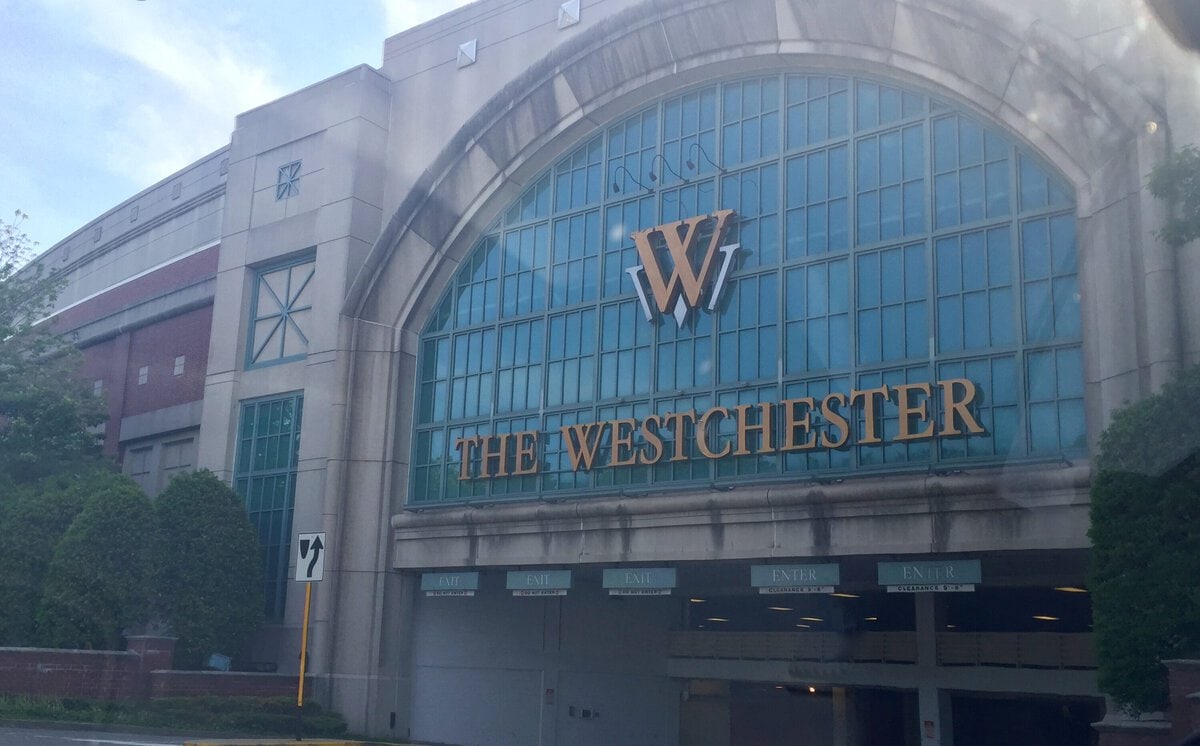
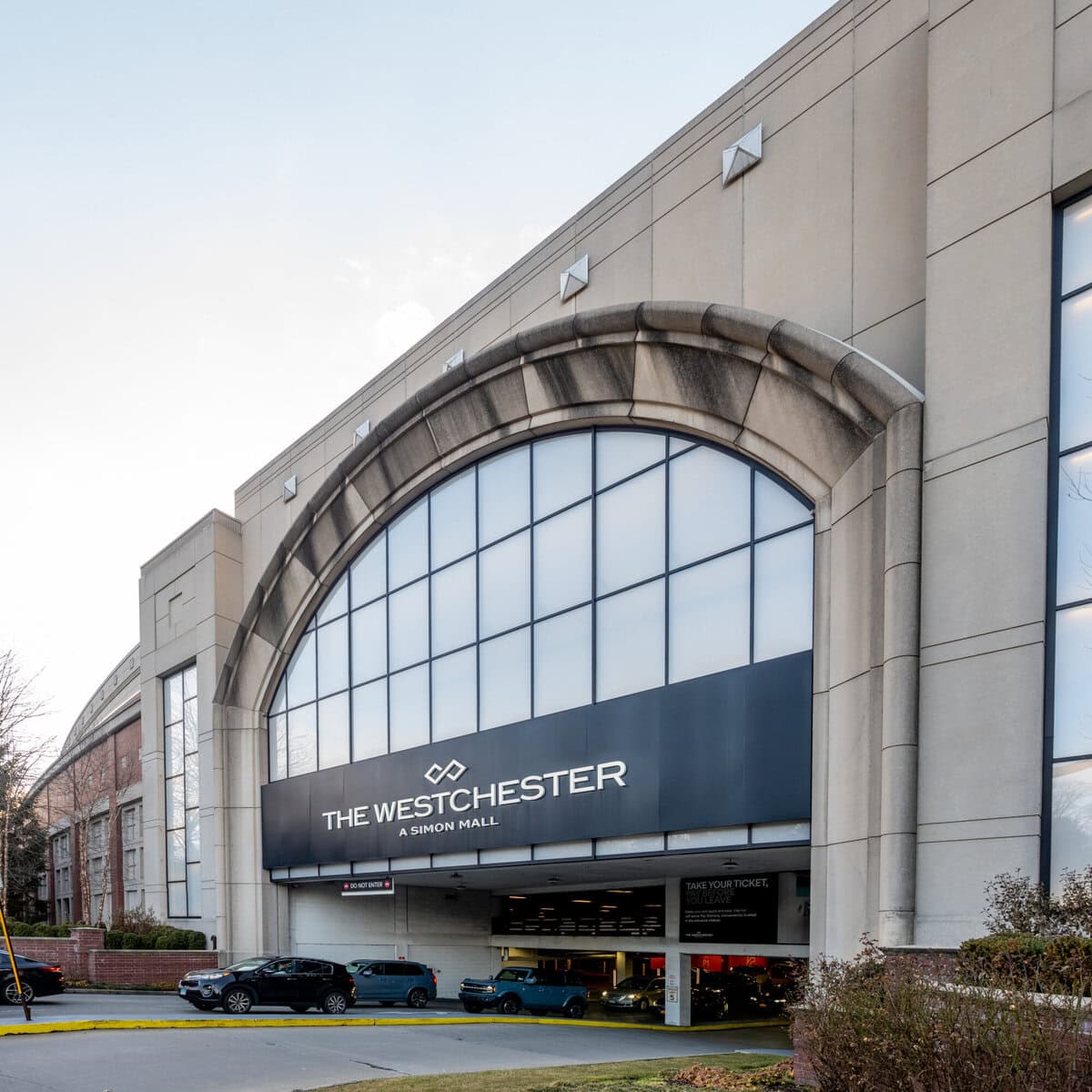
The Westchester is an upscale enclosed mall at 125 Westchester Avenue in downtown White Plains, New York, 25 miles north of the city.
It opened in 1995 with Nordstrom and Neiman Marcus, a $250 million project squeezed onto a tight downtown site.
For nearly 30 years it shared downtown with the Galleria at White Plains, which closed in 2023.
The Westchester stayed open.
In 2025 it still ran with around 150 stores and restaurants, from Tiffany and Gucci to a Level 4 food hall.
Saks Global put its Neiman Marcus on a closure list in March 2026, then took it back off within weeks.
The story is how a luxury mall built in a bad lending market became the enclosed one that stayed open after its downtown neighbor closed.
Here's how it got built, and why it's still busy.
Three anchors, then two
In 1989, the developers planning what would become The Westchester counted on three department stores to fill it: Nordstrom, Neiman Marcus, and B. Altman.
Nordstrom signed a letter of intent that year for a 200,000-square-foot store, the chain's first in New York State.
Then B. Altman went bankrupt, and the third anchor was gone before a wall went up.
The plan got redrawn around an L. Nordstrom would sit at one end and Neiman Marcus at the other.
A pod of specialty shops and a food court would do the work of a third anchor at the top of the L.
Planning had begun on April 1, 1989, in a downtown White Plains that sat 25 miles north of New York City and wanted its old place as the county's retail center back.
What stood on the land before
Long before the mall, the corner held a piece of White Plains retail history.
B. Altman & Co. first came to White Plains in 1930, then opened its Westchester Avenue store on the old railway terminal site in 1951.
It was part of a run of Manhattan department-store names that treated the city as a suburban outpost, among them Macy's, Saks Fifth Avenue, nearby Lord & Taylor, and Bloomingdale's.
Before Altman's, the same ground had carried the New York, Westchester & Boston Railway terminal, whose use there ended in 1937.
One anchor was already standing when planning began.
The Neiman Marcus on the site had opened in the 1970s as Bergdorf Goodman's only suburban branch, then changed its name.
Through the entire rebuild, that store stayed open while the site around it was torn down and remade.
Rezoning a site built for freestanding stores
The land had been zoned for freestanding retail, so an enclosed mall needed a rezoning, an environmental impact statement, and site plan approval.
The White Plains Common Council approved the site plan on June 17, 1991, and the rest of the approvals were finished by August 31, 1991.
Then came the land itself.
The development team assembled six parcels plus air rights, and the purchase closed on December 30, 1992.
The footprint came to about 12.1 acres, a tight downtown parcel for a regional mall.
Four foreign banks and a no-strike deal
Money was the hard part.
The early 1990s were a brutal time to finance a big retail project, and U.S. banks had pulled back.
So the $160 million construction loan came from four foreign banks: Bank of Montreal, Hypo Bank, Credit Lyonnais, and Sumitomo Bank.
The project required $100 million in owner equity, and CIGNA provided the permanent financing.
The lenders set terms. At least 125,000 square feet had to be preleased before they would commit.
They also wanted a written agreement from all 40 trade unions on the job: no strikes, no work stoppages, for the length of construction.
The developer spent about $2 million on early site work before the loan even closed.
Building on bedrock and a high water table
The first thing built was the garage, a 10-level precast concrete tower.
Construction started on January 4, 1993.
It had to go up first because the old Neiman Marcus garage needed to come down before crews could dig, so Neiman's customers were shifted to part of the old B. Altman garage in the meantime.
The site fought back. The northwest corner sat on solid bedrock with a 55-foot drop in grade.
The eastern edge stood only four feet above the water table, so excavation needed well points and a pumping station just to keep the hole dry.
Once the new garage had its certificate of occupancy, the B. Altman garage came down and construction on the rest of the mall began during the 1993 Christmas season.
Opening day at The Westchester, March 1995
The Westchester opened on March 17, 1995, with 829,000 square feet of leasable space packed into a downtown footprint.
Nordstrom opened a store the chain listed at 219,000 square feet, its first anywhere in New York State and part of a mid-1990s push east from its West Coast and New Jersey base.
Neiman Marcus was the renovated 143,000-square-foot anchor.
Between them ran about 141 inline stores, a 500-seat food court, and 3,200 structured parking spaces.
The layout followed the L. One leg had three retail levels, the other had two, with the food court and specialty pod set above the two-level section near downtown, so office workers and nearby residents could reach the dining without climbing through the whole building.
Marble downstairs, carpet upstairs
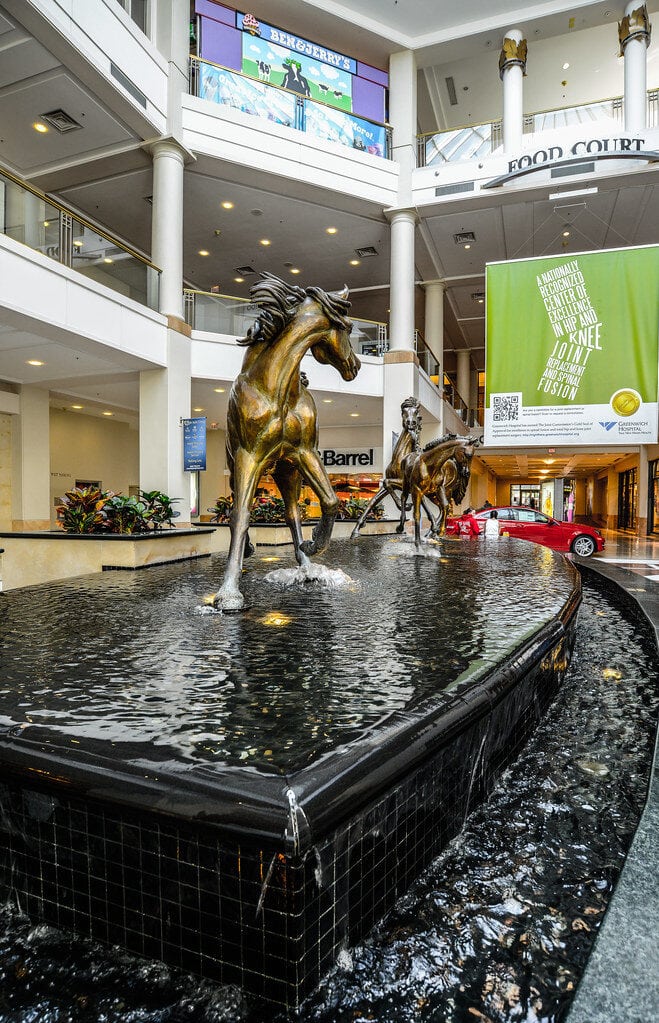
Inside, the mall stacked three retail levels under a fourth-level food court.
The ground floor used marble; the upper levels used carpet, chosen for hotel ambience and for a quieter walk than marble.
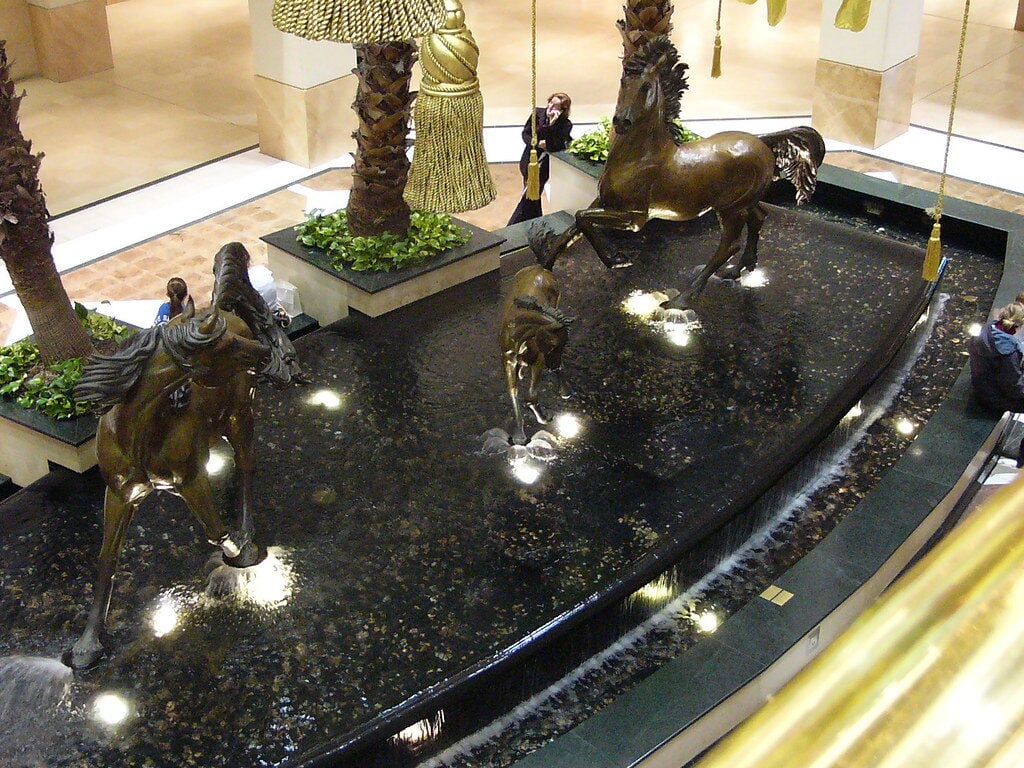
There were brass railings, fountains, skylights, vaulted ceilings, three domes, 14-foot Doric columns, and 10 sets of escalators.
The building also kept pieces of the city's past inside it.
One was an exhibit on the old New York, Westchester & Boston Railway terminal.
Another was a marble fountain carved in 1905 for B. Altman's flagship in Manhattan, brought in and set among the new stores.
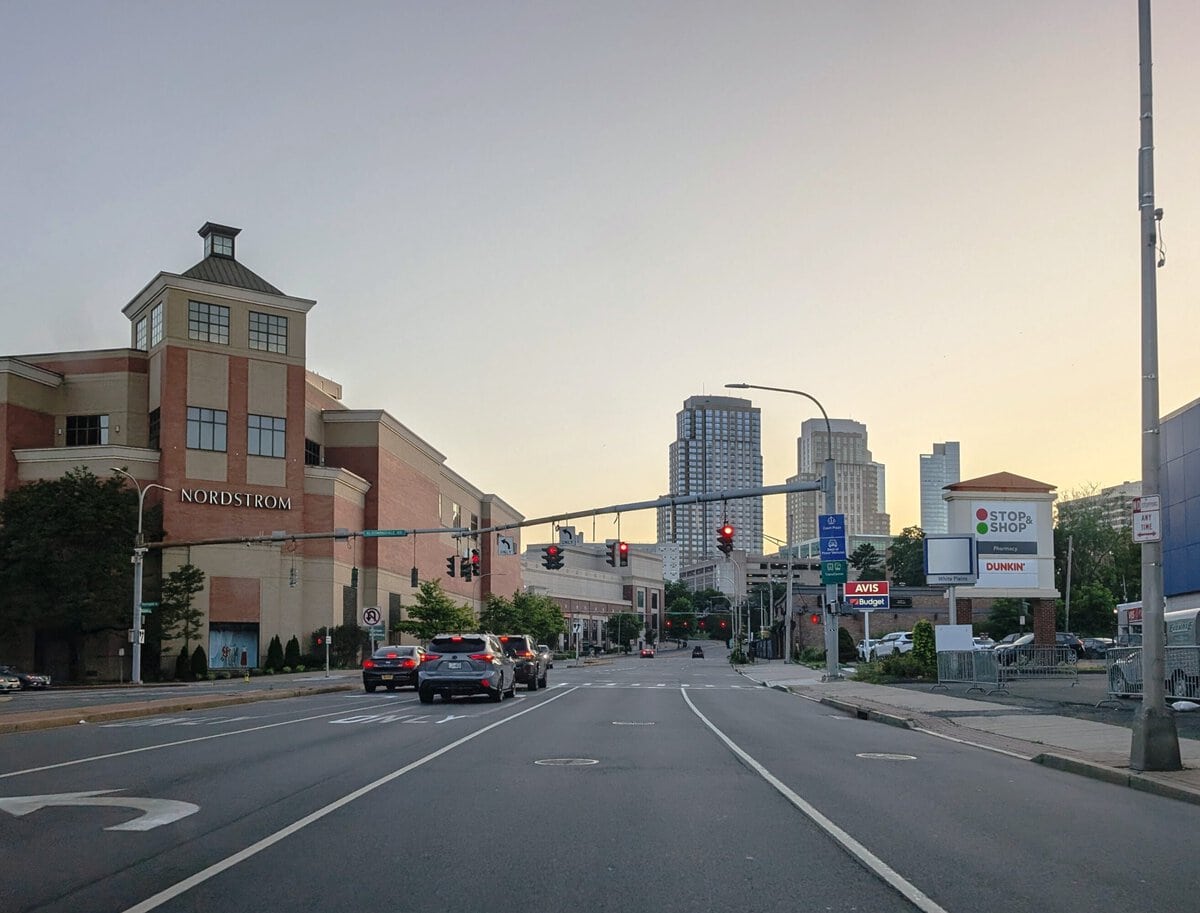
The exterior went neoclassical: red brick, precast concrete, arched entrances, and a curved Bloomingdale Road wall set back to hide the building's bulk.
A Barbie shop and a two-level Crate & Barrel
The store list leaned toward shoppers with money.
F.A.O. Schwarz took 15,000 square feet and ran a full Barbie shop inside it.
Crate & Barrel spread across 33,000 square feet on two levels.
Tiffany, Brooks Brothers, Williams-Sonoma, Abercrombie & Fitch, and Warner Bros.
filled in around them.
Clothing did most of the work.
Women's apparel alone ran to 28 stores and 101,600 square feet, the largest single category in the building.
Add the men's, children's, and family shops, and the place was, more than anything, built to sell clothes.
Simon takes over
The O'Connor Group built the mall and ran it in the early years, training the garage, security, and housekeeping crews before opening so the service matched what it had promised.
That arrangement did not last long. Simon Property Group bought into the property in 1997.
Ownership has stayed split since.
By 2025, Simon and Institutional Mall Investors, a venture tied to CalPERS, still held major stakes in the property, with Simon running the public side, from the website to the leasing to the store promotions.
The food court becomes a food hall
The first real overhaul came two decades in.
From 2015 to 2017 the owners spent about $59.8 million on the food court, common areas, exterior, parking, and valet.
The 2016 city review called it the first major upgrade since the mall opened in 1995.
The centerpiece was Savor Westchester, a fourth-level food hall that replaced the old food court.
It came with an outdoor terrace, built by pulling out the windows facing Armory Place and opening the space toward Tibbits Park.
A children's area called Play and a lounge called Connect opened first, in December 2016.
Play covered 2,300 square feet with a padded toddler zone; Connect had nine screens, iPad stations, and phone chargers.
Two malls, two tiers, one downtown
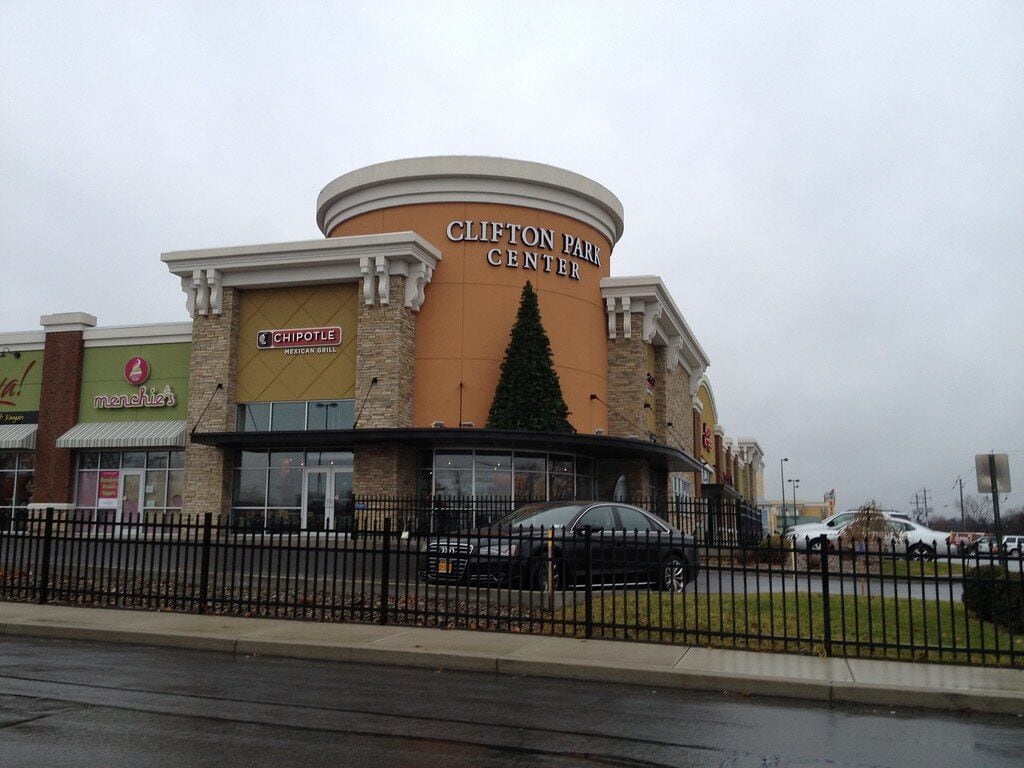
For nearly 30 years The Westchester shared downtown White Plains with the Galleria at White Plains, and the two sold to different shoppers.
The Galleria had Macy's, Sears, and middle-market stores.
The Westchester had Nordstrom, Neiman Marcus, and the luxury and home-furnishings names that came with them.
Its trade area reached well past the city, into northern Westchester, southwestern Fairfield County in Connecticut, Putnam, Rockland, Bergen County in New Jersey, and New York City.
At opening it held about 600,000 people with household incomes near $100,000.
White Plains also had a huge daytime pull, with workers and visitors later put at around 250,000, against roughly 58,000 residents.
In 2023 the Galleria closed, and The Westchester was left as the only enclosed mall standing in downtown.
A $400 million loan, then a COVID shutdown
By January 2020 the mall looked like a sure thing.
A $400 million refinancing closed that month, a 10-year, interest-only loan at 3.25%, secured against a property valued at $810 million in a late-2019 appraisal.
Inline stores under 10,000 square feet were selling $1,115 per square foot.
Apple had become one of the highest-grossing tenants in the building.
Then it closed. The Westchester shut on March 18, 2020, under COVID-19 orders and stayed dark until July 10.
Rent collection ran 79% that August.
A January 2021 appraisal put the property at $647 million, a $163 million drop from where it had stood before the pandemic.
Occupancy that fall slid to 89%, from 97% earlier in 2020.
On the closure list, then off it
In January 2026, Saks Global, then the parent of Saks Fifth Avenue, Neiman Marcus, and Bergdorf Goodman, filed for Chapter 11 bankruptcy.
In March it put the White Plains Neiman Marcus on a list of stores set to close in May, which would have opened a multi-level hole in a mall whose pitch still runs on department-store traffic.
The plan lasted about two weeks on paper.
On March 24, 2026, the company said it would keep the store open after talks with the landlord.
The same reversal saved two Saks Fifth Avenue stores in California and Florida, all three of them in Simon-owned centers.
Both of The Westchester's original anchors stayed put.
By June, it had emerged from bankruptcy as Exemplar Luxury Group.
Where The Westchester stands now
Both department stores are still open at 125 Westchester Avenue, the same two that opened the place in 1995.
Across downtown, the Galleria sits empty and slated for a redevelopment of about 3.4 million square feet and 3,000 apartments.
The Westchester ran around 90% occupied in 2026, with around 150 stores and restaurants.
The garage that had to go up before anything else still runs, gated and automated, $5 flat for the day, free for the first 20 minutes if you are only dropping someone off.
The food hall sits on Level 4, with Shake Shack where the old food court used to be and P.F. Chang's elsewhere in the building.
Nordstrom and Neiman Marcus still anchor the two ends, and on a weekday the downtown office crowd the mall was built for still walks in.
Independent Publisher Notice
BestAttractions is an independent editorial publisher. We are not affiliated with, endorsed by, or acting on behalf of any location, business, property owner, manager, government agency, or organization described in this article.
Comments posted on this page are not forwarded to, reviewed by, or acted upon by any entity mentioned in the article.
For official inquiries, complaints, applications, bookings, or other requests, please contact the relevant entity directly through its official website or other verified channels.