In 1975, thousands of balloons hung from the ceiling of a new shopping mall on Birmingham's east side. Some balloons had cash inside. People could grab one, pop it, and possibly get money.
This opening stunt showed what Century Plaza was meant to be. It was not just a place to shop or eat. It was meant to draw people in, give them something to do, and make the trip out to Crestwood Boulevard feel worthwhile.
Construction had been underway long enough that a Sears store on the west end opened early, on September 25, 1974, while the rest of the mall was still being built.
When the mall officially opened in August 1975, it covered 65 acres just off U.S. Route 78, near Interstate 20, across from the older Eastwood Mall.
The project cost $25 million. Workers removed more than 2.4 million cubic yards of earth from the site, and much of that soil was used in nearby interstate construction.
Building Century Plaza required moving a large amount of land to prepare the site.
Century Plaza Opens in Birmingham's Eastwood Area
Engel Realty Company developed the mall, with Marvin Engel, Jerome Leader, and James R. Bennett as the executives in charge. The architect was Crawford, Giattina & Mitchel.
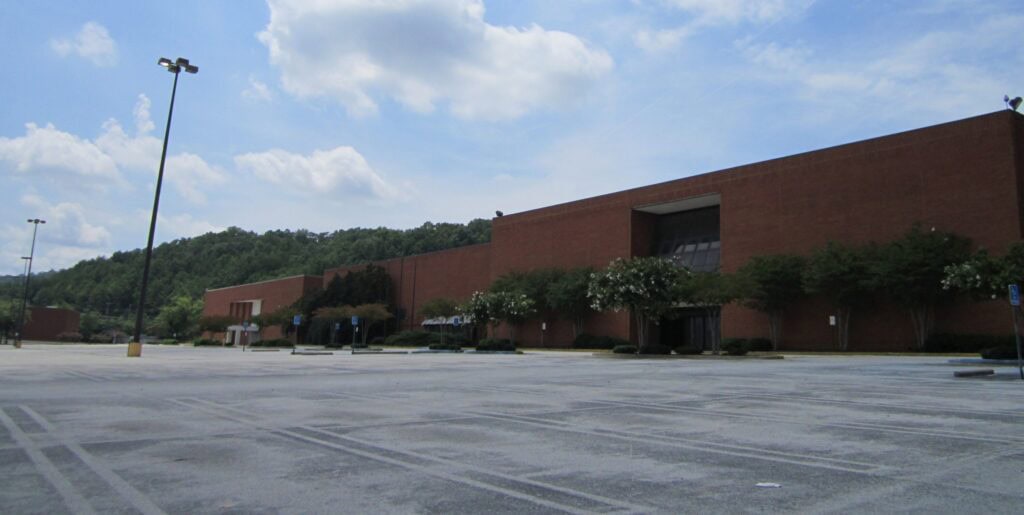
The original building had light-brown brick on the outside, brown tile floors inside, open stairways, angular fountains, and bronze-glass partitions - a very specific 1970s idea of what modern should look like.
The finished mall contained 743,785 square feet spread across two levels.
The four anchor stores placed at the cardinal points of the building were Sears to the west, Rich's to the south, JCPenney to the north, and Loveman's of Alabama to the east.
Between them, 90 tenants filled the inline spaces. Loveman's lasted until 1980, when Pizitz took over the east anchor box. Pizitz held that spot until 1987, when McRae's moved in.
The east anchor rotated through four different names across three decades before the building closed - Loveman's, Pizitz, McRae's, and finally Belk in 2006, which lasted less than a year.
A Full Commercial Ecosystem at Its Peak
By the 1980s, Century Plaza had taken the lead over the older Eastwood Mall across the street. Its mix of stores and restaurants shows how people shopped and spent money at the time.
The food options covered everything from quick bites to full meals: Baskin-Robbins, Chick-fil-A, El Chico, Morrison's Cafeteria, Orange Julius, Piccadilly Cafeteria, Sbarro, Shoney's, Subway, Wendy's, and York Steakhouse.
The mall also covered every major retail category that people expected. Shoes came from Foot Locker and Champs Sports.
Music stores included Camelot Music and Musicland, and books were sold at B. Dalton Booksellers. Electronics stores included RadioShack and Wolf Camera & Video.
Jewelry stores included Bromberg's and Things Remembered. Eyewear shops included LensCrafters and Pearle Vision.
Toy stores started with Circus World and later became Kay-Bee Toys. Clothing stores included The Gap, Express, The Limited, Lane Bryant, Casual Corner, and Victoria's Secret.
There was also Aladdin's Castle for games, plus Spencer Gifts and Karmelkorn.
In 1990, the mall interior was redone with brighter finishes and more skylights. Century Plaza was not a minor or temporary space.
It was a complete regional shopping center and an important part of Birmingham's east side retail scene.
Santa Claus, Enchanted Penguins, and a City's Traditions
By the 1970s, many of Birmingham's older downtown Christmas traditions had migrated to the suburban malls. When Loveman's closed, Rich's picked up the "Breakfast With Santa" event.
Century Plaza was specifically named among the Birmingham malls where the Santa-photo culture had taken root by 2005.
A stranger and more specific story attaches to the mall's relationship with downtown Birmingham's past.
After the downtown Pizitz department store closed, animated figures from Pizitz's famous Enchanted Forest holiday display were kept alive at various locations.
Some ended up at McRae's, which was occupying the old Pizitz spot in Century Plaza's east anchor. Later, others moved into the mall itself.
As late as the 1999 Christmas season, a group of original Pizitz penguins - mechanical figures that had delighted Birmingham shoppers for years downtown - was still moving in Century Plaza's center court.
That is a small detail, but not a trivial one.
The mall had become a container for things the city could not quite let go of, a place where Birmingham's retail memory accumulated alongside the regular inventory of Gap hoodies and Sbarro slices.
The Summit Opens, and the Anchors Begin Leaving
The opening of The Summit in 1997 pushed Birmingham's retail market past saturation. Both Eastwood Mall and Century Plaza felt it.
The city already had more enclosed mall square footage than its population could support, and The Summit - an upscale open-air center on the other side of town - pulled shoppers and tenants in a new direction.
The decline at Century Plaza moved in steps. Rich's was rebranded Rich's-Macy's in 2003, part of Federated Department Stores' plan to convert its entire chain to the Macy's name.
The Rich's-Macy's at Century Plaza closed after only one year and never made it to the Macy's rebrand. Piccadilly Cafeteria also closed in October 2003.
When Eastwood Mall across the street closed in 2004, two of its former tenants - Books-A-Million and Parisian - had discussed relocating to Century Plaza, but those plans did not come through.
JCPenney left in 2006. Belk, which had just converted the McRae's space, also closed in 2006, the same year it moved in. By 2006, JCPenney and Belk had both relocated to newer shopping centers in Trussville.
General Growth Properties, which had bought the mall in the 1990s for $32 million, was watching its asset empty out anchor by anchor.
Empty Halls and a Parade of Plans That Went Nowhere
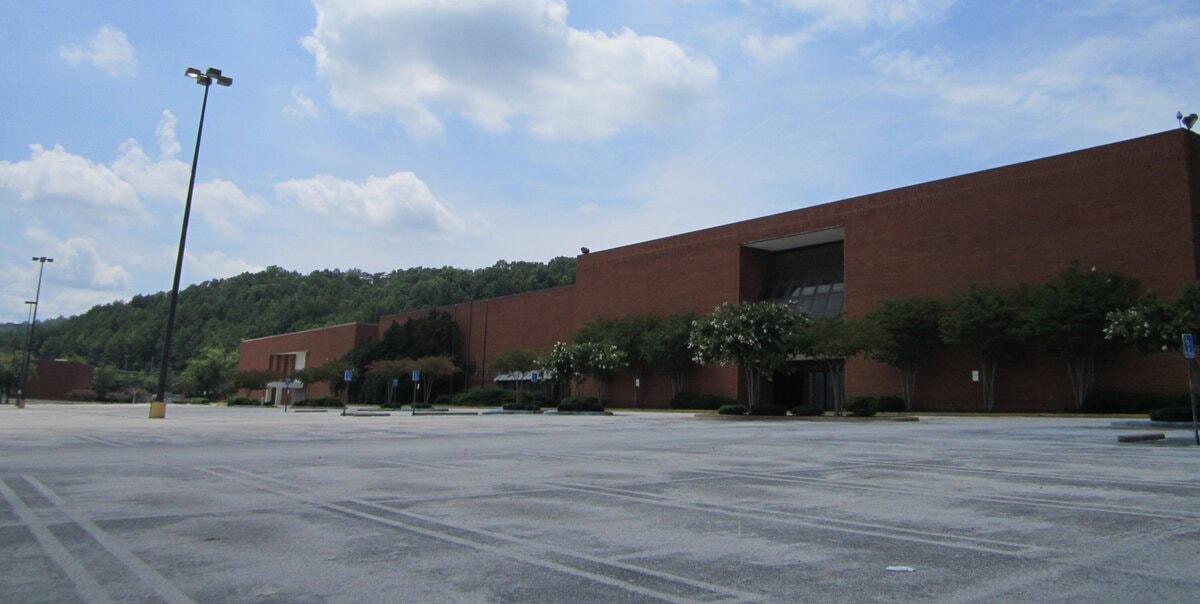
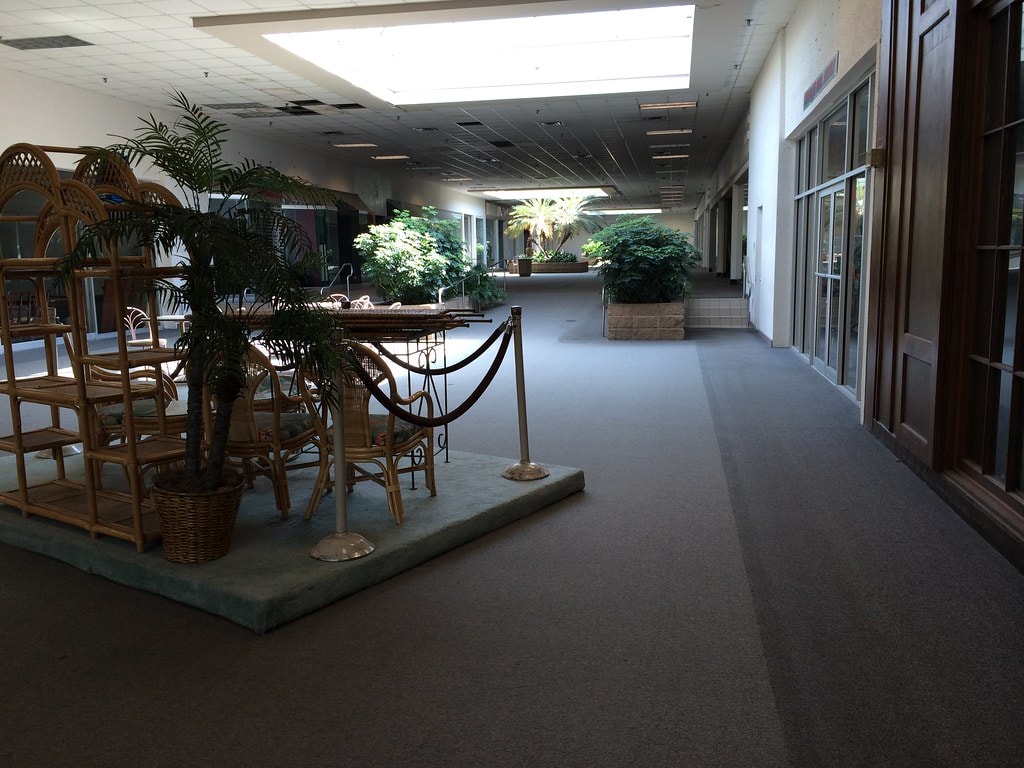
Century Plaza closed on May 31, 2009. Fewer than 40 stores were still open when the lights went off - Foot Locker, Champs Sports, Finish Line, and RadioShack among them.
Sears, which owned its own portion of the building, stayed open a few weeks longer to finish its liquidation and closed on June 14, 2009.
What followed was eleven years of announcements and reversals.
In October 2008, while the mall was still open, Mayor Larry Langford proposed that the city and Jefferson County buy it and convert it into a senior-citizens recreation center.
In December 2008, about 20 artists staged a revolving exhibition called "Everything Must Go" inside the nearly vacant building.
After closure, General Growth and later Howard Hughes Corporation - which took possession after General Growth's bankruptcy - discussed turning the site into a county jail or regional municipal justice center.
Those talks ran from 2010 into 2011 and then died. By 2014, the brick veneer on the exterior was coming loose, and the owner put up a safety barricade.
In 2017, Pastor Thomas Beavers announced plans to relocate New Rising Star Church to the former mall and open the Star Academy charter school there.
That same year, Gregory Gerami of Arlington, Texas, announced a plan to invest $480 million in an entertainment resort with an indoor water park, laser tag, paintball, and bowling.
Neither plan advanced. In January 2018, Lumpkin Development of Pelham bought the property for $3 million and began converting the old Sears building into Metro Mini-Storage.
Stonemont, Project Magic, and What Replaced Century Plaza
Stonemont Financial Group of Atlanta brought the plan that finally ended the waiting.
"Project Magic" called for demolishing Century Plaza entirely and building a 201,500-square-foot Amazon last-mile delivery center in its place.
Birmingham City Council rezoned the parcel to allow it. Stonemont bought the property from Lumpkin for $12 million - four times what Lumpkin had paid three years earlier.
The total development cost came to $60 million. Brasfield & Gorrie won the construction contract at $36,928,000.
Demolition began in November 2020.
A television crew filmed workers tearing down the Sears building on November 10.
The new facility - officially Amazon DBM5, the Eastwood Amazon Distribution Center - replaced Amazon's older North Birmingham distribution center.
Brasfield & Gorrie's project records, which include photographs dated February 17, 2022, document the completed building.
The original plan called for more than 320 associates and managers inside the building and more than 1,400 delivery drivers operating out of it.
In 2024, Amazon contracted to install 155 electric-vehicle charging stations at the site.
The 65 acres where Birmingham shoppers once grabbed cash-filled balloons from a mall ceiling now processes packages around the clock.