The Americana at Brand, a site picked by the plan
Glendale planned The Americana at Brand through a public process that began in the mid-1990s and produced the Greater Downtown Strategic Plan in 1996, known as the Cooper Report.
The plan treated Brand Boulevard as a one-mile office and retail corridor and identified a gap near its southern end.
It described a two-block-wide stretch of underdeveloped land between Brand Boulevard and the Glendale Galleria, an indoor mall built in the 1970s and expanded in the 1980s.
The Cooper Report proposed a "Town Center" on that site to serve as a southern anchor for downtown.
Architectural drawings in the report, prepared by Moule and Polyzoides Architects and Urbanists, showed a street-based layout with blocks and connections, rather than an enclosed mall arrangement.
The proposed site had been in regular commercial use for decades.
Properties on the assembled footprint had included the Capitol Theatre, a Pep Boys Auto Supplies store, Western Auto Supply Company, and other small commercial buildings.
By the mid-2000s, the area showed a visible decline, with vacant storefronts and closed tenants. Former spaces associated with Tower Records and The Good Guys sat without replacement.
Vacant blocks, land deals, and a fight
The Greater Downtown Strategic Plan was adopted in 1996, and the Town Center proposal followed with land acquisition.
In 1996, the Glendale Redevelopment Agency began buying parcels within the proposed footprint so the site could be assembled for redevelopment.
The agency issued a formal solicitation for a developer to build the Town Center. Rick J. Caruso and Caruso Affiliated were selected.
Caruso Affiliated had developed The Grove, an outdoor retail center in Los Angeles.
The selection brought sustained opposition. General Growth Properties, the owner of the adjacent Glendale Galleria, opposed the project and used political and legal challenges to try to block it.
The dispute continued for roughly four years. Some merchants along Brand Boulevard and inside the Glendale Galleria said the project would divert shoppers from existing stores.
Some residents focused on the scale of the development and the expected effects on traffic, and argued it would change Glendale's established suburban character.
2004 vote, lawsuits, and why it's called Americana at Brand
The project went to a public vote in September 2004. Glendale residents narrowly approved the Caruso proposal in a referendum. General Growth Properties continued its opposition in court.
In November 2005, the Los Angeles Superior Court rejected the company's legal challenge, removing the final barrier to the development.
During the approval process, Caruso Affiliated ran a public outreach campaign that included a contest to name the project.
The chosen name was "Americana at Brand," a reference to Leslie Coombs Brand, whose name is attached to Brand Boulevard.
Brand was born in Missouri in 1859 and moved to California in 1886. Around 1906, when Glendale incorporated with about 550 residents, Brand was already active in developing the area.
Earlier, he had partnered with Henry E. Huntington in the San Fernando Valley Land and Development Company and helped extend the Pacific Electric Railway line to Glendale in 1904.
In 1903-1904, Brand commissioned his brother-in-law, architect Nathaniel Dryden, to build a mansion called "El Miradero," translated as "a high place overlooking an extensive view."
The design drew from the East Indian Pavilion displayed at the 1893 World's Columbian Exposition in Chicago and used crenellated arches, domes, and minarets in a Saracenic style.
Brand and his wife later left the mansion to the city. It became the Brand Library.
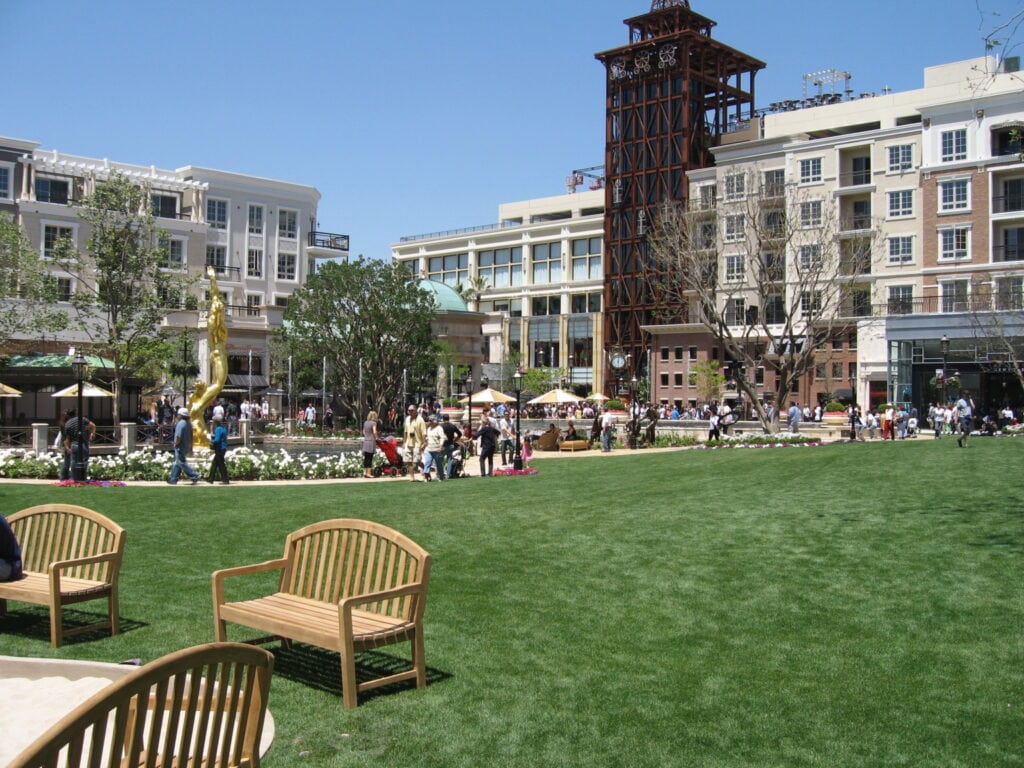
Eclectic streets, trolley loops, and green
The design phase brought in several firms and a clear internal lead. Elkus Manfredi Architects was credited for the project.
Harley Ellis Devereux served as the architect of record. David Williams, vice president for design at Caruso Affiliated, guided the overall look and the way the parts fit together.
Early references included Boston's Newbury Street and traditional town squares. The finished buildings combined multiple styles in one place.
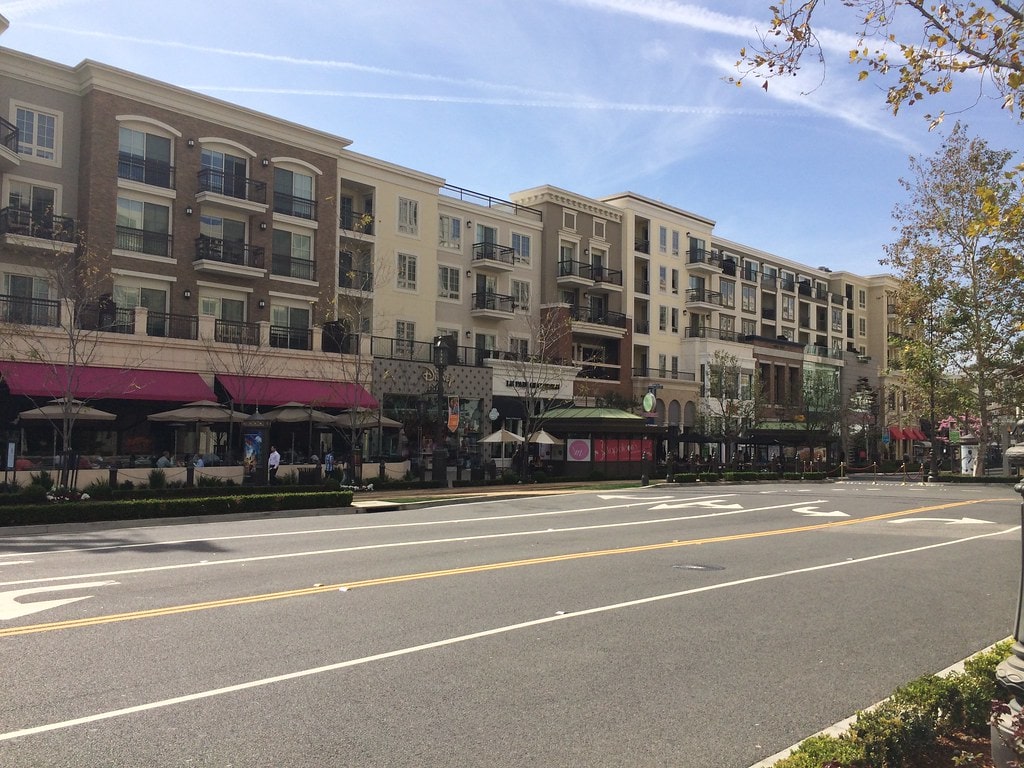
The primary elevator tower for the parking garage used an exposed steel frame. The condominium building used French Empire elements, including mansard roofs and decorative detailing.
A restaurant wing was composed in an Art Deco manner and finished with a patinated dome. Other facades used Neo-Georgian cues, including brick walls, precast concrete cornices, and traditional balcony rails.
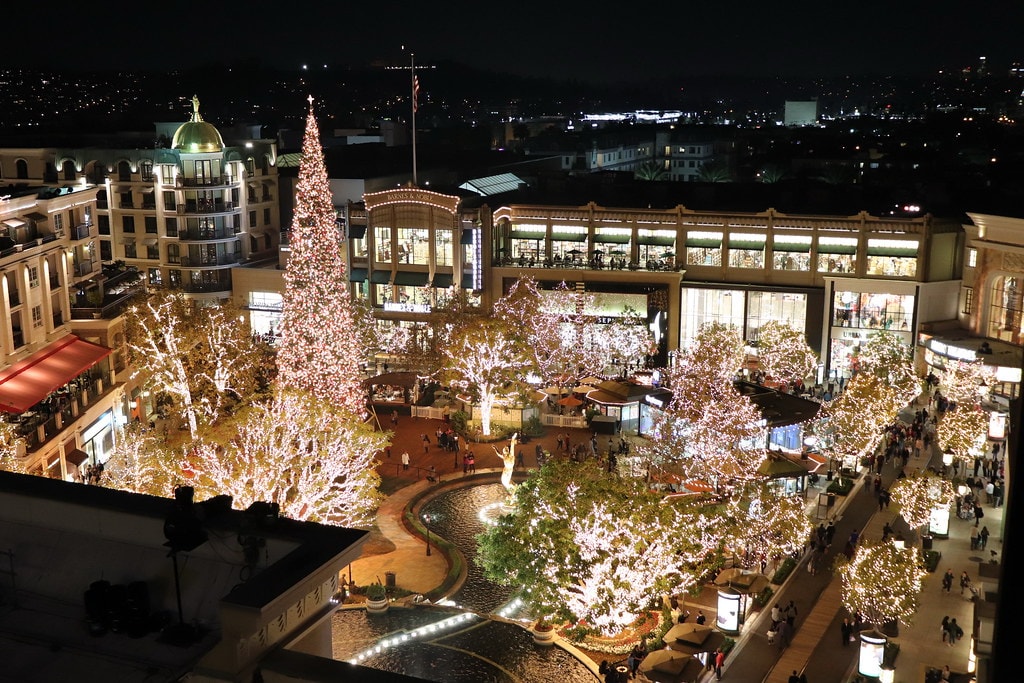
A two-acre green was placed at the center of the site. It was landscaped with mature trees and built out with a fountain designed by WET Design.
The fountain runs choreographed musical shows on the hour and operates non-musical programs between scheduled performances.
At the center of the fountain is a gold-leaf sculpture, a cast reproduction of Donald Harcourt De Lue's 1949 work "The Spirit of American Youth Rising from the Waves," originally installed at the Normandy American Cemetery in France.
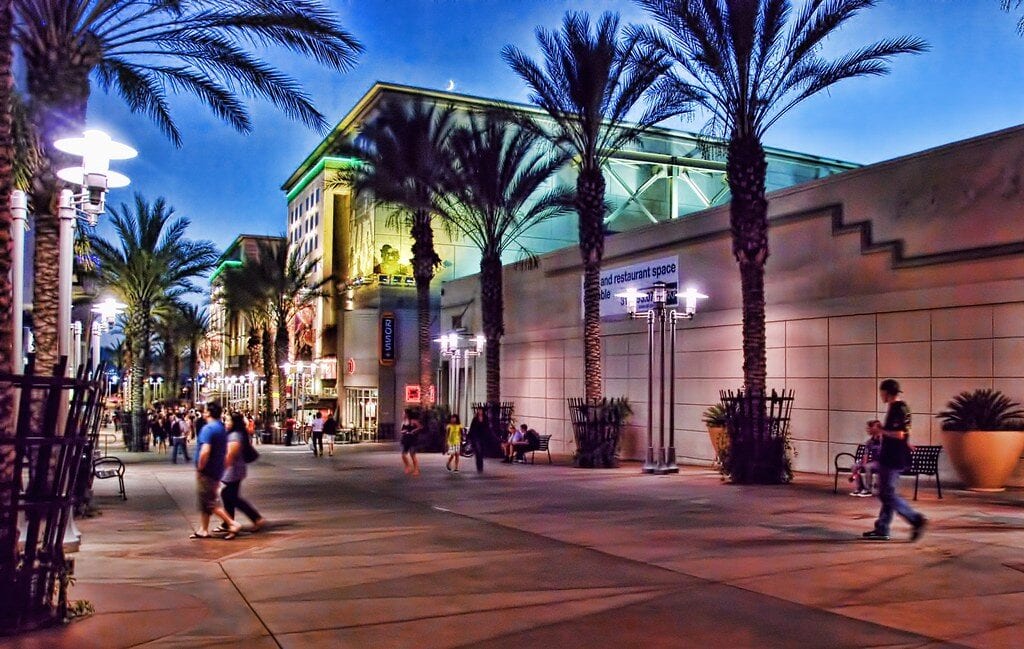
The public areas also included Victorian-style pedestrian lighting, specialty brick paving, vintage-inspired neon blade signs, and faux-fresco artwork in public lobbies.
The site was laid out to move people through it in several ways. A red trolley car circulates around the property and briefly travels onto Brand Boulevard.
Three building clusters face Brand Boulevard with two internal streets aligned to the downtown grid.
Those streets continue as pedestrian routes to the central green. A pedestrian arcade passes through the condominium building with interior sidewalk café-style dining and connects to a secondary Nordstrom entrance.
May 2008 opens with fountains and fashion
After the court fight, the project could finally be built.
It carried a development cost above $400 million and occupied 15.5 acres bounded by Brand Boulevard, Colorado Street, Central Avenue, and the Glendale Galleria, with parking for more than 2,700 vehicles.
The Americana at Brand opened May 2, 2008. It arrived with an 18-screen Pacific Theatres complex, plus Barnes & Noble and about 75 retailers.
The Los Angeles Times dubbed it a "Grove on steroids," and the opening mix leaned upscale: A/X Armani Exchange, Barneys New York CO-OP, BCBG Max Azria, Calvin Klein, J. Crew, Juicy Couture, Kate Spade, and Tiffany & Co.
It also pulled in H&M, Urban Outfitters, and Anthropologie, with storefronts designed to read like standalone shops, not mall modules.
Dining played anchor, too, with The Cheesecake Factory.
Industry groups handed out praise: Chain Store Age, the Gold Nugget awards at the Pacific Coast Builders Conference, the California Redevelopment Association, and the International Council of Shopping Centers all recognized the project.
The green was public property, but it ran on private protocols.
A private security force patrolled, professional photography required permission, and Grove-style rules applied: no bikes or skateboards, no dogs over 25 pounds.

Homes above shops, balconies, and boom
The Americana at Brand opened as a mixed-use complex with housing built above retail and dining. The residential program included about 240 rental apartments and 100 luxury condominium units.
The units were grouped into small clusters, described as mini-neighborhoods of about 25 homes each.
Many of the clusters were connected by interior courtyards or internal corridors.
The housing was integrated into the same buildings as the shops, but it was operated on separate paths.
Residents entered through dedicated doors and used separate parking from the retail visitors. The property offered complimentary concierge services.
Residential lobbies and shared interior spaces were finished as part of the overall development and sat above the storefront level.
All units included a private outdoor space. Some were fitted with bedroom balconies about four feet wide facing Brand Boulevard. At opening, reported monthly rents ranged from about $2,060 to $5,500.
In the decade that followed, downtown Glendale added more than 3,000 residential units across more than 20 nearby projects.
Nordstrom grows, temple revived, and offices
Success brought expansion, and expansion brought demolition. In 2011, Caruso Affiliated bought and cleared the adjacent Golden Key Hotel site, about an acre, to make room for a larger Nordstrom.
Callison, later known as CallisonRTKL, designed the replacement store. The three-level, midcentury modern building opened in September 2013 at roughly 135,000 square feet.
It included the Bar Verde restaurant and Nordstrom's updated beauty and tech features, with an entrance near the southeast corner of the green. Caruso also pushed into adaptive reuse.
In 2015, the company bought Glendale's landmarked Masonic Temple, a nine-story Art Deco building completed in 1928 and designed by Arthur G. Lindley, who had also designed the Alex Theatre in 1925.
It had served six Masonic organizations, then sat largely vacant for more than 30 years, and housed A Noise Within from 1991 to 2011.
The restoration ran 10 months under Tom Veje and David Williams. Lindley's plan prized privacy, with double-height ceremonial rooms and few windows.
Caruso added 18 new, 20-foot-tall windows, restored original front windows, and converted the vaulted cathedral-trussed penthouse into a meeting room with stadium seating.
CBRE took four floors, while the ground and basement remained unoccupied.
AMC screens and a luxury-level reset
The Americana at Brand opened with an 18-screen Pacific Theatres cinema. In 2020, the theater closed during pandemic shutdowns, and then Pacific Theatres filed for bankruptcy.
AMC acquired the lease in July 2021 and reopened the location in August 2021 as AMC The Americana at Brand 18. The renovation kept 18 screens and added IMAX with LASER 3D, Dolby Cinema at AMC, and RealD 3D.
On November 6, 2021, Netflix opened an official Stranger Things store at the Americana, described as one of two locations worldwide at the time.
The space was about 7,000 square feet and was built with themed areas, including Joyce's House, Starcourt Mall, the Palace Arcade, the Upside Down, and the Russian Lab.
Staff appeared in costume as Scoops Ahoy employees, Demogorgons, and Russian guards.
By 2023, the tenant mix moved further into luxury brands.
Chanel, Saint Laurent, and Gucci opened, followed by Bottega Veneta, Byredo, David Yurman, Golden Goose, and Omega, with anniversary benefits promoted through Caruso Signature.
In October 2024, Louis Vuitton opened a roughly 4,500-square-foot store. That month, Skyline Pitch opened as a 25,000-square-foot open-air rooftop soccer facility on the top level of the parking structure.
In November 2025, Paradise Dynasty and Le Shrimp Noodle Bar replaced Din Tai Fung.

Life on the green in 2026
As of January 2026, The Americana at Brand operates on standard posted hours. It is open Monday through Thursday from 10 am to 9 pm, Friday and Saturday from 10 am to 10 pm, and Sunday from 11 am to 8 pm.
The tenant mix includes more than 80 businesses. Nordstrom remains a primary anchor.
Barnes & Noble operates a three-story bookstore, with most of its inventory on the third level. Other major tenants include the Apple Store and Nike.
Dining options include The Cheesecake Factory, Mendocino Farms, Shake Shack, Chick-fil-A, Eggslut, and Crumbl Cookies, along with additional restaurants and food counters.
The central green remains the main gathering space. The fountain designed by WET Design runs choreographed musical shows on the hour and operates non-musical programs between scheduled performances.
Seasonal and scheduled events include free yoga sessions, holiday celebrations such as tree lightings, and appearances by Santa Claus and the Easter Bunny.
The property also hosts live music performances, fashion events, and limited-edition automotive displays. Visitor traffic is drawn from across the Los Angeles region.
The overall condition of The Americana at Brand comes across as very good: public areas look clean, the landscaping on the central green is kept up, and the place generally presents like it is being actively managed rather than merely left to coast.