
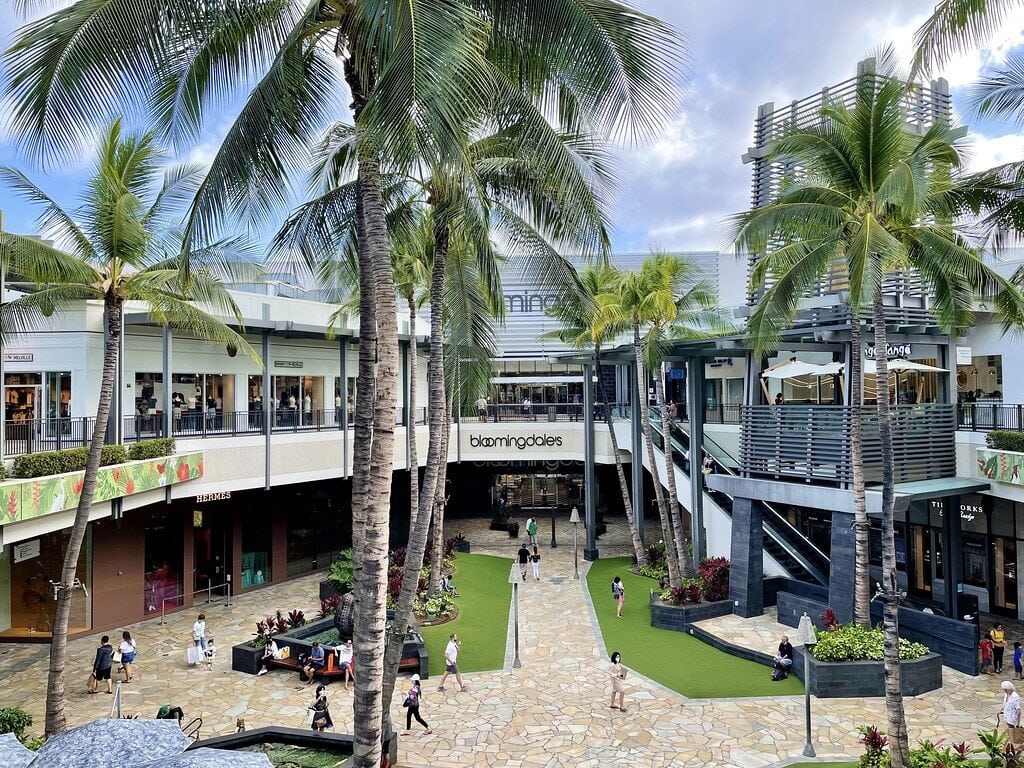
Stand in one of the open walkways at Ala Moana Center on a warm afternoon in Honolulu. Trade winds blow in from the ocean.
Coconut trees rise through openings in the deck above. Nearby, a hula dancer performs to live music. That is part of everyday life at Ala Moana Center.
The center has been one of Honolulu's main commercial and social gathering places since August 1959. It stands at 1450 Ala Moana Boulevard.
More than 350 shops and restaurants fill 2.4 million square feet of open-air space, making it one of the largest open-air shopping centers in the world.
About 52 million people pass through the center each year. Some are visitors from far away.
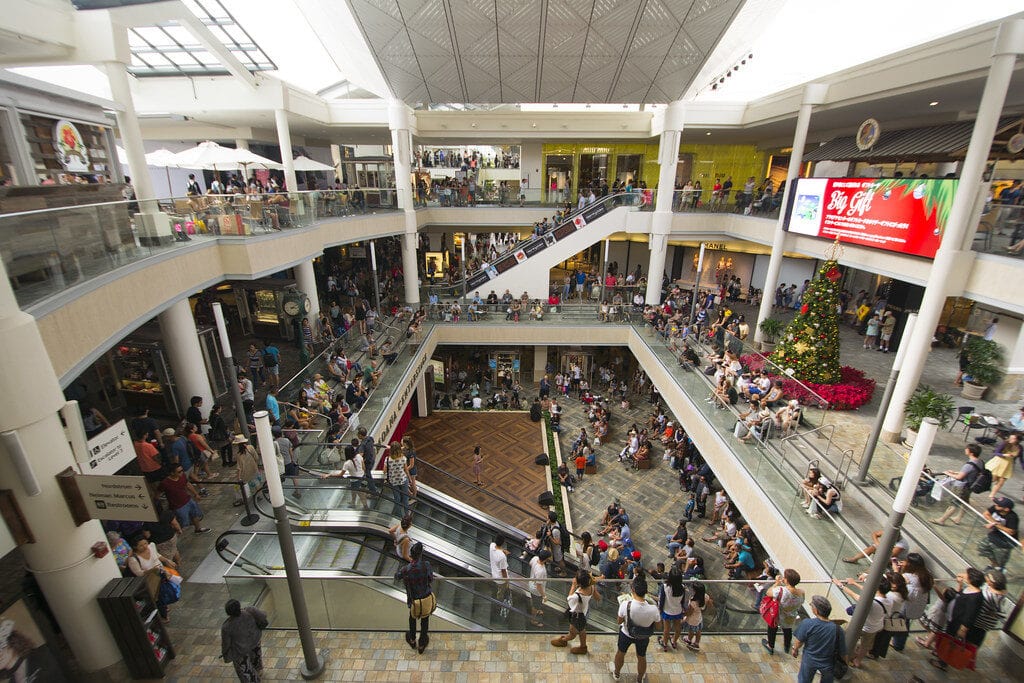
Many are local residents doing what people in Honolulu have done here for decades: walking the open corridors, watching the city around them, and stopping at Centerstage at 5 pm for the free daily hula show.
Ala Moana Center is more than a place to shop. It is also a familiar part of daily life in Honolulu. That mix of uses has kept it at the center of the city's life for more than 60 years.
How Ala Moana Center Was Built on Former Swampland
The name "Ala Moana" means "pathway to the sea." That fits the shopping center that exists today, but it would not have fit the site in its earlier form.
Before any stores were built, the land at 1450 Ala Moana Boulevard was a marshy wetland along the south shore of Honolulu.
In 1884, the 50-acre property was put up for sale under the will of Princess Bernice Pauahi Bishop because it was viewed as land with no real value.
In 1912, businessman Walter F. Dillingham bought the swamp for $25,000. He then used coral from nearby dredging work to fill the wet ground and turn it into solid land.
The idea for development came from Walter's son, Lowell Dillingham. He began planning a shopping center on the reclaimed site in 1948.
The main obstacle was getting downtown merchants to leave established business districts and move to a new location near the water that had not yet proven itself.
Getting Sears to commit as an anchor store made the project possible.
Sears agreed to move with one condition. The new center also had to accept many of the smaller stores located around the Sears store downtown.
That is how a group of local businesses became part of Ala Moana before the center opened.
Eighty Stores Opened Beneath a Giant Lei
Ala Moana Center opened on August 13, 1959, about a week before Hawaii became the 50th state. Community leaders took part in the opening ceremony, and a 40-foot maile lei hung across the entrance.
The first section of the center contained about 680,000 square feet on two levels. It opened with around 80 stores.
Sears stood on the Ewa side, and the Japanese department store Shirokiya stood on the Diamond Head side. The site also included 4,000 parking spaces for the large crowds expected at the new center.
Its size mattered, but the design also made it different. Architect John Graham and his firm planned a two-level complex with gently sloped roofs that angled away from the Pacific Ocean.
Wide roof overhangs helped keep the walkways shaded. Coral stone and breeze-block details appeared throughout the structure.
The center was designed as an outdoor place where people could move through comfortably.
Coconut trees rose through openings in the upper deck. Koi ponds and water gardens lined the corridors and added to the open, relaxed setting.
There was also an aviary, play areas for children, and original artwork by local artist Edward Brownlee.
The goal was to build a public outdoor space that fit life in the islands, not a standard commercial building copied from somewhere else.
Doubling the Size and Reaching for the Sky
An expansion added Ala Moana Tower in 1961, a 24-story office building that was Honolulu's first office tower higher than seven stories.
At the top was La Ronde, a revolving restaurant. The dining room turned around a fixed central core. It seated 162 diners and gave them wide views of the city.
The original Ala Moana Center was a hit so quickly that developers moved ahead with Phase II well ahead of schedule.
By 1966, the expansion had roughly doubled the center's size to 1,351,000 square feet and 155 stores, with 7,800 parking spaces and two new anchor tenants - Liberty House and JCPenney - added to the roster.
That made Ala Moana Center the largest shopping center under one roof in the entire United States.
Shirokiya, one of the original 1959 anchors, moved to a larger location as part of the expansion.
The whole pattern of Phase II showed how completely the center had already reshaped Honolulu's commercial landscape.
Within just a few years of opening, the old downtown retail districts had lost their pull, and Ala Moana had become the place where the city came to shop.
New Owners and a Push Into Luxury Retail
The changes after the mid-1970s focused on adding height and moving the center toward a higher-spending audience.
JCPenney added a fourth level in 1976, lifting leasable area to 1.4 million square feet, and Liberty House followed with its own fourth floor in 1980, bringing the total to 1.5 million square feet.
In 1982, a partnership between Daiei Hawaii Investments and Equitable Life Assurance bought the center for around $300 million and invested $15 million in renovations.
The Makai Market Food Court opened in 1987 with 19 international food vendors and more than 900 seats, filling space freed by Woolworth and Foodland relocations.
A large 1990 redevelopment reconfigured significant square footage.
It rebuilt Center Court as a luxury destination, filling it with brands including Christian Dior, Gucci, and Emporio Armani to attract the wave of Japanese high-end shoppers visiting Hawaii.
Daiei bought out its partner's 40 percent stake in 1995 for $410 million.
The following year, a fifth expansion phase began to accommodate Hawaii's first Neiman Marcus, which opened in September 1998 as the center's fourth anchor.
It completed a transformation from a locally oriented shopping center into one of the premier luxury retail destinations in the Pacific.

A Billion Dollars and a Center Reborn
In 1999, General Growth Properties bought Ala Moana Center for $810 million, having managed the property for the previous 12 years.
GGP added more than 30 stores to the upper level and opened a four-level parking deck with over 2,000 stalls in 2001.
After JCPenney closed in 2003, developers began subdividing its more than 180,000 square feet for new stores and restaurants.
A separate expansion plan, announced in 2004, later brought Hawaii's first full-line Nordstrom to Ala Moana.
Groundbreaking came in 2006, and the new wing opened in March 2008, adding roughly 300,000 square feet and drawing more than a thousand people on opening day.
In 2013, GGP began the largest transformation of the modern era.
A rebuilt Center Court and new Centerstage opened in November 2013, and the Ewa Wing - a three-level, 650,000-square-foot addition anchored by a 167,000-square-foot Bloomingdale's - opened on November 12, 2015.
Nordstrom relocated there in March 2016, and Foodland Farms returned that August, echoing one of the original 1959 tenants.
GGP invested close to $1 billion between 2012 and 2016. Brookfield Property Partners took over in 2018.
In October 2017, Target opened in the former Nordstrom space on the mauka side, becoming Hawaii's only two-story Target at the time.
Later that year, The Lanai opened in the former Shirokiya space as a new dining hall.
By 2019, the center had reached 2.4 million square feet with 52 million visitors a year, and change keeps coming - including the March 2026 announcement that Neiman Marcus would be closing after 28 years at Ala Moana Center.

Independent Publisher Notice
BestAttractions is an independent editorial publisher. We are not affiliated with, endorsed by, or acting on behalf of any location, business, property owner, manager, government agency, or organization described in this article.
Comments posted on this page are not forwarded to, reviewed by, or acted upon by any entity mentioned in the article.
For official inquiries, complaints, applications, bookings, or other requests, please contact the relevant entity directly through its official website or other verified channels.