
Chicago Place stands at 700 North Michigan Avenue in Chicago, Illinois, in the Near North Side neighborhood of Cook County.
It sits at the intersection of Michigan Avenue and Huron Street on the Magnificent Mile, a heavily developed shopping area in the United States.
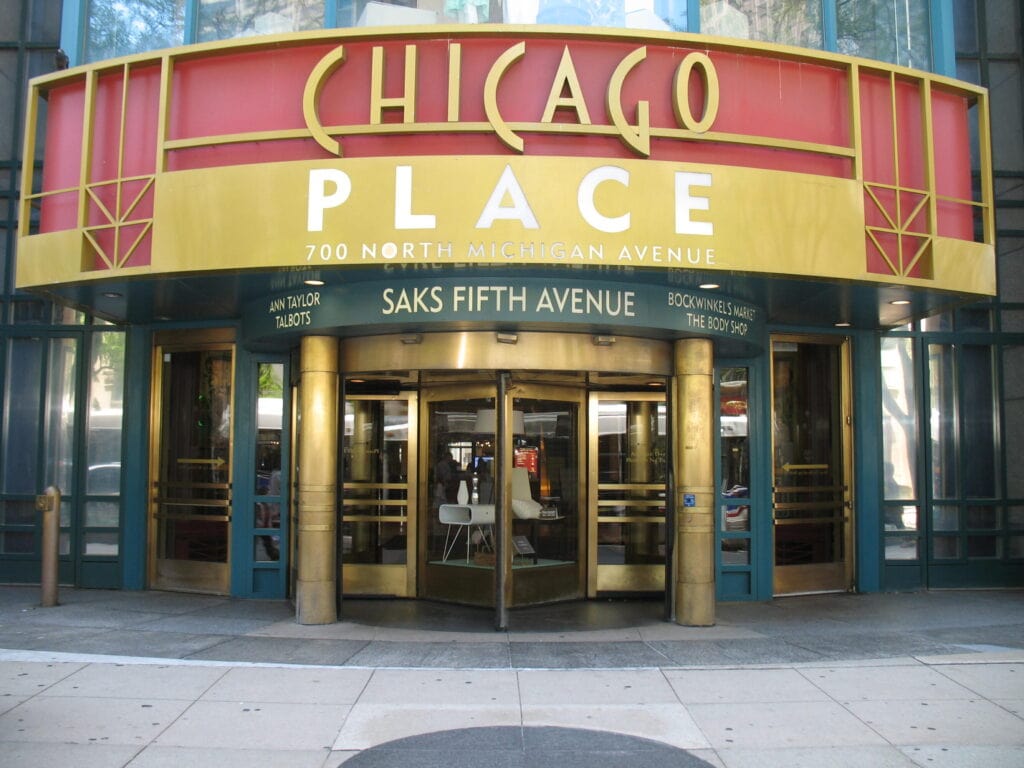
The building combines retail and residential uses, with street-level stores led by Saks Fifth Avenue and Zara, and serves customers from the Gold Coast, River North, and downtown Chicago.
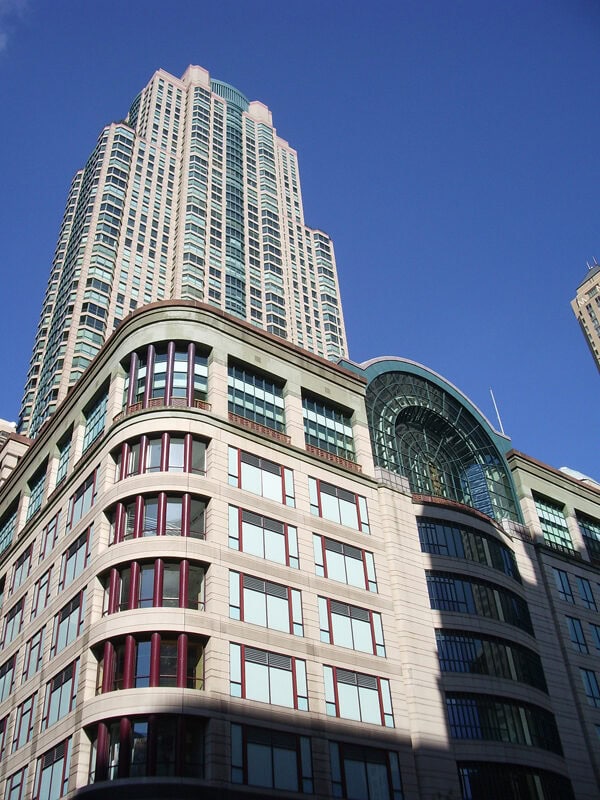
The retail portion opened in September 1990 as part of a $200 million project. Above it rises a 49-story tower, 608 feet tall, completed in 1991, with 204 residential units over approximately 300,000 square feet of retail space.
Chicago Place at 700 North Michigan
The $200 million price tag was the first signal that Chicago Place was not a modest ambition.
When the mall opened in September 1990 at 700 North Michigan Avenue, it arrived as the third vertical mall on the Magnificent Mile, following Water Tower Place and 900 North Michigan, and it came loaded with things the others did not have.
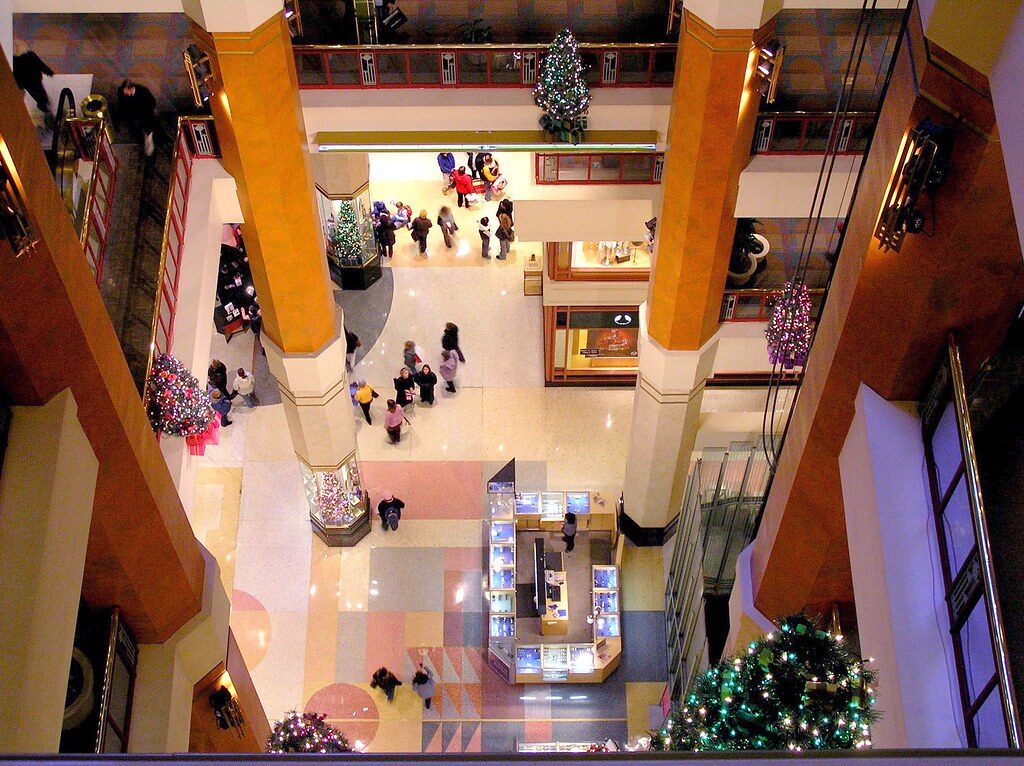
A full-height atrium. An upper-level food court. A massive arched window aimed directly at the Allerton Hotel across the street.
Two murals by artist Thomas Melvin flanked the Michigan Avenue entrance, each 42 by 23 feet, painted specifically for the space and completed that same year.
The architects split the job. Skidmore, Owings, and Merrill designed the retail base. Solomon Cordwell Buenz handled the 49-story, 608-foot residential tower above it.
Bruce Graham, the SOM architect behind the retail concept, had a specific problem in mind: Michigan Avenue was lined with department stores that gave pedestrians nothing to look at.
His answer was windows, visible interior activity, and a deliberate theatrical quality.
The interior design firm Sussman/Prejza filled the mall with color and explicit references to the first Chicago School and the Prairie School.
The building that opened that September sat on land where two older commercial structures had stood until 1982.
The Central Life Insurance Building, a 16-story D. H. Burnham and Co. project from the early 1920s, occupied the north end of the block.
A five-story Holabird and Root building from 1928 sat on the south end. Both came down for the redevelopment.
How Chicago Place Was Designed - and by Whom
The design of Chicago Place was divided between two architecture firms. Skidmore, Owings, and Merrill handled the retail base. Solomon Cordwell Buenz designed the residential tower above it.
Bruce Graham, the SOM architect most closely tied to the project's concept, pushed for a retail building that opened up to the street.
He wanted windows, visible activity, and a clear connection to the energy of Michigan Avenue.
At the time, many department stores along the avenue had blank exterior walls that shut out the street. Graham aimed to avoid that.
The initial design placed a lower building along Michigan Avenue, with the taller residential tower set back behind it.
Sussman/Prejza Design created the interior. Their work used bold colors and drew directly from two Chicago architectural traditions: the first Chicago School and the Prairie School.
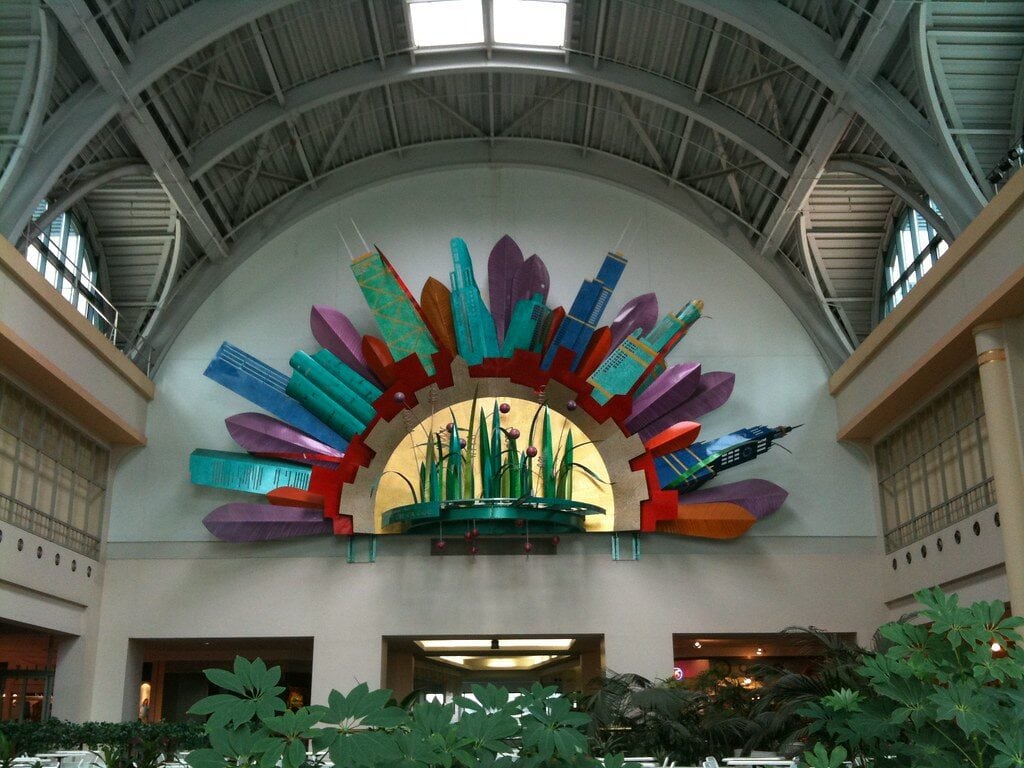
At the top level, the food court included a skyline installation representing Chicago.
At the Michigan Avenue entrance, two murals by Thomas Melvin, each measuring 42 by 23 feet, were completed in 1990. They are no longer visible at the site.
The full building reaches 608 feet and was completed in 1991. The retail mall opened earlier, in September 1990.
What Stood at 700 North Michigan Before Chicago Place
The site did not arrive empty. Two separate commercial buildings stood on the Michigan Avenue side of the block bounded by Michigan, Huron, Rush, and Superior before the 1980s redevelopment began.
On the north end, at Michigan and Superior, the Central Life Insurance Building opened in the early 1920s from plans by D. H. Burnham and Co. It ran 16 stories.
On the south end, at the southwest corner of Michigan and Huron, a five-story commercial building was planned in 1928 for property owner Dorothy Patterson Judah, designed by Holabird and Root.
That building was projected to cost $650,000 and featured polished granite and limestone with first-floor shops and upper office floors.
By 1937, the Marshall Field estate controlled the whole block, having purchased the five-story 700 North Michigan building in 1934.
The older buildings sat undisturbed for decades. The Central Life Insurance Building lasted from 1924 to 1982.
B. Dalton closed its location at 700 North Michigan in 1982 because the building was slated for demolition.
Both structures came down to make room for the project that became Chicago Place.
Chicago Place and Its Original Tenant Mix
The opening roster positioned the mall firmly at the luxury end of North Michigan retail. Saks Fifth Avenue served as the primary anchor.
C. D. Peacock, the Chicago jeweler, held the other anchor slot along the Michigan Avenue frontage.
Louis Vuitton and Ann Taylor were among the specialty tenants. The upper level held the food court.
The layout was vertical, stacked across eight floors, with the atrium running through the middle.
That configuration matched the general model of Water Tower Place and 900 North Michigan, but Chicago Place's execution created circulation problems that critics noted almost immediately.
Getting shoppers to ride escalators up through multiple floors is difficult under the best conditions. The interior at Chicago Place never managed it consistently.
C. D. Peacock and Saks were later remembered as the building's strongest anchors, but even in the early years, the upper-level retail was the weak point.
Tenants on the higher floors struggled with foot traffic from the start. By 2007, Room and Board and Ann Taylor had both departed. An attempt to sign Best Buy as a replacement anchor failed.
The food court, one of the project's signature features at opening, sat above the floors where the retail struggles were most visible.


Why Chicago Place Lost Its Battle as a Functioning Mall
Chicago Place struggled from the day it opened. Stores on the upper levels had a hard time staying in business, and many closed.
The atrium and the way people moved through the building never worked well. The fountain was eventually shut off. Many retail spaces sat empty.
The early timing issue grew into a deeper, long-term problem. Beyond Saks, the mall never formed a clear identity.
By 2007, the layout was seen as awkwardly vertical. The late-1980s design felt out of date. The mix of tenants outside Saks lacked focus.
These were three separate issues - layout, aging design, and leasing strategy - and none had been resolved by 2007.
By that point, the owners were planning a major overhaul.
Ideas included removing the central atrium, replacing the revolving-door entrance with separate street-facing entrances for each tenant, and possibly converting much of the upper floors into a hotel.
Not all of these plans were carried out. Instead, the shift happened more quickly, with a complete move away from the indoor mall format.
The $200 million spent to develop the project in the 1980s resulted in a building that, by the mid-2000s, was not performing well enough as a retail center to support continuing the original concept.
The Year Chicago Place Stopped Being a Mall
By February 2009, it was no longer a mall. The indoor shopping center was converting to an office building with street-front retail.
Saks and Zara would control most of the Michigan Avenue frontage. The upper floors would become offices.
A third retailer was planned between the two anchor tenants. Construction on a three-level Zara store was described as imminent.
The interior vertical mall was functionally over after roughly 19 years of operation.
Zara opened in the former Talbots space at 700 North Michigan in late October 2009, occupying 17,500 square feet across three floors - the largest Zara in the United States at that moment.
The continuing Saks flagship and the new Zara defined the building's retail identity going forward.
The offices above - the conversion described as the plan for the upper floors - never produced the full transformation ownership had outlined.
The interior mall space remained largely inaccessible to the public.
Chicago Place Now: Vacancy, Refinancing, and a Closing Saks
Ashkenazy Acquisitions and Aurora Capital Associates continue to market Chicago Place as an eight-story retail building on the Magnificent Mile, anchored by Saks Fifth Avenue, with Saks, Zara, and T-Mobile listed as tenants.
T-Mobile closed its 11,000 square foot store in 2023.
By September 2025, the property was operating as a 300,000 square foot retail space, with Saks and Zara in the two ground-floor corner locations and a vacant unit between them.
The owners kept control through a debt restructuring. Aareal Capital adjusted $33 million in senior debt, and Aurora Capital provided a $65 million junior loan.
JLL began marketing 8,325 square feet of street-level space that had been occupied by T-Mobile.
In February 2026, Gap entered advanced negotiations for that space, but the deal had not been completed as of April 2026.
On March 6, 2026, Saks Global announced it would close the Chicago Place store as part of a Chapter 11 restructuring.
The Chicago location, about 63,000 square feet, was one of 12 Saks stores included in that round of closures.
Those stores were expected to remain open until the end of May 2026.
The tenant that had anchored 700 North Michigan since September 1990, and remained through multiple ownership changes and redevelopment plans, is leaving after 35 years.

Independent Publisher Notice
BestAttractions is an independent editorial publisher. We are not affiliated with, endorsed by, or acting on behalf of any location, business, property owner, manager, government agency, or organization described in this article. Comments posted on this page are not forwarded to, reviewed by, or acted upon by any entity mentioned in the article. For official inquiries, complaints, applications, bookings, or other requests, please contact the relevant entity directly through its official website or other verified channels.