Lexington's first enclosed mall opens
Thursday, August 24, 1967, was a rainy day, and the crowds packed the covered walkway between Walgreens and a Thom McAn shoe store, edging around a small Variety Records stand set up in the aisle, with signs for McAlpin's and Montgomery Ward farther on.
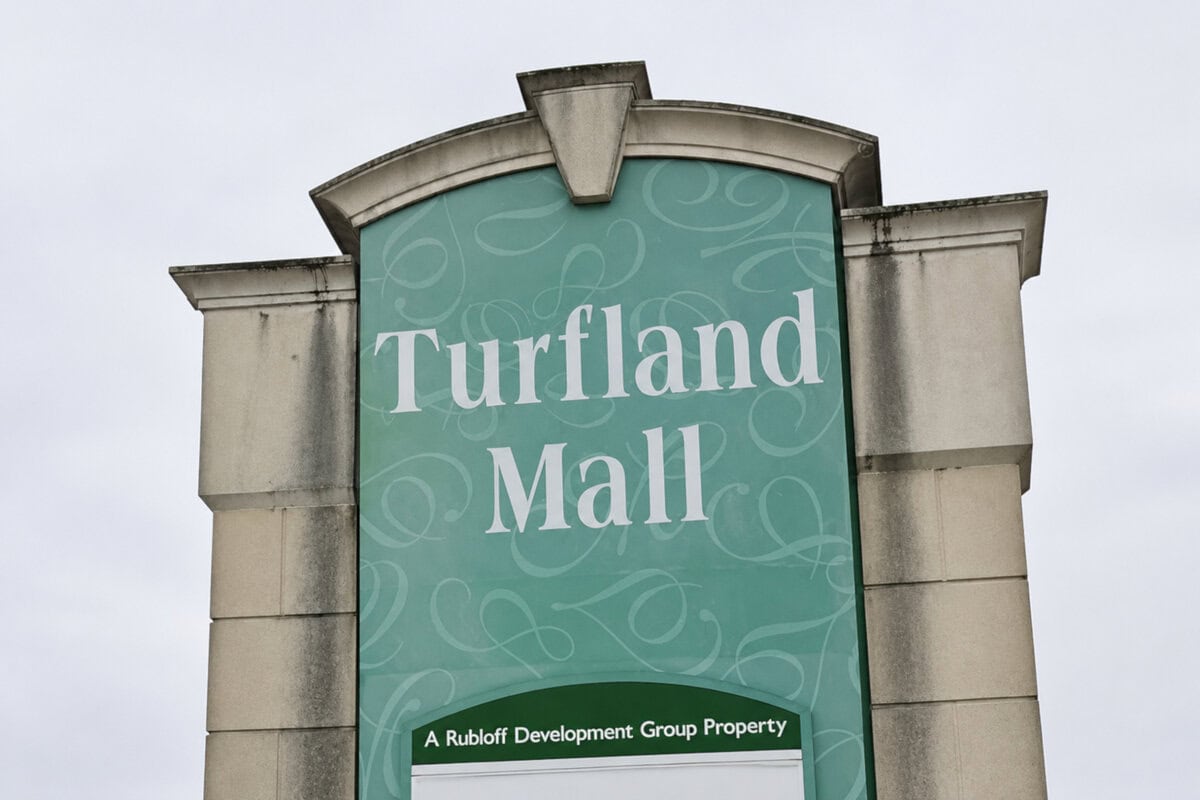
That day Turfland Mall opened at 2033 Harrodsburg Road in Lexington, Kentucky, as the city's first enclosed shopping mall.
Five years earlier the ground had been farmland along the road out of town toward Keeneland and Harrodsburg, with new neighborhoods spreading around it.
Montgomery Ward got there before the mall did. By 1966 its store stood on the property as a building of its own, with a wide entrance opening straight onto the outdoors.
The rest of the mall filled in around it.
W.T. Grant and McAlpin's came in as the other two large stores, with McAlpin's at the end opposite Ward's.
McAlpin's was new to Lexington, though not to Kentucky.
Lexington already had shopping centers at Southland and Eastland, but at Turfland three large stores and the shops between them sat under one heated, air-conditioned roof.
Shoppers left their cars in a big surface lot and walked from store to store indoors, and the advertising pressed the point that nobody had to step out into the weather between one door and the next.
Fountains, gag gifts, and a cinema out back
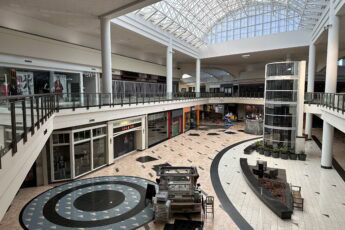
The walkway ran on a single level under a high roof set with skylights.
Stretches of it were carpeted, and flowers, sculptured animals, and fountains filled the public areas.
By 1969 one fountain stood in the central court beside the entrance to Graves-Cox, a men's clothier that had been selling downtown since the late 19th century.
Graves-Cox kept its Main Street store and ran the Turfland branch beside it, and in November 1969 the two families behind the company sold both stores to the national clothing company Genesco.
The day before opening, Spencer Gifts pitched liquor-flavored lollipops and a rubber chicken alongside an electric toilet-paper gag.
Walgreens ran a lunch counter, and McAlpin's had its own restaurant, the Turfland Room, along with a beauty salon and a bridal registry.
A 150-seat auditorium was part of the mall, and local groups paid nothing to use it.
A few months after opening day, a separate movie theater went up behind the building.
Moviegoers reached it from the parking lot, and a marquee out on Harrodsburg Road listed what was playing.
It opened under the name Turfland Cinema On-the-Mall.
Grant closes as Fayette Mall rises
In October 1971 Fayette Mall opened on Nicholasville Road with Sears among its department stores, about 65 shops, and roughly 800,000 square feet.
Lexington Mall opened on Richmond Road in September 1975, after years of delayed construction.
Each of the three malls sat in its own part of the city, and all of them drew households that had once done their shopping downtown.
McAlpin's ran stores at Turfland and at Lexington Mall, and when Fayette Mall later added a McAlpin's of its own, the same department store could be found at all three.
The first of Turfland's original anchors to go was W.T. Grant.
The chain went bankrupt in the mid-1970s and closed what remained of its stores, and the Turfland branch was gone by 1976.
JCPenney moved into the empty Grant building, and that end of the mall stayed occupied for another 17 years.
New entrances and a food court
On April 19, 1980, Turfland hosted the second stop on a Kentucky Armbenders Association arm-wrestling circuit that ended at a Louisville state championship with $5,000 in cash at stake.
Later in the 1980s the mall began a refurbishment that carried into the early 1990s.
New exterior doors replaced the original entrances, among them a rebuilt main entrance and a southeast entrance where a Kenny Rogers Roasters traded in the early 1990s.
McAlpin's grew as well.
The separate Winn-Dixie supermarket building had closed, and McAlpin's For The Home opened there in about 34,000 square feet, a furniture and home-goods store apart from the department store.
By 1991 the mall had a food court.
On June 29, 1991, the Kentucky Lotto jackpot reached a record $10 million, and a line formed at the lottery kiosk next to it.
JCPenney leaves for Fayette Mall
In December 1992 JCPenney announced it was moving to Fayette Mall, taking over the department store Hess's was closing there.
Fayette Mall was growing at the same time.
When its south wing opened in May 1993, more than 20 new businesses came with it, and the enclosed mall became Kentucky's largest.
Between the new wing and the relocated JCPenney, Nicholasville Road gathered more of the city's big stores in one place.
Turfland's side of the trade was an empty building.
The old Grant and JCPenney store at the end of the corridor stood vacant for more than four years, and McAlpin's carried on at the other end.
Competition was also going up on the far side of town.
In October 1997 Hamburg Pavilion opened its first big stores, Target and Goody's Family Clothing, on former Hamburg Place horse-farm land beside Interstate 75, and a Meijer followed there in 1998.
Marble floors inside, Home Depot outside
In July 1998 work began on a $5 million renovation of the mall.
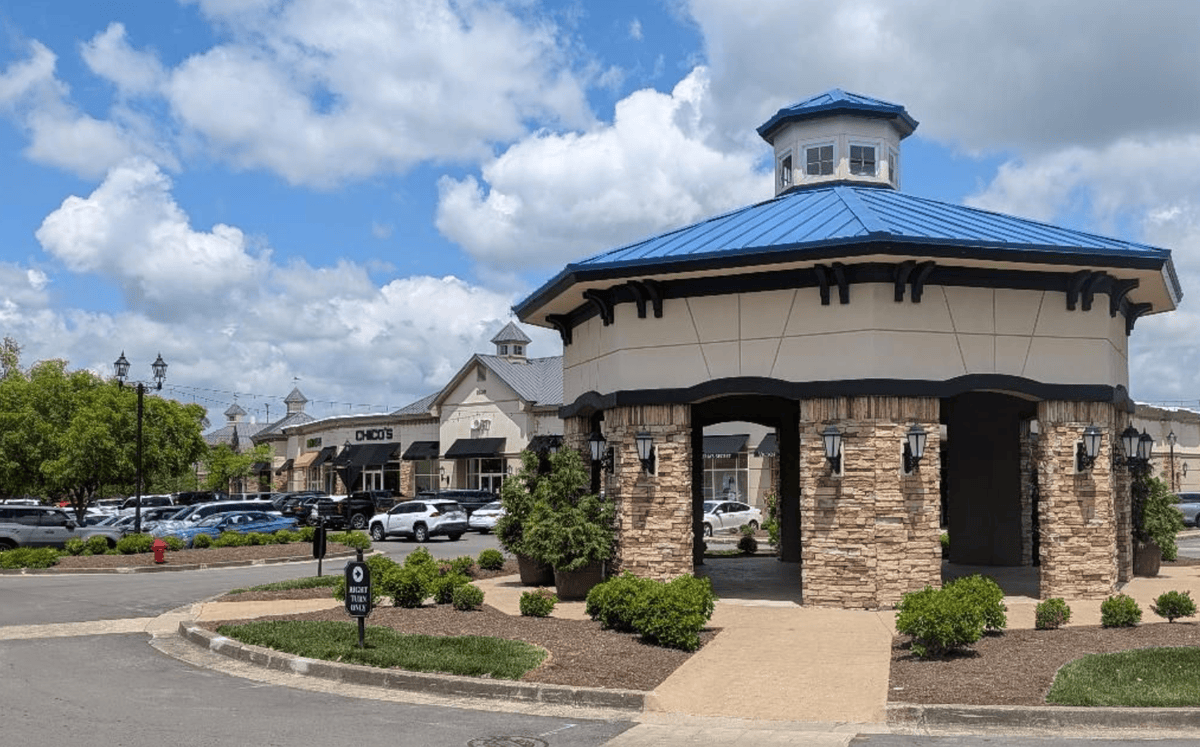
The green-and-black speckled tile came up, and marble floors went down, along with new plantings and three remodeled entrances.
Filling the empty JCPenney building was one of the project's main goals for Rubloff, the mall's owner.
The department stores changed names the same year.
Dillard's bought McAlpin's parent company, Mercantile Stores, in 1998, and both McAlpin's stores at Turfland took the Dillard's name.
While the money went into the corridor, new business went up facing the road.
Freestanding restaurants, O'Charley's among them, were built in the front parking area during the renovation, and by 2003 Staples was trading there too.
Montgomery Ward, the store that had come before the mall, announced at the end of December 2000 that it was liquidating its entire business, and the Lexington store's merchandise went into the sale.
Home Depot took over the Ward land and built a store there with no connection to the corridor.
In 2001 Rubloff sued Home Depot in state court over access and parking on the mall property, and in July 2001 the two companies settled with an agreement to share access and parking between their parcels.
That left four main businesses on the property, Dillard's, its home store, Home Depot, and Staples, and two of the four stood in buildings of their own.
Dillard's leaves and Turfland Mall closes
In 2007 the corridor held a bookstore, a nail salon, shoe and clothing shops, a few places to eat, and the discount theater out back, by then renamed Cinema 99.
Spencer Gifts, open since 1967, was still on the corridor, along with Waldenbooks, Gold Star Chili, and Old Kentucky Chocolates.
Walgreens and the restaurants out front traded in buildings of their own.
Over the course of that year the shops thinned out.
Waldenbooks, Foot Locker, and the theater were among those that closed in 2007.
Early in 2008 Dillard's announced it would close its 214,000-square-foot Turfland store as part of shutting locations that weren't earning enough.
The home store closed that April, and the main store shut on June 22, 2008.
The mall itself closed on October 1, 2008.
Home Depot, Staples, and the businesses in their own buildings out front stayed open, each reached straight from the parking lot.
Demolition spares the Dillard's building
Rubloff tried to give the closed mall another life in 2009, announcing Turfland Town Center as a mixed-use replacement.
Home Depot, Staples, and the main Dillard's building were to survive while most of the old mall came down, but the empty department store still had no new tenant.
The city council created a Turfland Town Center development area in 2010.
Rubloff never built the project, and by June 2012 Heritage Bank of Hopkinsville was moving to foreclose.
The buildings out front were not part of the deal when the mall changed hands in December 2012.
Turf Development, the company of a Lexington property owner, paid Rubloff $6 million for the main property and roughly 367,000 square feet of structure that remained.
Most of that was marked for demolition.
UK HealthCare became the tenant the old store needed.
In January 2014 it announced a lease of about 85,000 square feet on the former Dillard's first floor for its family medicine practice.
Demolition began in February 2014 and cleared the corridor, most of the small shops, and the second Dillard's space.
Bristol Group rebuilt around what was worth saving.
The old department store's steel skeleton stayed in place while its exterior was stripped away and rebuilt with precast concrete, energy-efficient glass, and more insulation at the roof.
Clinics opened to patients in March 2015.
A ribbon-cutting in April 2015 marked the formal opening, by which time more than 150 UK HealthCare employees had moved into the former department store.

Restaurants, stores, and a parking-lot fence
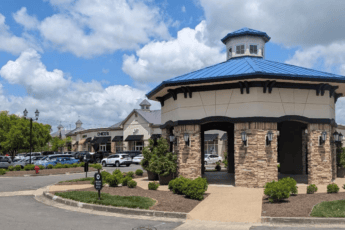
The old Turfland Mall property is an open-air cluster of separate buildings, with no enclosed mall among them.
The former McAlpin's and Dillard's building is UK HealthCare at Turfland, an outpatient center with primary care, dentistry, sports medicine, imaging, and a pharmacy.
Home Depot trades on the old Ward land, Staples is open, and Walgreens runs a 24-hour drugstore in the freestanding building it put up near Harrodsburg Road in 2014.
Chick-fil-A, City Barbeque, and LongHorn Steakhouse sit along the front.
O'Charley's closed in 2023, and PARLOUR Pizza + Pints opened in its building in October 2024.
The 2001 agreement came back over the lot in front of Home Depot.
Whitaker Bank's drive-up branch there closed in July 2023, and the bank had let Home Depot customers park on its spare spaces.
Turf Development, which owns the land around Home Depot, fenced off about 0.7 acre in September 2024 while it looked for a tenant, keeping the store's customers and contractors from parking there.
Home Depot sued in federal court in April 2025, and in July 2026 the court ruled that the agreement let its customers park on Turf Development's land as well as cross it, and ordered the fence taken down within 14 days.
The ruling did not bar building on the lot later.
The name stayed after the mall was gone.
It is on the health center, the Home Depot, and the Chick-fil-A, and Lextran's Route 58 night buses still list Turfland Mall among their stops.
The corridor that was relaid in marble in 1998 came down with its shops in 2014.
One piece of the shopping center still stands, a steel frame from the 1960s inside a skin of concrete panels. Patients park free outside it now.
Independent Publisher Notice
BestAttractions is an independent editorial publisher. We are not affiliated with, endorsed by, or acting on behalf of any location, business, property owner, manager, government agency, or organization described in this article. Comments posted on this page are not forwarded to, reviewed by, or acted upon by any entity mentioned in the article. For official inquiries, complaints, applications, bookings, or other requests, please contact the relevant entity directly through its official website or other verified channels.