
University Park Mall is the main enclosed shopping mall in Mishawaka, Indiana, still open in 2026 with Macy's, JCPenney, Barnes & Noble, and Apple.
But its single biggest space is empty.
Sears, the first store to open here in 1979, closed in 2019 after a 91-year run in the South Bend area.
It left 187,300 square feet on 16.3 acres with nowhere to go.
Sears' parent company and its brokers have marketed the box for retail, office, medical use, even housing.
No public taker yet.
Meanwhile, the mall keeps adding tenants: KPOT, LoveSac, a Mexican restaurant, a pretzel stand.
A living mall with a hole at one end is the shape of a lot of American retail right now.
This is how University Park Mall got there, and why it's still open.
University Park Mall and its empty anchor
On the north end of Mishawaka, Indiana, the biggest store on the property has sat dark since the fall of 2019. It was a Sears, the first store to open here, two weeks ahead of the mall itself.
University Park Mall opened in 1979 at 6501 N Grape Road, off State Road 23, and it's still the main enclosed shopping center for South Bend, Mishawaka, Elkhart, and southern Michigan.
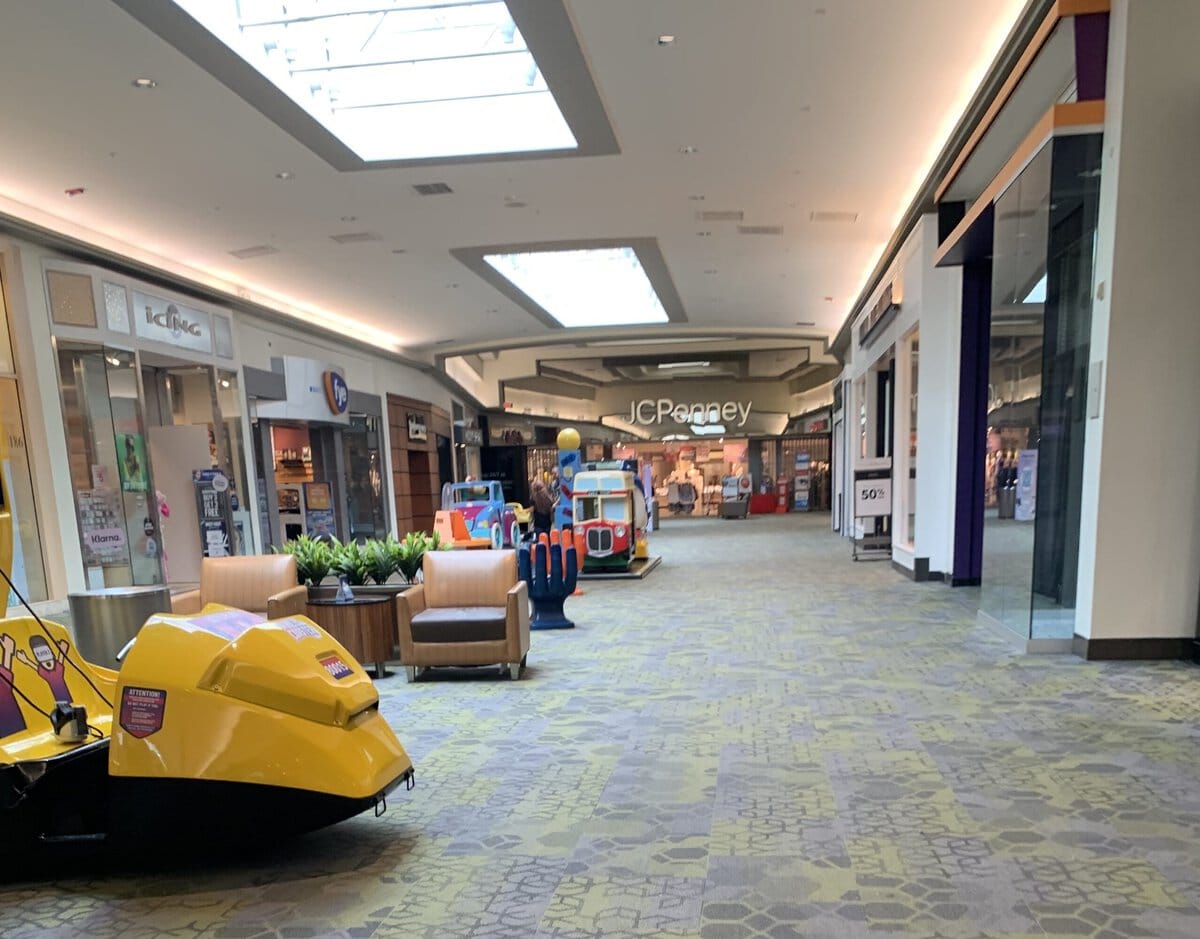
Walkers still lap the concourse before the stores unlock. But that empty Sears tells you most of the story.
Four department stores opened this mall. One is gone, knocked flat for something else. One trades under a new name. One still hangs its original sign.
And the first one in is the one nobody has managed to fill. It started, of all things, as a fight.
The fight over downtown South Bend
Before any of it, there was an argument about downtown. Sears ran a store at 411 S. Lafayette in downtown South Bend.
In November 1976, the company confirmed it would close that store and build a new one at the planned Mishawaka mall.
Neighborhood groups, unions, and downtown boosters pushed back.
The move would pull sales, jobs, and tax money out of South Bend's core and drop them on Mishawaka's edge. The two cities wanted opposite things.
Mishawaka had just annexed the land under the mall site, and Mayor Margaret H. Prickett backed the Sears move for the tax base.
South Bend Mayor Peter J. Nemeth answered with a service-focused downtown plan he called City in a Box.
A group tied to South Bend 2000, Inc. floated its own $50 million to $60 million downtown enclosed mall. It never got built.
Sears went to Mishawaka anyway. By February 1980, the old downtown store at Lafayette was a Chevrolet showroom. So DeBartolo had its first anchor. It still needed three more.
Recruiting four anchors, and the ones who said no
The mall was the Edward J. DeBartolo Corporation's project, built with Cressy Associates, led locally by George Cressy and his son Don.
DeBartolo was one of the country's largest mall builders, and this was a familiar play: a one-level enclosed concourse, four two-story department stores at the corners, more than 4,000 parking spaces, planted near Notre Dame and the households with money to spend.
The plan ran 964,100 square feet and a $35 million price. Filling the anchor slots took two years.
L. S. Ayres signed by early 1977. JCPenney followed by mid-1977 and said it would keep its downtown South Bend store too.
Hudson's, the Detroit chain, came last, confirmed in July 1978 for a 122,000-square-foot store, its first in Indiana.
Others looked and left. Robertson's stayed downtown so it wouldn't split its own sales.
Carson Pirie Scott and the William H. Block Co. sat in early talks and walked. By March 1978, all three were out.
Opening day, and a $15 ticket to tour Hudson's
Sears opened first, on March 1, 1979: 196,000 square feet, 17 automotive bays, a catalog desk, and a central solar-heating unit.
The mall itself opened March 14, 1979. Nearly 70 of a planned 100 inline stores were ready, and 95% of the space was leased.
You could grab lunch from Chick-fil-A, Hot Sam, Orange Julius, Bresler's 33 Flavors, Burger Chef, or Wag's.
There was an Osco Drug, a Brown's Sporting Goods, and a three-screen theater.
The anchors arrived in pieces. L. S. Ayres opened May 6, 1979, a 120,000-square-foot store and the 13th in the Ayres chain.
JCPenney opened January 2, 1980, with 144,000 square feet, a restaurant, and auto repair. Hudson's finished the set on February 7, 1980.
Three days earlier, 500 residents paid $15 each to a charity preview and walked the new store while the South Bend Symphony played.
For a while, the building did exactly what it was built to do.
How Scottsdale Mall lost the region
The new mall rearranged where the area shopped.
Scottsdale Mall, on the South Bend side, started shedding tenants through the 1980s.
Chains with a store at both malls put their weight behind University Park, which had Grape Road, State Road 23, and easy Toll Road access.
Scottsdale sat off the main highway, and it showed.
Around the mall, retail piled up. Indian Ridge Plaza opened across the Toll Road in 1987 with a T.J. Maxx.
By 1991, the city was still rezoning land across Grape Road for more shopping-center space.
Restaurants, hotels, and freestanding chains kept filling Grape Road and Main Street for two more decades.
The mall became the anchor for the whole district, not just for its own concourse.
Then the names on the anchors started to move.
The anchors kept changing names
The signs out front turned out to be the least permanent part of the place.
In 1996, Simon Property Group merged with DeBartolo Realty in a $3 billion deal that built a company holding 183 shopping centers across 32 states.
University Park Mall came along with it, and Simon has owned and run it since.
The department stores churned faster than the landlord.
Dayton-Hudson turned Hudson's into Marshall Field's in 1997.
Federated Department Stores later swept up Marshall Field's and L. S. Ayres both, closed Marshall Field's here in 2006, and turned Ayres into Macy's the same year.
Two of the four original brands gone in one stretch, and Macy's standing where Ayres had stood.
That left a two-story department-store box sitting empty, and a decision about what to do with it.
Tearing down an anchor to build The Village
Simon's answer in 2006 was demolition. The former Marshall Field's came down in 2007.
What replaced it was The Village, a 110,000-square-foot open-air addition built in phases: four stand-alone buildings, exterior entrances, fireplace seating, water features, fresh landscaping.
It swapped one enclosed department-store wing for a row of outward-facing shops and restaurants.
Barnes & Noble opened there on April 8, 2009, after moving from another Grape Road spot.
Five Guys, Bar Louie, Lane Bryant, and Ulta Beauty came with it.
Apple landed inside the mall in November 2010, near the food court.
For a stretch, the place looked like it had its next decade figured out.
Food courts, blue-and-gold lights, and a long renovation
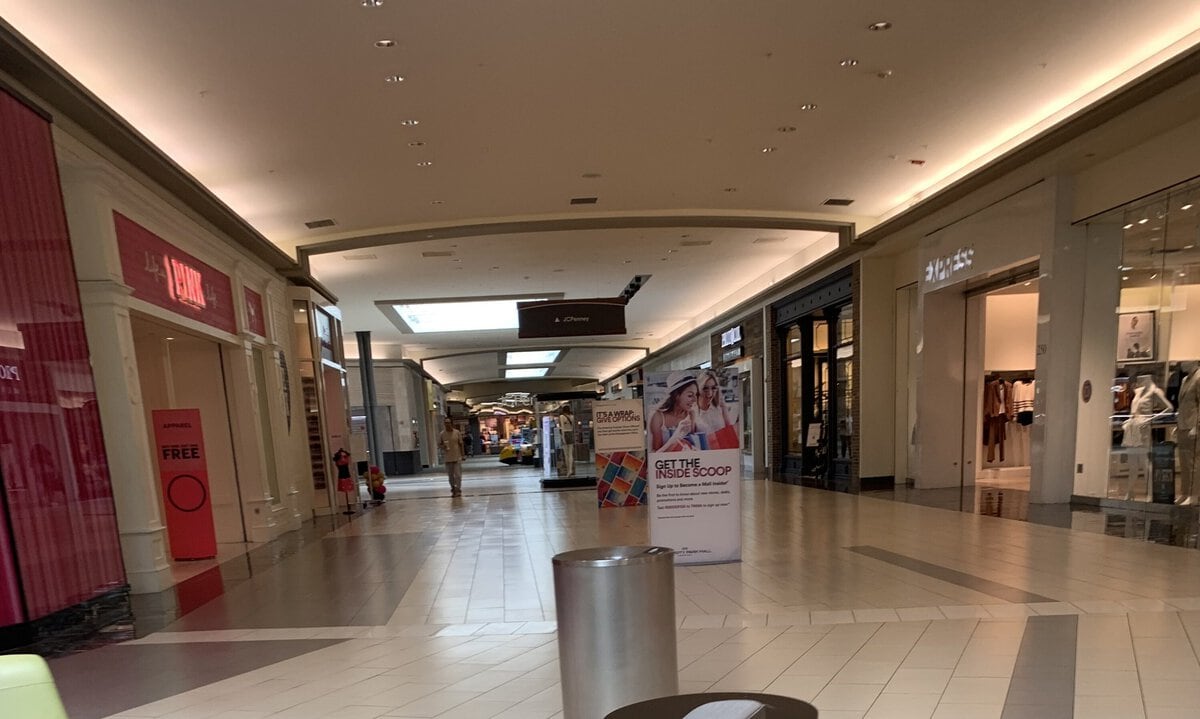
The inside kept getting redone.
The first big remodel ran from 1995 to 1996, a $15 million job that dropped a food court near Sears and expanded L. S. Ayres by 33,000 square feet.
The food court came in at 62,000 square feet, set where a cinema entrance used to be.
That cinema, a three-screen General Cinema, closed in 2000 against bigger screens nearby; by 2001 its space held shops like PacSun.
A second overhaul started in February 2014.
Crews worked after the 9 p.m. close so the mall could stay open: new floors, new lighting, rebuilt restrooms, fresh carpet by the JCPenney wing.
The food court grew past 500 seats, adding more than 150, with high-top tables where you could charge a phone.
The column lights could change color by season, Notre Dame blue and gold among them.
Then came Sears.
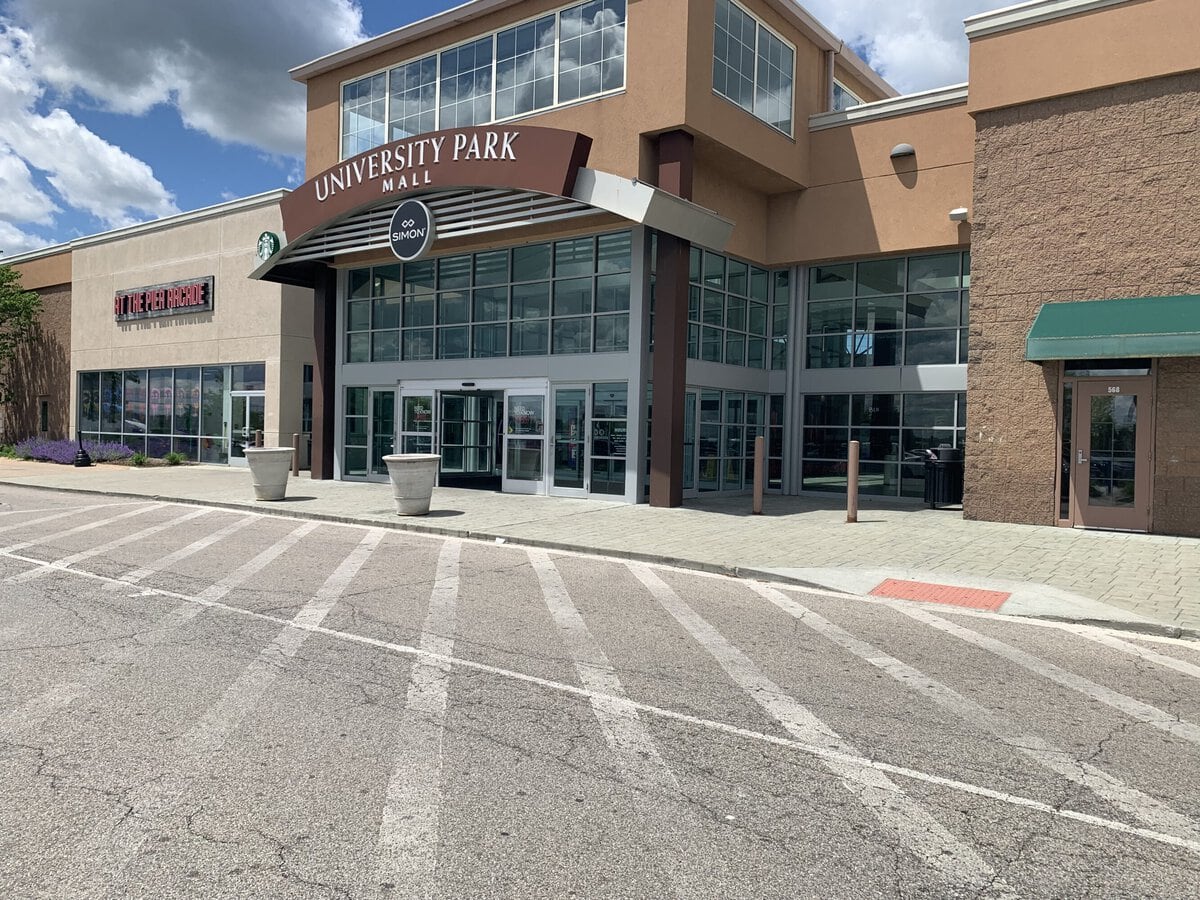
What University Park Mall is now
In 2019, Transform Holdco put the Mishawaka store on a list of 26 large-format Sears and Kmart closures.
The auto center shut in late August. Liquidation started mid-month.
On November 10, the store shut for good, ending a 91-year Sears run in the South Bend area and leaving the mall its largest hole: a former anchor box now listed at 187,300 square feet on 16.3 acres, pitched over the years for retail, entertainment, office, medical, or housing.
No taker yet.
More followed. Simon shut every U.S. property at 7 p.m. on March 18, 2020, for the pandemic. The Disney Store, in since the 90s remodel, never reopened.
By that September, more than a dozen storefronts sat empty: Banana Republic, Zales, and Jos. A. Bank among them. Simon said it would add more security after a 2024 incident in center court.
And it's still open. Macy's, JCPenney, and Barnes & Noble still anchor it; the 2025 round of 66 Macy's closures skipped this store.
Apple, Coach, Michael Kors, lululemon, and Dry Goods fill the concourse, and La Patrona Mexican Restaurant opened in early 2025.
Wetzel's Pretzels was announced for the mall in 2026.
The mall cut a ribbon for its 45th anniversary on March 14, 2024, and added KPOT, LoveSac, and The Suit Company around it.
On a weekday in 2026, it can feel quiet.
Online shopping cut into it, and tenants say the slow afternoons show.
But the doors open early for the walkers, people still come for food, and the one original anchor nobody can replace is the one that opened the whole thing.
Independent Publisher Notice
BestAttractions is an independent editorial publisher. We are not affiliated with, endorsed by, or acting on behalf of any location, business, property owner, manager, government agency, or organization described in this article.
Comments posted on this page are not forwarded to, reviewed by, or acted upon by any entity mentioned in the article.
For official inquiries, complaints, applications, bookings, or other requests, please contact the relevant entity directly through its official website or other verified channels.