On a February morning in 1963, a new kind of place opened on Ritchie Highway in Glen Burnie, Maryland. Even in a county that had already seen modern shopping centers, this one still felt strikingly new up close.
It was a fully enclosed shopping mall, all under one roof, with many different stores gathered together simply because someone decided they should be.
Montgomery Ward served as the main anchor store. Inside, shoppers would soon find a G.C. Murphy variety store and an A&P grocery store.
A small lunch counter sat inside the pharmacy. There was also a restaurant called the Lamp Post. Around the building, there was space to park 3,500 cars. The entire complex covered 329,000 square feet.
At the time, Ritchie Highway was a wide, busy commercial road linking Baltimore and Annapolis. A mall of this size was built to attract not only local residents but also drivers traveling between the two cities.
The southern suburbs of Baltimore were growing quickly with working families who needed a convenient place to shop for groceries, handle banking, buy shoes, and pick up household goods without making multiple stops.
The mall brought all of those needs together in one place.
Glen Burnie Mall and Its DeBartolo Roots
Edward J. DeBartolo, Sr. announced plans for the mall in January 1962.
Glen Burnie became the fifth mall-type shopping center developed by his organization, part of a postwar building surge that placed enclosed malls in car-dependent suburbs across the United States.
DeBartolo secured Montgomery Ward as the main anchor store. J.C. Penney was originally set to occupy the north end of the building, but the company withdrew before construction was finished.
That section of the mall remained incomplete for several years.
By early 1964, the center included Montgomery Ward, G.C. Murphy, and an A&P grocery store.
Other businesses included American Finance Corp., a Beacon Pharmacy with a luncheonette, Bond Furniture, Carpet Fair, and an Equitable Trust branch.
The mall also had the Glen Burnie Mall Theatre, a Glidden Decorating Center, the Lamp Post Restaurant, Paramount Barber Shop, Popcorn Village, Thom McAn Shoes, and a group of smaller specialty stores.
The mix of businesses allowed people to handle everyday needs in one stop. Visitors could take care of banking, buy groceries, shop for shoes or hardware, get a haircut, and see a movie without leaving the building.
By 1964, the property covered 329,000 square feet and had parking for 3,500 cars.
The North End Finally Gets Its Anchor
The north end that had been planned for J.C. Penney sat without an anchor for nearly six years. On March 17, 1969, Topps Discount City opened there in roughly 89,000 square feet.
Topps was a division of Interstate Department Stores, and it drew the kind of suburban working-class shoppers that Ritchie Highway had always served.
The store lasted only about five years. Topps closed its Glen Burnie location in 1974.
Toys "R" Us, also an Interstate division, had taken over the space by September 1974 and stayed for nearly 44 years - one of the longest tenant relationships in the building's entire history.
Years later, the other half of the old Topps box went to Epstein's, a Baltimore-area department store. Together, those tenants kept the north end commercially viable into the 1980s.
That later split - one half to a national toy chain, one half to a local department store - set the template for how the north anchor would be subdivided and reused for the next four decades.
Fire, Renovation, and a 1,200-Degree Night
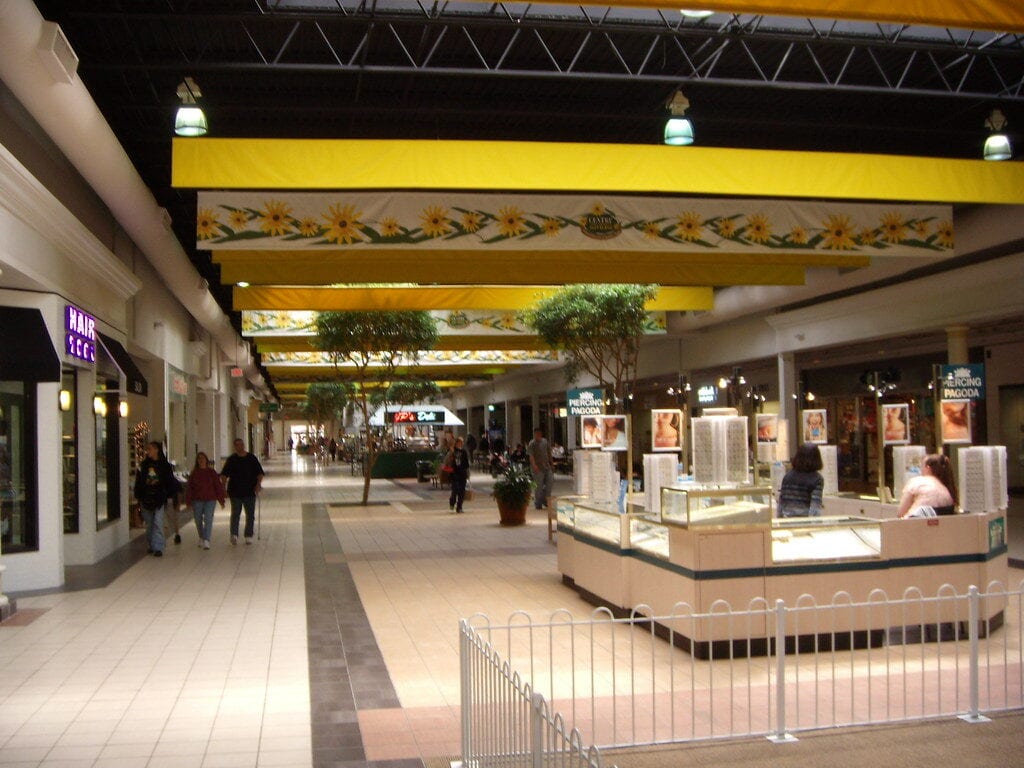
Work on a $3 million facelift began on July 1, 1981. The plan included a new roof, 42 skylights, decorative lamp posts, quarry-tile flooring, ficus trees, and repaved parking.
Three months and 23 days in, on October 24, 1981, a fire broke out at the north end of the mall. It escalated to three alarms.
Temperatures inside hit roughly 1,200 degrees. The roof truss supports collapsed. The sprinkler system was not yet fully operational.
No occupants or firefighters were reported injured, but the damage closed the entire center - except Montgomery Ward, which stayed open - while rebuilding proceeded.
The north end reopened on November 21, 1981. By 1983, the property had grown to roughly 418,000 leasable square feet with 41 stores and services.
The tenant list that year ran from Marvin's Sport City and Radio Shack to Kay Jewelers, Jo-Ann Fabrics, Revco Drugs, and Zales, with Toys "R" Us and Epstein's still holding the north anchor boxes.
By 1983, the mall had a broad mix of retail categories typical of a second-tier American mall of the period.
The Theater That Ran for Twenty Years
The Glen Burnie Mall Theatre opened on January 15, 1964, with a showing of "The V.I.P.'s." It was promoted as Baltimore's only "All Climate Theatre," which meant it stayed comfortable year-round at a time when many movie theaters did not have dependable air conditioning.
The theater had a single screen and operated for twenty years. It closed on April 1, 1984, when its lease expired, exactly 20 years and 77 days after it first opened.
When the theater shut down, the mall lost its main source of evening traffic.
Stores like department shops and toy stores bring in people during the day, especially on weekends. A movie theater brings people in at night, even on weekdays.
That difference affects how a mall stays active over the course of a day, even if the impact is not immediately clear in lease income.
Years later, redevelopment plans for the Centre at Glen Burnie included a "future theater" as a possible feature. The original screen went dark in 1984, and there still has not been a replacement.
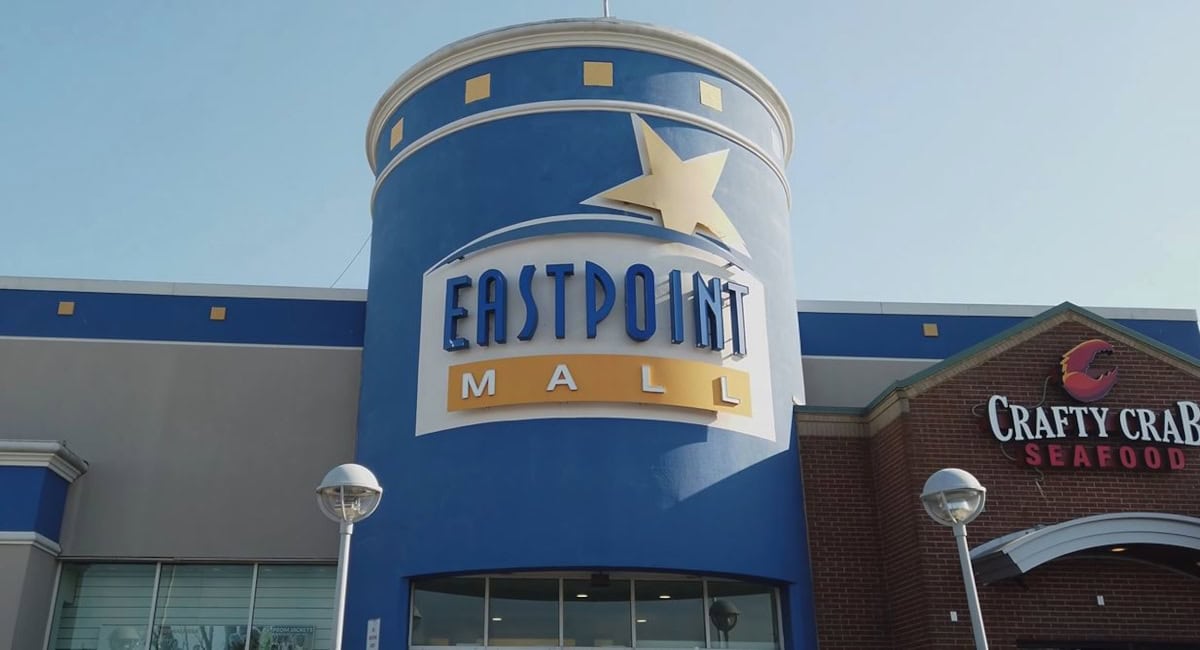
Big Boxes Replace Department Stores in the 1990s
Simon DeBartolo Group, Inc. reclassified Glen Burnie Mall on December 31, 1997 - not a regional mall anymore, officially, but a community center.
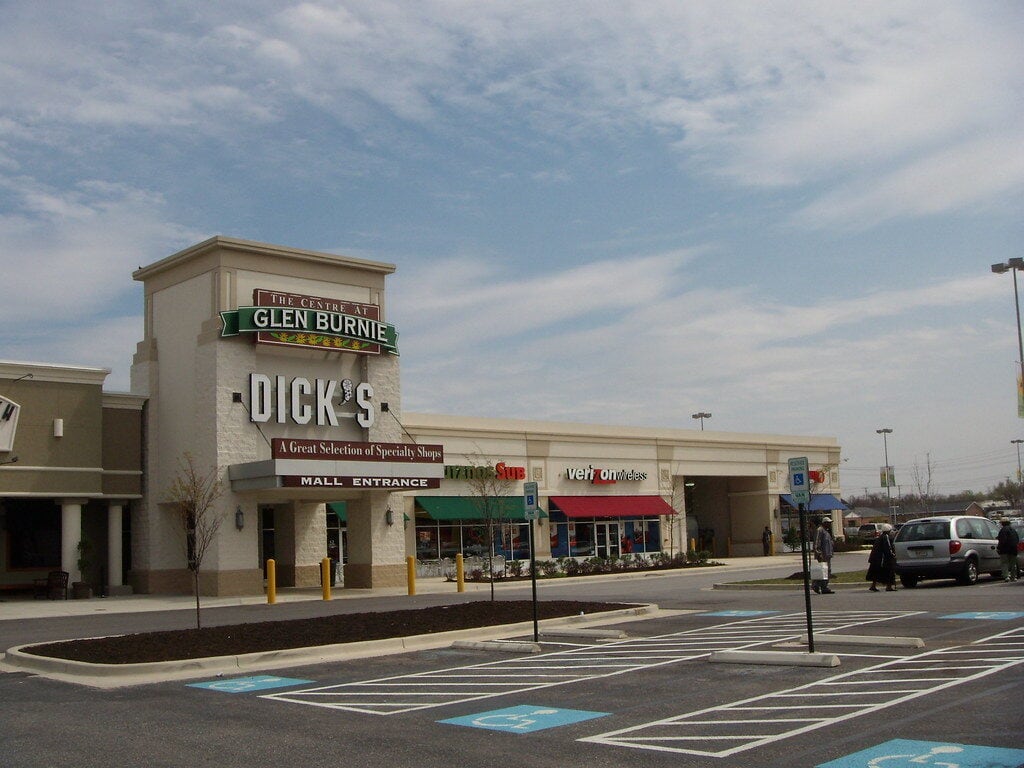
Best Buy had taken the former Epstein's box in November 1994. Dick's Sporting Goods opened on the former G.C. Murphy site in October 1995.
By 2001, the property stood at 455,000 square feet with Toys "R" Us, Best Buy, and Dick's Clothing and Sporting Goods as the dominant tenants.
A variety store and a department store had been replaced by two national big-box chains. Montgomery Ward, the south anchor since 1963, went out of business in 2000. Its Glen Burnie store went dark in March 2001.
What that left was a building with a roughly 161,100-square-foot hole at one end, Dick's Clothing and Sporting Goods in the former G.C. Murphy space, and Best Buy and Toys "R" Us occupying the former north anchor - not a mall in any traditional sense, but not yet something with a clear identity to replace it.
Target Arrives and the Old Mall Name Disappears
Sticks 'n Stuff, a furniture seller, occupied the former Montgomery Ward space for about two years before demolition crews moved in.
Petrie interests took over the redevelopment of the site with a plan to tear down the old Ward's building as part of a larger redevelopment that also added a Target on the former A&P site.
Demolition began in 2003. The new Target measured 123,700 square feet and opened on October 10, 2004.
In July 2005, The Daily Record reported that Petrie was finishing the redevelopment of the 459,000-square-foot property while the mall stayed open during construction.
The name Glen Burnie Mall was already being retired by 2004. A formal dedication under the new name - The Centre at Glen Burnie - followed in 2005. Jones Lang LaSalle came in as leasing agent and manager in 2012.
In March 2016, the property transferred from BACM 2006-5 Ritchie Highway LLC to 6711 Glen Burnie Retail LLC for a book amount of $15 million, with both entities tied to the Starwood/LNR ownership and servicing orbit in Greenwich, Connecticut.
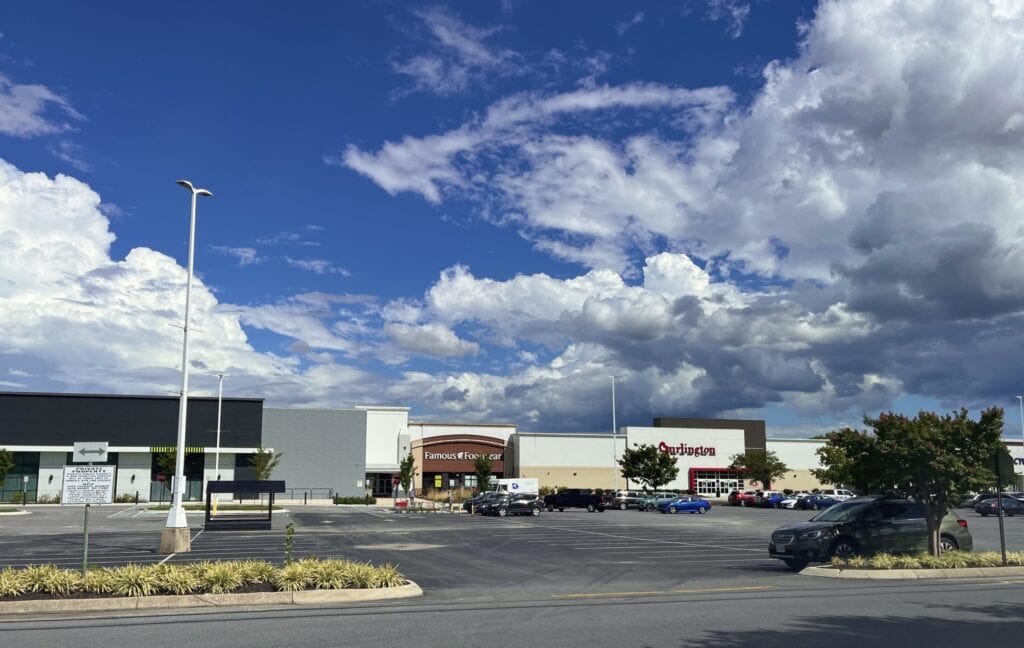
Toys "R" Us Closes and the De-Malling Begins
Toys "R" Us filed for Chapter 11 bankruptcy in 2017 and closed its Glen Burnie store in 2018, ending 44 years in the building.
The lease at 6711 Ritchie Highway went to auction, and Ollie's Bargain Outlet won the bidding. Ollie's took half the old box. The other half had already run through Best Buy, which moved across the street in 2010.
Then hhgregg, which opened on May 6, 2010, closed with the rest of the chain in 2017, and briefly became a Spirit Halloween before being merged with the adjacent former Office Depot - closed in 2019 - into a single unoccupied unit.
Selective demolition began across the property after 2018, including the former Dick's Sporting Goods space, which was gone by 2022.
As of 2026, the Centre covers approximately 424,600 square feet with 1,480 parking spaces.
Its tenants include Target, Burlington, Ollie's, Famous Footwear, Chick-fil-A, Five Guys, Cycle Gear, Cold Stone Creamery, Truist, and Bonefish Grill.
This lineup would be unrecognizable to anyone who walked the enclosed mall in 1983.