
Copley Place breaks ground over the Mass Pike
In 1980, work began on Copley Place, a mixed-use complex planned to sit on a deck built over the Massachusetts Turnpike and railroad tracks at the edge of Boston's Back Bay.
The location was a long open cut of highway lanes, interchange ramps, and rail lines that separated the Back Bay from the South End.
The project was financed by the Pritzker family, owners of Hyatt Hotels, and developed with Urban Investment and Development Co.
The Architects' Collaborative, founded by Walter Gropius, designed the complex. Howard Elkus served as lead architect and described the project as a way to reconnect the neighborhoods across the corridor.
The $400 million plan required constructing a 9.5-acre platform above six lanes of the turnpike and the rail lines.
Crews drove steel and concrete pilings about 100-165 feet deep to reach bedrock beneath filled wetland soils.
The design also included a ventilation system intended to carry highway fumes away from retail and hotel interiors.
Copley Place opened in phases between 1983 and 1984, completing a new block of retail, office, and hotel space over the turnpike trench and restoring a continuous built connection between the Back Bay and the South End at that point.
From the South Armory to the Turnpike trench
The South End Armory stood on the site when it was completed in 1890.
It was removed in the 1960s to make room for the Massachusetts Turnpike's extension into downtown Boston. By 1964, the turnpike interchange ramps were in place.
The area became a transportation corridor, carrying highway lanes and adjacent railroad tracks.
After the turnpike was built, the site remained an open trench. For nearly two decades, the highway cut and rail corridor formed a physical break between the Back Bay and the South End.
The gap was visible from the street level and shaped how people moved between the neighborhoods.
In the 1960s, Boston had already built the Prudential Center over the turnpike as an early air-rights project. No comparable air-rights development followed for roughly the next 20 years.
Copley Place later became the next major project to build over the corridor, using a deck above the highway and tracks to reconnect the two sides.
When completed, the development totaled about 3.7 million square feet of mixed-use space. Roughly 385,000 square feet was devoted to retail.
Office space was provided in four seven-story office buildings. The project was the first major work designed by Howard Elkus and was Boston's largest urban mixed-use development at the time.
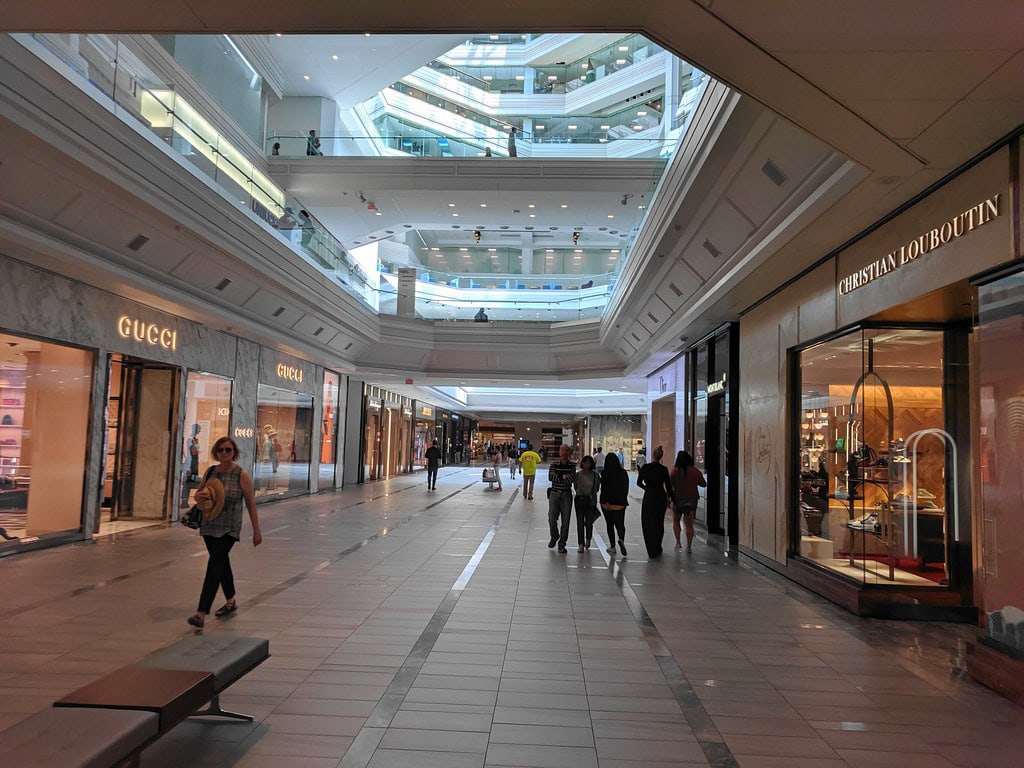
Opening days: Neiman, hotels, new routes
Copley Place opened in phases between 1983 and 1984, and it arrived with anchors that made its intentions plain.
Neiman Marcus opened in 1984, Boston's first, and stayed as the multi-level department store at one end of the mall.
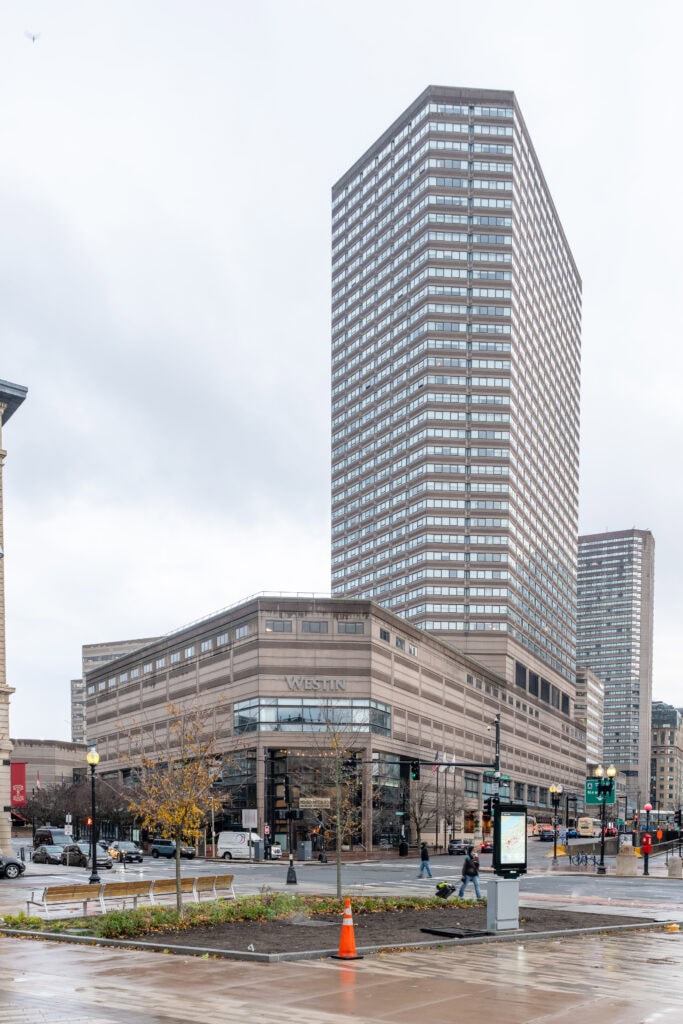
The Westin Copley Place opened the same year, rising 36 stories. In 1984, the Boston Marriott Copley Place followed at 38 stories, taking the other end and ensuring the project never lacked foot traffic.
Copley Place also built itself into the neighborhood's circulation system. A skybridge crossed Huntington Avenue to the Prudential Center shopping mall.
Another skybridge crossed Huntington at a different location to connect to the Westin and a few small shops.
An underground pedestrian tunnel linked the complex to Back Bay Station, the MBTA and Amtrak hub, running beneath Dartmouth Street.
It was connected to other nearby destinations managed separately as well, including the Prudential Center complex and the Sheraton Boston Hotel.
Parking was handled with a 1,430-space underground garage, which kept the surface from turning into a parking lot with nicer lighting.
Copley Place's multiplex and its atrium fountain
On February 17, 1984, a nine-screen cinema complex opened at Copley Place. Sack Theatres operated it first. USA Cinemas later took over, followed by Loews.
The complex used rounded, postmodern forms, and the design drew criticism, including complaints about small screening rooms.
For years, it was one of Back Bay's few movie theaters. After the Paris Cinema closed in 1993 and the Loews Cheri closed in 2001, Copley Place became Back Bay's last remaining cinema.
In later years, it screened foreign and art films. It closed permanently on January 30, 2005.
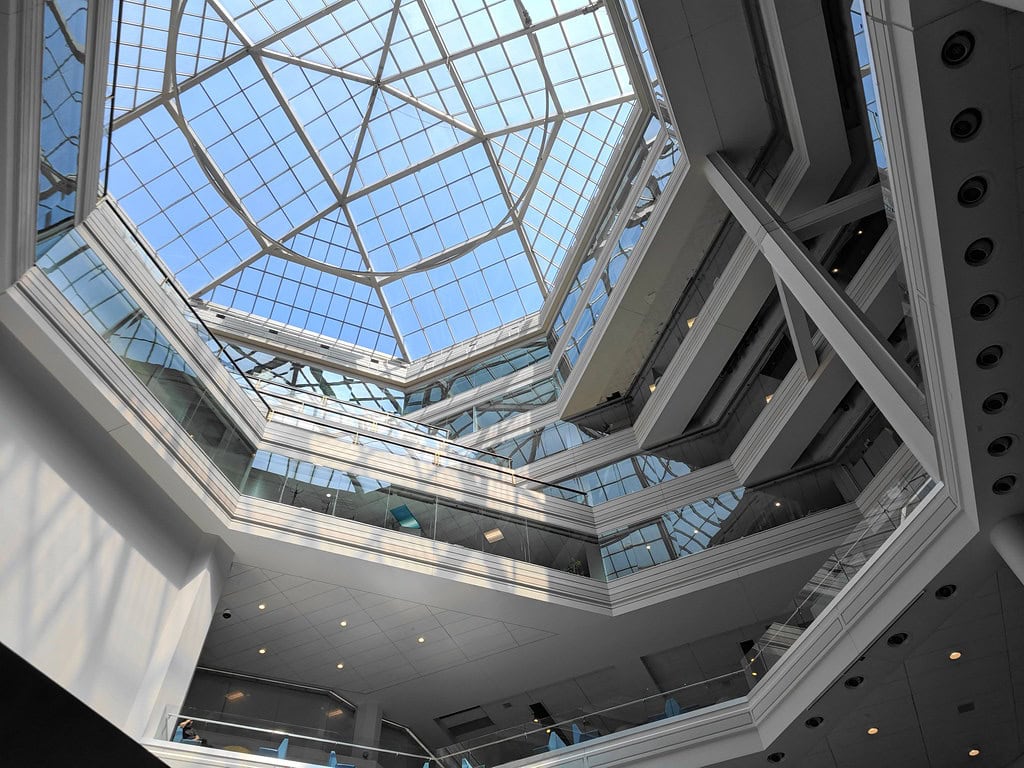
The main gathering point inside the mall was the central atrium. The space was organized around a 60-foot sculptural fountain designed by Boston artist Dimitri Hadzi.
The fountain combined abstract granite and travertine marble shapes, with water falling into a shallow pool.
Marble benches surrounded the base. Au Bon Pain operated nearby, and the fountain became a common reference point for meeting inside the mall.
Simon takes over, and Barneys moves in
Retail drift showed up in the directory long before it showed up in headlines. A sizable Rizzoli Bookstore sat opposite the elevators behind the central water feature, but it had closed by 2000.
Other stores cycled out, including Stoddard's, known for fine cutlery and personal care tools, and Williams Sonoma, which had sold kitchenware and food ingredients.
As the wider US retail market shifted, Copley Place leaned harder into fashion, shoes, and accessories, until by 2020 that was almost the whole mix.
Ownership changed in 2002, when Simon Property Group acquired Copley Place as part of the sale of Netherlands-based Rodamco North America's U.S. mall portfolio, and Simon has continued to operate it as a luxury-oriented property.
After the cinema closed in 2005, Simon refilled the space with Barneys New York, which opened a two-level flagship in March 2006.
The store, about 46,000 square feet, became one more marker of the area's upscale retail identity, in a neighborhood often compared to Rodeo Drive.
Then the retail world did what it does. Barneys filed for bankruptcy in 2019. Early plans in August 2019 tried to save the Copley store, but liquidation followed, and the store closed in early 2020.
On August 14, 2020, Saks Fifth Avenue Men's Store opened in its place.
Tower plans fade, Copley Place interior is remade
The Westin completed an $18 million renovation in 2011, updating guest rooms and corridors with a Back Bay grid pattern.
Simon Property Group proposed a 52-story residential tower to be built above the existing Neiman Marcus building at Copley Place.
In 2011, the Boston Redevelopment Authority approved plans that also called for a 60,000-square-foot addition of retail space and a 54,000-square-foot expansion of the Neiman Marcus store.
By early 2013, the proposal was still waiting on final design plans. Opposition focused on the tower's height and the shadows it would create.
In October 2016, Simon cancelled the tower project, citing rising construction costs, market concerns, and competition from other luxury towers then under construction in Boston.
Inside the mall, changes centered on the atrium. In 2013, a proposed renovation that would remove the main fountain drew public criticism.
The fountain was a 60-foot sculptural work by Boston artist Dimitri Hadzi, built from abstract granite and travertine marble forms with water falling into a shallow pool, and it had long served as the main interior landmark.
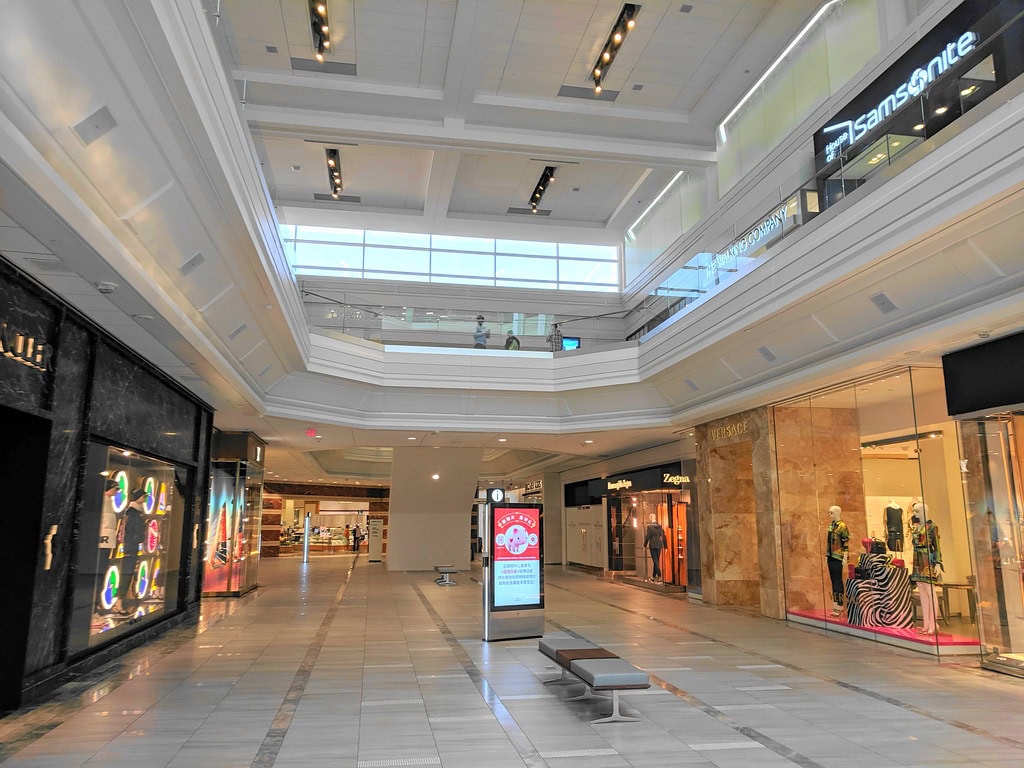
In 2017, the mall completed an interior renovation that replaced the original brick and dark tile floors with bright white.
The atrium fountain was removed to open floor space, and long-time visitors reacted in different ways.
After the removal, the location and status of the fountain's sculptural components were not publicly known. Howard Elkus later led additional renovations as a principal of Elkus Manfredi Architects.
Copley Place in the mid-2020s: luxury tenants, protests, and Harbor Sweets' boat shop
By early 2026, Copley Place remains Boston's premier luxury destination, anchored by Neiman Marcus and a Saks Fifth Avenue Men's Store.
Stores include Alexander McQueen, Balenciaga, Christian Dior, Louis Vuitton, Gucci, Saint Laurent, Versace, Thom Browne, Ralph Lauren, John Varvatos, Michael Kors, Tory Burch, Victorinox Swiss Army, Jimmy Choo, Tiffany, Van Cleef and David Yurman, Salvatore Ferragamo, Ermenegildo Zegna, Burberry, and Furla.
Upstairs, The Bridgespan Group in Tower 2, Wayfair in Tower 4, the US Census Bureau's Boston regional office in suite 301, and the consulates-general of Canada and Germany in Tower 3, in suites 400 and 500.
In November 2019, MassLive ranked Copley Place fourth among 40 Massachusetts malls and shopping centers, with Prudential Center fifth.
In June 2024, Loewe made its Boston debut with a 1,937-square-foot store.
On November 29, 2024, hundreds of pro-Palestinian protesters urged a Black Friday boycott while moving through the mall; police said the group was not inside long and made no arrests.
Nearby, Lyrik at Parcel 12, not part of Copley Place, opened in 2024 over the Pike as the first major air-rights deck since Copley Place.
In mid-September 2025, Harbor Sweets debuted a shop built around a 40-foot boat with a mast and sails.
Independent Publisher Notice
BestAttractions is an independent editorial publisher. We are not affiliated with, endorsed by, or acting on behalf of any location, business, property owner, manager, government agency, or organization described in this article.
Comments posted on this page are not forwarded to, reviewed by, or acted upon by any entity mentioned in the article.
For official inquiries, complaints, applications, bookings, or other requests, please contact the relevant entity directly through its official website or other verified channels.