
Allen Park makes more sense when you stop asking whether the city itself has everything you need. It covers only 7.00 square miles. In a place that compact, the municipal boundary is a weak way to measure daily life.
Work may be in Dearborn. Dinner may be somewhere else Downriver. A weekend may point toward Detroit. Groceries and routine errands can stay close to home, while the rest of the week moves across neighboring cities almost without ceremony.
That is the real Allen Park proposition: a small, settled residential base inside a much larger Metro Detroit routine.
It works especially well for people who value stable neighborhoods and regional access more than a large local downtown or a car-free lifestyle.
Allen Park feels more like a home base than a destination city
The Census Bureau estimated Allen Park's population at 27,445 in 2025.
That population sits inside just seven square miles, with 4,094 residents per square mile at the 2020 Census.
The city is therefore compact in a geographic sense, but compact does not automatically mean that your whole week happens on foot.
The EPA's National Walkability Index is useful here because it treats walkability as a combination of street connectivity, land-use mix, and transit access rather than simple distance.
A small city can still produce a car-based routine when work, shopping, recreation, and social life point in different directions.
That is often the better way to judge Allen Park. Do not ask, "How far am I from downtown Allen Park?"
Ask, "How many of my repeated weekly trips start here, and how many naturally continue into the rest of Metro Detroit?"
If you are comfortable with that regional rhythm, Allen Park's size becomes an advantage rather than a limit.
The morning commute is part of the value proposition
Allen Park workers had a mean travel time to work of 23.8 minutes in the 2020-2024 Census estimate.
That number does not tell you where an individual resident works, and it should not be turned into a promised commute to Detroit or Dearborn.
It does show that Allen Park functions inside a regional labor market rather than as a place where everyone works locally.
The wider Detroit-Warren-Dearborn metro also has an employment mix that still carries a strong industrial and technical signature.
In May 2025, production jobs accounted for 8.8% of metro employment, compared with 5.5% nationally.
Architecture and engineering jobs made up 4.0%, versus 1.7% nationally. Transportation and material-moving jobs accounted for another 8.7%.
That matters for the kind of household Allen Park can suit.
Someone working in engineering, manufacturing, logistics, office support, healthcare, or another Metro Detroit field can use Allen Park as a residential anchor without needing the city itself to contain the employer.
The practical moving test is simple: run the exact work trip from the exact address at the hour you will actually drive it.
The city is unusually homeowner-heavy
One of Allen Park's most revealing numbers is not the home price. It is the ownership rate.
The Census Bureau reports that 87.3% of occupied housing units were owner-occupied in 2020-2024.
That is much higher than nearby Dearborn at 68.4%, Lincoln Park at 68.8%, and Wyandotte at 73.7%.
The same Census estimate shows that 92.9% of Allen Park residents age one and older were living in the same house as a year earlier.
Those figures do not prove that every block feels close-knit or quiet.
They do support the idea of a stable, owner-heavy housing market where many residents are not treating the city as a temporary stop.
For a buyer, that can be attractive if the goal is an established residential routine rather than a fast-changing apartment district.
It can be less appealing if you want a large supply of new rental buildings, constant redevelopment, or a neighborhood where the social scene changes quickly.
Allen Park is not simply the cheap Downriver choice
The housing numbers also complicate the usual affordability story.
For 2020-2024, the Census Bureau put the median value of owner-occupied housing at $183,700 in Allen Park.
That was higher than Lincoln Park's $131,000 and Wyandotte's $166,900, but lower than Dearborn's $218,800.
These are broad Census values, not current asking prices or a comparison of matched homes.
They should not be used to predict what a particular house will sell for.
They do make one point clear: Allen Park is not automatically the lowest-cost option around it.
A buyer may be paying more than in some nearby Downriver cities for a compact, heavily owner-occupied residential base, while still paying less than the citywide Dearborn figure.
That is a more useful way to think about value here. The question is not whether Allen Park is cheap.
It is whether its location, housing pattern, and daily routine are worth the difference between the actual homes you are comparing.
Everyday errands can stay local without making the city self-contained
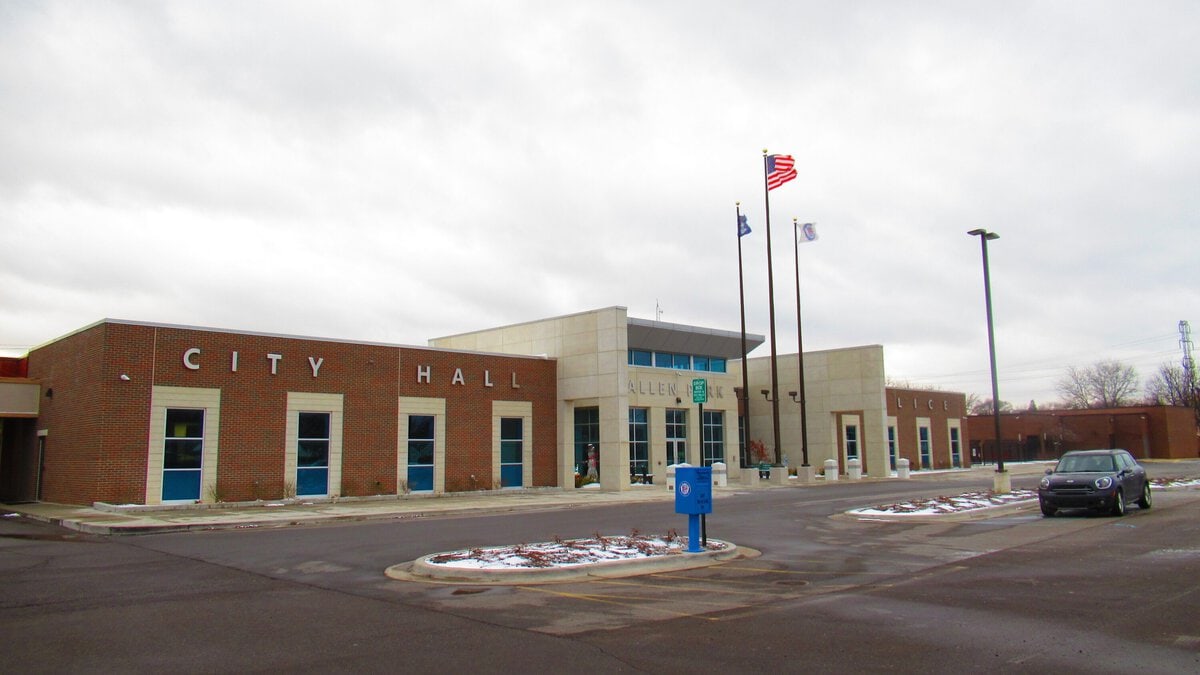
Allen Park has a real commercial base.
The 2022 Economic Census recorded about $526.3 million in retail sales and $115.4 million in accommodation and food-service sales in the city.
Those totals include spending by nonresidents and do not tell you whether your favorite grocery store, restaurant, or service is nearby.
They do show that Allen Park is not purely residential.
For many households, routine shopping and casual meals can fit into the local week.
The important distinction is what happens after those basics are covered.
A seven-square-mile city is unlikely to satisfy every specialized shopping, dining, entertainment, healthcare, or social preference.
The surrounding region is part of the lifestyle.
That can feel freeing if you already think in terms of Metro Detroit rather than municipal lines.
It can feel inconvenient if your ideal suburb keeps almost every recurring activity inside one compact center.
Car ownership buys flexibility, but the exact address still matters
Allen Park's small size can hide an address-level issue: regional convenience can come with transportation friction.
If your home sits close to the routes you use most, the city can feel efficient.
If your daily trips repeatedly cross the city in the wrong direction before continuing outward, that advantage shrinks.
Do not choose a house based only on a citywide commute number.
Test the morning work drive, the evening grocery trip, the route to your most-used medical provider, and the places you visit on weekends.
If you are considering a one-car household, repeat those tests without assuming that short map distances mean comfortable walking.
The right Allen Park address can make a regional life feel compact. The wrong one can turn several short trips into repeated driving.
Who is Allen Park most logical for?
Allen Park is strongest for someone who wants an established, homeowner-oriented suburb without moving far from the economic and social pull of the larger Detroit area.
It can fit commuters whose jobs are spread across the region, households that are comfortable driving for some social and entertainment trips, and buyers who prefer a settled residential environment over a large new-development district.
It is less convincing for someone who wants a dense downtown lifestyle, expects most daily trips to happen without a car, or wants the suburb itself to provide a deep restaurant, nightlife, and cultural market.
The final test is to ignore the city limits for a moment.
Map your actual week: work, groceries, school or childcare, exercise, dinner, friends, healthcare, and one normal weekend outing.
Then look at how many trips Allen Park shortens, how many stay local, and how many simply become part of the larger Metro Detroit network.
If that regional pattern feels natural, Allen Park's compactness is a strength.
If you want your home city to contain almost the entire week, seven square miles may feel smaller than the housing price first suggests.
Sources and further reading
- U.S. Census Bureau QuickFacts: Allen Park city, Michigan
- U.S. Census Bureau QuickFacts: Dearborn city, Michigan
- U.S. Census Bureau QuickFacts: Lincoln Park city, Michigan
- U.S. Census Bureau QuickFacts: Wyandotte city, Michigan
- U.S. Bureau of Labor Statistics: Occupational Employment and Wages in Detroit-Warren-Dearborn, May 2025
- U.S. Environmental Protection Agency: National Walkability Index User Guide and Methodology
Independent Publisher Notice
BestAttractions is an independent editorial publisher. We are not affiliated with, endorsed by, or acting on behalf of any location, business, property owner, manager, government agency, or organization described in this article.
Comments posted on this page are not forwarded to, reviewed by, or acted upon by any entity mentioned in the article.
For official inquiries, complaints, applications, bookings, or other requests, please contact the relevant entity directly through its official website or other verified channels.