
Ypsilanti is compact. The Census Bureau puts the city at 4.2 square miles of land, with a 2020 population of 20,648. Yet a week here does not necessarily revolve around one center.
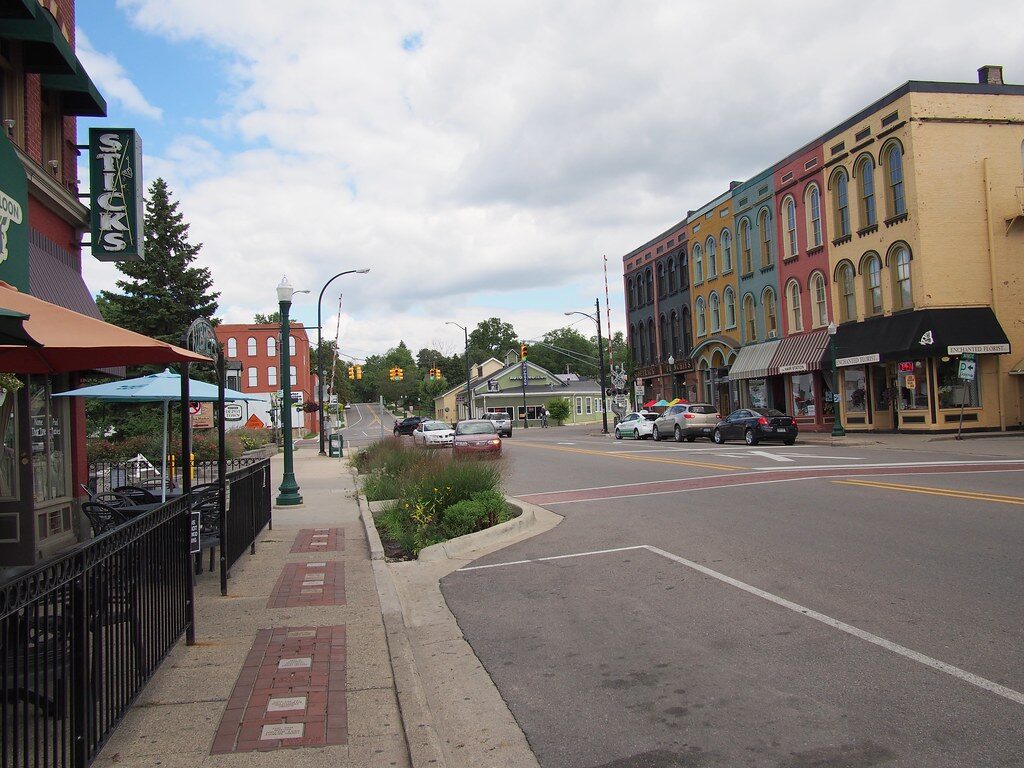
Three places pull daily life in different directions. Downtown gathers activity around Michigan Avenue. Depot Town sits northeast of it around East Cross Street and North River Street.
West Cross and the Eastern Michigan University edge form a third node farther west. They are close enough to share one afternoon, but they are not interchangeable.
One may handle coffee and an errand, another dinner and drinks, another a class-day lunch or campus stop. The useful map of Ypsilanti is a map of repeated trips among all three.
The three centers do different jobs
Downtown has the broadest "middle of town" role.
Around Michigan Avenue, the mix includes coffee, restaurants, nightlife and grocery shopping, so several ordinary purposes can fit into one stop.
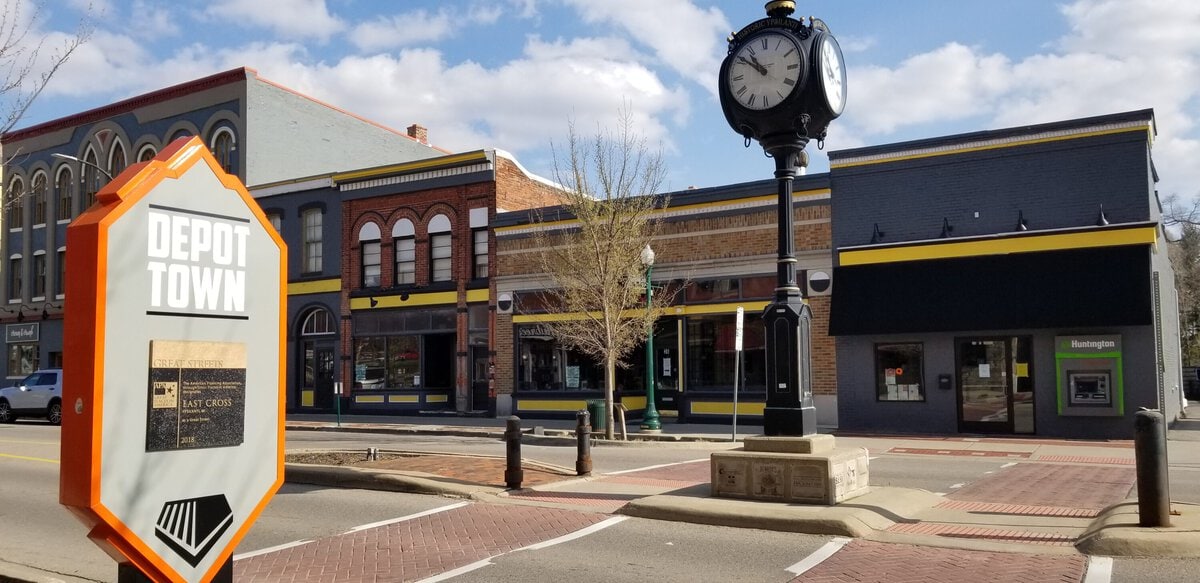
Depot Town is smaller and more linear.
Its commercial life clusters around East Cross Street near North River Street, with food, drinks and grocery options close together.
It also sits across the Huron River from most of the west-side city grid.
West Cross feels different again.
The commercial strip meets the eastern edge of Eastern Michigan University, so quick food, coffee and convenience retail sit beside a campus whose schedule creates its own weekday pulse.
Federal education data identifies EMU as a public, state-controlled university operating on a semester calendar.
A person can spend most of a weekday near EMU and still prefer Downtown or Depot Town after work.
Another resident may rarely enter campus but cross the river several times a week for dinner or groceries.
Small distance does not make the centers perform the same job.
Cross Street explains the geography better than a neighborhood list
Follow the streets and the three-center pattern becomes easier to see.
West Cross Street runs east from the EMU side toward the Huron River. Continue across the river and East Cross Street becomes the spine of Depot Town.
The campus-side center and Depot Town therefore sit along the same east-west corridor, with the river between them.
Downtown sits south of that line. Huron Street provides the obvious north-south connection from the Downtown grid toward Cross Street.
From Downtown to Depot Town, the route is basically north toward Cross, then east across the river.
From Downtown toward West Cross, the second move goes west toward EMU.
That pattern matters more than a single walkability score.
Three destinations can be close while still feeling separate because of traffic signals, weather, darkness or the simple friction of crossing a larger street.
They feel connected when the route becomes familiar enough that it no longer needs to be planned.
The useful test is not a precise walking time. It is whether a center-to-center trip fits naturally into the street grid and into the rest of the day.
A weekday can move through all three centers
Picture an ordinary Tuesday.
A morning near West Cross might begin with coffee or quick food before work or class.
Around midday, the university gives that part of town a built-in reason for people to move around.
Later, an errand may pull the day toward Downtown. Dinner can move the evening across the river into Depot Town.
That is one possible Ypsilanti day, not a universal routine.
Another resident may work from home, use Downtown for coffee and groceries, and barely cross the Huron River during the week.
Someone tied to EMU may spend four days mostly west of the river, then cross it repeatedly on Friday night.
The city feels different depending on which short movements repeat.
Friday evening and Saturday also change the balance.
Downtown and Depot Town have strong reasons to pull people after the workday because both concentrate restaurants and places to meet.
West Cross has food and coffee too, but its most distinctive force is the university beside it.
A weekend-only visit can therefore hide part of how Ypsilanti works.
On Saturday the three centers can look like a compact collection of places to eat, drink and browse.
On Tuesday, their separate jobs are easier to see.
EMU changes West Cross by changing the clock
Eastern Michigan University does not simply add another destination. A university changes when people appear.
During the academic year, class schedules create repeated waves of arrival, departure, lunch stops and short gaps between obligations.
Businesses near West Cross can sit inside that rhythm.
The area has a reason to be active on an ordinary weekday that is different from the evening pull of Downtown or Depot Town.
Summer changes the source of that activity.
It would be wrong to claim a precise seasonal drop without foot-traffic data, or to assume the district becomes empty.
What changes is structural: when the semester is not supplying the same class-day schedule, West Cross loses one of the forces that makes its weekday rhythm distinctive.
The map has not changed. The reason for moving through it has.
The Huron River matters when the week mixes east and west
How often do residents cross the Huron River in ordinary life? There is no single useful number. The answer depends on the trip pattern.
Depot Town sits east of the river. Downtown and West Cross/EMU sit on the other side.
If dinner, groceries or social plans regularly involve Depot Town while work, campus or other errands begin to the west, crossing the river becomes routine.
If most daily needs stay between Downtown and West Cross, it may barely register.
The river is also tied to the city's older fabric.
The National Register describes the Ypsilanti Historic District as following an irregular pattern along the Huron River.
In practical terms, the river is both landmark and separator.
It becomes important when Depot Town belongs to the same chain of errands and social stops as the west side.
If those chains rarely mix, the river can sit close by without structuring much of the week.
Everyday services reveal the limits of each center
The centers make more sense when their strengths are kept separate.
| Center | What fits naturally into the routine | What often sends the trip elsewhere |
|---|---|---|
| Downtown | Coffee, restaurants, nightlife, grocery stops, several errands in one compact area | Large-format shopping, specialized appointments, destinations outside the central grid |
| Depot Town | Dining, drinks, grocery stops, a compact social outing | Campus-oriented needs, broader shopping, trips already centered west of the river |
| West Cross/EMU | Coffee, quick meals, convenience purchases, campus-linked activity | A wider set of household errands, many evening destinations, needs unrelated to EMU |
"Everything is close" is therefore only partly useful. Close does not mean each center substitutes for the others.
A week becomes easier to do on foot when repeated needs line up along this central network.
Driving becomes more important when destinations scatter beyond it.
Where the car returns
The three-center web does not contain every part of ordinary life.
Jobs outside the city, medical appointments, larger shopping trips, destinations in surrounding townships and trips elsewhere in the Ann Arbor area can break the compact pattern quickly.
So can a day that requires several distant stops.
The useful dividing line is not "walker" versus "driver." The same person can be both.
Someone might walk from West Cross toward Downtown for part of the afternoon, then drive to an appointment farther away.
Another person might drive to one center, park once, and do several things on foot.
What matters is how much of the week stays inside the three-center network before the next destination pulls it out.
Ypsilanti makes more sense as a weekly map
Ypsilanti is small enough that Downtown, Depot Town and West Cross/EMU can interact constantly, yet distinct enough that each keeps a separate role.
Downtown is the broad central node. Depot Town adds a compact commercial and social strip across the Huron River.
West Cross gains a weekday rhythm from its relationship with EMU.
Cross Street ties the east and west centers together, while Huron Street connects Downtown into that line.
The result is not one downtown surrounded by everything else.
It is a small city where ordinary life can move among several centers depending on the hour, day and season.
That is the useful way to understand living in Ypsilanti: follow the week. Where does breakfast happen?
Which direction does work or class pull you? Does dinner cross the river? Does Friday shift the center of gravity?
When does a short trip stop being part of the central street network and become a drive?
Answer those questions, and Ypsilanti's internal geography becomes visible.
Sources and further resources
- U.S. Census Bureau - QuickFacts for Ypsilanti city, Michigan
- National Park Service - Ypsilanti Historic District
- NCES IPEDS - Eastern Michigan University institutional data
- U.S. Geological Survey - Huron River at Ypsilanti, Michigan
Independent Publisher Notice
BestAttractions is an independent editorial publisher. We are not affiliated with, endorsed by, or acting on behalf of any location, business, property owner, manager, government agency, or organization described in this article. Comments posted on this page are not forwarded to, reviewed by, or acted upon by any entity mentioned in the article. For official inquiries, complaints, applications, bookings, or other requests, please contact the relevant entity directly through its official website or other verified channels.