Watson Road once drew people looking for motels, drive-in businesses, and the spread of shops and services that lined Route 66. By the mid-1950s, the area was changing quickly.
Crestwood was annexing land south of Highway 66, more families were moving out from St. Louis, and a permanent shopping center was about to open in the middle of that growth.
Hycel Properties, led by Milton, Lewis, and Hyme Zorensky, picked the corner of Watson Road and Sappington Road, about 12 miles southwest of downtown St. Louis, for a project meant to serve this new suburban population.
The location was chosen very deliberately. Watson Road already had strong traffic and active commercial business, and Crestwood was shifting from a roadside stop into a town with its own shopping center district.
The same stretch of road also included the 66 Park-In Theatre and the first McDonald's west of the Mississippi. Crestwood Plaza stood directly in that growing corridor.
Crestwood had 11,106 residents in 1960 and 15,123 by 1970, and the mall was at the center of that period of growth.
Before it had later names and later problems, the project began with a simple idea: the era of the open road was giving way to the era of the shopping center.
Crestwood Plaza Opens in Stages
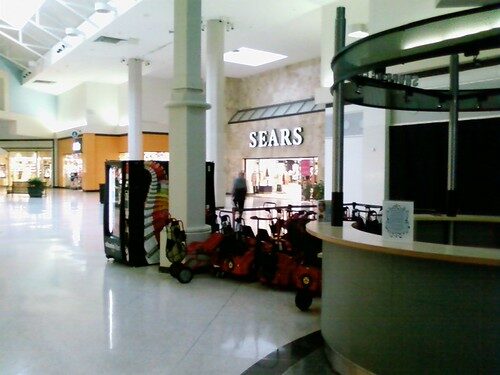
The first part of Crestwood Plaza opened on March 21, 1957. Sears opened a 2-level store with 156,000 square feet.
Other first-day tenants included National Shirt Shops, Baker's Shoes, The Children's Shop, and a 23,000-square-foot Kroger.
From the start, the center was built on the scale of a regional mall.
It had about 550,000 square feet of leasable space, and part of the property even included a basement arcade concourse. The full project did not open all at once.
It opened step by step, with each stage adding more stores.
The second group of stores opened on May 19, 1957. That group included Walgreen Drug, Lerner Shops, Thom McAn Shoes, and a 2-level, 36,000-square-foot F.W. Woolworth.
The department store lineup expanded on August 14, 1958, when Scruggs, Vandervoort, and Barney opened a 3-level store with 165,000 square feet.
Shoppers could move among well-known local and national stores without going into downtown St. Louis. Crestwood Plaza quickly became one of the first real suburban malls in the area.
Some local residents later remembered split-level parking that allowed shoppers to enter anchor stores on different floors, which felt modern in the late 1950s.
Parking Decks, New Anchors, and Early Growing Pains
The mall kept growing because stopping was never part of the plan. Sears expanded to 221,400 square feet and was rededicated on November 11, 1963. Then came the biggest change of the decade.
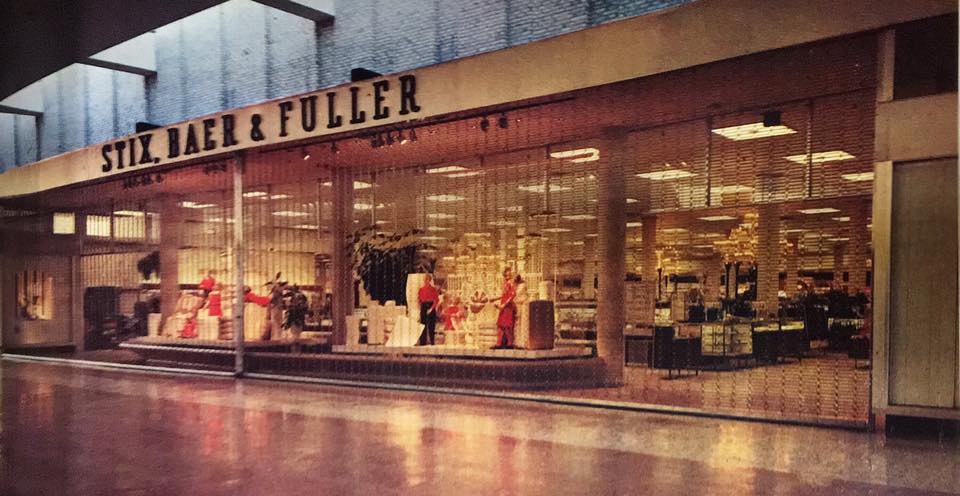
On January 23, 1967, a new enclosed east wing opened over a 3-level parking garage, anchored by a 4-level, roughly 252,000-square-foot Stix, Baer and Fuller.
John Graham & Associates designed the wing, Millstone & Associates handled construction, the garage held 2,300 cars, and landscape architect Robert Goetz shaped the open court facing Watson Road.
Scruggs, Vandervoort, and Barney became Famous-Barr on September 15, 1969.
Politics passed through the building as well. John F. Kennedy stopped there on October 22, 1960, during the presidential campaign. Daily business inside the center could be rougher.
Kroger left in November 1972 for a larger store across the street in the Crestview Shopping Center, arguing that the newer mall layout had created traffic and parking problems around its old space.
When Kroger subleased to Tipton Electric, the dispute landed in court and ended with Kroger allowed to sublet.
By then, Crestwood Plaza was already dealing with the headaches that follow a growing mall - changed traffic patterns, shifting anchors, and old spaces that no longer fit the center around them.
An Enclosed Mall And The City's Cash Flow
By the early 1980s, the old open-air design was no longer enough. Crestwood Plaza either had to change or remain stuck in an earlier era.
From September 1983 to October 1984, the center was rebuilt as a fully enclosed mall.
The rededication took place on October 3, 1984. The Cornucopia food-court area opened on the basement level, including The Market as one of its tenants.
The anchor stores had their interiors remodeled, and the center returned as the kind of enclosed regional mall shoppers expected in that period.
A 5-screen cinema opened in 1986. Another theater later opened behind Dillard's and eventually expanded into AMC Crestwood Plaza 10.
The mall had become large enough to directly affect the city's finances. By 1986, it had about 140 stores and was one of the largest enclosed malls in Greater St. Louis.
Around the same time, it produced about 60 to 70 percent of Crestwood's sales-tax revenue.
People came for department stores, a food court, movies, and an arcade, and the city came to depend on the tax revenue they generated.
Stix became Dillard's in spring 1985, which kept the anchor lineup current as retail chains changed names and ownership.
Crestwood Plaza no longer looked like a shopping center from 1957. It had become a full 1980s enclosed mall, polished, turned inward, and designed to keep shoppers inside for as long as possible.
Renames, Closures, and the Last Years of the Mall
The name changed in 1998, but the building was still in the same place. Westfield America bought the mall in January 1998, for $106.4 million, and renamed it Westfield Shoppingtown Crestwood that November.
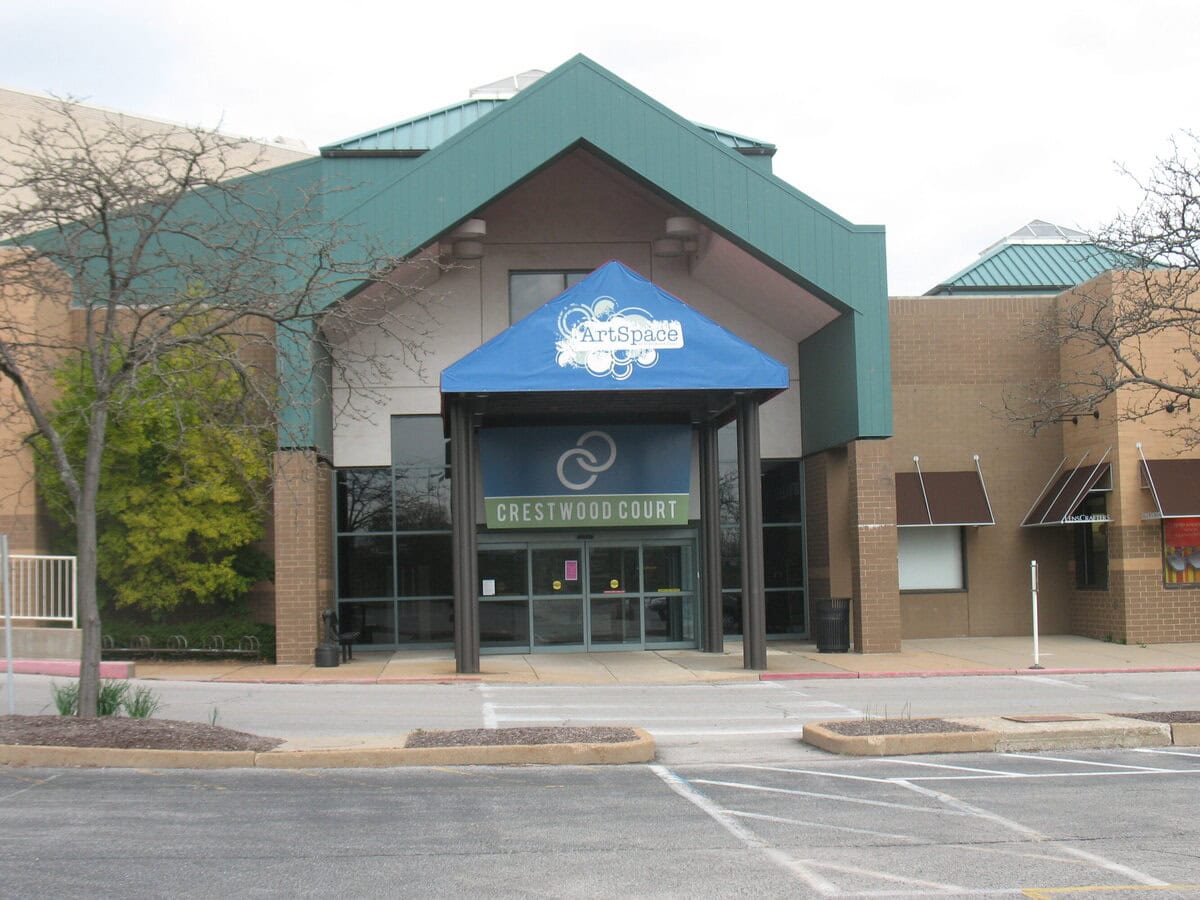
In June 2005, the name was shortened to Westfield Crestwood. By March 2008, the property had been sold again, this time to Centrum Properties and Angelo, Gordon, and the new name became Crestwood Court.
Locals kept calling it Crestwood Plaza anyway.
The real problem was not the sign. Dillard's closed in 2007. Macy's followed in 2009 after the old Famous-Barr line had already passed through another corporate rename.
Sears announced its closure in December 2011 and went dark in 2012.
The city's mall-related tax income fell from about $1.7 million in 2002 to $1.1 million in 2006 and to about $300,000 by 2011.
The loss cut city revenue by more than 20 percent and reduced staffing from 130 employees to 89.
Centrum tried an unusual rescue, filling around 60 spaces with art galleries, dance studios, and theater groups on very low rents.
The Auction Years and the Long Dirt Field
Closing did not come with one clean final day. The mall itself was shuttered on March 1, 2012. Sears, the last anchor, closed in April.
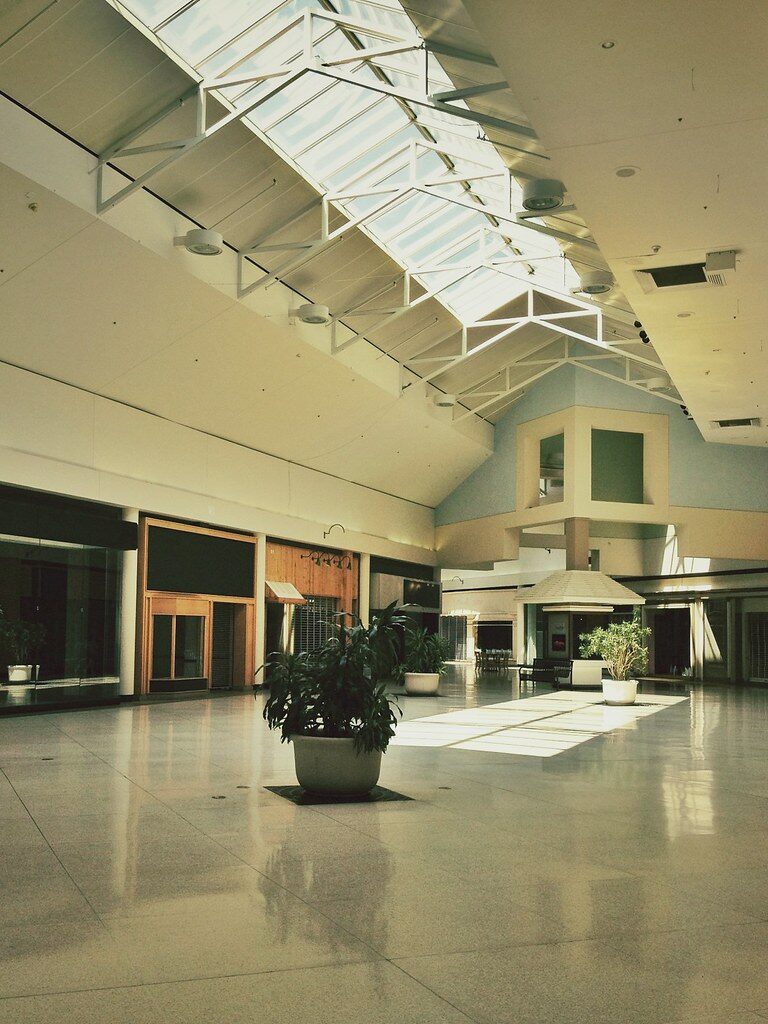
Interior common areas were later closed to the public in July 2013, while LensCrafters, using an exterior entrance, hung on a little longer before closing on September 16, 2013.
After that, the halls were dark, and the long decline turned into a redevelopment fight over what would replace almost six decades of retail history.
UrbanStreet Group emerged as the winning bidder for the 47-acre property in an online auction in April 2014 after Centrum had paid $17.5 million in 2008.
Crestwood approved a $25 million incentive package in March 2016 for an UrbanStreet plan that promised retail, entertainment, dining, office space, housing, and about $79 million in private investment.
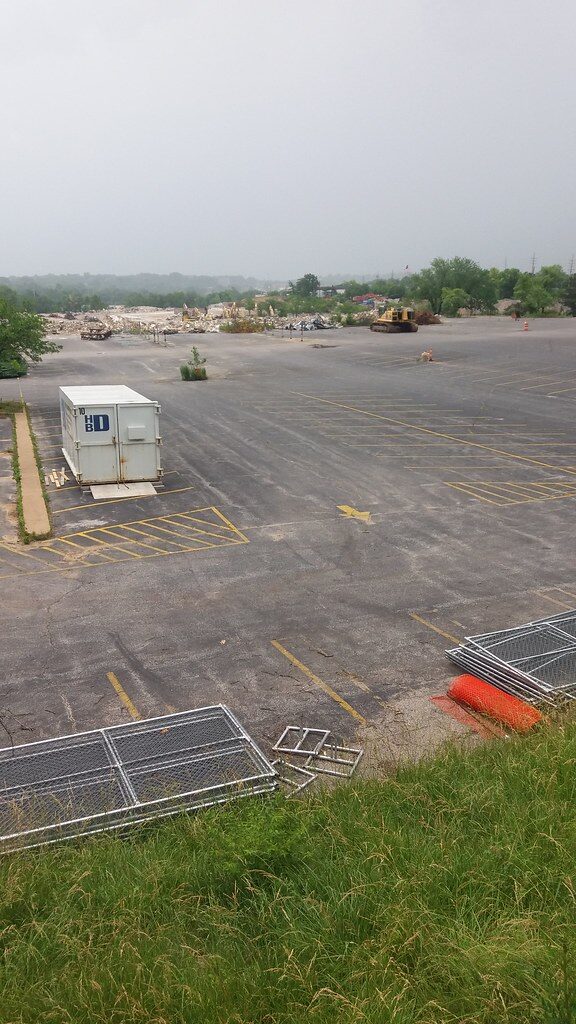
Demolition began in 2016, and by 2017, the mall was effectively gone. The site looked stranger than many people expected because much of the building had sat below the Watson Road grade.
A giant dirt mound left behind picked up the nickname "Mount Crestwood" before finally being removed by October 2018.
For a while, the old mall site was just a broad field seeded with native grasses.
Crestwood Crossing Takes Shape, One Phase at a Time
The next reset started on July 22, 2020, when Crestwood issued a request for proposals for the dead mall property.
By December 2020 and January 2021, Dierbergs Markets and McBride Homes had been chosen for the job, and the city approved the new plan in November 2021.
The front of the site along Watson Road would return to commercial use. The back would become housing.
McBride laid out 81 single-family homes, and grading work started in March 2022. Dierbergs broke ground on April 19, 2022, for its 27th store.
The grocery store opened on March 28, 2023, at Sappington and Watson Roads, launching Crestwood Crossing with a roughly 72,000-square-foot anchor and nearby space for more retail and restaurants.
The Villages at Crestwood Crossing filled up all 81 homes, and the first public improvements included a pedestrian bridge over Gravois Creek toward Grant's Trail.
By early 2026, tenants include Hometown Veterinary Partners, Arch City Mattress Co., SOHO Nail Salon, Crumbl Cookies, Roosters Men's Grooming, Mercy-GoHealth Urgent Care, Eye See Vision Center, Club Pilates, Andy's Frozen Custard, Panera Bread, and Dierbergs itself.
More is still coming. Plans have been submitted for a 7 Brew drive-thru coffee shop, and a QuikTrip with a 6,400-square-foot store and 12 pumps has been approved, with construction anticipated by fall 2026.
Crestwood Court, Westfield Crestwood, Crestwood Plaza
Former shopping mall in Crestwood, MO
Address: 9555 Watson Rd, Crestwood, MO 63126
Opened: March 21, 1957
Closed: July 11, 2013
Developer: Milton Zorensky and Louis Zorensky
Owner: Centrum Properties
Floor area: 1,034,494 square feetClosest cities:
St. Louis, MO
Kirkwood, MO
Webster Groves, MO
Sunset Hills, MO
Shrewsbury, MO
Des Peres, MO
Glendale, MO
Fenton, MO