
Livingston Mall: From blueprint to ribbon-cutting
Livingston Mall rose at 112 Eisenhower Parkway in Livingston, New Jersey, a two-level enclosed shopping center built on 43 acres near the Eisenhower Parkway and South Orange Avenue junction.
Its gross leasable area totals 969,000 square feet. Drivers reached it from Interstate 280 at Exit 4A, Route 10, Route 24, Interstate 78, and Interstate 287.
Public transit reached it through NJ Transit bus routes 70, 73, and 873, and the Livingston Express Shuttle connected riders to the South Orange station.
The mall was planned in the late 1960s as suburban commercial expansion marched west. N. K. Winston Corp. developed the project and hired Charles Luckman and Associates for the design.
The construction cost was estimated at $15 million, a number that made it clear this was not a modest neighborhood center.
It opened in stages. Bamberger's arrived first in 1971, opening a new suburban store at Livingston Mall.
In 1972, the mall proper opened with Sears and Hahne & Company, and more than 100 stores inside an enclosed, air-conditioned two-level layout.
It was promoted as "a whole new concept in shopping," which, in 1972, mostly meant you could forget the weather and keep walking.
A suburban shift: Livingston Mall and Newark's retail decline
Livingston Mall did not invent suburban shopping, but it opened as Northern New Jersey's retail map was shifting.
Population and consumer spending were moving outward from Newark and other older city centers, and retail followed that movement into the suburbs.
Downtown Newark had been the region's premier shopping district. After the July 1967 race riots, the decline accelerated, and the downtown draw weakened.
Shoppers and stores left the urban core in larger numbers, and suburban locations drew the next wave of investment.
The anchor stores marked the move. Bamberger's and Hahne & Co. operated flagship stores in Newark when they established their Livingston Mall locations.
Sears also maintained a prominent Newark store on Elizabeth Avenue in the South Ward. Their suburban branches drew traffic that might otherwise have gone downtown.
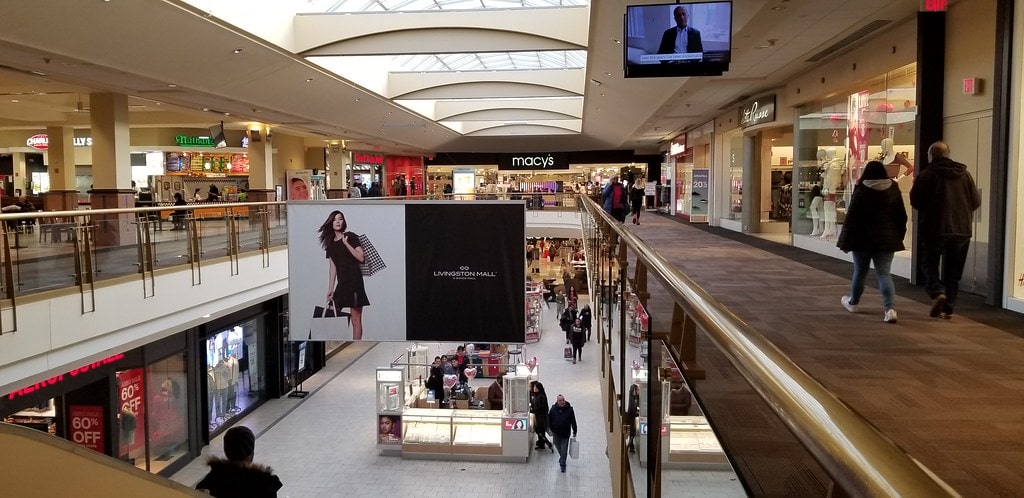
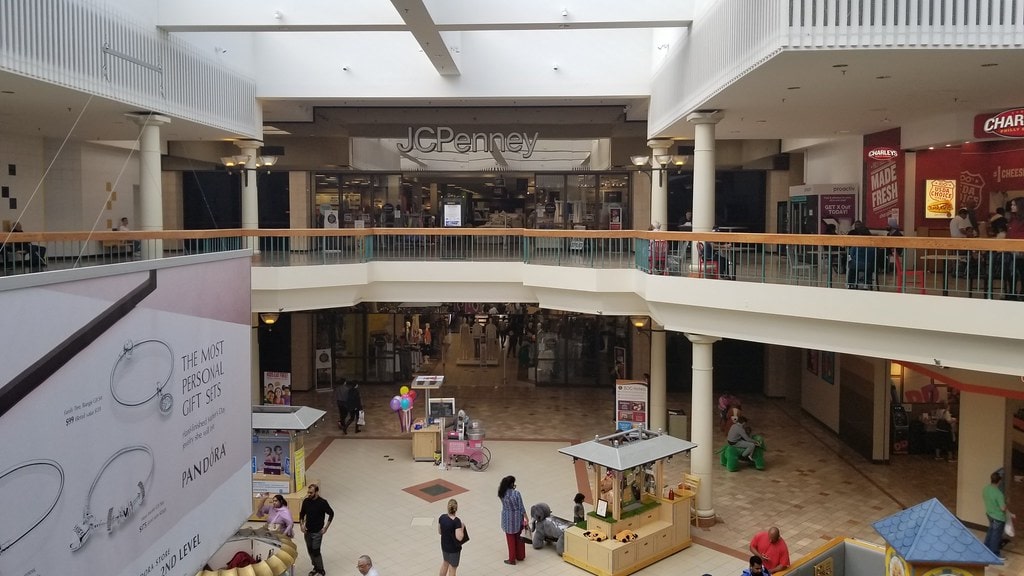
Inside, the mall's two-level plan formed a continuous loop that made it easy to keep walking. The design kept shoppers circulating past storefronts on both floors.
Built to serve Essex, Morris, and Union counties, Livingston Mall functioned through the 1970s as a steady regional shopping destination.
Anchors shuffle as the 80s consolidate
In the 1980s, Livingston Mall's anchor lineup began changing. The building stayed the same, but the names on the doors and the way the anchor space was used started to shift.
Bamberger's was converted to Macy's in 1986.
Around the same period, M. Epstein, an original 1972 anchor, was converted into a Macy's annex, expanding Macy's presence by bringing additional floor space under the same banner.
Hahne & Company remained in place through the decade while trying to reposition itself.
The Livingston store served as the chain's flagship in the 1980s under CEO Alan Kane, a Wharton School graduate appointed in 1978.
The company aimed for an upper-market customer, but the business weakened as Hahne's became unprofitable with its increased focus on suburban shopping malls.
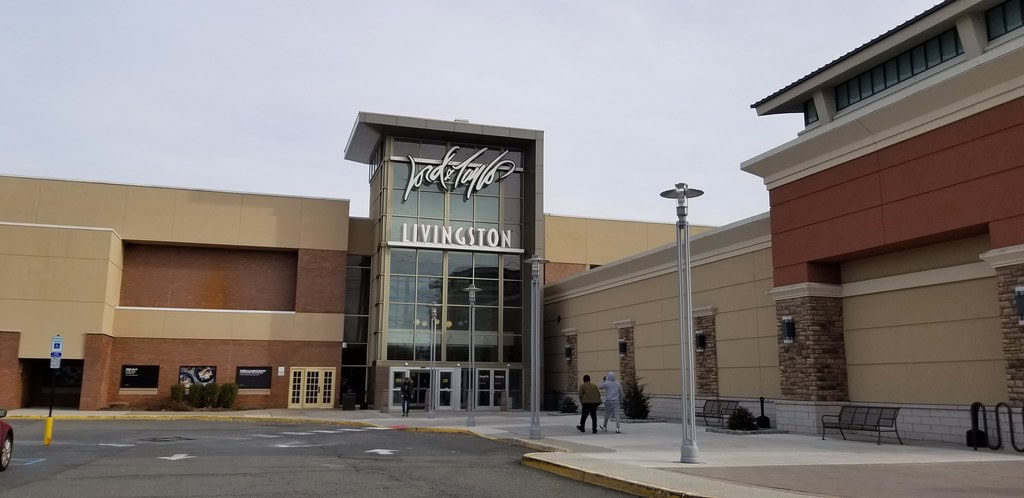
In 1989, May Department Stores decided to retire the Hahne's brand. The chain's nine locations closed between April and June 1989, and six converted to Lord & Taylor.
At Livingston Mall, the Hahne's space began converting to Lord & Taylor in fall 1989, with the changeover continuing through summer 1990.
Gap, Goody, and the loud little middle
During Livingston Mall's busiest years, activity in the building was also supported by the smaller stores located between the anchor department stores.
The Gap opened at the mall in 1973 and was later noted, at one point, as one of the oldest Gap stores still operating in New Jersey.
Herman's sporting goods served local demand for athletic equipment and school-related buying.
Kay Bee Toy and Hobby operated as a steady gift and toy store, handling routine purchases that brought families into the mall.
Music retail was part of the tenant mix. Sam Goody sold current releases, and Alwick Records served the same category nearby.
Nathan's Hot Dogs operated as a quick-service food option inside the mall. Heroes World sold comics and collectibles and drew customers who came to browse specialty merchandise.
As the mall later thinned out, these smaller tenants and activity spaces were among the first parts of the experience to disappear.
But, in the 1970s and 1980s, they supported a routine use of the mall as a place to walk, meet, and spend time between purchases.
The 2007 renovation tries to stay current
By the mid-2000s, Livingston Mall had already been renovated once, in 1991, and it still needed another update to keep pace with newer properties.
In August 2007, a major renovation began, managed as a partnership between owner Simon Property Group, general contractor Whiting-Turner, and architect SPG3 of Philadelphia.
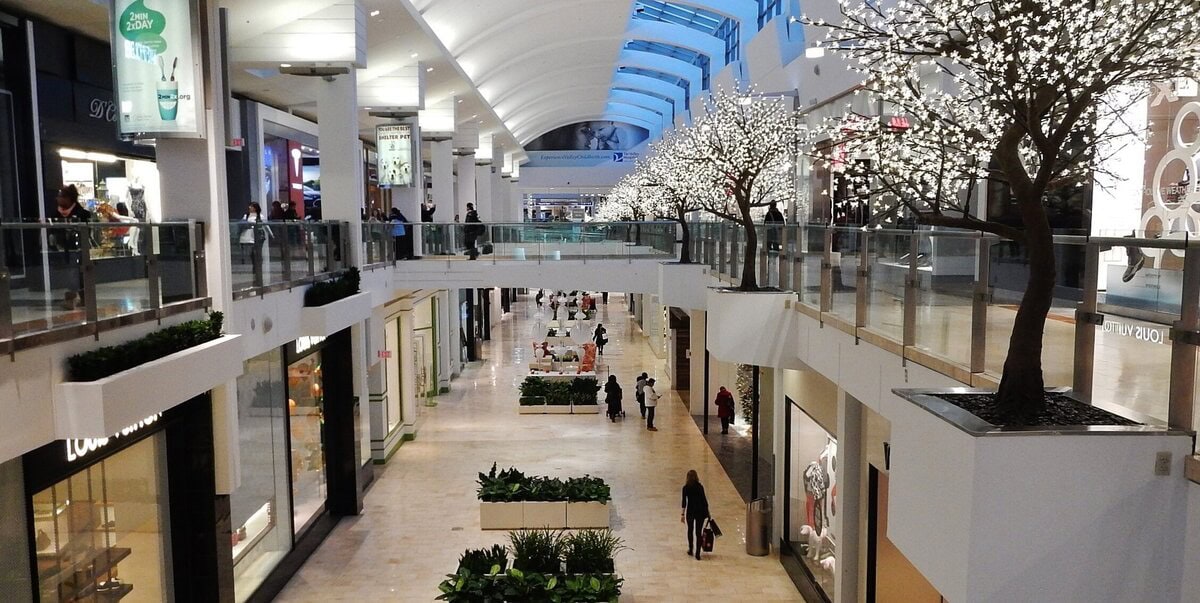
Center Court was rebuilt for a cleaner, more contemporary look. The existing stairway and fountain were replaced with a decorative elevator, and a marble medallion was embedded in the lower-level floor.
Bridge rotundas at escalator entranceways were enhanced on both levels. The work was meant to be felt everywhere.
Flooring was replaced throughout, with tile and a natural stone appearance on the lower level and new carpeting on the upper level, plus tile at concourse entrances.
Common areas received new finishes and lighting. A new two-story glass entrance was designed, with new pavers, lighting, and graphics.
Wayfinding was updated, and the South Orange Avenue monument sign was renovated, alongside enhanced landscaping at mall entranceways.
The plan also added a new food court on the upper level near Macy's, with seating for almost 400, seven tenants, and two kiosks.
Construction included a Barnes & Noble next to the main entranceway, about 28,000 square feet meant for browsing. Exterior work was expected to start in early 2008, with disruption kept as minimal as possible.

Short Hills, online shopping, and exits
The renovation did not change the surrounding market. Beginning in the 1990s, The Mall at Short Hills, about four miles away, drew shoppers with a more upscale tenant mix.
It offered luxury anchors including Bloomingdale's, Neiman Marcus, and Nordstrom.
It also had more than 40 boutiques exclusive to New Jersey. Livingston's position eroded over nearly three decades.
Retail conditions also shifted outside the local trade area. E-commerce absorbed routine purchases and moved sales online.
Mall shopping became less frequent for many customers. The COVID-19 pandemic accelerated the decline and increased the pace of closures.
Sears, an original 1972 anchor, announced in February 2020 that it would close the Livingston store and shut the location in April.
After Sears' bankruptcy, Transformco acquired its assets and stake in the mall. Lord & Taylor, which had replaced Hahne's, announced in August 2020 that it would close 24 stores nationwide due to pandemic impacts.
The Livingston location closed permanently on December 29, 2020, after about 31 years.
Once billed as "the premier shopping destination of North Jersey," the mall could draw as many as 100,000 holiday shoppers at its peak.
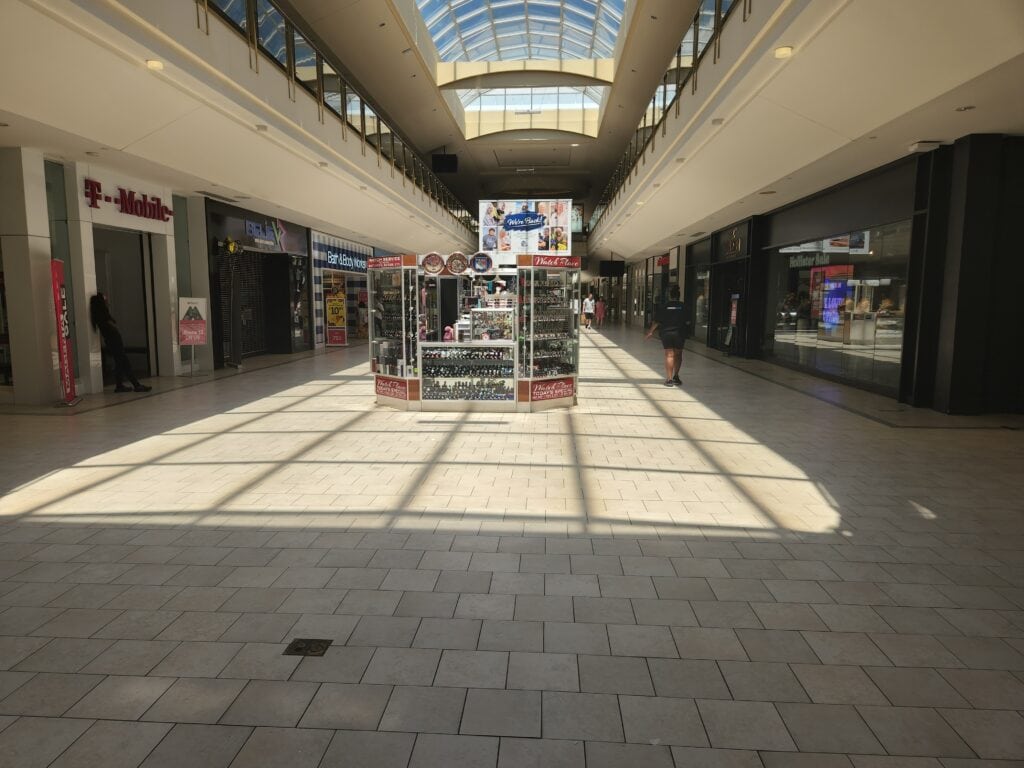
By late 2025, it was described as "quiet, dim and stripped of crowds," with roughly 90 percent vacancy, only Macy's and Barnes & Noble still operating as anchors, and a food court running on minimal service.
Power cuts and the town draws a line
By 2024, Livingston Mall's problems were no longer limited to vacancies and reduced foot traffic. Power was cut off at the mall on October 11, 2024, after nonpayment to Jersey Central Power & Light.
It was the second time a shutoff had been imminent and the first time service was actually disconnected.
The owners later negotiated a payment plan to restore power. Around the same period, the mall fell behind on property tax payments.
Three days later, on October 14, 2024, the Livingston Township Council passed Resolution 24-232 under the Local Redevelopment and Housing Law.
The action designated the mall property as an "Area in Need of Redevelopment with Condemnation." The designation allowed the township to adopt redevelopment plans and enabled the use of eminent domain if needed.
The redevelopment process was complicated by divided ownership and long-term lease structures.
Kohan Retail Investment Group acquired the property from Simon Property Group in July 2022, but other interests controlled key sections.
Macy's held options connected to its building and roughly 10 acres in the south section.
The former Lord & Taylor parent company controlled a 50-year ground lease on about 10 acres. Sears' stake shifted to Transformco after bankruptcy.
2026: Macy's out, streets go on the map
In March 2021, Livingston authorized a preliminary redevelopment-law investigation of the Livingston Mall site. The effort did not immediately produce a redevelopment plan or construction activity.
After the October 2024 designation, the work moved into a formal plan with a public process.
Topology, LLC, prepared a redevelopment plan dated February 2025. The township ran community visioning sessions from March 17 through March 22, 2025, and a related survey drew about 4,200 responses.
On March 24, 2025, the Township Council adopted the plan. It sets controls on layout, buffers, and the size, scale, and appearance of what gets built.
The concept envisions turning the enclosed mall site into a mixed-use neighborhood with new streets, more open space, and public activity areas, with development scaled to transition to adjacent residential streets.
Housing is part of the redevelopment framework. Under a prior fair-housing settlement, the township authorized 376 residential units on the former Sears site, with 20 percent designated as affordable.
In January 2026, Barnes & Noble signed a long-term lease for 24,740 square feet in Livingston Shopping Center, aiming for a mid-to-late 2027 opening and a move out of the mall.
Macy's announced it would close its Livingston store under the "Bold New Chapter" strategy announced in February 2024.
The move was part of a plan to close about 150 underperforming stores by the end of 2026. Clearance sales were set to start in mid-January and run about 10 weeks. The store is expected to close around mid-March 2026.

get boscov's to go in there or dillards they would do great in livingston mall
Great idea! Boscov’s or Dillard’s would be a fantastic addition to Livingston Mall. Here’s hoping the management takes note. Thanks for the suggestion.