Marble House: Built in Secret, Lit Up at Last
No one in Newport expected it. For about four years, from 1888 to 1892, William K. Vanderbilt put up fences around the building site on Bellevue Avenue and kept the project tightly controlled.
The whole plan was meant to end with a dramatic reveal: a surprise for his wife, Alva, for her 39th birthday. In August 1892, guests arrived at the iron gates on Bellevue Avenue for the house's dedication ball.
Many stories say the property was kept purposely dark at first, with no sign of what was inside. Then, at the right moment, the lights came on.
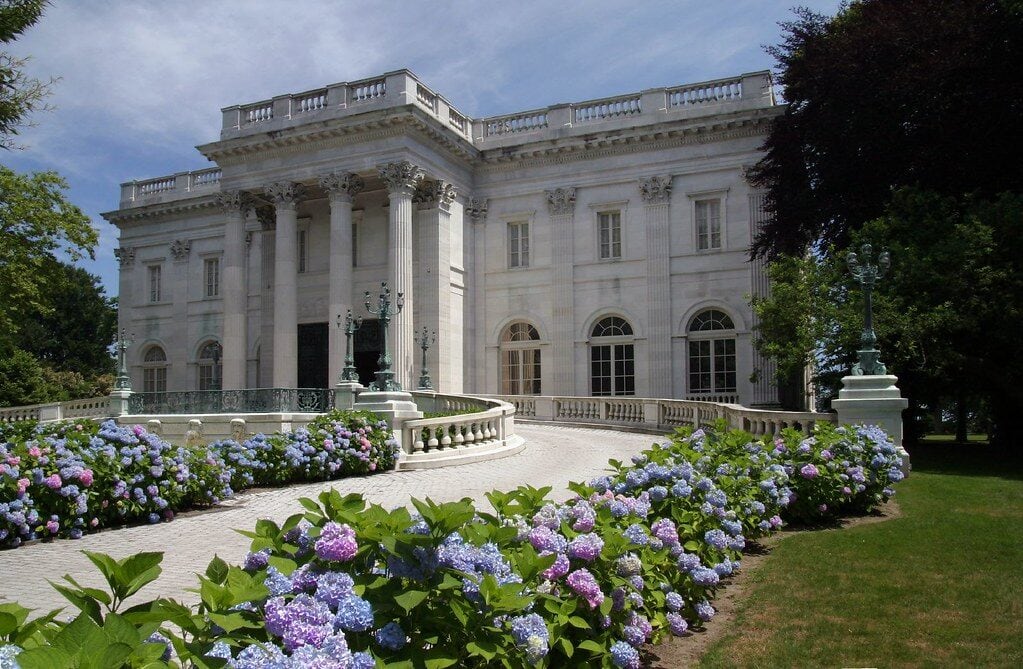
The crowd saw a 50-room mansion on 4.4 acres, its white marble walls shining in the lamplight: tall columns above a curved driveway, and a half-circle fountain with strange stone faces spouting water.
Building it cost $11 million, and $7 million of that was spent on marble.
Back in the early 1890s, Newport was already famous as a summer spot, but Marble House helped change the size and goals of Bellevue Avenue, moving away from "cottages" and toward huge, palace-like homes.
William's older brother, Cornelius Vanderbilt II, began building the new Breakers soon after, in 1893.
The rush to build big houses on Bellevue Avenue was speeding up, and Marble House became one of the first big examples that made the "stone palace" Newport we know today seem certain.
The Architect Who Trained in Paris to Build This
Richard Morris Hunt had done the pedestal for the Statue of Liberty and drawn the Fifth Avenue facade of the Metropolitan Museum of Art.
He had also trained at the Ecole des Beaux-Arts in Paris, which put him almost alone among American architects of his generation for formal European schooling.
The Vanderbilts had been relying on him for years by the time Marble House came along. Hunt would go on to design The Breakers for Cornelius Vanderbilt II, starting in 1893.
For Marble House, Hunt looked to the Petit Trianon at the Palace of Versailles and built outward from there.
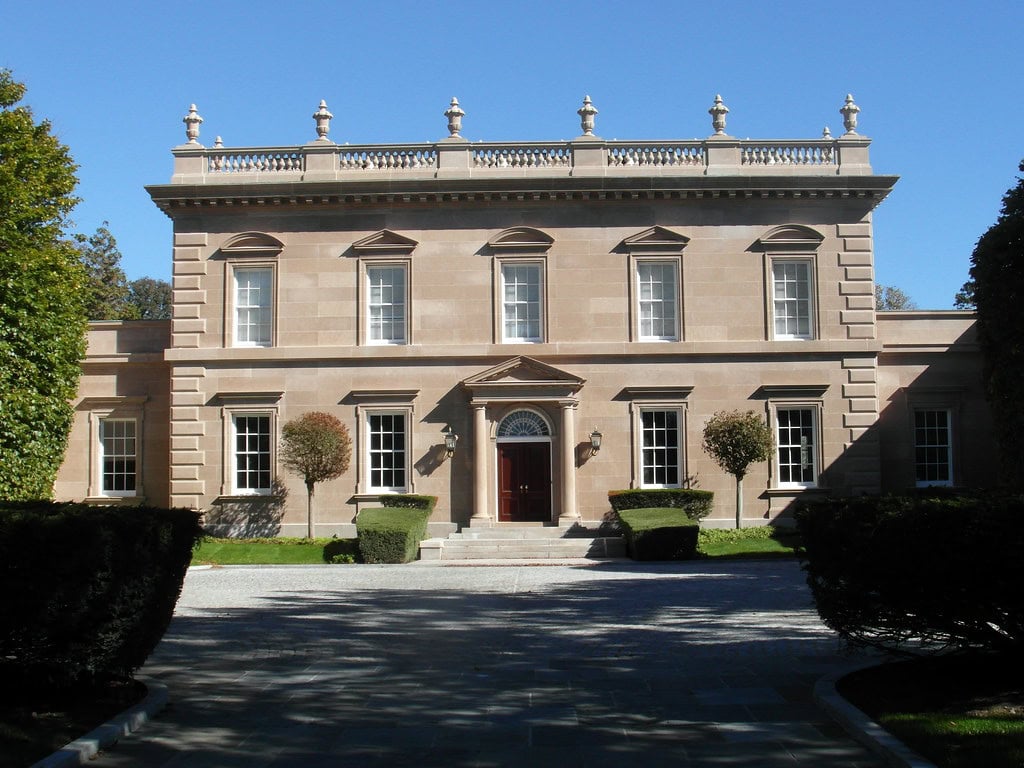
The building is U-shaped, with its main front on Bellevue Avenue marked by tall decorative columns, arched windows on the first floor, rectangular windows above, and a large four-columned entrance in the center.
Around the back, facing the Atlantic, a marble terrace sits enclosed by a marble balustrade.
From the street, it reads as two stories. It's actually four.
The basement holds the kitchens and service rooms, the ground floor the reception rooms, the second floor the bedrooms, and above that - out of sight behind the roofline - a concealed third floor of servant quarters.
The visible exterior surfaces are faced in white Tuckahoe (Westchester) marble, applied over probably an iron or steel frame with brick reinforcement and casing.
Rooms Designed to Stop You in Your Tracks
You enter through one of two large French Baroque bronze doors, each weighing about a ton and a half, both marked with the initials "WV" in an oval badge.
Cast at the John Williams Bronze Foundry in New York. The statement is made before you have gone three steps inside.
The Stair Hall is two stories of yellow Siena marble. The wrought iron and gilt bronze railing copies the design of railings at Versailles.
Above, an 18th-century Venetian ceiling painting shows gods and goddesses in the clouds. Sculptor Giuseppe Moretti worked on the marble decorations throughout the inside.
The raised images of Hunt and Jules Hardouin-Mansart, Louis XIV's architect at Versailles, placed next to each other on the staircase landing were carved by Karl Bitter.
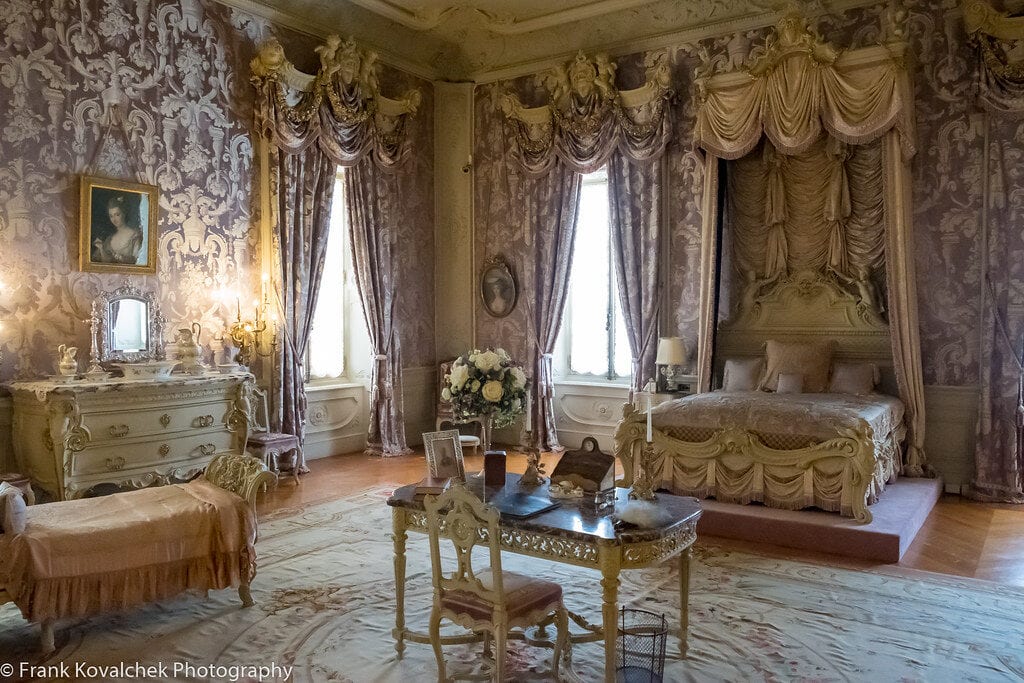
Jules Allard and Sons of Paris designed the Grand Salon - a ballroom and reception room in Louis XIV style, its carved wood and gold-gilt wall panels drawn from the work of Versailles decorator Charles Le Brun.
Crystal and ormolu chandeliers hang above, inspired by those at Château de Maisons-Laffitte (near Paris).
The ceiling features an 18th-century French painting in the manner of Pietro da Cortona depicting Minerva (Athena), with a surround adapted from the ceiling of the Queen's Bedroom at Versailles.
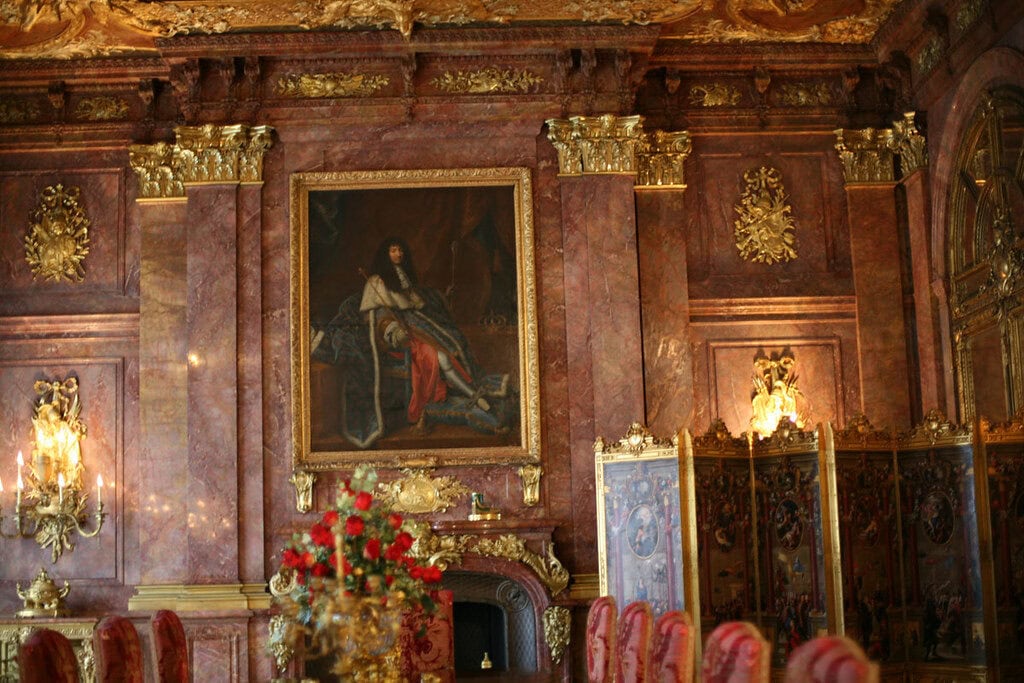
The Dining Room uses pink Numidian marble brought from Algeria, with gold-colored bronze tops on the columns and carvings of helmets and weapons in the Louis XIV style on the walls.
Alva's private Gothic Room was built around her collection of medieval and Renaissance objects, with a stone fireplace copied by Allard & Sons from one in the Jacques Cœur House in Bourges.
Joan of Arc occupies the mantelpiece relief - an unusual choice that says something about the woman who picked it.
When Alva Kept the House and Rewrote Her Own Story
The divorce in 1895 caused a genuine scandal.
In the social world that William and Alva Vanderbilt occupied, marriages simply did not end that way - and certainly not publicly, with papers filed and everything made official.
But Alva went ahead anyway. William came away with the bulk of their shared holdings.
Marble House, though, had been deeded to Alva outright as her birthday gift years before any of this happened. It was already hers, and it stayed that way.
She remarried the following year - Oliver Hazard Perry Belmont - and moved into his mansion, Belcourt, not far down Bellevue Avenue.
After Belmont died in 1908, she came back to Marble House and got to work.
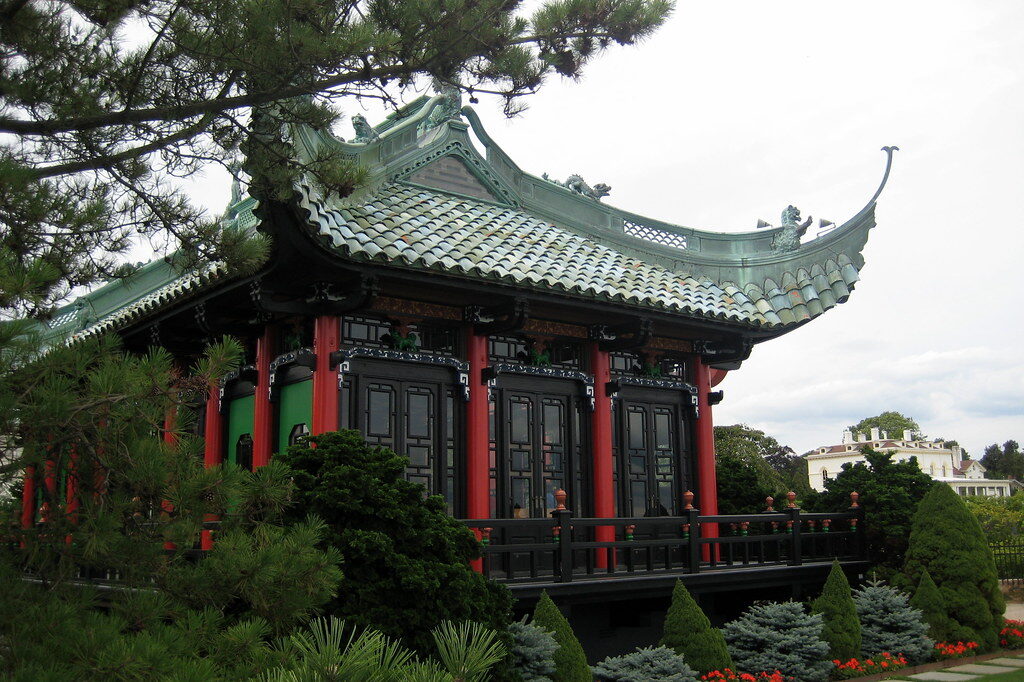
She built the Chinese Tea House on the cliff behind the mansion in 1914, facing the ocean. She did this on purpose, putting Eastern art next to the French style of the main house.
Next came the fight for women's right to vote. Alva used Marble House to support the cause, holding rallies there and using the house's name and fame to help women win the vote.
The same rooms where she had arranged her daughter Consuelo's marriage to the Duke of Marlborough, using the house to improve her family's place in society, she now used for something much more important.
She left Newport in 1919. The following year, the 19th Amendment was passed. She packed up the house, moved to France to be close to Consuelo, and sold Marble House to Frederick H. Prince in 1932.
She died the next year, at eighty.
The Prince Years: Quiet, Careful Stewardship
The Princes came every summer and mostly stayed in the servant rooms on the third floor. The fancy rooms below, like the Grand Salon, the Dining Room, and the Gothic Room, were not theirs to change or decorate.
They made as few changes as possible. Most of the furniture and objects stayed where they were, and when things were moved, it was usually to store them, not to redecorate.
The family's guiding rule was basically: leave it alone.
It sounds like neglect. It wasn't. During those years, fancy old houses across America were taken apart, sold off bit by bit, or torn down because they were too expensive to keep up, and people did not care much.
Marble House stayed the same inside, not because of any big organization, but because the family who lived there knew to leave everything as it was.
One evening in July 1957 was different from the usual. Tiffany and Company threw a benefit ball at Marble House for the Preservation Society of Newport County.
The guest list included then-Senator John F. Kennedy and his wife Jacqueline Bouvier Kennedy, the Astors, E. Sheldon Whitehouse and his wife, and Count Anthony and Countess Sylvia Szapary of the Vanderbilt family.
It ran well into the early morning hours - the house briefly, extravagantly itself again.
In 1963, the Preservation Society bought the property from the Prince Trust, with Harold Stirling Vanderbilt, the youngest son of William and Alva, helping fund the purchase.
The Prince family donated the original furniture directly to the Society, ensuring the whole collection stayed with the building.
Open to the Public Since 1964 and Still Going
Marble House has welcomed the public since 1964, with the Preservation Society of Newport County in charge of running it.
After opening, the mansion gained formal historic status over time. It joined the National Register of Historic Places in 1971 and later received National Historic Landmark status in 2006.
Marble House is also part of the bigger Bellevue Avenue Historic District, which has several other nearby mansions and was named a landmark in 1976.
Tours operate all year and come in a few styles. Visitors can tour on their own with an audio app, or they can take a structured family tour.
Behind the house, afternoon tea is served at the Chinese Tea House, the cliff-top structure Alva built in 1914.
The property also holds private events and weddings all year, so there is always something happening besides the usual tours.
Marble House has also been used for filming. It appears in "The Great Gatsby," "Amistad," and the HBO series "The Gilded Age," along with other productions.
In 2015, a 15th-century Sienese gold-ground cassone, a decorated chest from the original Vanderbilt collection, returned to the Preservation Society after conservation.
Preservation work continues while visitors come through. Projects have included a full roof restoration and exterior steam cleaning.
A new heating and cooling system that uses the earth's natural energy is also being put in and should be done by late spring 2026, bringing modern systems into the mansion's 130-year-old marble walls.