At 5 a.m., the parking lots at 2200 South 10th Street are already filling up. This happens every Black Friday. Shoppers arrive before sunrise, looking for discounts that can reach 70 percent.
Some come from across the Rio Grande Valley. Others drive over the border from Reynosa or Nuevo León, using directions the mall provides on its website, including step-by-step routes from the Hidalgo and Anzalduas international bridges.
About 40 percent of the people who shop here each year come from Mexico. This is central to how the mall operates.
La Plaza Mall is about five miles north of the Mexican border. Its main stores include Dillard's, JCPenney, Macy's, and a Macy's Home Store.
The mall covers 1.3 million square feet and has more than 190 specialty retailers. Restaurants like Texas de Brazil and Yard House share space with Palenque Grill and Sweet Paris.
Stores such as Zara, H&M, Lululemon, Marc Jacobs, and Miniso line the interior walkways.
In 2018, McAllen Mayor Jim Darling said that the mall accounted for nearly a fifth of the city's sales-tax revenue.
La Plaza Mall Opens in McAllen, 1976
La Plaza Mall began operating in 1976 in a part of Texas that had no close competition.
McAllen, Texas, lies at the state's southern edge, with the Rio Grande forming its southern boundary and farmland and ranches surrounding it elsewhere.
At that time, the Rio Grande Valley already had another enclosed regional mall, Amigoland Mall in Brownsville, so La Plaza immediately served a large population of shoppers on both sides of the border.
Both the city and Simon Property Group, its current owner, identify 1976 as the opening year.
Over its first twenty years, the mall developed in line with the standard regional mall approach. It centered on several large department stores, with national chains and some regional businesses filling in around them.
Property filings from 2002 and 2005 list Dillard's, JCPenney, Sears, Foley's, Foley's Home Store, Bealls, and Joe Brand among the main tenants.
This combination of national and Texas-based retailers allowed the mall to serve a wide range of customers and shopping needs.
That range was important in a market that included both working-class families near the border and Mexican shoppers making planned trips to spend money.
By the 2000s, La Plaza had become the primary retail center for the Rio Grande Valley.
Jones & Jones, Foley's, and the Macy's Conversion
In late April 1996, May Department Stores Company took over the Jones store at the mall, replacing the earlier Jones & Jones operation.
A local McAllen historical record also dates this change to May 1996.
By 2005, this space was listed as Foley's and Foley's Home Store. By 2007, it had changed again to Macy's and Macy's Home Store.
The progression from Jones & Jones to Foley's to Macy's mirrors a nationwide pattern, as many regional department store brands were absorbed into a smaller group of national retailers.
At La Plaza, these changes did not disrupt the wider group of anchor stores. The 2007 filing that listed Macy's also included Sears, Dillard's, JCPenney, Bealls, and Joe Brand.
The mall continued using its multi-anchor layout, a system in place since 1976, with several large stores attracting shoppers from different parts of the property.
This structure held for nearly another decade, until the loss of a Sears anchor space led to a major change.
The 2000 Expansion That Enlarged La Plaza Mall
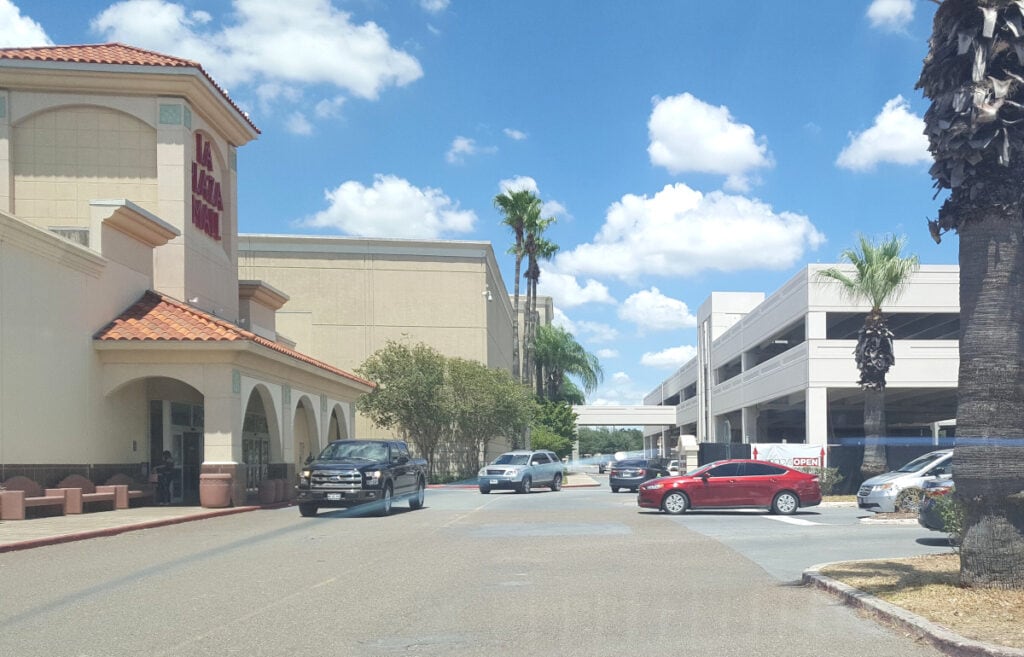
Around November 2000, La Plaza Mall expanded for the first time in a major way when the mall opened a new corridor with 30 more stores.
The expansion added 205,000 square feet of retail space, 1,200 parking spaces, and 450 permanent jobs.
In the same year, Dillard's listed the mall as a replacement-store location, showing that its anchor store was upgraded during the same period.
That 205,000-square-foot addition increased the mall's size by about 20 percent. The extra parking made it possible to handle more visitors as the number of stores grew.
Simon's 2002 property records show the expansion was complete and 98.9 percent occupied.
The project pushed La Plaza further ahead of any competing retail center in the Rio Grande Valley and led to nearly fifteen years of steady performance.
The period would eventually end with a demolition tied to a specific real estate deal, rather than a slow decline.
Acquiring Sears and Planning a Major Expansion
In 2015, Simon announced it had agreed to acquire the Sears Holdings store at La Plaza Mall - and then said it had completed that acquisition.
The Sears parcel freed up anchor-sized real estate at the edge of the existing mall without requiring demolition of any functioning tenant space, and that is what made a large-scale redevelopment possible.
A detailed public plan had already been announced in May 2015. In March 2016, the City of McAllen laid out what Simon intended to build.
The plan included an 80,000-square-foot two-level anchor, two junior anchors, 50 to 60 specialty stores, and four to eight restaurants.
It also called for a separate addition between Macy's and JCPenney that would add 20 to 25 more shops and several more restaurants.
Simon also planned to upgrade flooring, lighting, restrooms, seating, and landscaping throughout the existing mall.
Two parking decks were part of the package - 500 spaces near Macy's and 700 more serving JCPenney, Dillard's, and the new wing.
McAllen said La Plaza was already generating about $400 million a year in sales, employed 2,500 people, and that the expansion was expected to create at least 500 new jobs.
By September 2016, the city had committed $20 million toward the two parking decks, to be repaid through a sales-tax increment tied to the project.

The 2017 Expansion Wing and Its Tenants
The finished expansion added 245,000 square feet to the property, including 40 specialty retailers, five first-to-market restaurants, four junior anchors, and the two parking decks.
The overall project came in at more than $130 million - the largest single retail development in McAllen's history.
Tenant announcements in May 2017 named Zara, H&M, Kendra Scott, REEDS Jewelers, Flip Flop Shops, Texas de Brazil, and Palenque Grill among the early arrivals.
Several were entering the Rio Grande Valley market for the first time.
Rather than filling the former Sears site with duplicates of what was already in the mall, Simon concentrated fashion, dining, and new-to-market names in the new wing.
The first phase of tenant openings in fall 2017 moved quickly enough that the mall's growth continued into the next decade without a meaningful pause.
Primark and Ongoing Construction
Simon's current property materials list includes Primark alongside the department stores.
On December 12, 2024, Primark opened its first Texas store at the mall. The location covers more than 37,000 square feet and marks the company's entry into the state through McAllen.
Construction continues into 2026. Lululemon is expanding and renovating its store, operating from a temporary space elsewhere in the mall during the project.
The work covers about 7,250 square feet and has a budget of around $1 million.
Ulta Beauty is building a new store with 12,000 square feet, at a cost of about $1.05 million, and an expected opening date of July 1, 2026.
Both projects were filed with the Texas Department of Licensing and Regulation and list a start date of February 2, 2026.
Nearly fifty years after it opened, La Plaza Mall continues to expand and renovate.