If you stand at State Street and Orange Street today, you are in the spot that was once the center of downtown Redlands.
Back in 1888, a Sanborn Insurance Map showed this was the only intersection in town with buildings on all four sides.
Starting in the 1880s, people called it the "100 percent corner." Buildings rose two, three, even four stories, with shops on the ground floor and apartments above.
The building styles were all mixed together: Main Street Commercial, Craftsman, Mediterranean, and Victorian.
Everything was close enough to walk to because the whole downtown got built before cars took over.
Two big buildings held down that corner for years. The First National Bank Building went up in 1914 on the southwest side.
Arthur Gregory built the La Posada Hotel in 1931 on the northwest corner in the Spanish Colonial Revival style.
The hotel became the center of things in town, a place for civic meetings and commerce, where visitors got their first look at Redlands.
Electric streetcar service in Redlands began in 1899, when the Redlands Street Railway converted to electric operation.
The Redlands Central Railway's line opened in 1908 and was later folded into the larger regional system, which by 1911 operated as part of Pacific Electric.
Riders could step off the trolleys and walk to nearby downtown shops.
Then cars showed up. Highway 99 came through on Redlands Boulevard. Interstate 10 opened in 1962.
By the mid-1970s, the city saw those 12 acres of old buildings as old-fashioned. In 1975, bulldozers knocked down six city blocks.
The First National Bank Building came down. The La Posada Hotel came down. Downtown Redlands lost its heart.
The Mall That Replaced Downtown's Heart
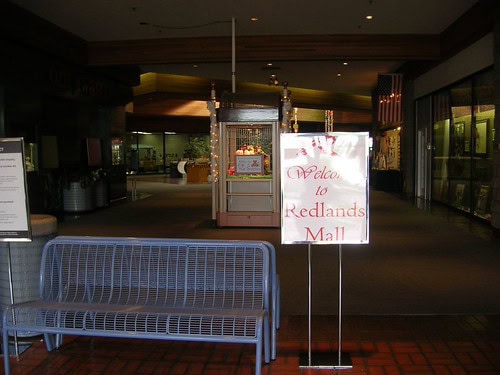
The Redlands Mall opened on March 10, 1977, built by The Hahn Company as part of a trend across America to replace old buildings with new shopping malls.
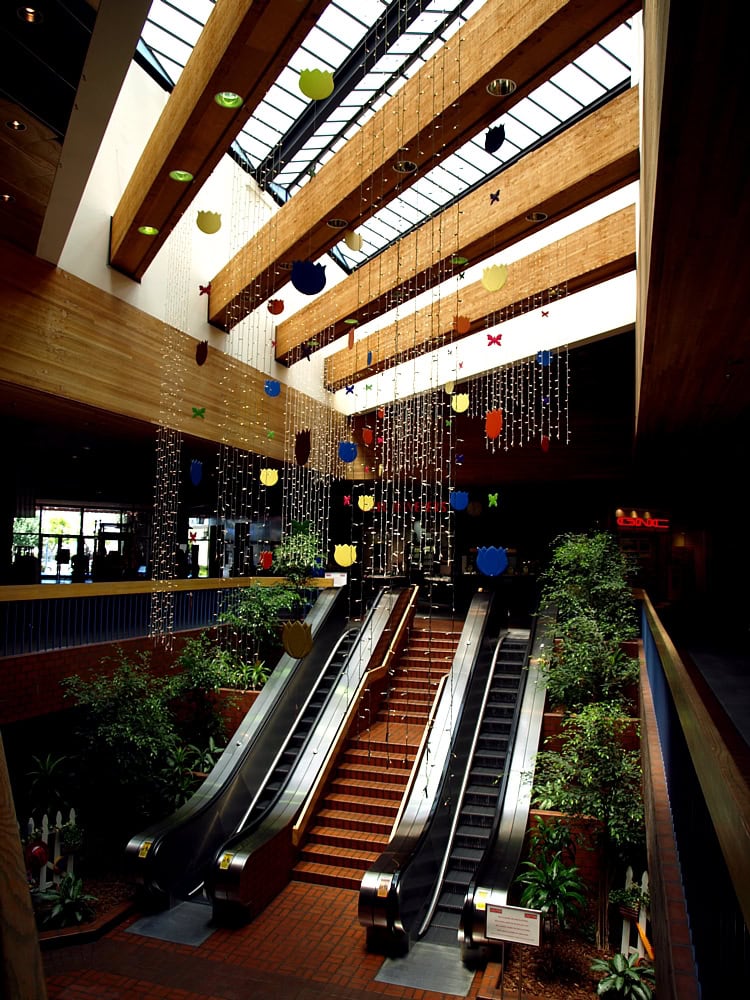
More than 173,000 square feet of enclosed space spread across two floors, plus a 12,600-square-foot freestanding building at Orange Street and Redlands Boulevard.
Harris' department store anchored one end. Sav-on Drugs, later rebranded as CVS Pharmacy, took another spot.
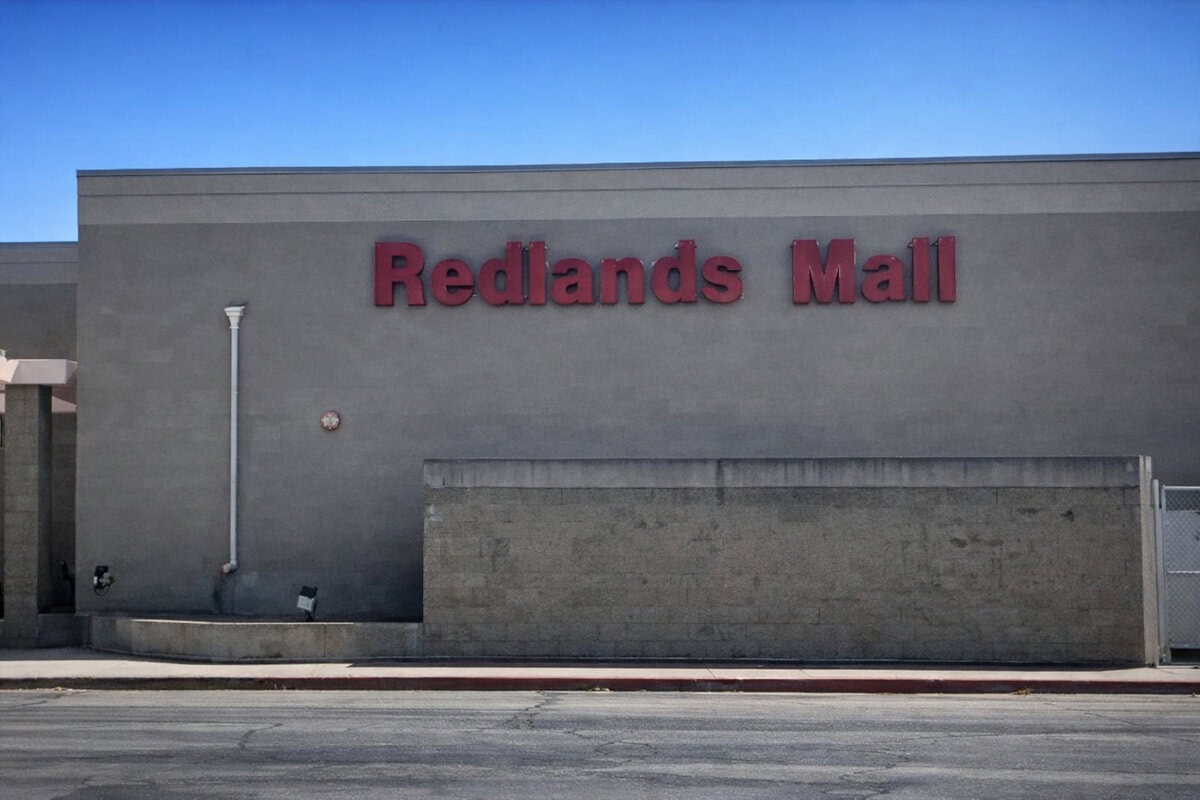
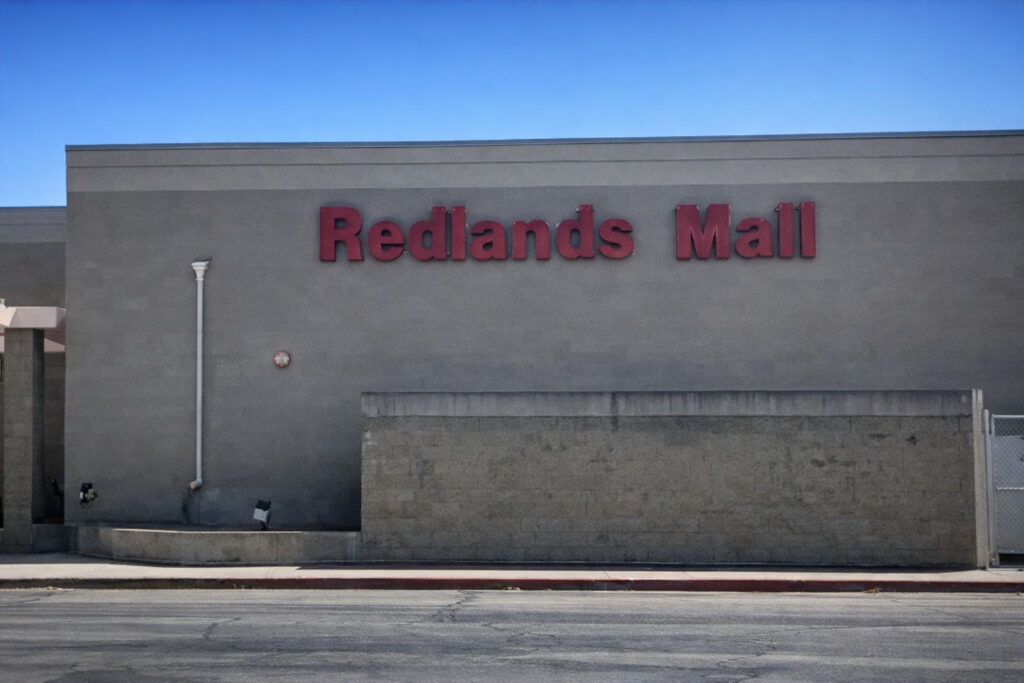
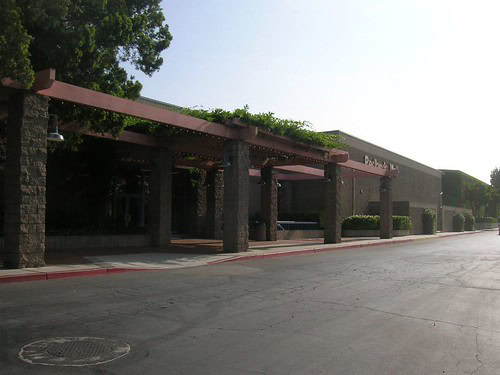
The mall was in the middle of a huge parking lot, surrounded by pavement. The building faced away from the street, with walls that had no windows and was designed to face inside.
Critics quickly complained that the plain cinder-block design ignored the style of the buildings it replaced.
The "100 percent corner" status of State and Orange Streets disappeared the day the mall opened. Surface parking lots now separated the sidewalk from the windowless building.
North-south circulation between the Downtown Station, Smiley Park, and neighborhoods to the south got harder.
People had to go around the mall to move east or west because it was built like a fortress. But for a while, that did not seem to matter. The mall became a popular place for people to gather and shop.
The Slow Death of Redlands Mall
The mid-1990s brought the first cracks. Popular nationwide stores started leaving, replaced by independent tenants that didn't draw crowds.
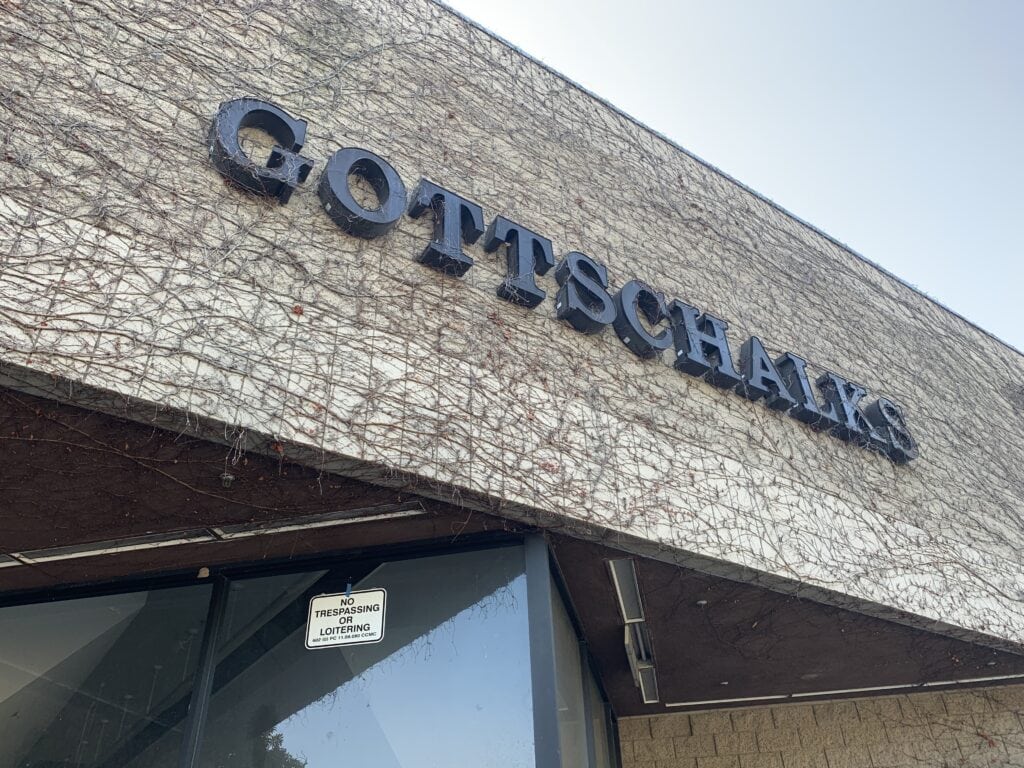
In 1998, Harris' closed after the Harris-Gottschalks acquisition merged the two chains. Gottschalks moved in to replace it, but the mall kept weakening. Sales dropped to dangerously low levels in the early 2000s.
The death blow came in 2009 when Gottschalks filed for bankruptcy and closed all 58 stores, including the Redlands Mall location.
After just 11 years as a tenant, the anchor was gone.
The mall limped along for about one more year, then closed for good on September 30, 2010, and all leases were immediately terminated.
Only CVS Pharmacy stayed open, along with tenants in the freestanding building, including Denny's, Union Bank, and a mattress showroom. The rest became a concrete shell.
Brixton Capital Buys and Does Nothing
In July 2014, Brixton Capital LP, out of San Diego, bought the property and announced plans to convert it to mixed-use development with housing and retail.
But Brixton refused to move forward unless it owned the entire lot, including the city-owned parking area. The city sold that parking for $1.95 million in 2017. Brixton still did nothing.
For five years, Brixton owned the property but did nothing with it. The empty building became something locals thought looked ugly in the middle of downtown.
Parking lots that used to be for shoppers were now used by downtown businesses across Orange Street and for events like Market Night.
A bus transfer center operated along Redlands Boulevard at the edge of the site, but the uninviting design made it an unpleasant place to wait.
The site occupies prime real estate near transit, within walking distance of the Downtown Station, bus and bicycle routes, Smiley Park, and restaurants along State Street.
But a stormwater easement on the southeast corner of Eureka Street and Redlands Boulevard complicates construction.
The underground stormwater pipe runs through that corner, so any building placed there would require the pipe to be moved out of the way.
Village Partners Wins Approval for State Street Village
In 2019, Newport Beach developer Village Partners Inc. bought the mall from Brixton and unveiled State Street Village.
The vision looked impressive on paper.
It promised 700 high-end apartments and condominiums, over 12,000 square feet of office space, 72,000 square feet of street retail, rooftop restaurant, pedestrian walkways, and a structured parking facility.
A 23,000-square-foot private plaza would connect to West State Street shops through a public art arch.
The design would mirror Redlands' Spanish, Mediterranean, Victorian, and Craftsman styles found on East State Street. CVS would move to a purpose-built structure south of the site.
By early 2022, Denny's, the mattress store, and Union Bank had moved out to clear the way.
The Redlands City Council and Planning Commission approved the plans in May 2022. Village Partners promised to respect downtown design elements and limit buildings to three or four stories.
The developers said demolition and construction would begin in the latter part of 2023, which would finally bring change to the empty site.
But summer passed, and the property stayed vacant while the company kept its approvals.
Residents Battle Over How High to Build
The fight over the mall site wasn't just about developers who couldn't get things done. It turned into a city politics mess.
In 2020, former mayor Bill Cunningham brought residents together to speak out against building taller buildings, especially with the Arrow rail line on the way.
They put Measure F on the ballot. The measure would've capped buildings near downtown train stations at three stories, with a few exceptions.
The goal was to preserve Redlands' historic look, even as the state continued to push for more housing.
There was a strong debate on both sides. In November 2022, voters rejected Measure F. But another issue soon appeared.
Senate Bill 330 from 2019 - the Housing Crisis Act - said cities couldn't reject housing projects based on subjective reasons if the projects followed the objective rules.
That law changed everything about how Redlands had to deal with developers. The state told Redlands it needed 3,516 new housing units by 2029, and some had to be affordable.
City officials thought that if they argued too much about building designs or how many homes could be built, they might lose the whole project and get in trouble with the state.
Voters had already killed Measure G in 2020, which was pro-development. Before that, voters had approved Measures R (1978), N (1987), and U (1997), which were all rules to control how much the city could grow.
Even so, people kept arguing, and some residents wondered why City Hall supported big new projects when earlier votes showed that people wanted growth to slow down.
Village Partners Defaults and Sells
County filings in late 2024 revealed Village Partners had defaulted on its business loan.
The property was scheduled for public auction. When local media published the news of the defaults, Village Partners announced they were working with lender Hankey Capital LLC to avoid foreclosure.
The trustee sale was postponed multiple times at the beneficiary/lender's request, with the auction ultimately set for May 1, 2025.
The foreclosure was then withdrawn via a notice of rescission filed April 28, 2025, canceling the auction.
A spokesperson announced minor refinements were being made, but the overall vision would remain intact, with updates coming soon.
Those updates never came. By November 2025, Village Partners sold the property to Jack and Laura Dangermond.
The sale happened on November 5 through Town Square Development Group LLC, a Wyoming-based company that the Dangermonds own.
It was the fifth ownership change in 20 years. A spokesman noted there were no specific plans yet, but the goal was to move reasonably quickly.
Local Billionaires Step In to Take Control
Jack and Laura Dangermond aren't typical real estate developers. They founded Esri in 1969, a geographic information systems company now deployed in 350,000+ organizations worldwide.
Their net worth sits at $11 billion. Jack graduated from Redlands High School in 1963 and holds degrees in landscape architecture, urban planning, and design.
The couple has given millions to the Nature Conservancy, Museum of Redlands, and UC Santa Barbara. They started investing in the nearby Packing House District in 2015.
They bought the mall site personally, not through Esri. Unlike previous out-of-town investors looking for profits, the Dangermonds seem motivated by improving their hometown.
They're not committed to Village Partners' plan to mix different types of buildings, but the permission they got in 2022 lasts until 2027.
Their plans include tearing down old, damaged buildings, keeping public access to the current parking, and coming up with a full plan for the site within a year.
The goal is to create a place that fits in with Redlands and helps the community.
After 15 Years, Construction Finally Begins
In the second week of January 2026, construction crews appeared on the property. Workers cleaned the site inside and out. Heavy equipment dug out light poles.
Crews removed the pergola. Portions of the hardscape came up. The work was preparation for the demolition of the buildings, though no demolition date has been announced.
Passersby watching the activity marked the first visible progress in over 15 years. The mall has been vacant since 2010, sitting as a gray building ringed by asphalt, while downtown around it experienced a renaissance.
The Arrow commuter rail line opened in 2022. Metrolink commuter rail added stops nearby. New businesses like the Redlands Public Market opened.
Other Inland Empire cities moved faster. Moreno Valley and San Bernardino approved or held ceremonies for mall overhauls or demolitions in 2023, leaving Redlands behind.
Now the wait appears to be ending.