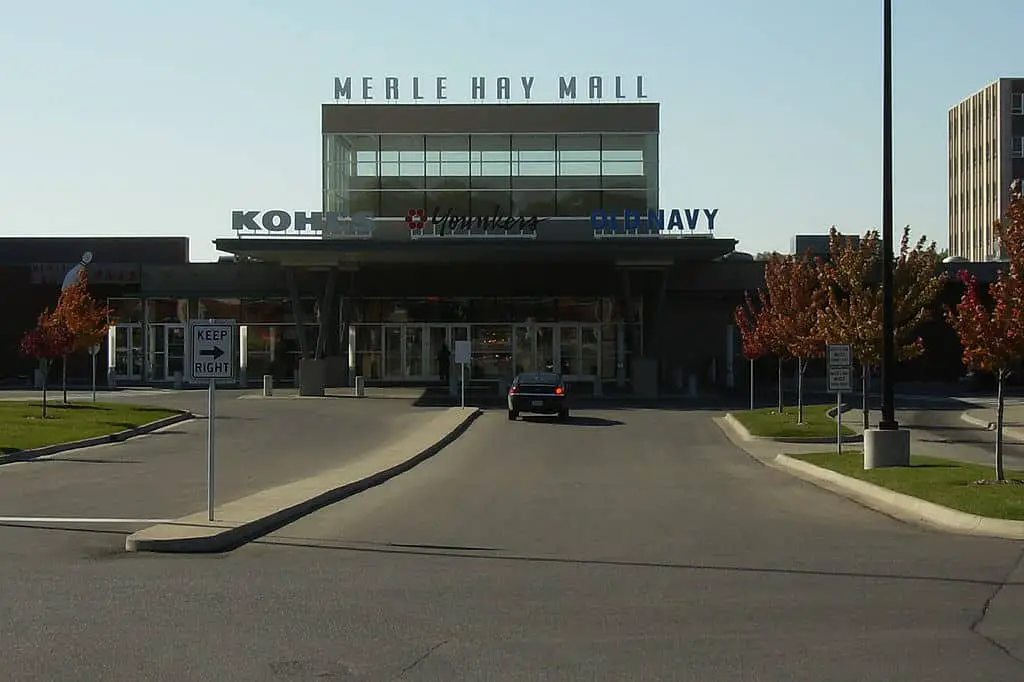
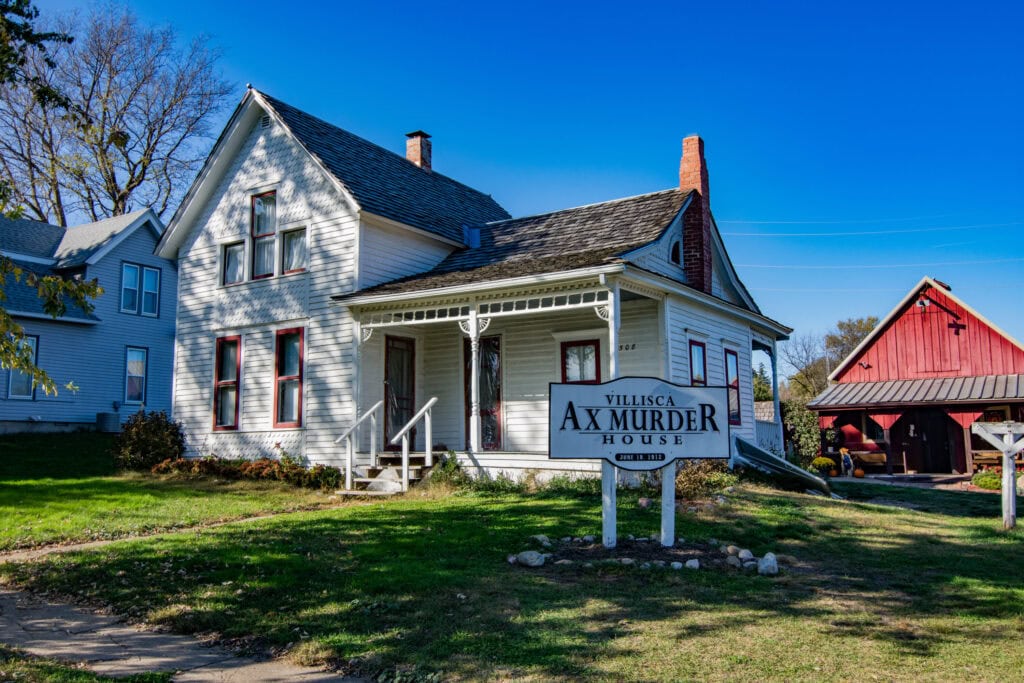
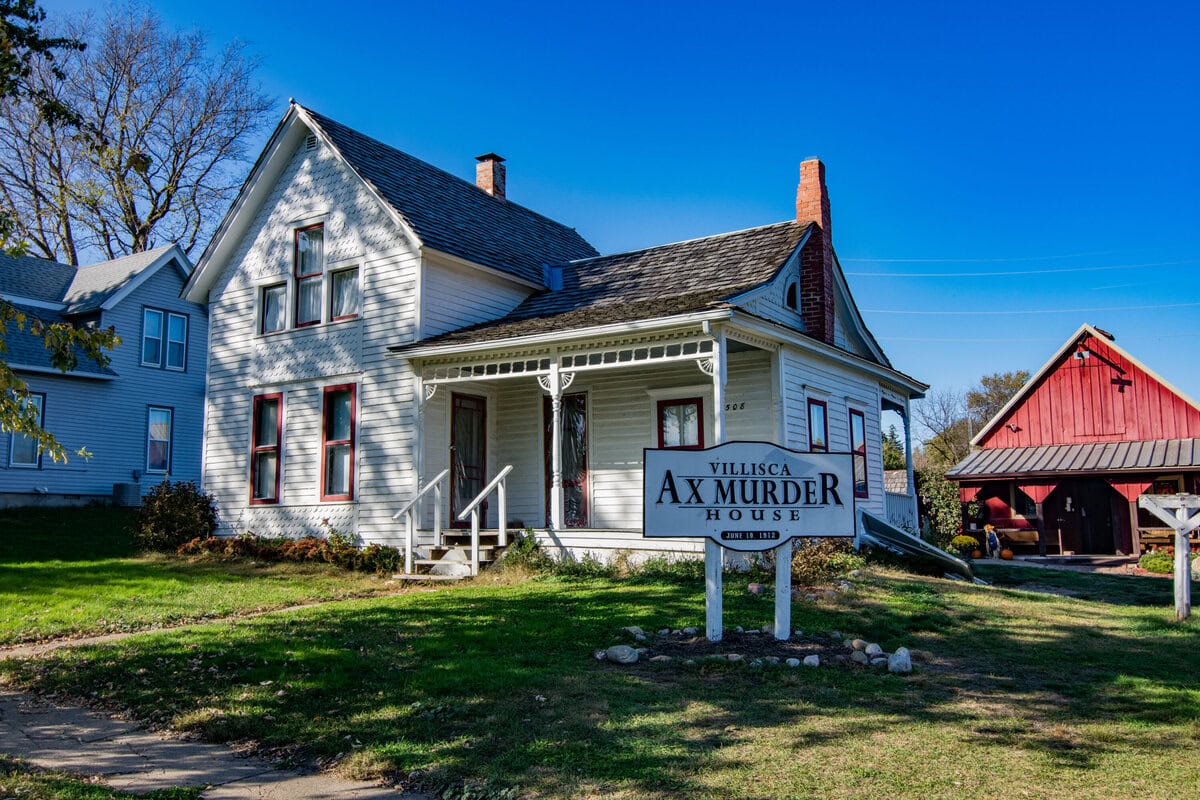
You walk up to 508 East Second Street, and it just looks like a house. White wood siding, a front porch, a yard. There's an outhouse in the back and a chicken coop beside it.
The whole property was put back together on purpose, piece by piece, to look the way it did on the morning of June 10, 1912 - the morning eight people were found dead inside it.
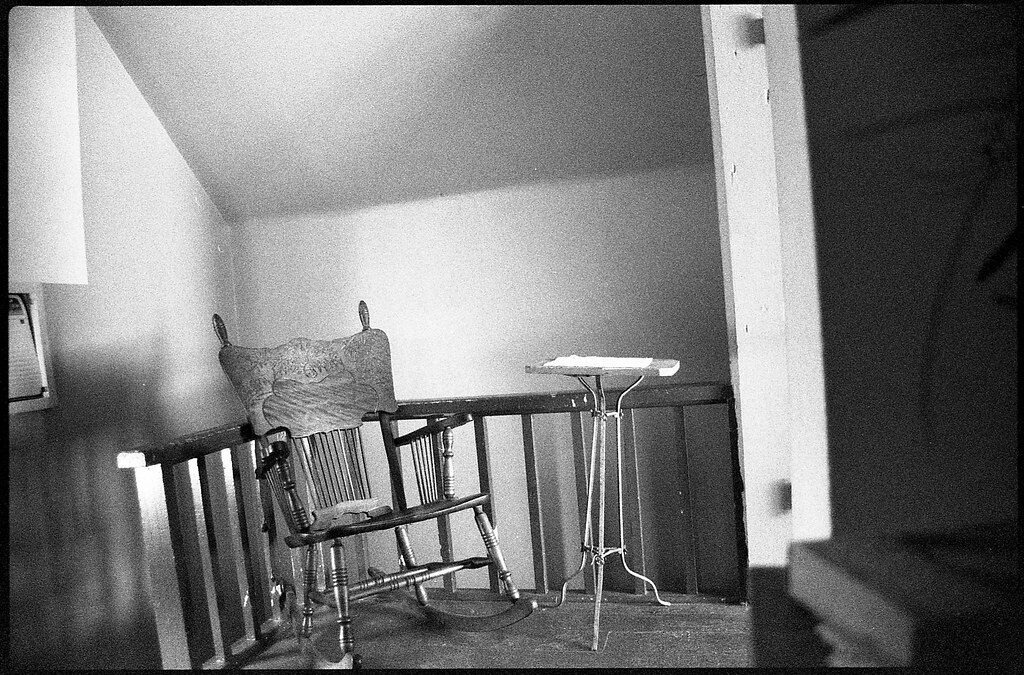
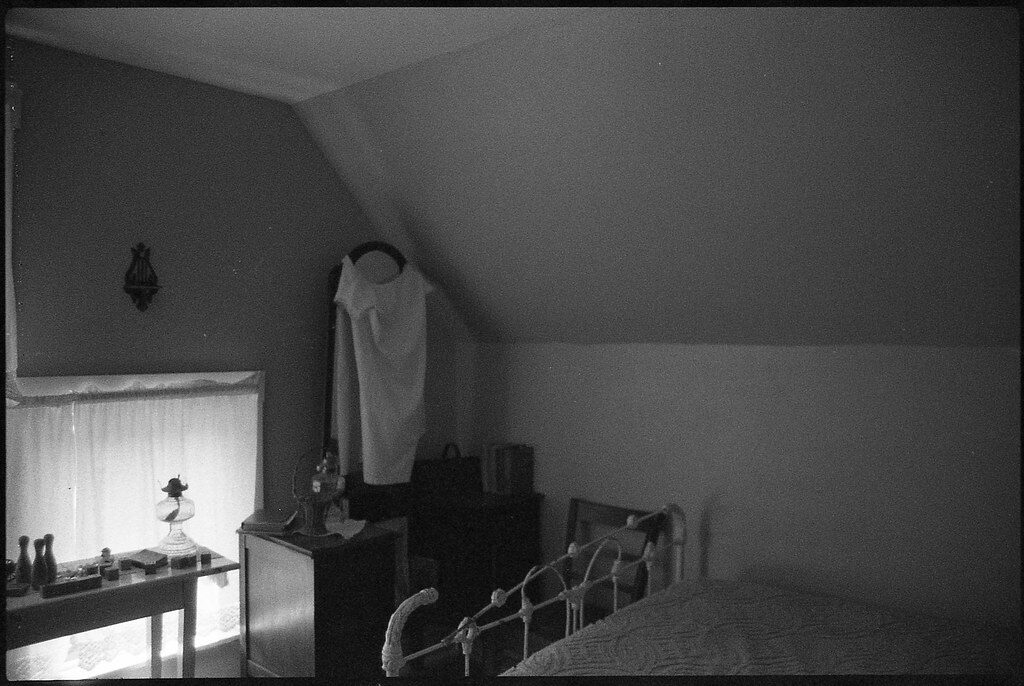
No electricity runs through the main structure. No plumbing either. The owners stripped all of that out in the 1990s to get the house back to what it was.
So when you do an overnight stay - which you can, and people do, regularly - you're sleeping in the dark in a house that hasn't changed much since a killer walked out of it before sunrise over a century ago, locked the door behind him, and was never caught.
Josiah Moore bought the place in 1903. It was already 35 years old then - a plain Queen Anne-style frame house built in 1868, though some records place its construction around 1901, for a man named George Loomis.
It was built shortly after the Chicago, Burlington and Quincy Railroad came through and turned a surveyor's dot on a map called "The Forks" into an actual town.
Moore lived there with his wife and four children for nine years.
On the last night of his life, he walked home from church and went to bed, and nobody in a town of 2,000 people - where everyone knew everyone - saw or heard a thing.
A Good Family in a Town That Trusted Itself
J.B. Moore was 43 and doing well. He'd left his old boss - Frank F. Jones, a state legislator with a hardware store - in 1908 to open a John Deere dealership of his own.
He took customers with him. Jones noticed. Whether that had anything to do with what happened four years later, nobody ever proved, but investigators spent years turning the theory over.
Sarah Moore, 39, spent weeks getting the Children's Day program ready at the First Presbyterian Church.
June 9 was the night it finally happened. The whole family went - Josiah, Sarah, and all four kids: Herman, 11, Mary Katherine, 10, Arthur, 7, and little Paul, who was 5.
Mary Katherine had invited two friends, Ina May Stillinger, 8, and her older sister Lena Gertrude, 11, daughters of a local farmer. The girls were going to spend the night.
The program ended around 9:30 p.m. It was a Sunday in early summer, and the walk home was short.
Everyone was back inside by 10 at the latest. The Stillinger girls took the downstairs sewing room, sharing a twin bed.
The Moore kids went upstairs. Josiah and Sarah took the master bedroom. Nothing about it was out of the ordinary. Nobody in that house had any reason to be afraid.
What the Killer Left Behind
Josiah got it worst. Whoever came in through the back door sometime after midnight went to the master bedroom first.
There, the person struck him with the blunt end of the axe - the family's own axe, taken from the coal shed outside. Thirty blows, give or take. The ceiling had gouge marks in it.
Sarah was also killed with the blunt end. Then the children's room upstairs, all four kids, same method, same beds.
Then back downstairs to the sewing room, where the Stillinger sisters were sleeping.
Lena was found sideways across the bed with a defensive wound on one arm - she'd been awake, or woke up. Ina was killed beside her.
After that, the killer went back upstairs and hit some of the Moore family members again, people already long dead.
What came next is the part that still bothers people. The killer took his time. Every mirror in the house was covered with shirts, with bed linens, with whatever was in the dressers.
The window blinds were pulled down. Two windows that had no blinds got fabric draped over them. A 4-pound slab of bacon came out of the icebox, got wrapped in a towel, and was left on the floor next to the axe.
A bowl of bloody water and a plate of uneaten food sat on the kitchen table, as if the killer had rinsed his hands, and sometime before dawn, he left, with the front door later found locked.
A piece of a keychain was left on the floor. It didn't belong to the Moores. Nobody in the neighborhood heard any of it.
Ross Moore Opens the Door
Mary Peckham lived next door. She was up early on June 10 and noticed, by about 7 a.m., that nothing was moving at the Moore house.
The chickens were still locked up. She knocked on the door. No one answered. She let the chickens out herself and went to find Ross Moore, Josiah's brother, who had a key.
Ross went in first. He found the Stillinger girls in the downstairs bedroom and came straight back out. He told Peckham to get the town marshal.
Marshal Henry Horton searched the rest of the house and found all eight. By 8:40 a.m., the town's telephone switchboard had sent an all-call to the whole community.
Within minutes, the house was full of people. They picked up the axe. They handled it and passed it around. Some of them left with pieces of Josiah Moore's skull in their pockets.
County Coroner Dr. Linquist got there around 9 a.m., saw the mess, and pushed the sheriff to bring in the National Guard.
A perimeter went up by 10:30 a.m., but whatever the scene had once been able to tell them, it couldn't anymore.
The bodies stayed in the house until after 10 that night. They were transported to the fire station, which served as a temporary morgue, and the last of them arrived there close to 2 a.m. on June 11.
The funerals on June 12 drew so many people that the National Guard managed the crowds again.
A funeral cortege about fifty carriages long followed as the eight caskets were taken to Villisca Cemetery for burial.
The whole state had been reading about it for two days.

The Minister Who Confessed and Then Didn't
For years, the main suspect was Rev. Lyn George Jacklin Kelly, an English-born traveling minister.
He was in town for the Children's Day program and took an early train out of Villisca on the morning after the murders. Investigators had records tying him to arson, peeping, and mental illness.
He also began sending investigators long, unusual letters, which kept their attention on him.
In 1917, Kelly signed a confession. He said God told him to kill. He took it back almost right away and said someone had pressured him to write it.
There were two trials, and he was not convicted in either one. The first jury split 11 to 1 for acquittal. The second jury acquitted him.
Frank Jones, the senator who had once employed Josiah Moore, was never brought to trial, even though people suspected him for years.
Some investigators believed Jones had hired William Mansfield to commit the murders. Mansfield's payroll records placed him somewhere else that night. He later sued the private detective who accused him and won.
Investigators also considered Henry Lee Moore, who was not related to the Moore family.
He had killed his mother and grandmother with an axe in Missouri, and some people thought he might be a traveling killer. That lead also went nowhere.
In his 2017 book "The Man from the Train," author Bill James argued in detail that a drifter named Paul Mueller committed the murders.
He linked the Villisca case to dozens of similar family murders in railroad towns across the Midwest. It is the most detailed theory anyone has presented. It is still only a theory.
Thirteen Owners and a House Nobody Wanted
The property sat in the Moore estate through 1915, then was sold to a man named J.H. Geesman, and kept moving.
At least thirteen recorded owners over the next eight decades, including the Villisca State Savings and Loan, which held it from 1963 to 1971 - almost certainly through foreclosure, since banks don't usually end up with houses on purpose.
It was a rental for stretches of the 1960s and 70s, and the tenants didn't tend to stay.
Darwin and Martha Linn, who bought it in the mid-1990s, later tried to track down a full list of renters from that era. They couldn't do it.
Too many had left after two or three weeks, no notice, no explanation.
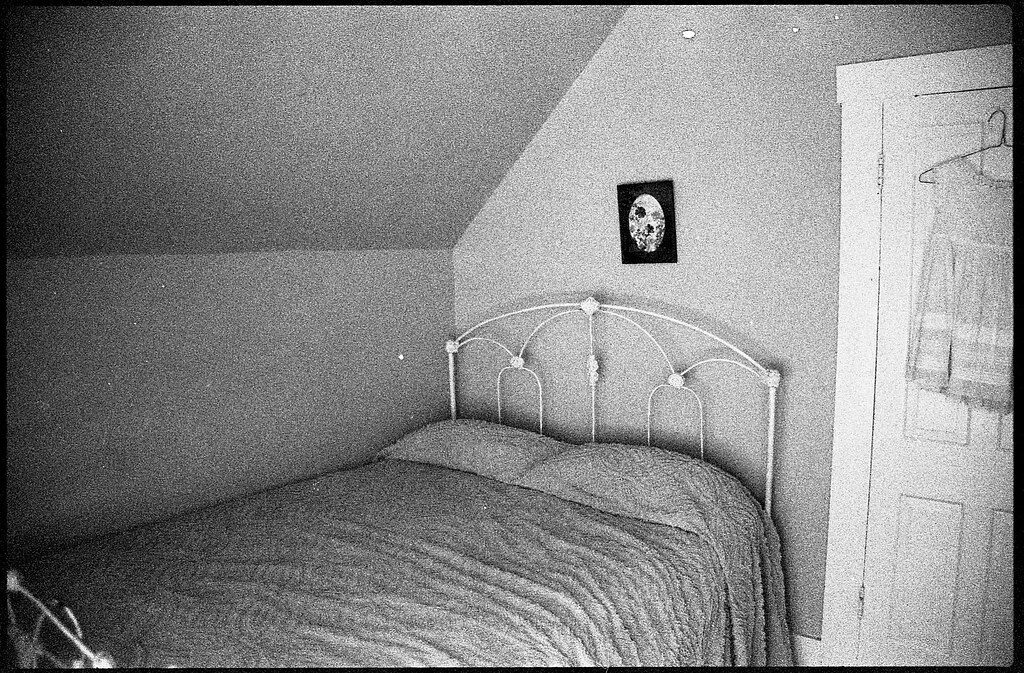
The porches had been glassed in. Indoor plumbing and electricity had been added at some point between 1936 and the 1990s. The pantry was now a bathroom. Outbuildings that had stood in 1912 were long gone.
Rick and Vicki Sprague bought the house on January 1, 1994, and figured out fast they'd made a mistake.
The house was close enough to condemned that the Spragues couldn't see a clear path forward and started looking for an exit.
They found Darwin Linn, a real estate agent in town who also ran the Olson-Linn Museum with his wife, Martha.
Linn was a historian, and he was interested. He made a low offer with a hard deadline - midnight, January 1, 1995.
The Spragues turned it down. Then called back months later to say yes.
By then, Darwin had talked himself out of it, and after the call, he sat on the news for a few more months before he told Martha what they'd just agreed to buy.
Taking the Whole Thing Apart and Starting Over
Martha was not thrilled - everyone who knew her seemed to agree on that. But the Linns were both historians, and once they had it, they treated it like the important original document it was.
They dug up old photographs. They went through the original coroner's inquest testimony line by line.
They knocked on doors and talked to neighbors who were old enough to remember. Then they started dismantling everything that didn't belong.
The vinyl siding came off, and the old wood underneath was fixed up and painted again.
Plumbing and electrical systems were pulled from the main structure.
The enclosed porches came down, the bathroom in the pantry became a pantry again, and an outhouse and chicken coop went back up in the backyard - rebuilt from scratch, since the originals were long gone.
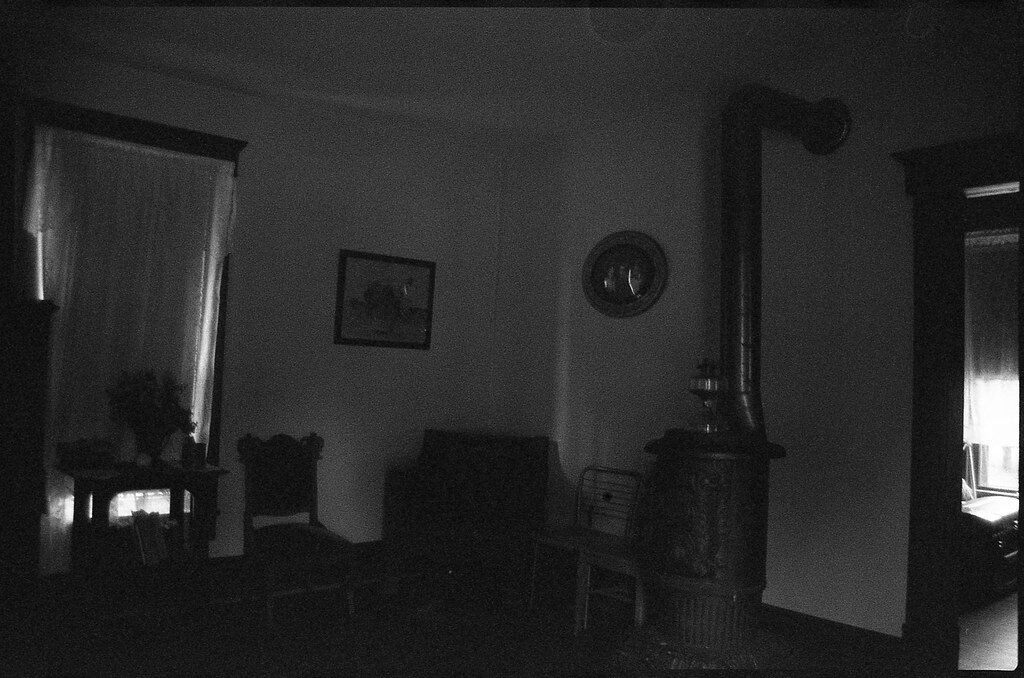
When they were done, the house had no running water and no electricity inside it - same as 1912. The National Register of Historic Places added it to the rolls on December 1, 1997.
That same year, the Iowa Historic Preservation Alliance gave the project its "Preservation at its Best" award.
Darwin and Martha opened Villisca Axe Murder House to visitors in 1998. They never took out an ad. People found it anyway.
Darwin died in 2011. Martha kept running the property through her mid-80s, showing up to greet visitors, keeping the grounds in shape, telling the story the way she'd always told it.
A Marine Veteran Buys Villisca Axe Murder House
Martha Linn was 87 in October 2023 when she signed a contract to sell.
The buyer was Lance Zaal, founder of US Ghost Adventures and a Marine Corps veteran whose company already operated other dark-history properties, the Lizzie Borden House in Fall River, Massachusetts, among them.
The paperwork went final in January 2024.
Zaal's team added modern bathrooms and some climate control in the outbuildings for guest comfort, but left the main house exactly as the Linns left it.
Tours run daily - self-guided with audio or private with a guide. Overnight stays are available by the room or for the whole house, and walking tours cover the cemetery and the surrounding town.
People keep coming. More than a century of distance hasn't cooled the interest much. The house still looks like a house.
It still has no answer for the question everyone eventually asks - who walked out of there at 5 in the morning in June 1912 and locked the door behind them.
Nobody ever has. The house just sits there, same rooms, same silence, and waits.
The House as a Haunted Destination
Villisca Axe Murder House's haunted reputation grew much later than the 1912 murders. Darwin and Martha Linn turned house into a museum.
Paranormal investigators soon began contacting them, and visitor stories about strange activity increased.
Since the Linns opened the house to the public in the 1990s, hundreds of visitors have reported unusual experiences.
These include sudden feelings of dread, sadness, or anger, fog moving through rooms, photos showing "orbs" or mist, and EMF and EVP readings.
Some stories are specific to rooms. It mentions children seeming to play with someone unseen under a bed in the parlor bedroom, where the Stillinger girls died.
Also, many visitors link a stronger activity to about 2 a.m., when a train passes and blows its whistle.
A 2024 People article by Julie Jordan gives a detailed overnight example.
It includes motion detectors going off, an audio recording of a child saying "Mommy," a REM Pod battery draining quickly, a hair tug, and a word device producing "struck," "Reverend," and "Kelly."
In 2014, Robert Laursen, 37, stabbed himself during a paranormal investigation at about 12:45 a.m. and was flown to Omaha for treatment.
Authorities did not know the motive. The house later stated he had brought a hunting knife inside and returned to apologize.
Villisca Axe Murder House still attracts visitors interested in crime history as well as those curious about the paranormal.