
Harford Mall begins on racetrack ground
Long before people came here to shop for candles or buy a birthday card at the last minute, the land at Bel Air Road and Route 24 was used for horses. In the 1900s, the Bel Air Racetrack was here.
It had a three-quarter-mile dirt track, stands for the crowd, and a special kind of excitement that came with horse racing and local talk.
For many years, people came for the fast races, the chance to bet, the loud sounds, and the hope that comes whenever an announcer says the race will be very close at the end.
The end was less exciting. After owner Ray Bryson died in 1958 and the track's race dates were shifted away amid political controversy, Bel Air Racetrack ran its final season in 1962 and closed.
What was left was a cleared hundred-acre piece of land just as Harford County was growing with new neighborhoods.
The land was already used to cars, makeshift parking, and the idea that free time could be spent waiting in lines.
When the mall finally opened, it kept the same basic routine. You would still come, walk around, and leave with something to show you had been there.
The difference was that the new show was bright and expected, and the cheers were just the quiet sound of shopping bags brushing together.
1973: enclosed corridor and two anchors
Harford Mall opened in 1973, built by Mid Atlantic Realty Trust as a typical, one-story indoor shopping center.
Located at the busy intersection of U.S. Route 1 and Maryland Route 24, it became Harford County's only enclosed indoor mall.
This main shopping spot could handle errands, boredom, and give teens a place to hang out all in one place.
The first group of stores was balanced, as was common at the time. Montgomery Ward was on the west side.
E.J. Korvette was on the east. The smaller stores offered little treats that made people stay longer than they meant to.
Waldenbooks sold paperbacks and gift books, the kind of browsing that felt useful even if it was just for fun.
Horn & Horn served meals cafeteria-style, so lunch was all about trays and timing. A movie theater with several screens meant a shopping trip could turn into a night out.
Friendly's, also there from the start, sold ice cream and made sitting in a booth feel special.
The mall's inside walkway quietly brought people together. You could see who was there without having to make plans. You could run into someone without setting up a meeting.
As the county became more suburban, the mall acted like a new downtown, built to be comfortable no matter the weather or the year.
Expansion, food courts, and the '80s swap
In October 1977, the mall added a Hochschild Kohn department store. This expansion made the project feel bigger than a corridor with two ends.
The extra anchor suggested growth, but the late 1970s and early 1980s were already teaching malls a harsher lesson: stability depends on corporate health, and corporate health is not a local tradition.
E.J. Korvette went out of business in 1980, and the eastern anchor space began a quick succession of identities.
Hutzler's, a Baltimore-based department store, moved in briefly, offering a familiar regional name and not much time to settle.
In 1981, Hecht's acquired the lease and opened a new store in the former Korvette-Hutzler's box, relocating from a smaller nearby location into a larger stage.
The shuffle changed how people navigated: directions that once relied on Korvette now pivoted to the new name, as if the building itself had been renamed.
In the center court, the mall featured an F.W. Woolworth Company store with a lunch counter, the kind of democratic pause that turned shopping into an afternoon.
After Hochschild Kohn later closed, its space was reconfigured into the mall's original indoor food court, a very 1980s answer to the question of how to keep the loop moving: feed people, then send them back out to browse.
CBL buys Harford Mall and launches the 2006-07 renovation
By the early 2000s, Harford Mall was old enough to need a facelift and young enough to believe one would work.
Montgomery Ward, an anchor since 1973, fell with the chain's bankruptcy, and in 2002, Sears took over the western pad.
Even the outlying pieces shifted: the old Montgomery Ward Auto Center became a Hecht's Furniture Gallery (2001-2006) and then a Macy's Furniture Gallery, which lasted until 2025.
In 2003, CBL & Associates Properties purchased the mall for $71 million, bringing REIT discipline to a property that had long behaved like a community routine.
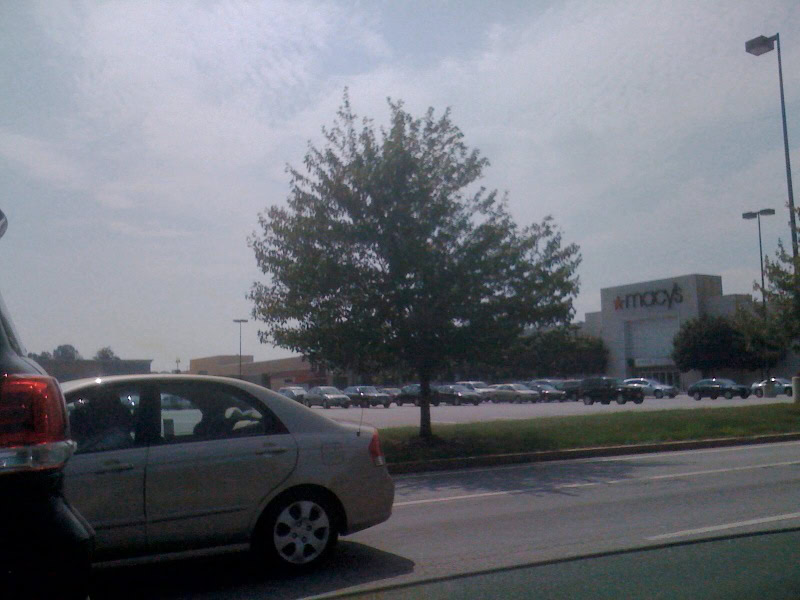
The eastern anchor changed again in 2006, after Federated Department Stores acquired May Department Stores, and the Harford Mall Hecht's was rebranded as Macy's, a corporate swap that asked shoppers to accept continuity through signage.
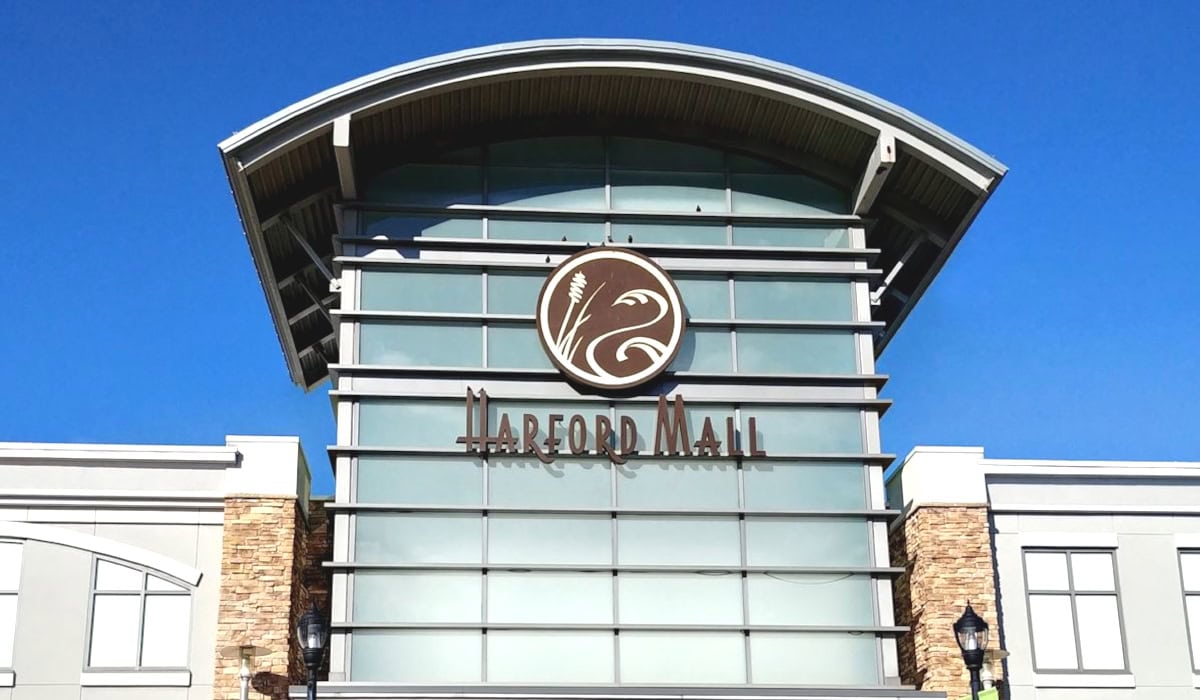
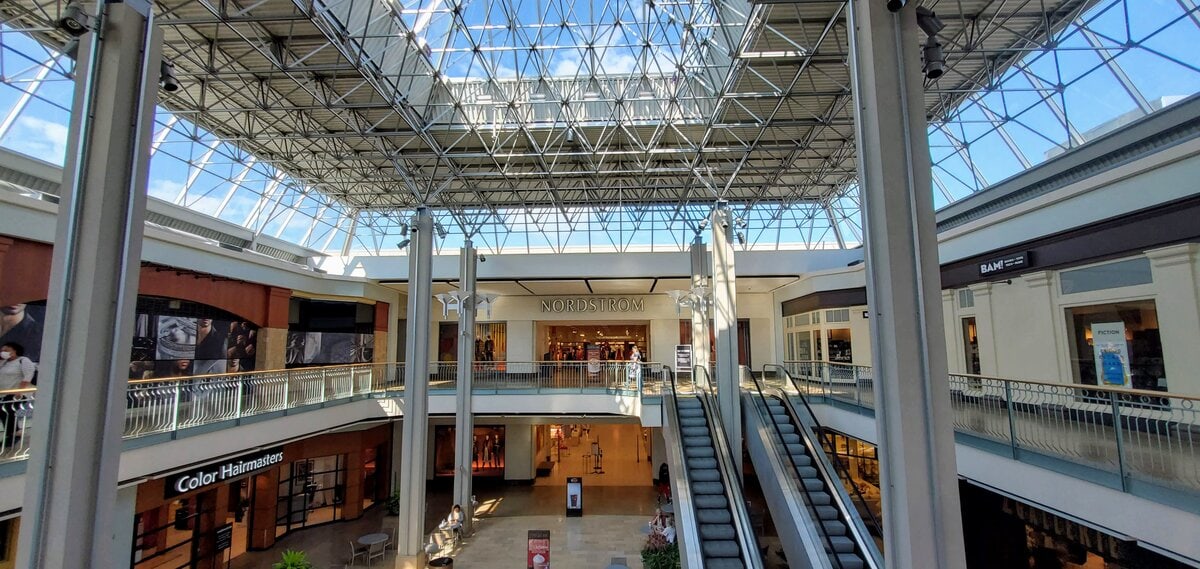
CBL's big bet came in 2006 and 2007, when the mall underwent an extensive renovation.
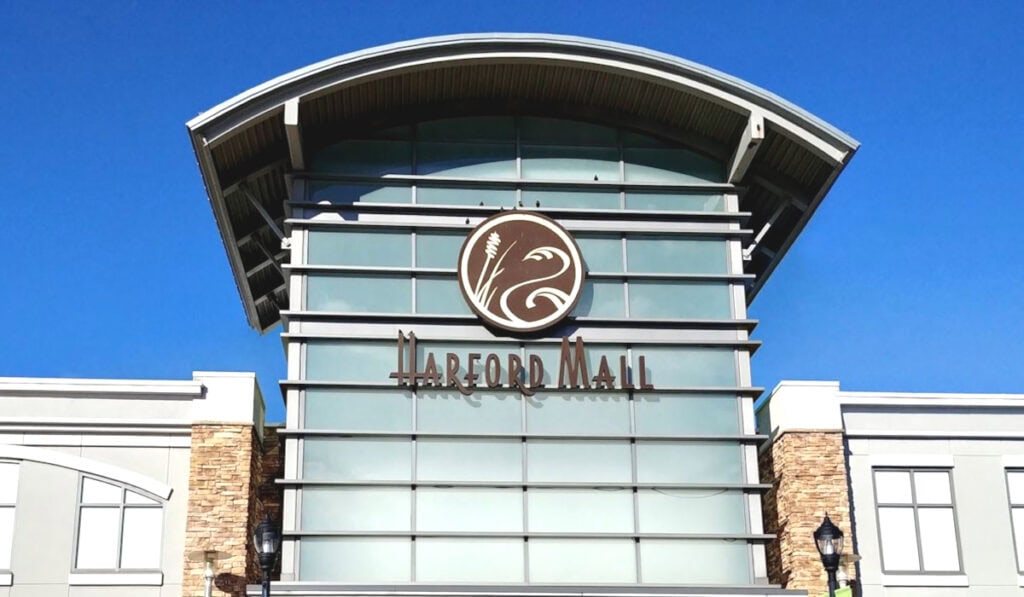
The center court and interior were remodeled, the exterior was refaced, and the original indoor food court - created from the old Hochschild Kohn space - was removed to make room for more retail.
A new outdoor streetscape followed, with patio restaurants like Red Robin, Bonefish Grill, Qdoba, Five Guys, and Vaccaro's Italian Pastries.
Trend was part of the plan, too: Hollister (which replaced KB Toys and later closed) and American Eagle were added to make the tenant list look younger.
Retail apocalypse years and the anchor fall
The 2010s brought a new kind of challenge: instead of just competing with other nearby malls, the mall now had to compete with stores everywhere.
Even after being updated in 2006 and 2007, Harford Mall started to lose stores that had seemed like they would always be there.
In 2013, Old Navy moved to The Boulevard at Box Hill, a shopping center in Abingdon, and took with it many families and regular shoppers.
The empty spot was filled by The Shoe Dept. Encore, a useful but less exciting store, showed that the mall was becoming less of a main attraction and more of a place to fill shopping needs.
By 2019, store closings were expected and happened on a set schedule.
Payless ShoeSource said it would close its Harford Mall store because of bankruptcy, and Charlotte Russe closed in March 2019, part of a wave of store closings across the country that made empty stores seem normal.
The mall still had places to eat and hang out. Friendly's stayed open. Other places to eat inside included The Greene Turtle and Pretzel Twister.
But people started coming just to buy one thing and then leave, which is tough for a place built for people to walk around and explore.
The anchor stores finally reached a breaking point. In early February 2020, Sears closed at Harford Mall because the chain was shutting down stores all over the country.
That left Macy's as the only big traditional store, trying to keep alive a way of shopping that was becoming more and more shaky: the idea of the mall as the main place to shop in town.
Crime, sentencing, and a closing announcement
On June 2, 2024, Harford Mall became part of a story no community wants for a well-known place. There was a shooting inside Harford Bounce Party Place at about 4:00 p.m. The effects lasted beyond that day.
The suspect, Wesley Larry Lyons Jr., was arrested after a 28-day search, and the case went through the slow court process.
In December 2024, Lyons was found guilty. In February 2025, he was sentenced to ninety-three years, with all but sixty-five to serve, and the first twenty years without a chance for parole.
The end of the trial did not change how the incident changed what the mall meant to the public.
Retail changes happened more quickly. On January 9, 2025, Macy's said it would close the Harford Mall store as part of a plan to close sixty-six stores across the country.
The store closed in March 2025, leaving the mall without a main department store for the first time. Another change came when The Greene Turtle closed on April 30, 2025.
In less than a year, the property went from a struggling shopping center to a place clearly getting ready for a new purpose.
From the enclosed mall to The Shops at Harford
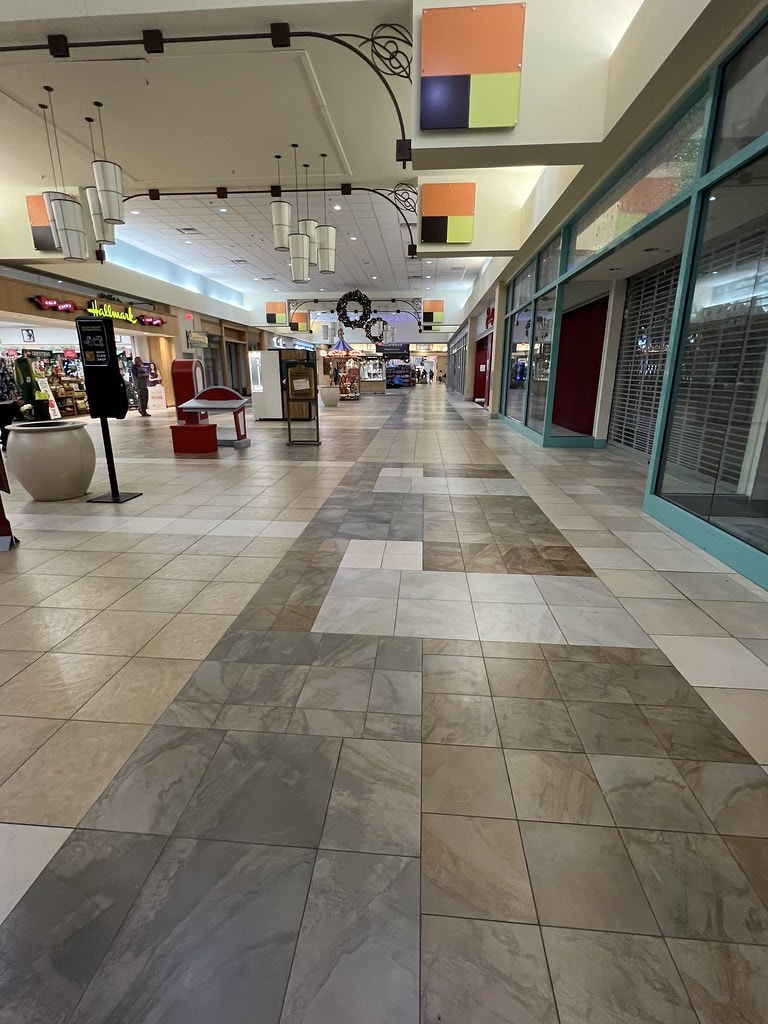
By December 2025, Harford Mall exists in a hybrid state: a quiet corridor wrapped in fencing. The interior hallway is still open, but vacancy dominates.
Bath & Body Works, Hot Topic, Spencer's, and Friendly's keep operating, while many other storefronts sit empty or host short-term local vendors.
Outside, CBL Properties and SJC Ventures are converting the site into The Shops at Harford. The former Sears building was demolished in early 2022 and replaced with a new structure for an Amazon Fresh grocery store.
The building is complete, but after delays through 2023 and 2024, the opening is now expected in 2026.
The former Macy's parcel is the bigger rewrite. Macy's closed in March 2025, and the eastern end is fenced for abatement and demolition preparation.
In July 2025, Phase III plans were approved for 600 Baltimore Pike: remove the Macy's box and part of the enclosed mall (about 172,000 square feet), then add 82,900 square feet of open-air retail and restaurants.
The roughly $100 million center is anchored by Whole Foods Market (about 35,600 square feet, targeted for 2027), with additional buildings and tenants including THB Bagelry and Deli.
The residential piece, a 249-unit project, received a 12-month extension in September 2025, keeping approvals in place through January 2027, with a parking garage as part of the plan.
Across the street, the Harford Mall Annex keeps doing big-box business with Best Buy, PetSmart, Office Depot, Dollar Tree, and Banfield - technically separate, practically adjacent.
keep it open
Sometimes the simplest comment is the most honest.
This article brought back so many memories I dearly loved going into the Harford Mall with all the stores the eateries just everything and I remember back when it used to be a racetrack when I was a little girl and then it was turned into something else then something else then the mall I miss those stores especially Montgomery wards it was the go-to store for anything and Sears if you couldn't find it at Sears you found it at Montgomery Ward's you hit the nail right on the head explaining from year to year and brought back memories that I imagine a lot of people just never thought of anymore I'm enthused to see when the mall is finished this time but I'm not sure about what people are talking about it being partly apartments with parking garages that would be just a distraction and possibly calls more accidents right there at that intersection change is good but too much change takes away from the beauty of everything so I commend you on your article it was great
Thank you for this comment. It's long, personal, and full of real memories. I love that you remember the racetrack days and how things kept changing from one thing to another. That is the real story of these places: they keep changing because the community keeps changing, even when it feels like the ground is shifting under you.
Can't wait for Whole Foods Market!!
Same - that kind of anchor can change the whole vibe of the mall overnight.