
Old Town Mall exists because Baltimore took cars off a working commercial street. The current plan, in part, is to put them back.
In the 1970s, Old Town Mall's brick corridor still had merchants, and memory still puts the sound of records there: 33s and 45s from the record store, clothes from long-running shops, food from the market life around Gay Street.
Kaufman's Department Store anchored the corridor from the old buildings that had carried the Benesch name, and people from the high-rise housing nearby helped keep the sidewalks full.
For a few years, the pedestrian mall held its merchants and its foot traffic. That period was short. Loading and access got harder, and the businesses that stayed dealt with a layout that worked against them. By 2026, the corridor is mostly boarded and quiet.
Now the transportation department is redesigning the right-of-way to restore vehicle access and reopen circulation. The fix for the mall may be undoing the thing that made it a mall.
Gay Street Was a Shopping Street Long Before Old Town Mall
The selling came first, by more than a century. In 1818 the city built Belair Market just south of what became the historic district, and food trade and small shops gathered around Gay Street.
By 1869 the 500 block was mostly storefronts, with first-floor awnings stretched over the sidewalk.
It was a city retail street: small lots, attached buildings, shops below and rooms above, business pressed against neighborhood life.
The larger buildings came later. Isaac Benesch started with furniture after the Civil War, and in the 1880s he began buying rowhouses and rebuilding them.
By 1911 his business filled three four-story buildings on the 500 block of North Gay Street. The Great House of Isaac Benesch and Sons became one of the district's chief commercial landmarks.
Engine House No. 6 stood at the south end, built in 1853 and 1854 for the Independent Fire Company, with a tall bell and clock tower. It gave the corridor a civic building among the shops.
The Great House, Stirling Street, and the Buildings That Stayed
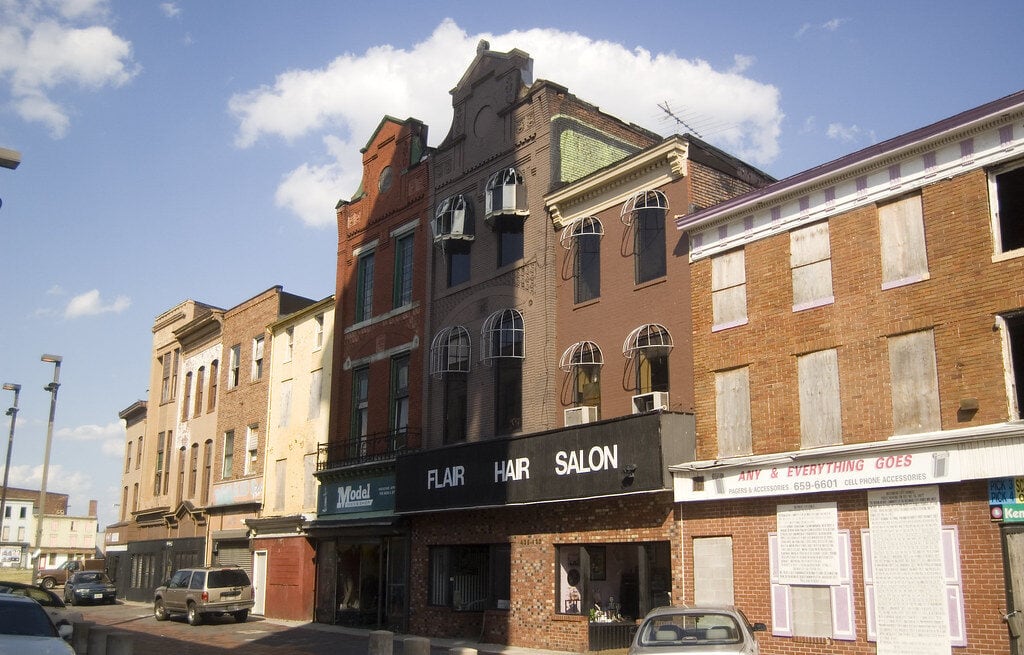
Some of those buildings are still standing. The structure at 549-557 Old Town Mall keeps its Italianate brick front.
Next to it, the 1904 building at 565-571 North Gay Street, designed by Charles E. Cassell, gave the block a formal department-store face in brick and terra cotta.
The district holds 200 years of commercial building, one period set over the last.
The Benesch store had a social history. It sold to Black and white customers during segregation, and later hired a Black salesman at a time when many department stores would not.
The renewal program reached past retail. As the city moved to remake Gay Street, its urban renewal agency planned to clear almost all of Oldtown's housing.
Preservation advocates pushed to save the 600 block of Stirling Street, modest Federal-style rowhouses built in the 1830s for free working people, Black and white.
The city agreed to test restoration there, and offered houses for $1 to people who would fix them. Twenty-four owners were chosen from more than 400 applicants, in one of the country's early urban homesteading efforts.
How Baltimore Turned Gay Street Into a Pedestrian Mall
Baltimore turned Gay Street into Old Town Mall in the mid-1970s.
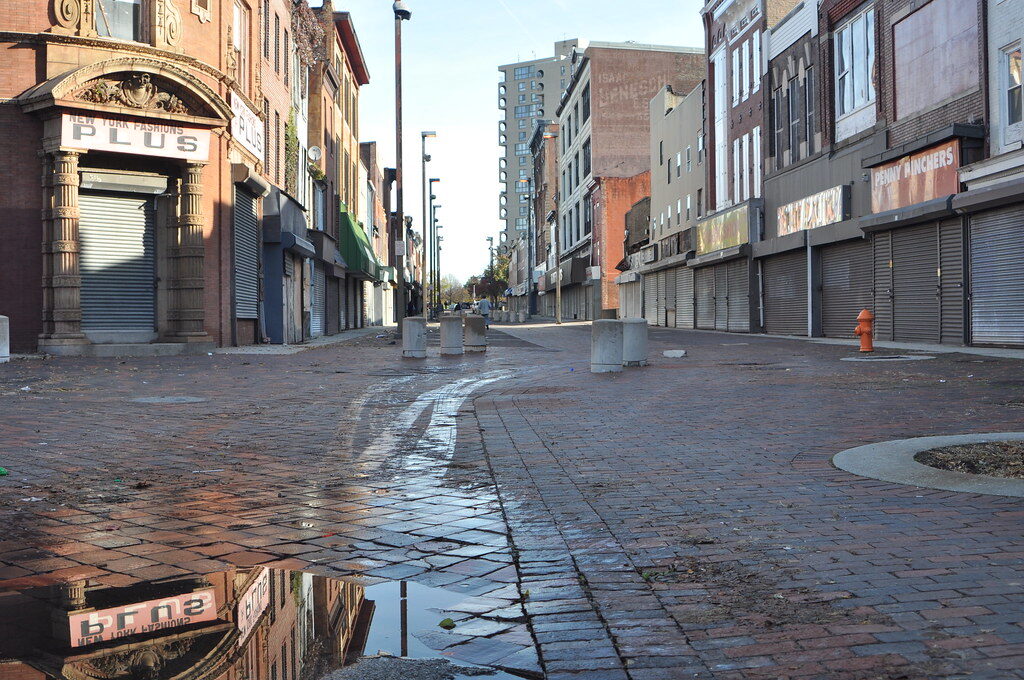
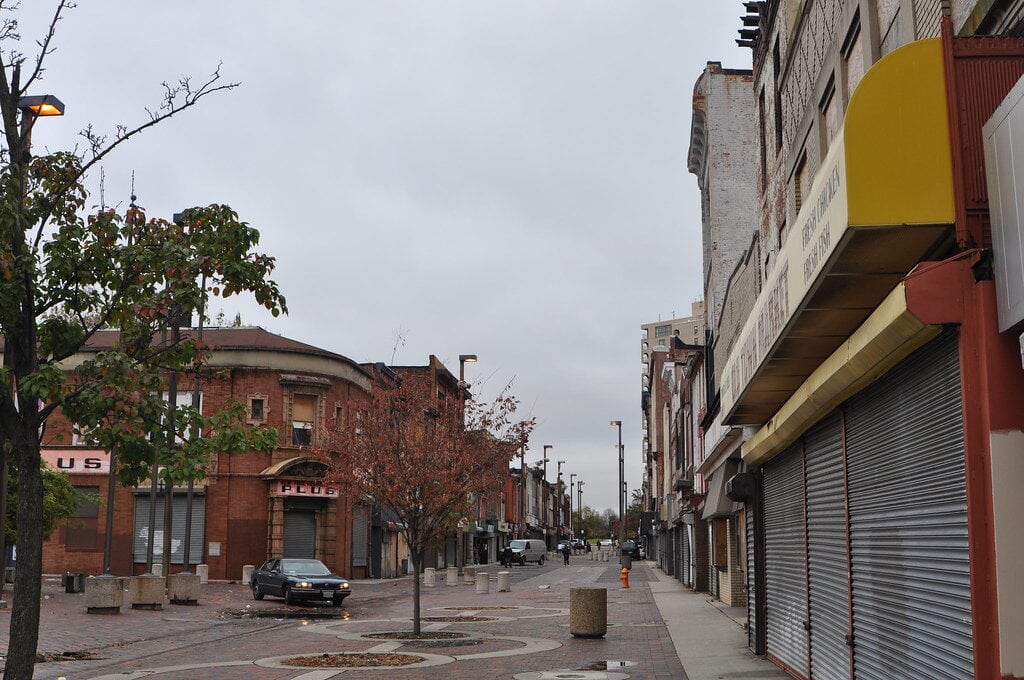
The work closed part of Gay Street to traffic and remade the corridor as a shopping promenade, with brick paving, planters and trees, lighting, benches, and fountain-and-clock features.
The Old Town Mall project was dedicated in June 1976.
Cities across the country were doing the same thing. They closed downtown streets to cars and hoped a traffic-free walk could keep older retail districts competitive with suburban shopping centers.
Baltimore wanted to hold its merchants, pull shoppers back to East Baltimore, and keep the old shopping street working by pairing public improvements with storefront rehabilitation.
That choice helped keep the parcel pattern and many old facades, though several original buildings were still demolished during redevelopment.
It also left the mall leaning on dozens of small buildings, private merchants and owners, public upkeep, and a nearby customer base that later proved fragile.
Kaufman's took the old Great House complex as the anchor. The smaller storefronts filled in around it.
The Anchor Closed and Old Town Mall Emptied Out
The surrounding population fell. Housing conditions worsened.
Suburbanization thinned the customer base, and the pedestrian-only layout left the businesses that stayed with harder loading, parking, and plain storefront access.
The winter of 1979 made it plain. Shops were looted during the Blizzard of 1979, and by the early 1980s much of the corridor had gone quiet.
The 1990s brought the sharper losses. Goldstein's Style Shop and the Diplomat Shop left in 1996 after repeated burglaries.
In early 1997, Belair Market was demolished in hopes of drawing a grocery store, but those grocery plans did not materialize.
The demolition ended the market function that had helped make the district a commercial center back in 1818. In March 1997, Kaufman's entered bankruptcy and closed.
The former Benesch complex then sat without the department store that had held its center for decades.
Plan After Plan to Rebuild Old Town Mall Stalled
A long run of plans followed, and most did not get built quickly, if at all. In 2000, the mayor introduced a $4.8 million proposal from Mid-Atlantic Realty Trust for a supermarket, a bank, and a fast-food restaurant.
It went nowhere.
In 2002, the Baltimore Development Corporation extended exclusive negotiating rights to The Peterson Companies of Fairfax, Virginia, whose plan included a 55,000-square-foot Safeway at one end of the mall.
That plan stalled as well.
The 2002 proposal drew pushback. Some merchants and residents worried that chain stores and land assembly would leave no room for the small and minority-owned businesses already there.
One local idea floated a global shopping village, an Old Town Mall organized around ethnic and small merchants instead of a single grocery box.
The city went looking for a developer again in 2014.
By early 2015, the only viable bid came from the New Old Town Team: Beatty Development, Henson Development Company, Commercial Development Group, and Mission First Housing Group.
In 2016, an affiliate of that team agreed to buy three parcels for $400,000.
A Fire, a Scan, and the Pressure on the Vacant Buildings
In September 2019, a two-alarm fire damaged an unoccupied part of the mall near Ensor and Orleans streets. It spared the open businesses and the Baltimore City Fire Museum.
Vacant buildings had long created pressure for demolition, while the historic ones gave the city reasons to preserve and reuse parts of the corridor.
By the time redevelopment planning reached its 2021 redesign phase, Old Town Mall had been digitized with ground-based laser scanners and aerial photogrammetry, producing color point clouds, raw drone images, elevation drawings, and 2D CAD drawings and models of a site full of old, damaged, and deteriorating structures.
The scan data fed the planning and design work that came next.
Old Town Mall Inside Baltimore's 244-Acre Redevelopment Plan
The mall stopped being handled as a stand-alone shopping center.
In July 2018, the broader Perkins, Somerset, and Old Town effort won a $30 million Choice Neighborhoods grant from HUD, and Old Town Mall became one piece of a 244-acre redevelopment tied to the former Somerset Homes site, Perkins Homes, and Old Town Mall.
The numbers kept shifting as the plan grew.
Early development materials described an $860 million program with about 1,600 mixed-income apartments, roughly 150,000 square feet of retail, 30,000 square feet of offices, a K-8 public school, a 120-key hotel, and more than 500 parking spaces.
Later materials put the broader PSO buildout at about $1 billion and 2,172 mixed-income homes across the 244-acre footprint.
A grocery anchor was planned at the center of the retail program, aimed at residents and at nearby demand from Johns Hopkins, Fells Point, Harbor East, and downtown; Lidl later signed a lease, though the store had not yet opened and its timing was reported as uncertain in 2025.
The housing mixes subsidized, affordable, and market-rate apartments, replacing old public-housing units one-for-one while adding many more mixed-income homes.
Some of it is built. The Ruby at Somerset opened at 420 Aisquith Street with 72 apartments, 52 of them affordable. An earlier phase added the 1234 McElderry building in 2021.
What Old Town Mall Is Now, and Why the Street May Reopen
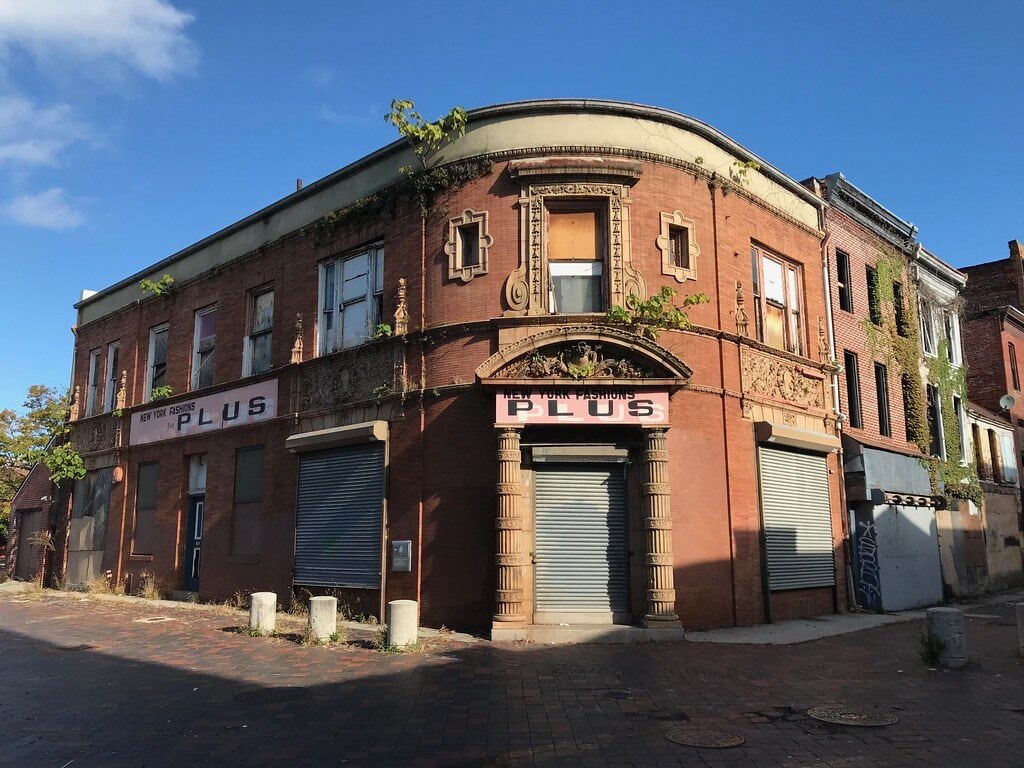
Old Town Mall in 2026 is still worn. Boarded buildings, vacant lots, gated alleys, lighting that is not pedestrian-friendly, old bollards, pavement that has not held up.
Random parking and traffic break the walk, and most of the corridor sits empty.
Some of it stays open. The Baltimore City Fire Museum is housed in Engine House No. 6 at the south end, though the museum itself is currently closed to the public.
The Nevermore Haunt has run as a seasonal attraction in the former Kaufman's building. A few small businesses remain.
In October 2025, a mural was unveiled at the corner of Gay Street and Old Town Mall: Kenneth Clemons's Old Town Essence, with local references to Latrobe Homes, the fire museum, and the Monument Street football field.
The first development phase is modest: 11 one-bedroom apartments, four retail spaces, and 7,000 square feet of incubator space, in the 400 block near Gay and Orleans streets, on an $11 million budget inside a $131 million plan.
The street is the other half of the work.
The city's transportation department is redesigning the public right-of-way to restore business access, add loading and parking, fix lighting and pavement, and reopen circulation through the corridor.
After 1968, Baltimore moved to revive the shops by turning the 400 and 500 blocks of Gay Street into the pedestrian Old Town Mall in the early-to-mid 1970s.
The 15 percent design for reopening parts of it went before residents at Paul Laurence Dunbar High School on February 5, 2026.
Above the old Benesch buildings, the copper sign band still reads Great House.
Independent Publisher Notice
BestAttractions is an independent editorial publisher. We are not affiliated with, endorsed by, or acting on behalf of any location, business, property owner, manager, government agency, or organization described in this article. Comments posted on this page are not forwarded to, reviewed by, or acted upon by any entity mentioned in the article. For official inquiries, complaints, applications, bookings, or other requests, please contact the relevant entity directly through its official website or other verified channels.