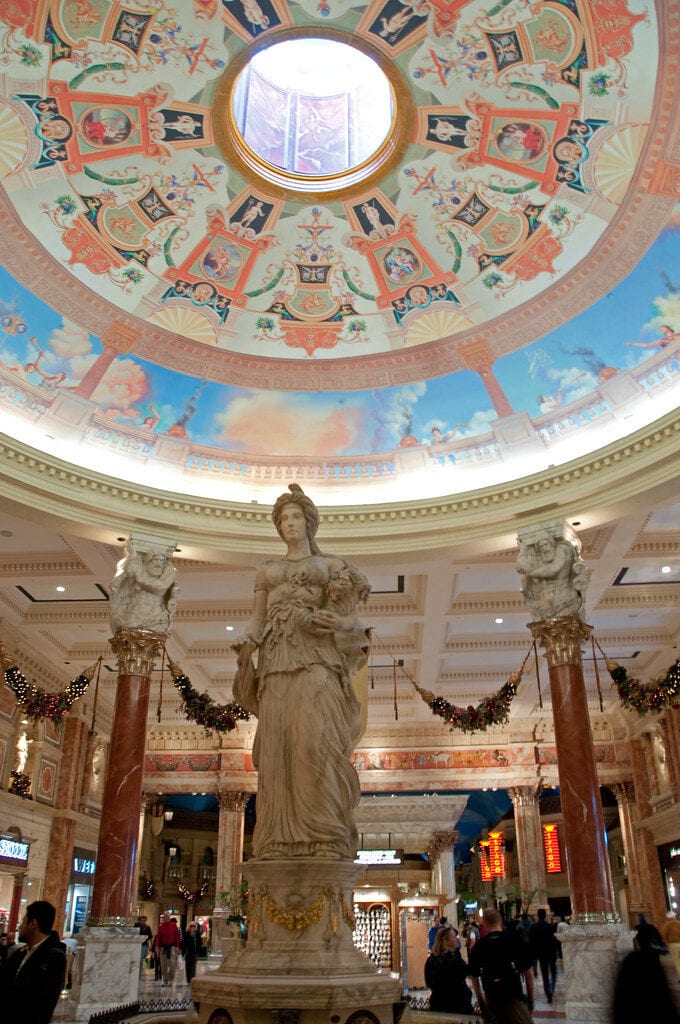
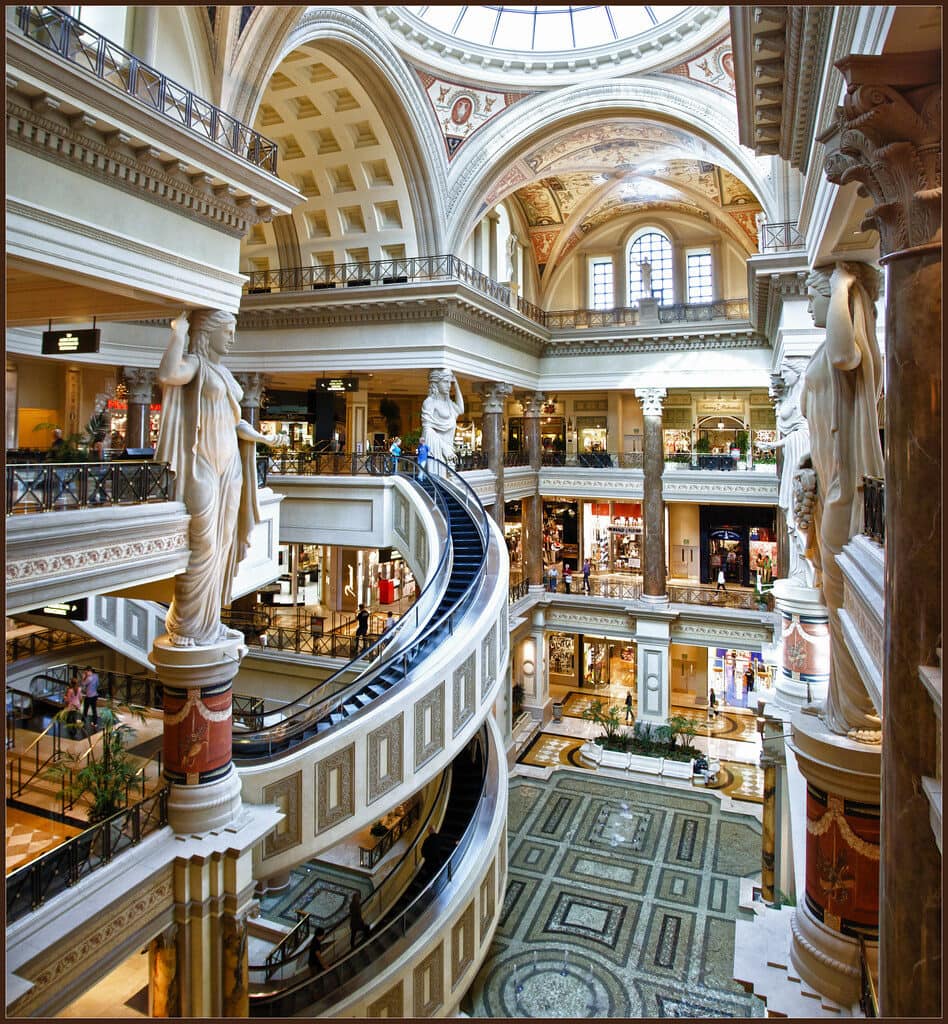
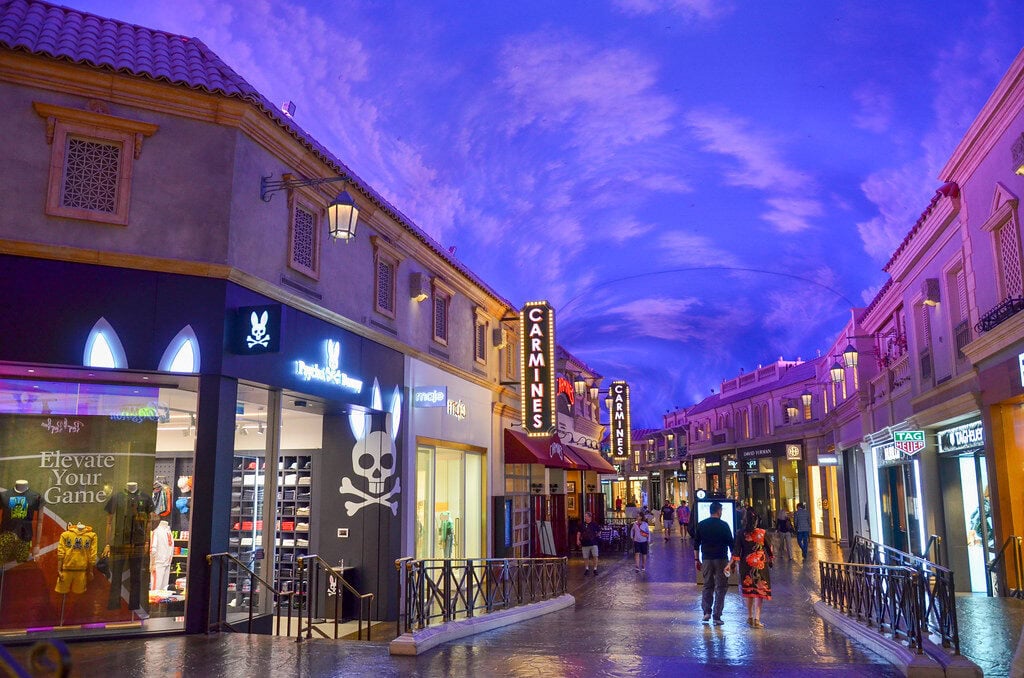
The ceiling runs a 30-minute program. Dawn bleeds into noon, noon into dusk, then it resets. You are standing inside, under a painted vault, and the light above you behaves like the sky outside - except there is no outside.
There is no weather, no wind, no actual hour of day. The floor is stamped concrete dressed as Roman stone.
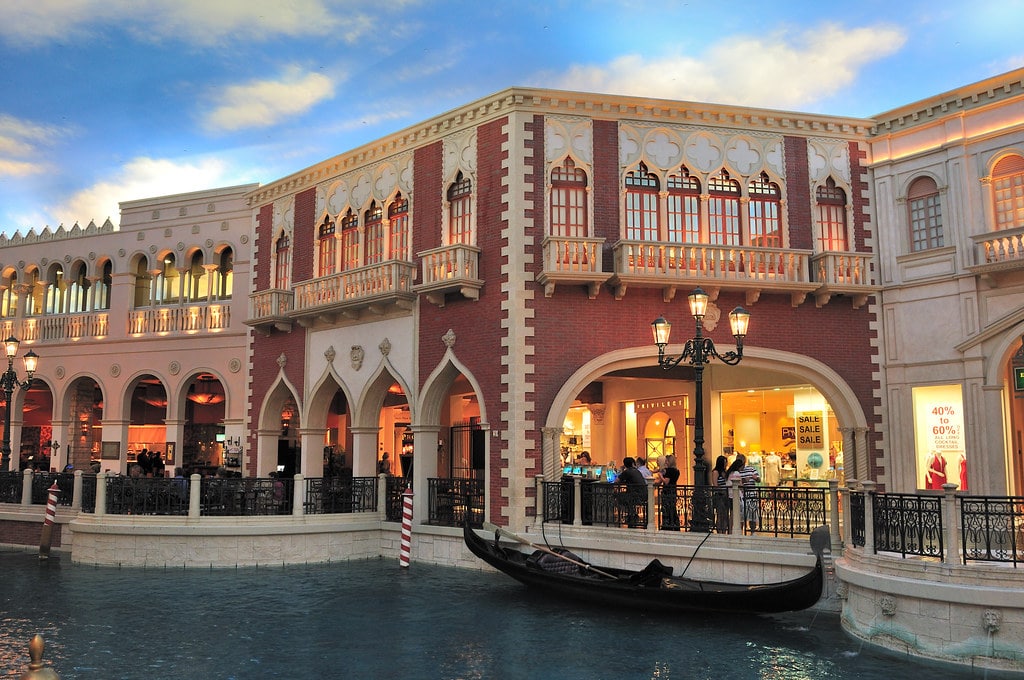
The street you are walking on has two-story building facades on both sides and no end you can see from where you entered.
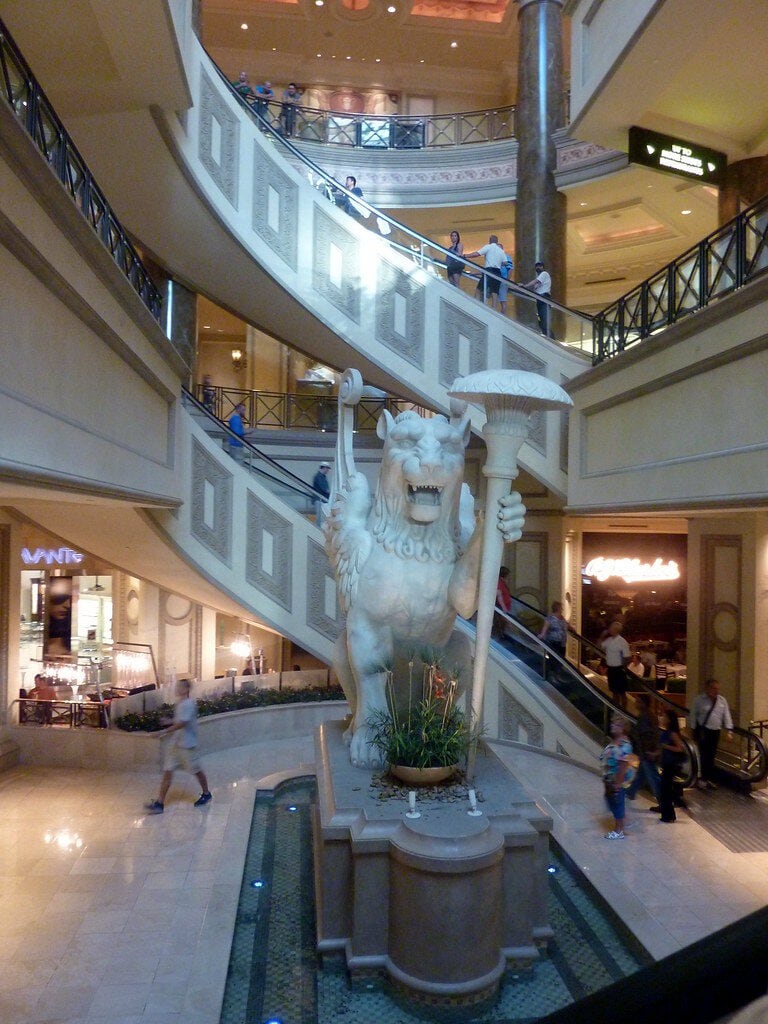
At the center of the original wing, a fountain once held four animated classical figures - Bacchus, Apollo, Venus, and Plutus - who moved and spoke on cue.
There is a spiral escalator near the entrance, one of the first installed in the United States.
Every surface, every sightline, every programmed light cycle was aimed at one outcome: keep people in the building and keep them moving through it.
It worked. The center drew more than 15 million visitors in its first year - about 50 percent more than projected.
Tenants were averaging roughly $1,100 in annual sales per square foot by the mid-1990s.
By 2016, a Green Street Advisors ranking put the property fourth among all U.S. malls at $1,615 per square foot, and noted it had held the top position in prior years.
The Atlantis Show - a water-and-animatronics production built into the architecture during the 1997 expansion - still runs. The aquarium still runs.
More than 25 years after they opened, neither one has needed replacing.
The Forum Shops Rose on Former Racetrack/Parking Lot
In the late 1980s, the land north of Caesars Palace was used for employee parking and was associated with the site of the former Caesars Palace Grand Prix racetrack.
Management concluded that it was not the best use of the location. Planning for a replacement project began in 1988. Approvals came in 1990, and construction started in February of that year.
The concept was internally called a "Street of Dreams." Caesars World leased the land to a development partnership that brought in Simon interests and Gordon Group affiliates to execute the retail plan.
Construction financing came from Yasuda Trust and Banking.
The architecture and custom finishes were complex enough that the team abandoned conventional shopping-center methods and used a design-build approach, with Dougall Design and Marnell Corrao Associates handling the major roles.
The original site covered 8.4 acres on the north side of the resort, shaped in an L, with the main retail experience set on a raised level rather than at street grade.
A sublevel held early attractions, including Cyberstation and the Cinema Ride.
Developer Sheldon Gordon was central to getting the project off the ground.
He believed Las Vegas could become more than a gambling destination and spent years persuading major restaurateurs and luxury retailers to commit to a mall in a city that most of them still considered peripheral.
The idea looked risky. Most people he approached thought it was.
When Spago Changed Las Vegas Dining
The Forum Shops opened on May 1, 1992. The original project comprised 68 stores filling 239,500 square feet of tenant space out of 250,000 square feet total.
By opening day, 90 percent of the space was leased. The project cost $90 million to build.
Early tenants included Versace, Gucci, and Louis Vuitton. Planet Hollywood opened its Forum Shops location in July 1994.
Even with those names, one opening stood out more than the rest: Wolfgang Puck's Spago. The restaurant opened later in 1992.
In most accounts of Las Vegas dining history, it marks the point when celebrity chefs arrived on the Strip.
Before Spago, the Strip was known for buffets and steakhouses.
After it opened, well-known chefs and restaurant groups began to treat Las Vegas as a serious place to do business. The Forum Shops did more than bring in luxury retail.
It introduced a new idea of what a resort in Las Vegas could be.
Spago stayed at the Forum Shops for more than 25 years. It served its final meal there on January 27, 2018.
By then, its role in the city's history mattered as much as the restaurant itself. When it closed, it felt like the end of an early chapter.
The 1997 Expansion That Nearly Doubled the Center
Planning for a major addition started early - a 1993 report noted that developers were already drawing up the next phase.
The finished work, completed in August 1997, added 235,000 square feet and nearly doubled the center in size.
Simon called it the most noteworthy expansion of that year. The centerpiece was an eight-story Roman Great Hall.
New tenants included Virgin Megastore, NIKETOWN, Cheesecake Factory, and FAO Schwarz. Sales per square foot continued running above $1,000 annually.
The expansion also brought in the Atlantis Show - a theatrical water-and-animatronics spectacle built around the legend of a sunken civilization - and an aquarium.
Both features became part of The Forum Shops identity so thoroughly that Caesars still promotes them today.
The 1997 addition pushed the center from a very successful themed mall into the top rank of international retail properties.
Simon Takes Full Control
For its first decade, Forum Shops operated under a partnership structure, with Simon as a major owner but not the only one.
After December 31, 2002, a limited partner started a formal buy-sell process. Simon chose to purchase the remaining stake.
The deal closed on March 14, 2003. Simon paid $174 million in cash and took on the minority partner's share of the debt, including $74 million.
Full ownership came at the right time. Plans were already underway for a third major expansion, and having a single owner made decisions easier and faster. The ground lease that supports the property runs through 2050.
The 2004 Phase III Opened Onto the Strip Itself
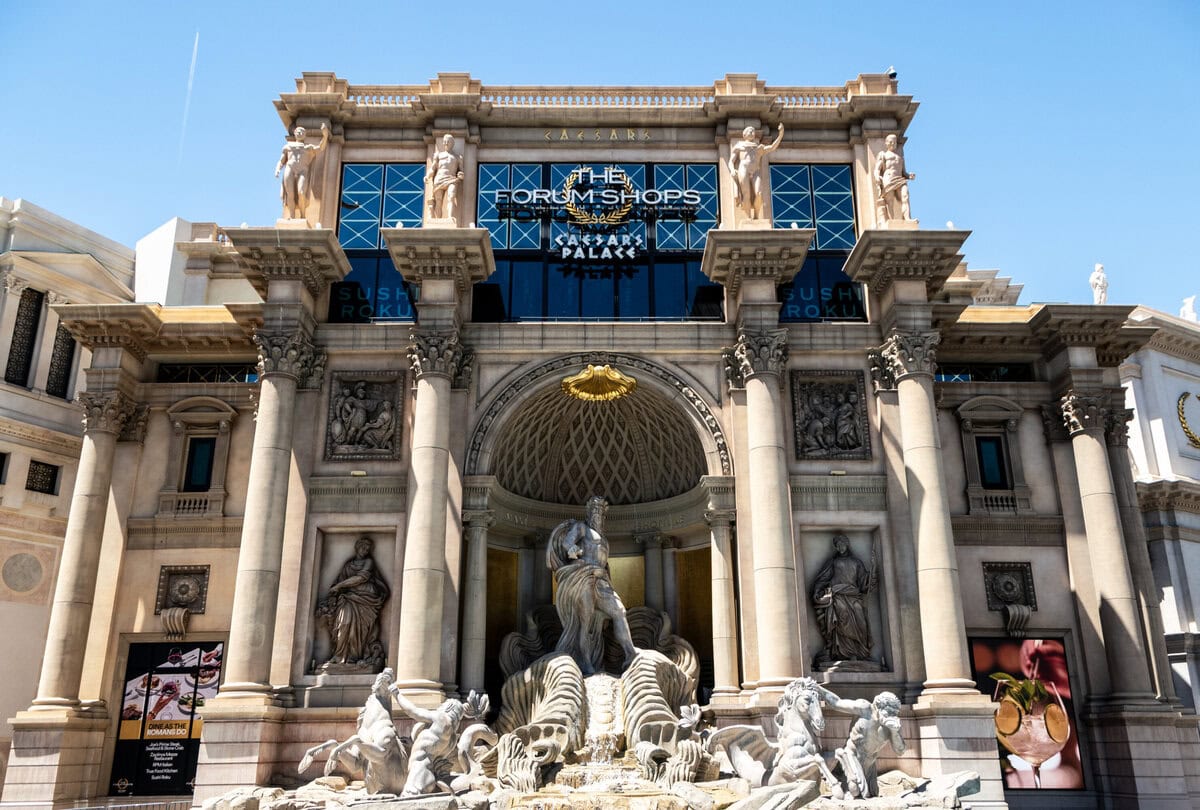
The third expansion opened on October 22, 2004, and it changed the center's relationship to Las Vegas Boulevard directly.
The project added 175,000 square feet of retail, dining, and entertainment space across three levels, within a total construction footprint of 304,000 square feet. The cost came in at $139 million.
New direct entrances from the Strip and curbside valet service were part of the program.
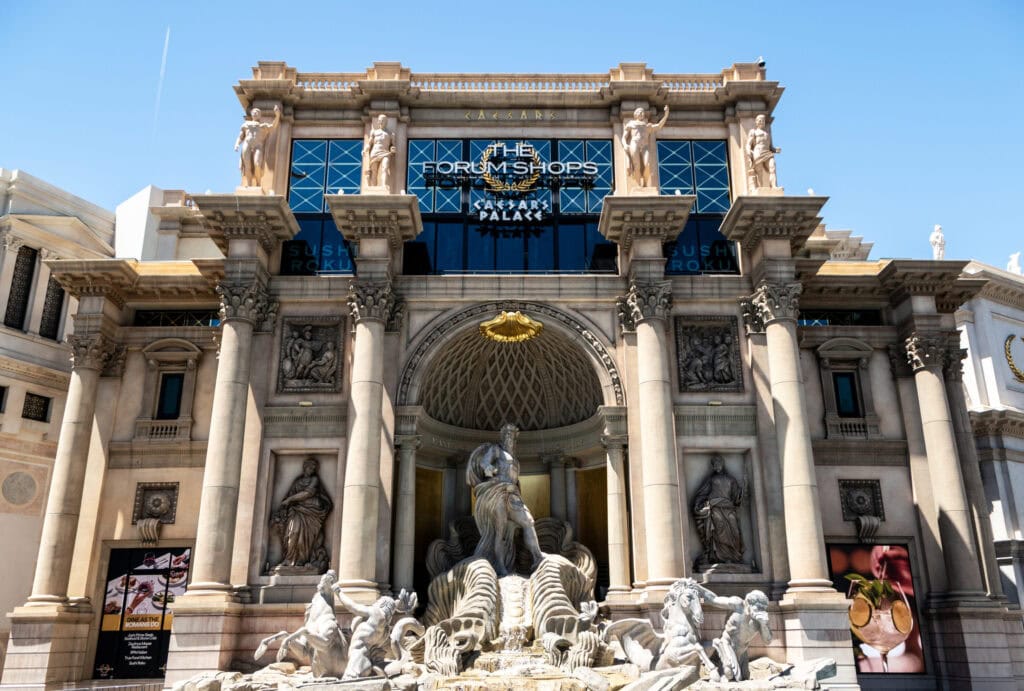
The pedestrian plaza outside included two-thirds-scale replicas of the Trevi Fountain and the Triton Fountain.
Tenants in the new wing included Baccarat, Harry Winston, Brooks Brothers, Kate Spade, Tommy Bahama, Il Mulino New York, and Joe's Seafood.
The new Strip-facing entrances meant visitors could walk in from Las Vegas Boulevard without passing through the casino first - a shift that widened the center's reach beyond the Caesars guest base.
A Flood, a Lawsuit, and 29 Years of Planet Hollywood
In July 1999, a severe desert storm sent thousands of gallons of water through the parking garage and a back service entrance, leaving roughly two feet of standing water in the center of the mall and flooding part of the adjacent Caesars casino floor.
A federal employment-discrimination case followed years later.
The EEOC filed suit in 2009, alleging that Hispanic housekeepers at Forum Shops had been subjected to a hostile work environment starting in 2005, ending only when the shift lead involved was terminated.
Simon settled the case in 2011 for $125,000.
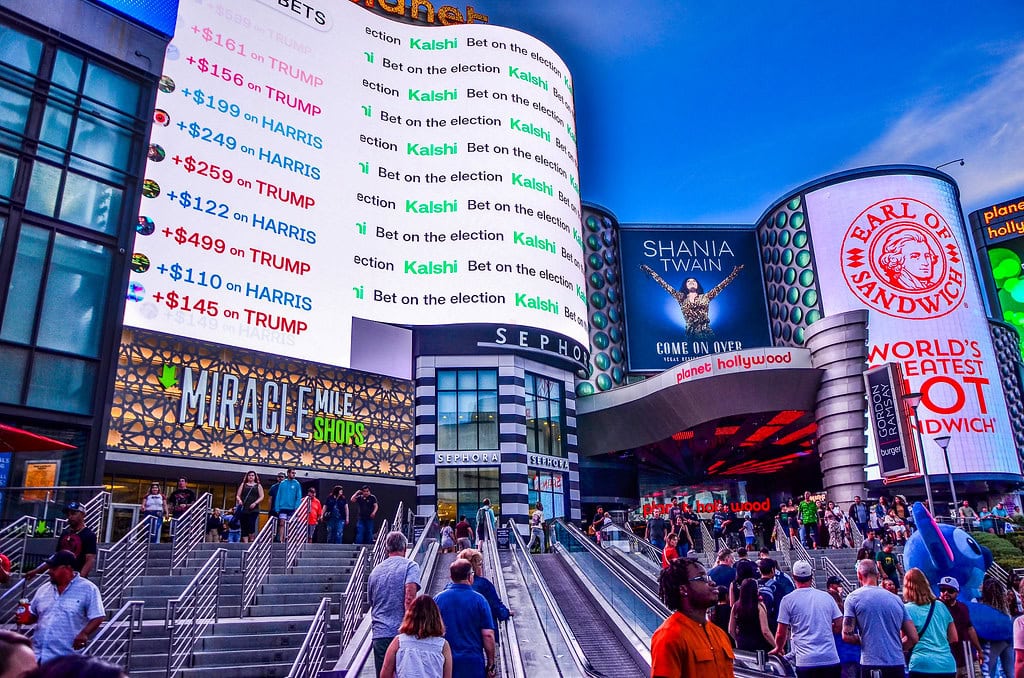
Planet Hollywood opened in July 1994, moved to the terrace level in 2012, and closed in May 2023.
Company leadership said the second location never drew the same traffic as the original spot. When it shut, it had been operating inside the same mall for 29 years.
New Floors, New Faces, and 87 Racing Simulators
The roughly 60,000-square-foot H&M at Forum Shops - once described as the world's largest - closed in February 2024.
Trevi, a long-running Italian restaurant in the center, closed in March 2024. Both closures opened space for a dense run of arrivals.
Eric Emanuel opened his first Las Vegas and first West Coast store at The Forum Shops in March 2025.
Zaytinya, a Mediterranean restaurant from José Andrés, opened in May 2025.
Zara opened a three-story flagship in the former FAO Schwarz space in October 2025.
Prada opened a new boutique in the Fountain of the Gods piazza in early November 2025.
F1 Arcade opened on October 17, 2025, taking 21,000 square feet across two floors. The venue holds 87 full-motion racing simulators, a 41-foot Champagne Bar, and an outdoor terrace.
In Simon's 2025 filing, The Forum Shops carries 672,798 square feet of gross leasable area at 95.5 percent occupancy.
Over forty of those storefronts are first-to-market Las Vegas locations.