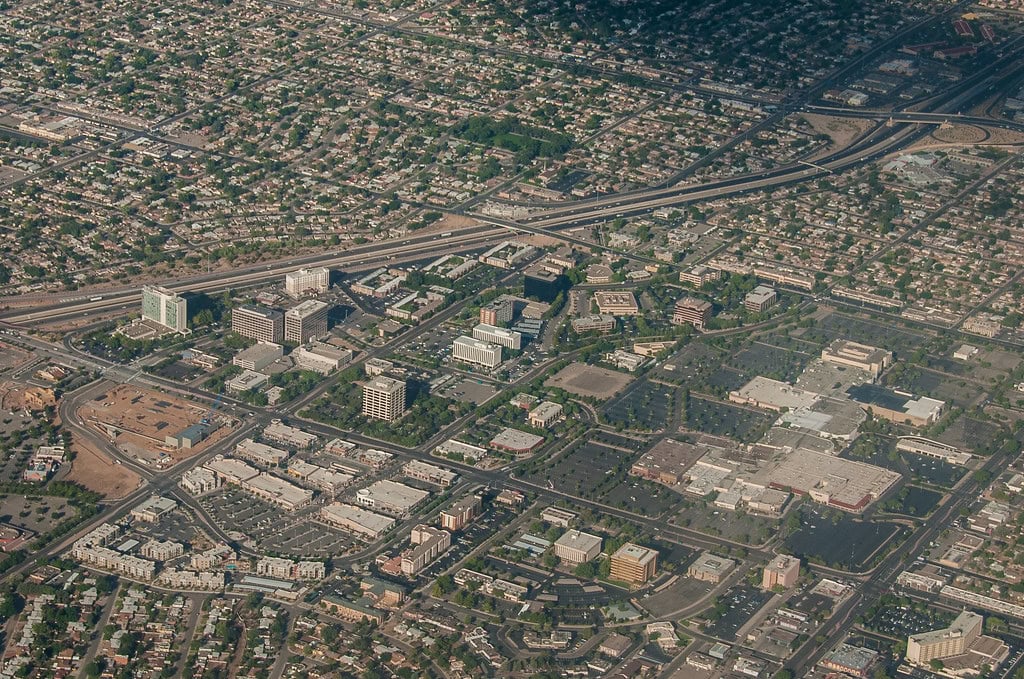
On a clear day in Uptown Albuquerque, the parking lots around Coronado Center feel like their own street grid, with glass doors, bright signs, and the steady pull of people headed inside.
This place began as a plan made in the early 1960s, when a 40-acre piece of the Jeannedale Tract, about 4 miles northeast of downtown, was chosen for a $7 million shopping center that would support the city's growth.
Plans were announced in January 1962 by Homart Development Company, a real estate arm of Sears, Roebuck & Company, and the project first carried the working name Homart Center.
By July 1963, it had a new name: Coronado Center, taken from Francisco Vasquez de Coronado, with a sculpture showing his march installed around 1964.
Groundbreaking followed on November 18, 1963. The design work was split across firms and cities.
Loebl, Schlossman & Bennett handled the overall mall. George L. Dahl designed the Sears store. Wood & Sibeck worked with Chaix & Johnson on Rhodes Brothers.
George A. Rutherford served as the general contractor.
The open-air mall era begins in 1964
Before most of the mall officially opened, Sears was already there, turning on the lights first on September 23, 1964.
The rest of Coronado Center followed as an open-air mall in March 1965. A dedication was held on March 17, 1965.
Albuquerque City Commission Chairman Archie Westfall attended. General Manager Jack Hieronymus attended. "Miss Coronado" Sharon Birkenbuel attended.
The program included performances by the Albuquerque Indian School Band and Caballeros de Vargas.
At the start, Coronado Center had about 407,000 square feet of gross leasable area, with 29 stores and services set across its open-air walkways.
Wyatt's Cafeteria, Hardy Shoes, PayLess Drug, and Fremont's Fine Foods were among the first stores, creating a sense of completeness for the new shopping center in the mid-1960s.
The second major anchor, Rhodes Brothers, opened as a two-story store with 118,300 square feet on October 1, 1965.
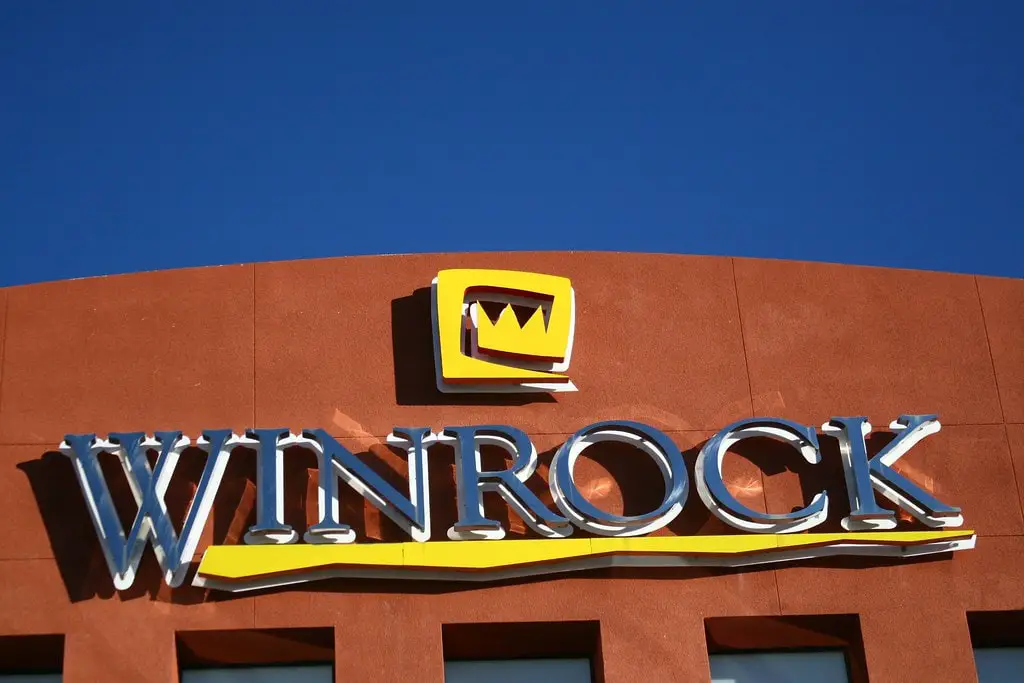
From the start, Coronado also faced the challenge of having a close neighbor: Winrock Center, which had opened in 1961, just half a mile to the south.
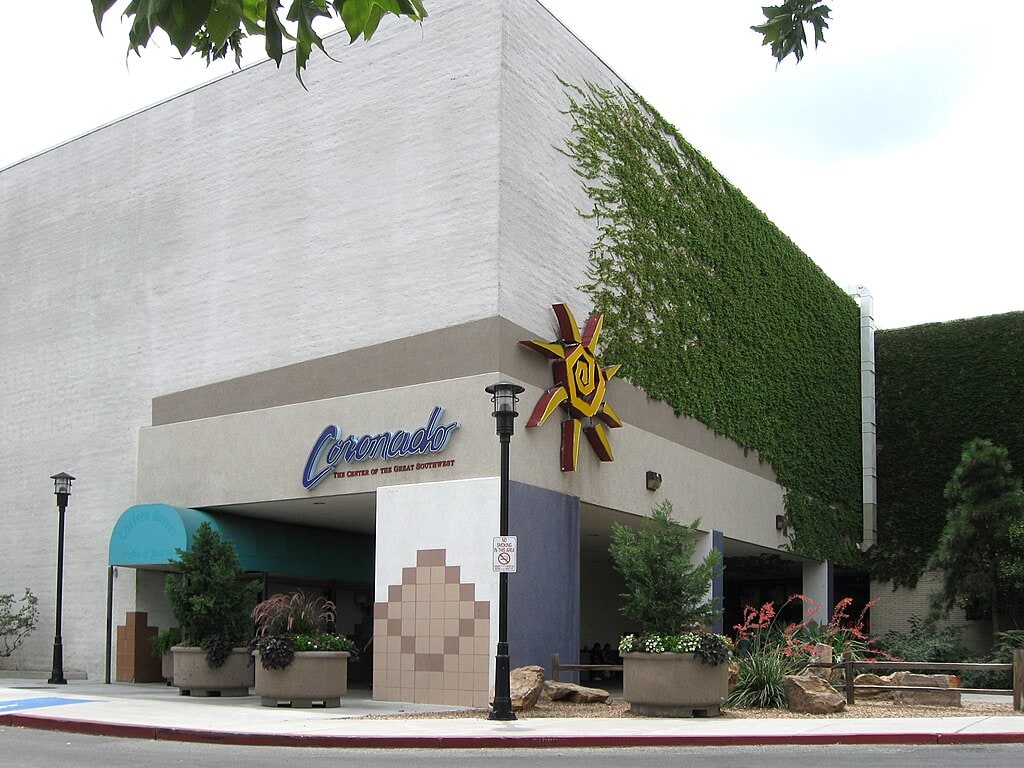
Uptown Albuquerque and Coronado's 1976 enclosure
In January 1971, developer Dale J. Bellamah, who had sold the land to Homart, laid out plans for the remaining 117 acres around the mall as "Uptown Albuquerque."
The plan included offices, hotels, and apartments. It also included the idea of another department store.
By July 1973, that vision shifted into a two-anchor expansion connected to the existing mall.
The project's control changed hands on December 28, 1973, moving to a joint venture between Dale Bellamah Corporation and Ernest W. Hahn, Incorporated of California.
The expansion drew environmental and neighborhood opposition that turned into lawsuits. Still, those were dismissed by March 1974, clearing the way for construction that began in December 1974 on a $40 million build.
The work did two major things at once: it enclosed the original open-air sections, and it added a large west wing with two levels and space for 94 stores, plus 13 new tenant spaces worked into the original portion.
Charles Kober Associates of Los Angeles designed the expanded layout.
The rebuilt Coronado Center was dedicated on February 16, 1976, with U.S. Senator Pete Domenici present, along with U.S. Representative Manuel Archibald Lujan Jr., Albuquerque Mayor Harry Kenney, and Ernest W. Hahn.
New anchors and a packed 1970s tenant mix
The 1970s expansion made Coronado Center much bigger and brought in new main stores that changed how the mall operated.
Goldwater's opened in 1975 as a two-level store with 106,000 square feet, and The Broadway opened in 1976 as a three-level store of 159,400 square feet.
With those additions, more than 70 new stores joined the mall.
The names reflected the shopping style of the time: Hartfield's, House of Fabrics, Butler's Shoes, Size 5-7-9 Shops, Gallenkamp Shoes, K-G Men's Store, Richman Brothers, Burger King, Hot Dog on a Stick, and Record Bar.
By this point, Coronado Center had grown to about 970,800 square feet of gross leasable area, spread across 139 tenant spaces on 84 acres, and it had moved beyond being a simple shopping stop into a full-day place.
Entertainment arrived on the property's southern edge with the opening of Coronado 4 Theatres on June 15, 1977.
The movie site expanded to Coronado 6 Theatres on December 13, 1985, and it stayed part of the property's orbit until it closed in 2004.
While Coronado and Winrock continued their friendly competition, Coronado Center's bigger indoor design helped it attract more people as the city's main shopping area kept moving.
1984 growth and decades of anchor reshuffles
Coronado Center hit another clear milestone on August 2, 1984, when a two-level Sanger-Harris store opened with 135,000 square feet, pushing the mall's gross leasable area to about 1,105,800 square feet and locking in its status as the state's largest shopping center.
Around the same time, renovations took place in 1984, with more renovations later in 1992 and 1995.
The anchor lineup did not stay still. Rhodes changed to Liberty House-Rhodes in the mid-1970s, then became full Liberty House by August 8, 1977, and then shifted again to Mervyn's on October 8, 1978.
The Broadway operated under the name Broadway Southwest starting in 1980.
Sanger-Harris rebranded to Foley's in April 1987, then closed in January 1989. Goldwater's was rebranded as May-Daniels & Fisher on May 7, 1989.
That store was remodeled and expanded to 154,000 square feet, reopening on October 3, 1991, before it was rebranded again to Foley's in April 1993.
The Broadway was rebranded as Macy's in 1996.
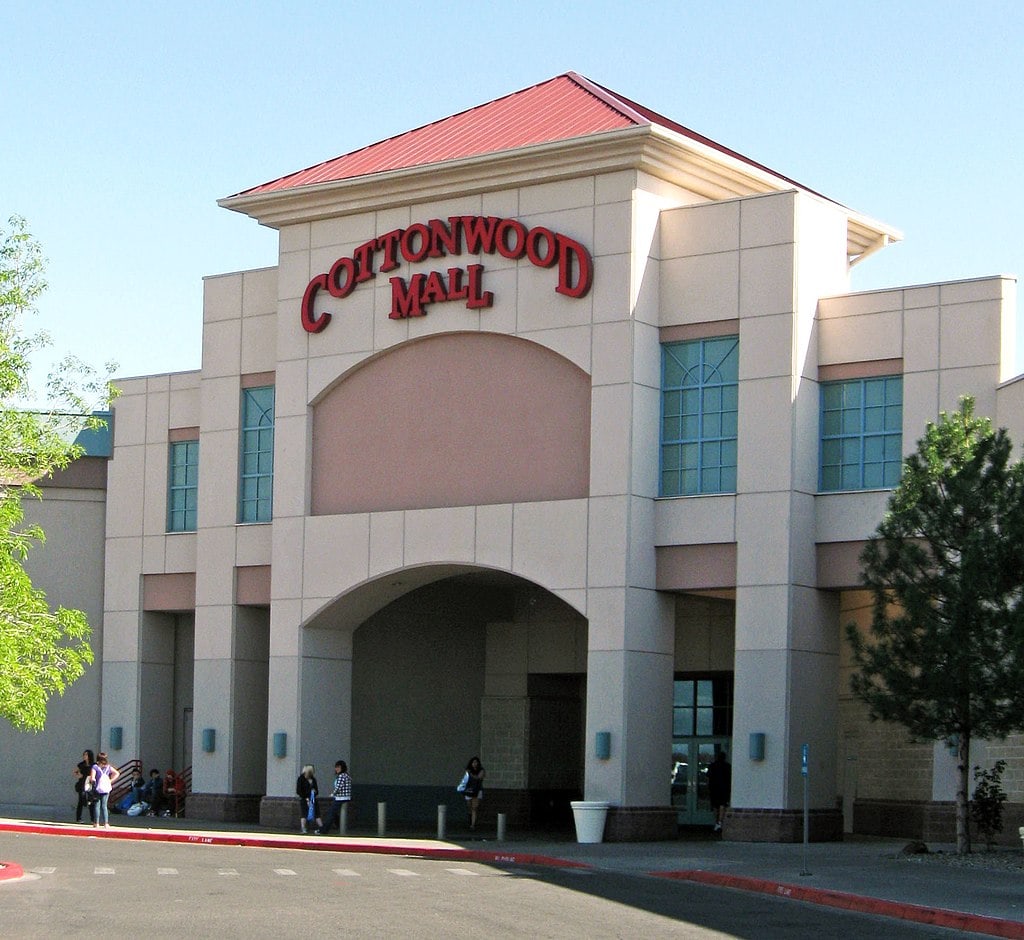
When Cottonwood Mall opened in July 1996, about 7.8 miles to the northwest, Coronado Center did not lose its grip, and Winrock's decline in the early 2000s only strengthened Coronado's position.
Ownership changes and a 2014 facelift
In July 2003, General Growth Properties acquired Coronado Center, and the next stretch brought a string of big, visible moves tied to national retail changes.
In January 2006, Macy's, still operating in the former Broadway space, ran a going-out-of-business sale and prepared to consolidate into the former Foley's building, which became Macy's in September 2006.
The old Broadway building was acquired by Target Corporation in July 2006, but no store was built there, and a new Target instead opened adjacent to Winrock on March 10, 2013.
Mervyn's closed in December 2008 during bankruptcy, and the space was remodeled into Kohl's, which opened in September 2010.
The mall also pushed into a more modern tenant mix with large new boxes and new construction inside old shells.
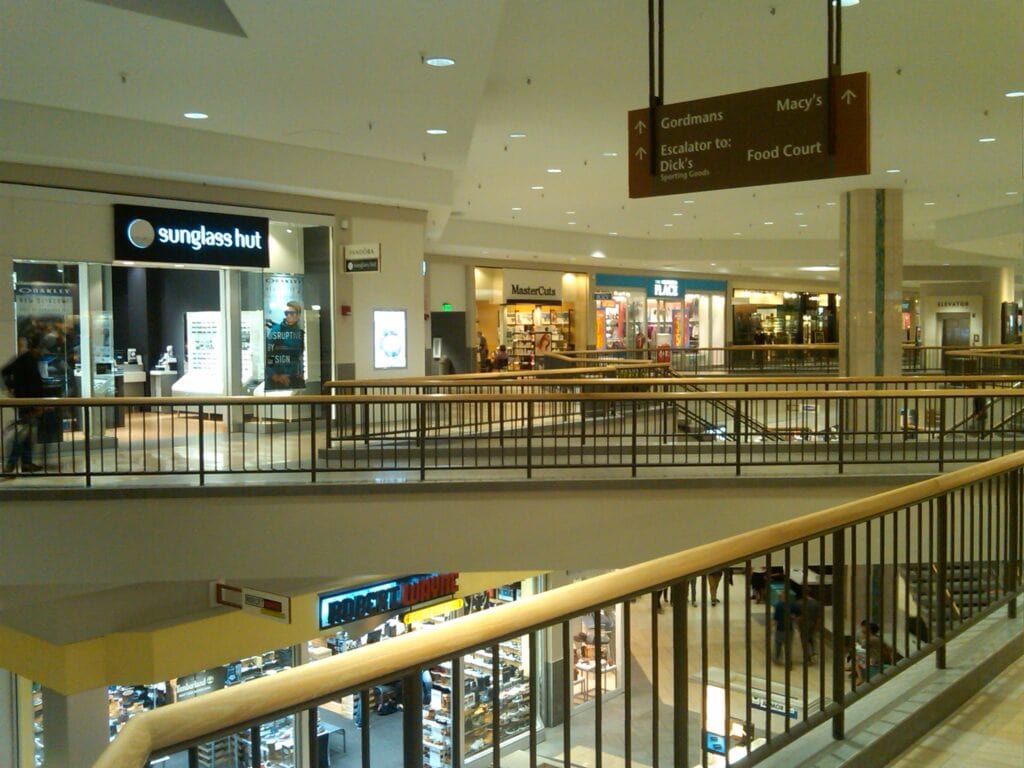
After seven years of vacancy in the former Broadway space, Gordmans opened in September 2013, on the upper level with 52,600 square feet.
Dick's Sporting Goods opened in October 2013, on the ground level with 47,700 square feet.
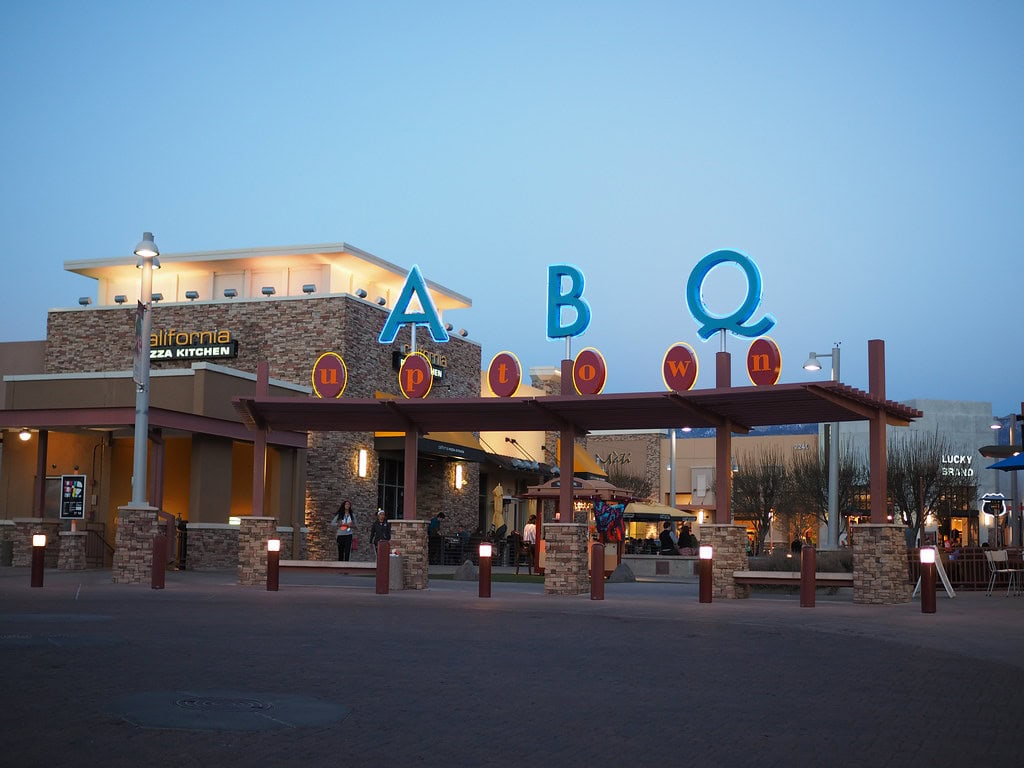
From February through November 2014, Coronado Center received a mall-wide facelift tied to its 50th anniversary, with new lighting, paint, signage, polished porcelain flooring, updated entrances, renovated restrooms, and a refreshed food court.
The main entrance shifted east to make room for a 23,000-square-foot H&M, which opened in November 2014.
Food, entertainment, and new tenants since 2016
Coronado Center's modern identity has leaned hard into dining and entertainment, while still keeping a deep list of familiar retail names.
The Cheesecake Factory opened on February 23, 2016, near the main entrance, adding a high-traffic restaurant in a spot designed to catch both shoppers and people who came only to eat.
Sears, one of the original anchors, downsized on December 11, 2016, to 78,100 square feet, closed its Auto Center, and left the remaining area to be converted into 15 inline stores.
One of the most visible of those was The Container Store, which opened on July 8, 2017, in an 18,000-square-foot space.
Gordmans closed in March 2017 after bankruptcy, and the upper level later became Round One Bowling & Amusement Center, which opened in June 2018.
Sears closed permanently in December 2018. In August 2018, Brookfield Property Partners acquired full ownership of the mall.
Urban Outfitters relocated to the mall's upper level in 2019 after leaving its earlier Nob Hill location.
Dining around the mall continued to shift with the times. Fuddruckers opened in July 2002. Bonefish Grill opened in July 2014, closed in August 2017, and was replaced by Saggios Italian Bistro in February 2021.
Other names tied to the mall's food and treats mix have included Blaze Pizza, Boba Tea Company, Jimmy John's, Cinnabon, Lolli and Pops, See's Candies, and Seasons 52 Grill.
Lawsuits and security shifts at Coronado
Coronado Center has had times when shopping was not the main focus.
In 1999, the mall became part of a free speech lawsuit alongside Winrock Town Center and Cottonwood Mall after protesters were denied permission to hand out leaflets.
The case was dismissed, and the legal reasoning leaned on the 1972 U.S. Supreme Court ruling in Lloyd Corp. v. Tanner, which allows malls to limit speech activity on their property.
In recent years, people have become worried about safety after violent events. A small Bernalillo County Sheriff's Office station opened at the mall in August 2022.
On November 24, 2023, a gun was fired outside the mall after a fight between two teenage boys. No one was hurt, and a 14-year-old was charged.
Another shooting happened on July 26, 2024. Because of these events, ShotSpotter technology was set up in summer 2024.
Coronado Center today: tenants and anchors
Even with empty stores and challenges from the larger retail industry, the mall has kept going.
Kohl's shut its doors on September 16, 2023, creating a large vacant space. Meanwhile, new stores continued to open in the area.
Mango opened its first New Mexico store in April 2025. Crocs opened its first Albuquerque store in May 2025, a 3,000-square-foot shop.
Lovesac opened on November 20, 2025, as the national furniture brand's first New Mexico store.
In October 2025, the mall held a Trick or Treat event to support Joy Junction and kept its children's play area updated.
Today, Coronado Center is still a two-story indoor mall in Albuquerque's Uptown area, covering about 1,153,000 square feet with more than 160 stores, a food court, and a mix of places to eat and have fun.
Current anchors include Macy's, JCPenney, Dick's Sporting Goods, Furniture City, and Round One Entertainment, with large vacancies left by Sears and Kohl's.
In contrast, major tenants include Barnes & Noble, H&M, Forever 21, The Container Store, The Cheesecake Factory, and Boot Barn.
This highlights an important fact about this place. It has changed many times, yet it remains a part of the city's daily life.