Dayton Mall is a regional indoor shopping center in Miami Township, Ohio, part of the Greater Dayton area in Montgomery County.
It stands along Miamisburg Centerville Road at the intersection of State Routes 725 and 741, close to the Interstate 75 and Interstate 675 corridor. That placement makes it easy to reach from several directions.
It serves as a key shopping destination for people in Dayton, Miamisburg, Centerville, and across southwest Ohio. Shoppers also travel from farther out, including Cincinnati, Columbus, and Indianapolis.
The mall opened in 1970 and was developed by the Edward J. DeBartolo Corporation. At the time, it was promoted as the largest enclosed mall between New York and Chicago, which helped define it as a major regional center from the beginning.
Dayton Mall rises in rural Miami Township
Construction began in September 1968 on a 102-acre site at the corner of State Routes 725 and 741 in Miami Township, just south of Dayton, Ohio.
The Edward J. DeBartolo Corporation set out to build what it called the largest enclosed shopping mall between New York and Chicago.
The plan was for a two-level center with more than 100 stores and about 1.27 million square feet of leasable space.
The site sat next to Interstate 75, and that location was central to the project. DeBartolo aimed beyond Dayton itself. The planned trade area included Cincinnati, Columbus, and Indianapolis.
Plans for a major shopping center in south Dayton first appeared in August 1967. About a year after construction began, the first stores were already opening.
Dayton Mall opens in stages, 1969-1970
The first major anchor, a two-level Rike's department store, opened on September 22, 1969.
By December of that year, Hickory Farms, Cassano Pizza King, and a First National Bank branch were all operating inside the half-built center.
The original single-screen Dayton Mall Cinema showed its first feature on Christmas Day, 1969.
JCPenney followed on February 11, 1970. Sears came in September. A preview opening in March 1970 had 25 stores running; the formal grand opening on September 24, 1970, counted 106.
When the mall reached full occupancy, 118 stores were operating.
The tenant roster read like a directory of mid-century American retail: a J.G. McCrory five-and-ten, Orange Julius, Kinney Shoes, Thom McAn, Jo-Ann Fabrics, Waldenbooks, Lerner New York, Lane Bryant, The Limited, Frederick's of Hollywood, Russell Stover, Hallmark Cards, and Chess King.
Restaurants included Bresler's Ice Cream, Hot Sam, Carousel Snack Bar, Forum Cafeteria, and Vic Cassano's.
The upper mezzanine held about twenty smaller retail spaces, with fountains anchoring the center points of the east and west wings.
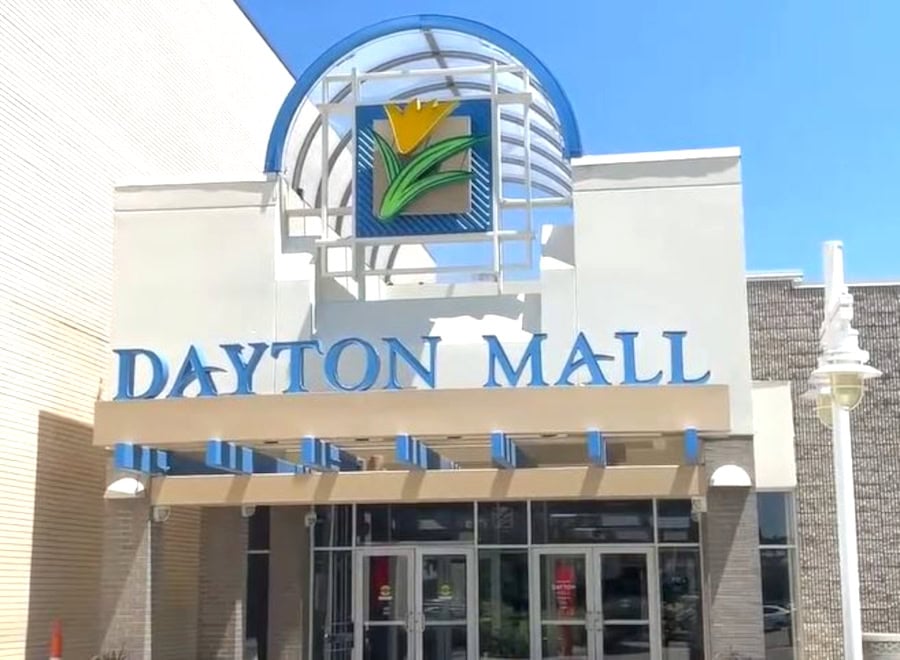
Cinema screens multiply, ownership shifts
Cinema 2 opened on the mezzanine on August 4, 1972. Cinemas 3 and 4 followed in October 1976, and four more screens opened in 1982 in space carved from a downsized McCrory store, bringing the total to eight.
The Liberal supermarket closed on January 20, 1979. Its former space cycled through Morrison's Cafeteria and later Sadie's Buffet and Grill before being divided further.
DeBartolo sold the mall to JMB Property Management in January 1983. JMB announced a $6 million renovation in April 1984.
Workers replaced much of the original terrazzo with terra-cotta tile, built a food court in unused mezzanine space, installed a glass elevator and reflecting pool in the center court, and converted closed-off entrances near Sears and JCPenney into additional retail bays.
The renovated mall was rededicated on October 26, 1984.
The 1990s rebuild: a fourth anchor and 160 stores
The Mall at Fairfield Commons opened in Beavercreek in 1993. Dayton Mall responded with a roughly $20 million redevelopment.
Lazarus, the department store occupying the original Rike's location, added a third floor, growing to about 253,000 square feet and reopening on January 14, 1994.
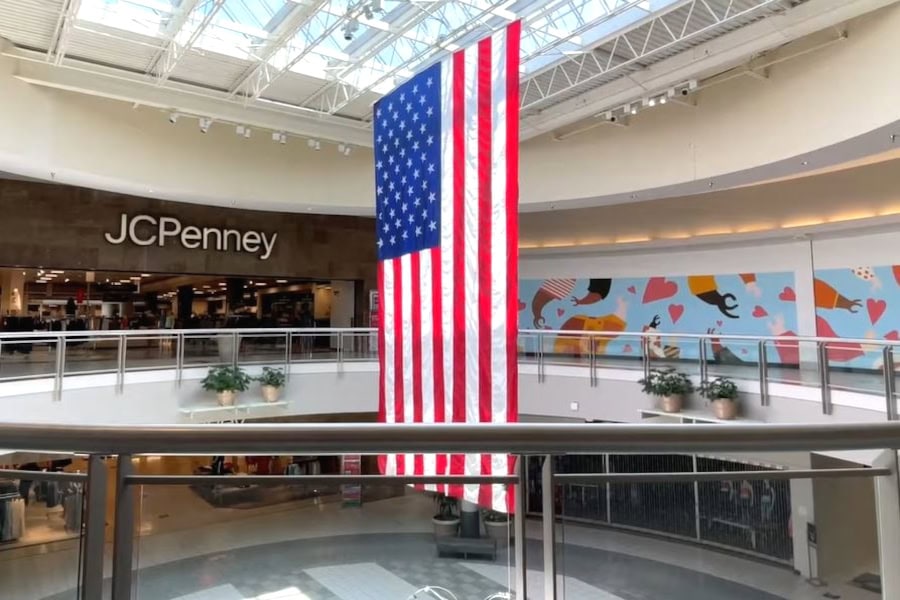
JCPenney vacated its original west-end location and moved into a newly built two-level anchor in front of what had been the main entrance - that store opened on March 6, 1996.
The old Penney space reopened as McAlpin's on October 30, 1996, then became Elder-Beerman in July 1998.
Interior concourses received new flooring, trellises, benches, and a birdbath fountain, and the mezzanine food court doubled in size.
A three-day dedication beginning November 3, 1995, marked the reopened mall, which held about 160 stores and services. Glimcher Realty Trust acquired the property in April 1997.
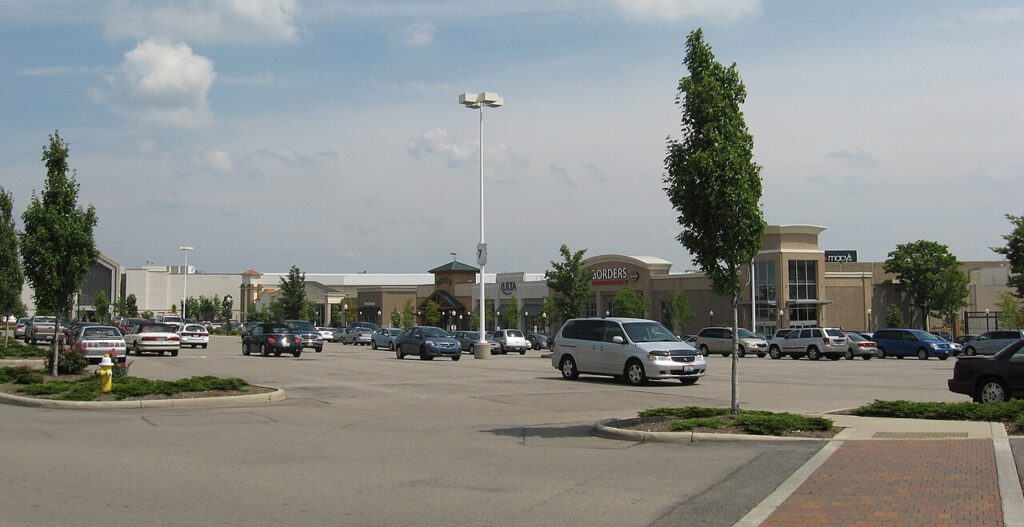
Rike's, Shillito-Rike's, Lazarus, Lazarus-Macy's, Macy's
Rike's opened its doors on September 22, 1969. Over the next 36 years, the same store took on four different names. In 1982, a merger with Shillito's led to the name Shillito-Rike's.
By 1986, it became Lazarus. In 2003, the store carried the Lazarus-Macy's name, and in 2005, it was fully rebranded as Macy's.
The Dayton Mall directory still lists Macy's as an anchor tenant today. It remains in the exact same spot it has occupied since the mall first partially opened.
That continuous use matters more than the changing names. Many anchor stores across the country eventually closed, but the original Rike's location never sat empty.
After a renovation in the 1990s, the building reached about 253,000 square feet, roughly three times the size of most new department store spaces today.
Village at Dayton Mall and the open-air era
A 20,000-square-foot DSW opened on July 9, 2000. A 30,000-square-foot Linens 'n Things replaced a Discovery Zone in early 2001.
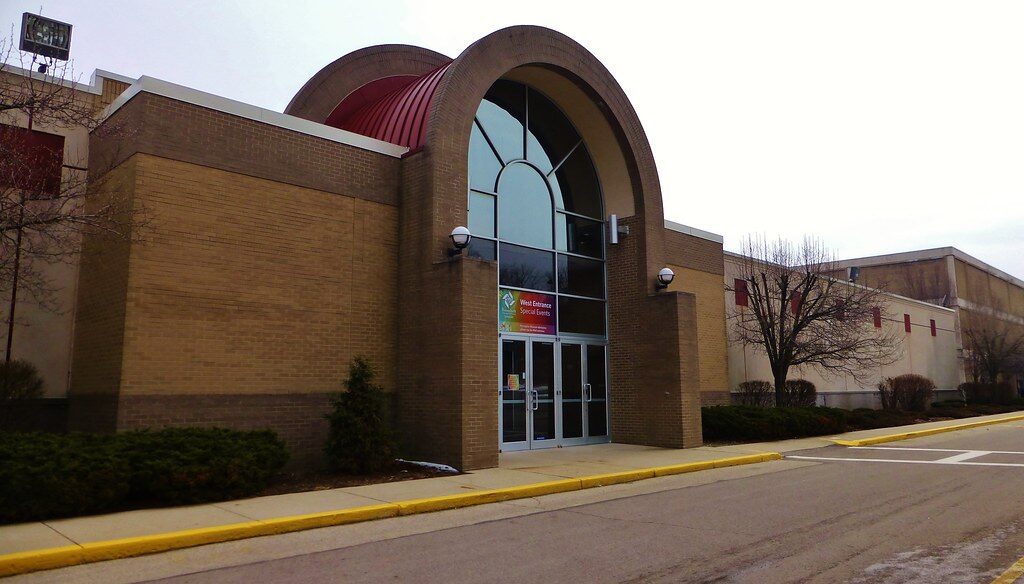
The hybrid indoor-outdoor format was becoming the standard answer to enclosed mall fatigue across the country, and Dayton Mall made its own version of that bet in 2006.
The Village at Dayton Mall added 97,000 square feet of open-air retail in the north parking area along Route 725. Construction began in 2005, with tenants opening across 2006 and 2007.
The same round of work refreshed the enclosed mall's exterior facade and added about 25 new tenants to the Village portion, including a Borders bookstore and an Orvis.
The project extended the mall outward toward the street edge rather than replacing the enclosed section - absorbing the open-air format rather than surrendering to it.
Dick's Sporting Goods, body scans, and anchor exits
In 2012, DSW moved from the enclosed mall into the former Borders space in the Village. Dick's Sporting Goods took the vacated DSW space plus an adjacent f.y.e.
unit and opened on November 7, 2012. Both Dick's and DSW are still listed in the current Dayton Mall directory.
In November 2014, Doppelganger Laboratories opened a store featuring Artec's Shapify full-body scanning booth - the first retail deployment of that technology in the United States.
Shoppers stepped inside, the booth scanned them in about twelve seconds, and they received a full-color miniature figurine.
The store did not last, but management was clearly chasing novelty, not just filling empty bays with identical chains.
Elder-Beerman closed on August 29, 2018, as part of the Bon-Ton bankruptcy. Sears shut its Dayton Mall store on November 25, 2018, after being named in a national closure round.
The mall that opened with three anchors, then gained a fourth in the 1990s, was down to two.
Macy's added an internal Backstage off-price section on June 2, 2018. Ross Dress for Less was announced for the former H.H. Gregg space in June 2018 and opened on October 12, 2019.
Crossroads Church moves into the old Sears box
Crossroads Church bought the former Sears building on July 29, 2022. The space totaled about 167,000 square feet.
Crews redesigned it into the group's first permanent Dayton campus, adding a 1,550-seat auditorium, 19 rooms for children, public co-working hours, and areas for students.
The Crossroads Dayton campus opened on April 20, 2025. A preview and ribbon-cutting happened on April 16, and regular weekly services began on Easter Sunday.
The current Crossroads Dayton page lists the active campus at 90,000 square feet.
Today, Crossroads appears in the official Dayton Mall directory alongside Macy's, JCPenney, Ross Stores, Dick's Sporting Goods, DSW, Ulta Beauty, and Morris Furniture.
The Elder-Beerman parcel and the Hull era begin
On April 10, 2025, the former Elder-Beerman site sold for $2.5 million to Miamisburg Springboro Mall Anchor LLC.
At the time, Dayton Mall suggested something new would take over the space, but did not say what it would be.
Hull Property Group took ownership of Dayton Mall on October 27, 2025. Township officials said shoppers would likely notice cosmetic changes as the new management stepped in.
Soon after, on December 1, 2025, Miami Township began updating the Miami Crossing master plan.
The update covers the mall and more than 400 nearby businesses and includes public input.
The township explained that the earlier 2015 plan had stalled. The mall's Chapter 11 bankruptcy filing in 2021 and the impact of the COVID-19 pandemic had slowed progress.
Washington Prime Group and related companies, including Dayton Mall III LLC, filed for bankruptcy on June 13, 2021.
By December 2025, Miami Township, Hull Property Group, and an oversight committee were working toward a new plan for the area.
The goal is to create a more walkable district that blends retail, housing, and office space.
The Elder-Beerman parcel, the last unfinished piece of the original four-anchor setup, had already been sold before Hull took ownership of the mall.