Tower City Center begins with the Van Sweringens' plan
Tower City Center exists because two brothers believed Cleveland should behave like a capital city. O.P. and M.J. Van Sweringen were not theorists.
They had already put their ideas to the test in Shaker Heights, where they insisted on strict planning, good transit, and attractive design. The suburb was a success, and it gave them influence.
Downtown was their next target. The idea was simple and enormous: consolidate Cleveland's railroads into a single terminal and place it directly beneath the city's most symbolic ground, Public Square.
Earlier plans had pointed rail traffic toward the lakefront, following Daniel Burnham's 1903 Group Plan. The Van Sweringens rejected that.
They wanted the heart of the city to stay the heart. On January 6, 1919, voters approved a vote allowing the project.
That decision made it possible for what would become Cleveland's biggest and most challenging building project of the 1920s.
From the beginning, the terminal was meant to do more than move trains. It was designed to pull business, offices, hotels, and shoppers into a single field.
Clearing the city to make room for ambition
Before anything could be built, much of downtown Cleveland had to be erased. Between 1922 and 1924, more than one thousand buildings were demolished.
Entire blocks were condemned and seized. The process displaced flophouses, jewelry auction houses, and the city's old central police station, among many others.
At the time, the excavation was described as the second-largest in the world, surpassed only by the Panama Canal.
Ground was officially broken in 1923, though the project stumbled through early uncertainty. Several design concepts were abandoned.
One idea was to use a short, rounded dome, but the Van Sweringens turned it down because they thought it looked too much like a German military helmet, which was still a touchy subject after World War I.
Whether the story is true or not, it shows how much the project's look and what people thought about it mattered.
What was built instead was bold and huge. The giant hole dug into the city was not just for train tracks, but for a new idea of what downtown Cleveland could be.
A classical tower in a changing architectural age
The Van Sweringens hired the Chicago firm Graham, Anderson, Probst & White to design the complex.
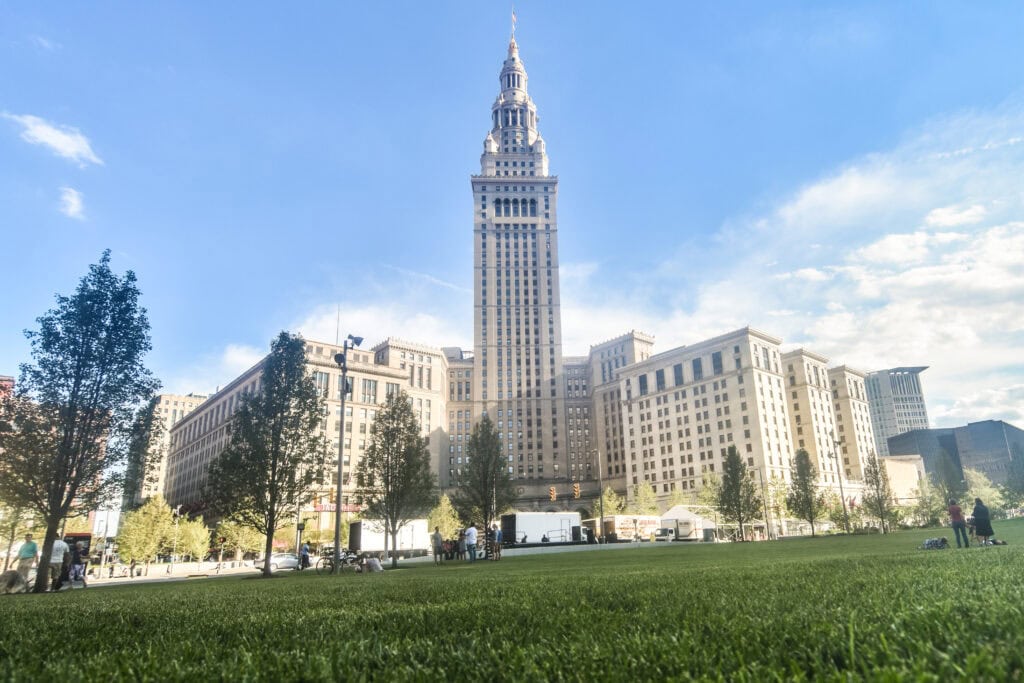
The firm was known for its grand, traditional style, and that style influenced the whole project. Terminal Tower was proudly classical at a time when Art Deco was starting to become popular in other places.
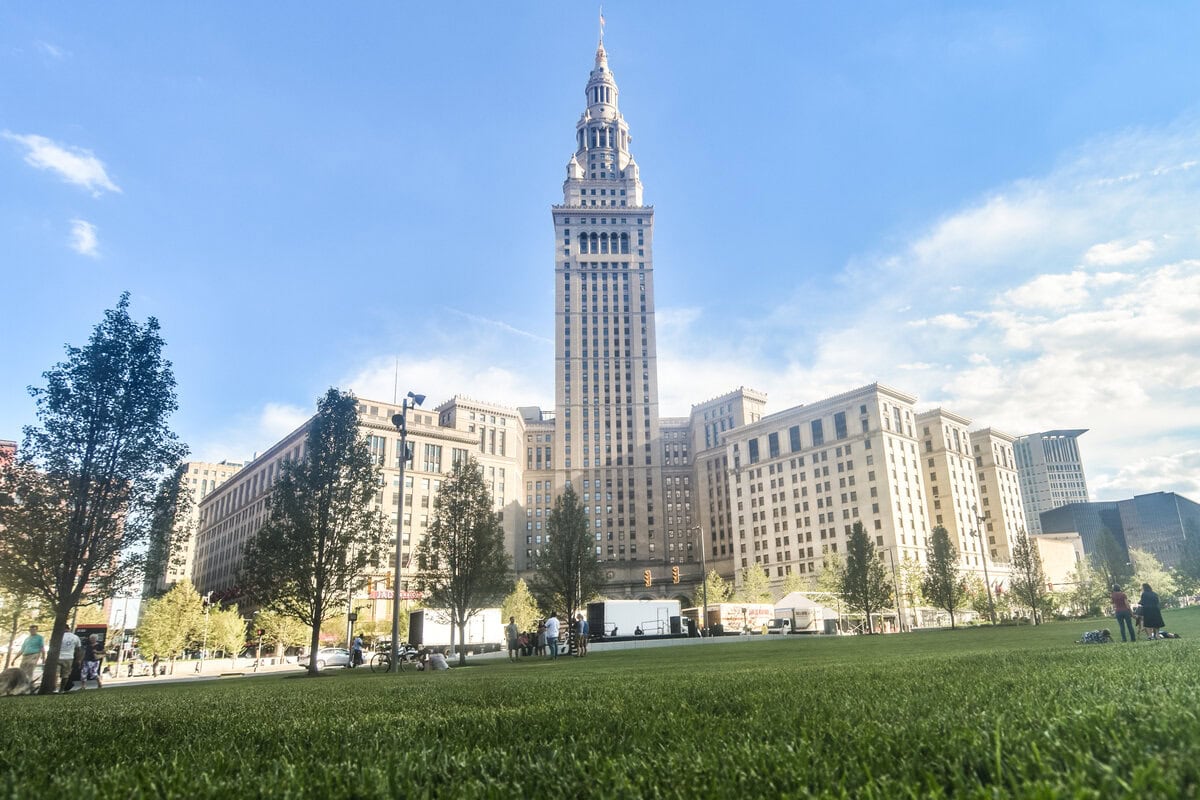
The tower's main entrance faced Public Square with five archways and Ionic columns.
Above that was a simple square section, with few decorations until the upper levels, where classical details appeared again.
The building ended with a cone-shaped roof and a spire.
The design was inspired by Roman tombs and the old Lighthouse of Alexandria, making the tower both a symbol and a useful building.
The building also grew dramatically during planning.
At first, it was planned as a 14-story building to highlight the train service to Shaker Heights, but it grew to 52 stories when the Van Sweringens saw they could make more money by building above the station.
The finished building was 708 feet tall to the roof, and 771 feet tall with the spire. By Cleveland standards, it was overwhelming. By national standards, it was a statement.
Engineering a city above moving trains
The engineering challenges were as ambitious as the architecture. Terminal Tower had to sit on top of an active rail terminal, which required foundations unlike anything previously attempted in the city.
Caissons were sunk 280 feet into the ground to support the 52-story structure.
The rail system feeding the terminal was equally complex. A four-track high-level viaduct crossed the Cuyahoga River valley. Seventeen miles of new electrified route mileage were built.
To keep smoke out of the downtown terminal, steam trains typically changed to electric locomotives at outlying yards (such as Linndale) before entering Cleveland Union Terminal, an approach that also aligned with the city’s later steam/smoke restrictions.
This requirement added time and complexity to every arrival.
Steel construction began in 1926. By 1927, Terminal Tower was complete, becoming the tallest building in the world outside New York City.
Tenants moved in during 1928. The first train entered the depot on October 23, 1929.
The formal dedication of the Cleveland Union Terminal complex followed on June 29, 1930.
A complex designed to be a city within the city
Tower City Center was never just a tower.
The terminal connected directly to the 1918 Hotel Cleveland and to three new office buildings completed in 1930: the Medical Arts Building, the Builders Exchange Building, and the Midland Building.
Together, they became known as the Landmark Office Towers Complex.
Retail was built into the system. In 1931, the Higbee Company relocated its flagship department store to a building connected to the terminal.
In 1934, the U.S. Postal Service moved its main Cleveland office into a new Walker and Weeks-designed building nearby, later known as M.K. Ferguson Plaza.
The concourse itself contained extensive commercial space, an unusual feature for the era. The core of the complex covered approximately 17 acres, with total site coverage reaching 34 acres.
The intent was clear: workers, travelers, shoppers, and hotel guests would all pass through the same controlled environment.
Movement would generate commerce. Commerce would justify scale.
Rail glory, complicated from the start
When the Cleveland Union Terminal opened in 1930, it was designed to handle more than two hundred train movements per day.
Its signaling system was the largest single-unit interlocking tower in the world, operated through 576 levers and a 34-foot electrified chart.
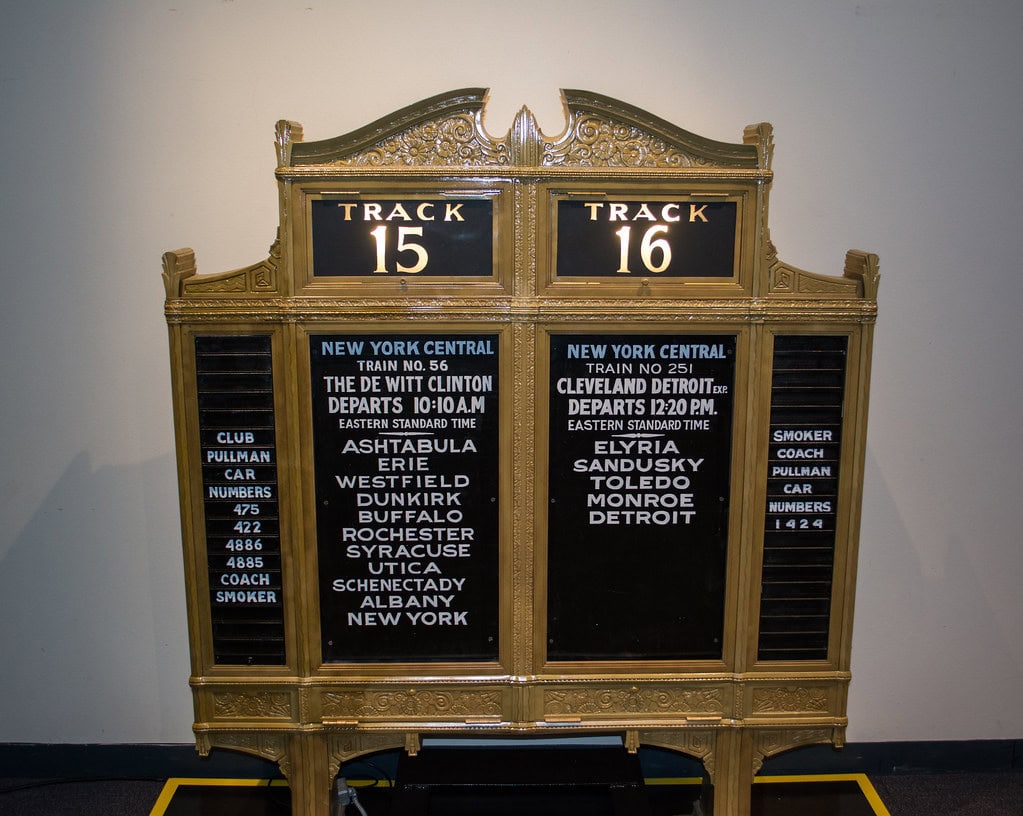
Major railroads served the terminal, including the New York Central, Nickel Plate Road, Big Four Railroad, Erie Railroad, and Baltimore & Ohio.
The Pennsylvania Railroad declined to participate and continued using the lakefront depot.
The station hosted many named trains, including the Empire State Express, Cleveland Mercury, Chicagoan, Pacemaker, Steel King, and Blue Arrow.
Yet operational problems quickly became apparent. Trains had to detour from the faster lakefront route.
Some railroads began bypassing the terminal. Others eventually left Cleveland entirely. Despite its design capacity, the terminal never reached its projected volume.
Decline arrives slowly, then all at once
Passenger rail traffic peaked during World War II, then declined steadily afterward. Automobiles and airplanes reshaped travel habits. The terminal remained busy, but not busy enough.
The Shaker Rapid Transit line used the terminal beginning in 1930, and the city-owned rapid transit line was added in 1955.
The two systems operated in separate stations due to ownership differences, an arrangement that lasted decades.
By the mid-1960s, long-distance rail service began disappearing. The Baltimore & Ohio and Norfolk and Western ended service by 1965.
The New York Central discontinued named trains by 1967. By 1970, only minimal service remained.
Amtrak briefly operated through the terminal in 1971, then left due to high rents. The final passenger train departed on January 14, 1977. Cleveland Union Terminal's role as a rail station ended after forty-seven years.
An empty landmark and an uneasy pause
The terminal was added to the National Register of Historic Places in 1976, just as its primary purpose vanished. That same year, Hotel Cleveland declared bankruptcy.
In 1976, a Vietnam veteran and Chessie System employee took executives hostage inside Terminal Tower during a labor protest.
This episode underscored the building's changed relationship to the city.
By the early 1980s, Tower City Center stood largely intact but underused. It was still central, still monumental, and still disconnected from daily life.
Forest City and the reinvention of the concourse
Forest City's takeover was less a rescue fantasy than a long, expensive sequence of fixes.
Planning began in 1982, and by 1983, Forest City had acquired most of the Tower City Center property, including the Terminal Tower, and purchased the former U.S. Post Office building next door.
Before the glossy parts could happen, the complex had to stop falling apart.
Between 1984 and 1986, about $18 million was spent on bridge repairs across the site, funded mostly through public transportation funding sources arranged by the city.
It was the kind of work nobody celebrates, but everything depends on it.
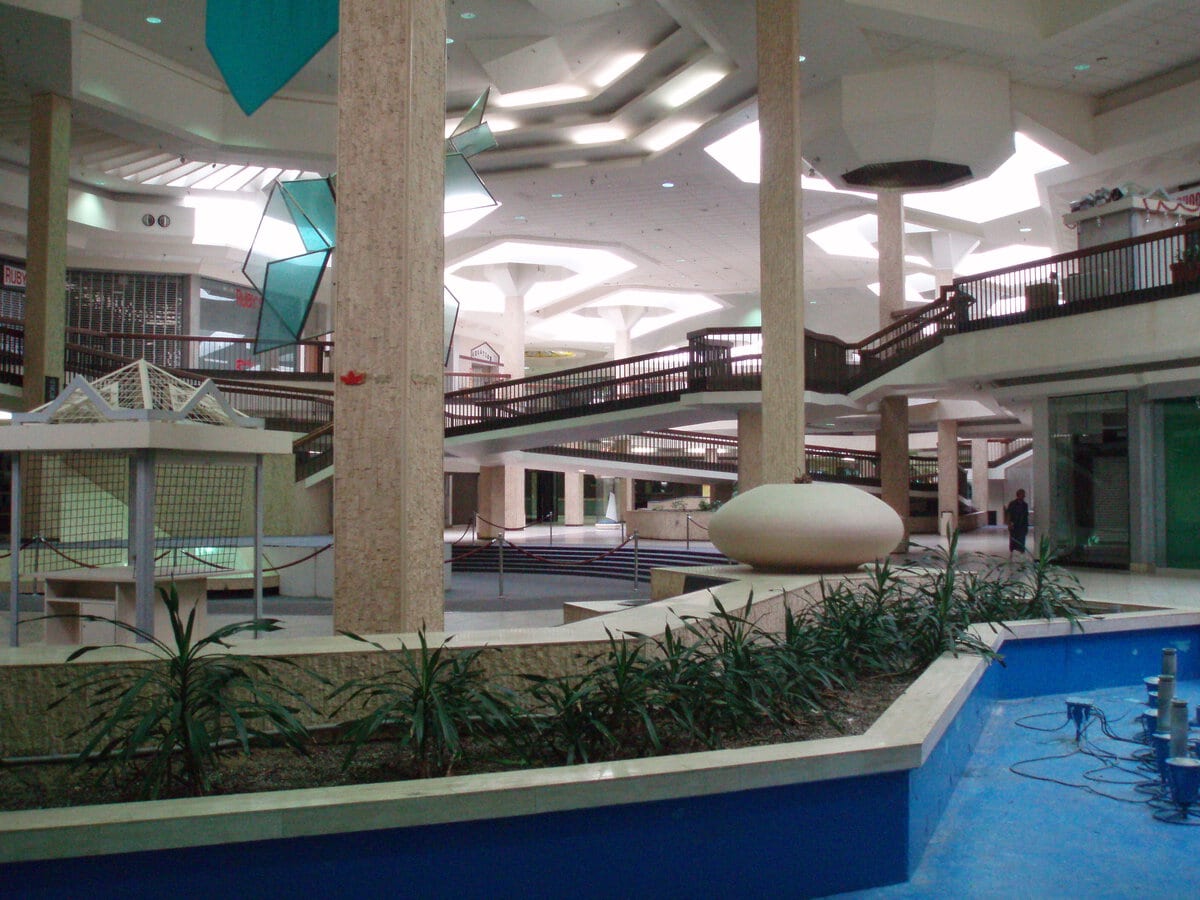
Design work with RTKL had to solve a layout that frustrated visitors at every turn. The old retail arcade was dark.
Platforms were reached through multiple concourses that broke the space into awkward pieces.
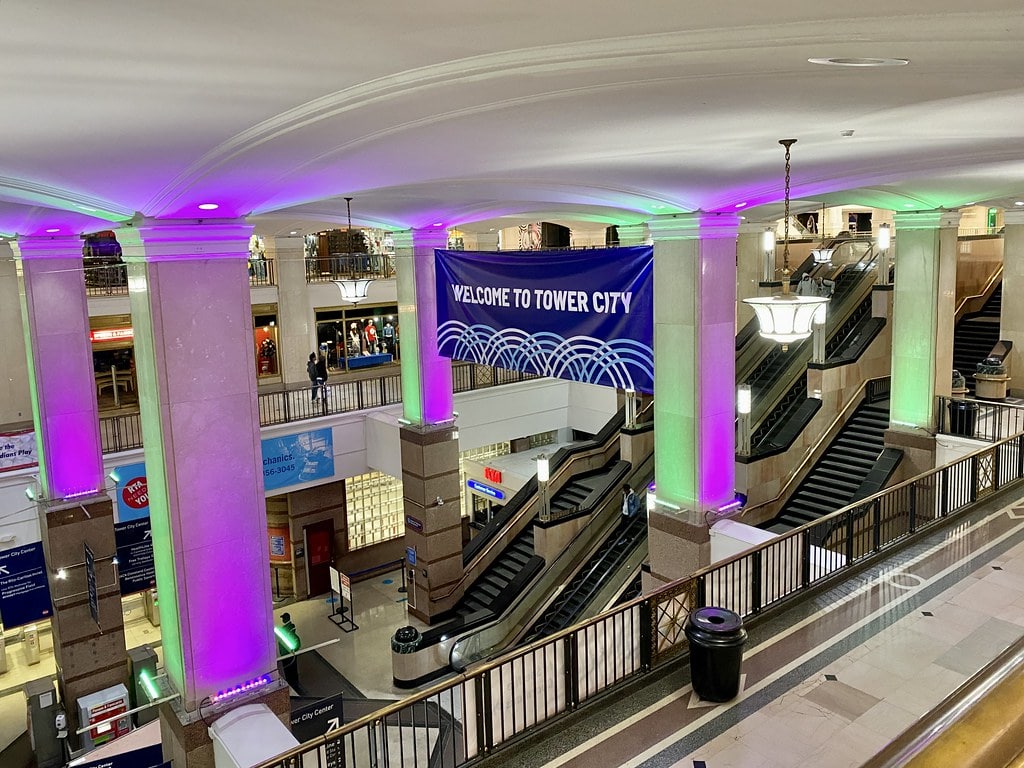
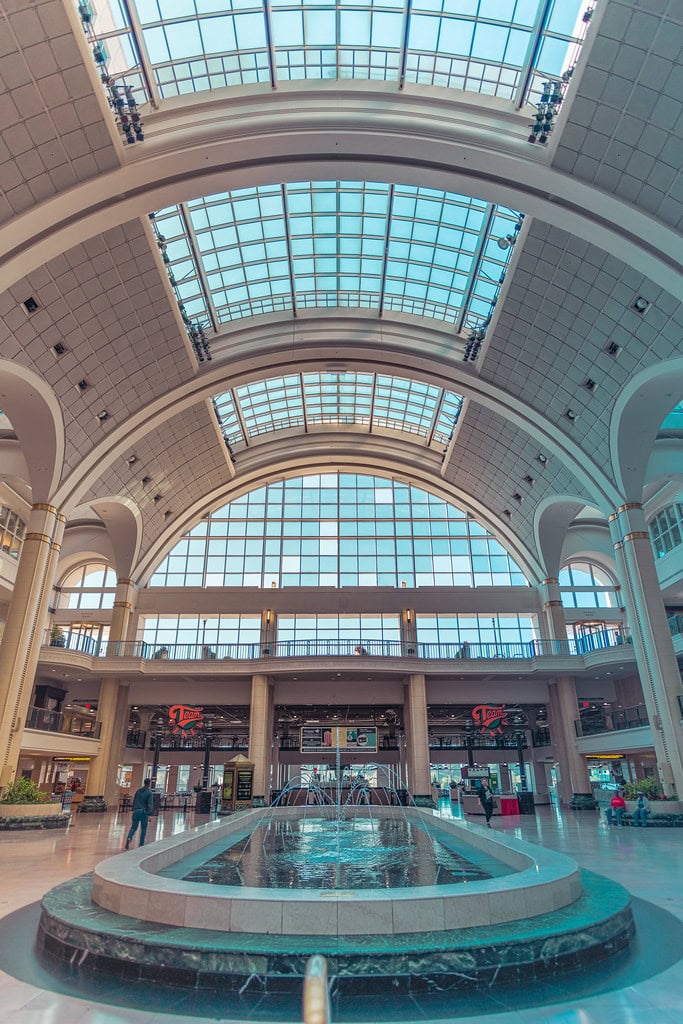
RTKL's answer was three big rooms that could behave like public space: Tower Court, Station Court, and a larger second concourse later known as the Skylight Concourse, capped by an arched glass skylight facing the river.
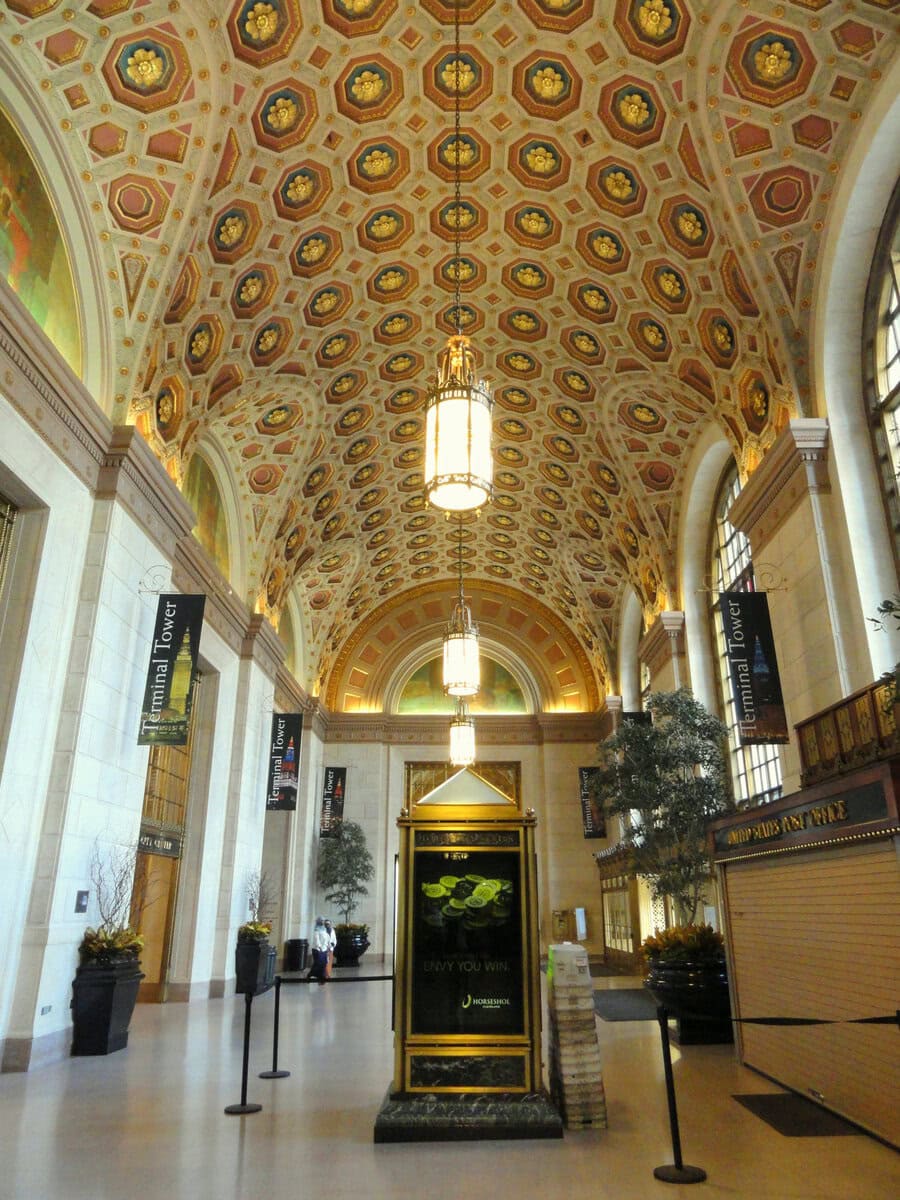
Fountains, art, and sculpture were used as anchors. Historic elements were treated as usable assets: murals were cleaned and regilded, fixtures restored and rehung, medallions reused in new railings, and columns from the old waiting room kept in place.
Construction started in July 1988, leasing began in mid-1989, and the retail opening arrived on March 26, 1990.
A brief moment of downtown optimism
When the retail component opened on March 29, 1990, the response was immediate and blunt in its scale. The first weekend drew more than two million people, and stores reported record opening-day sales.
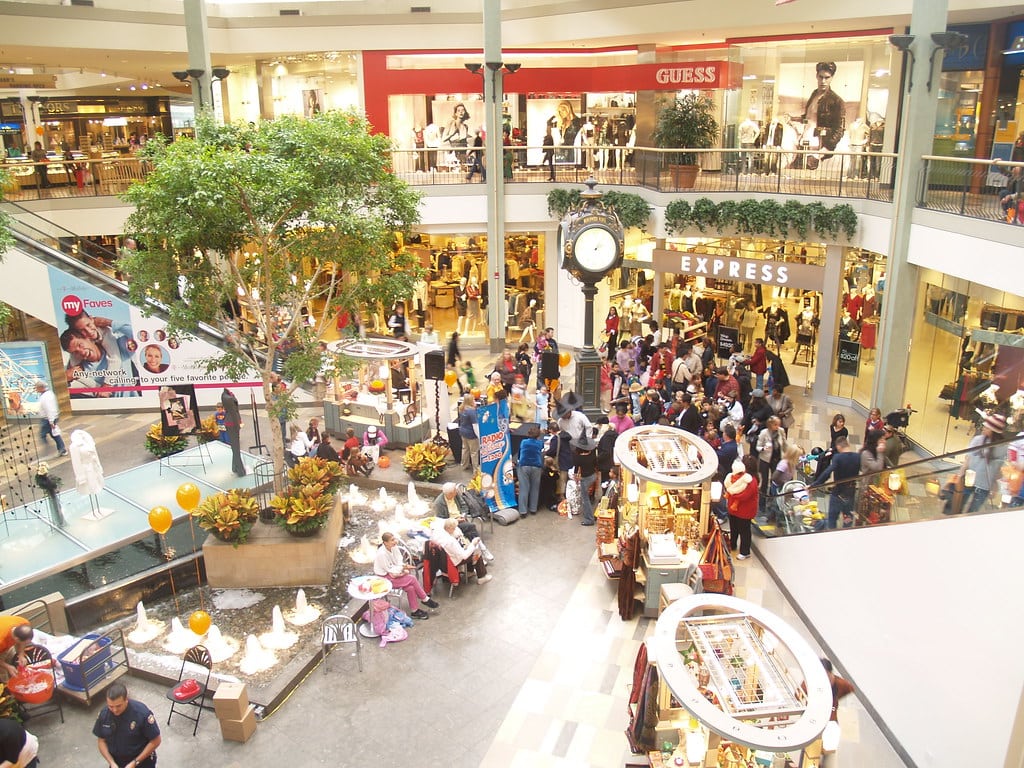
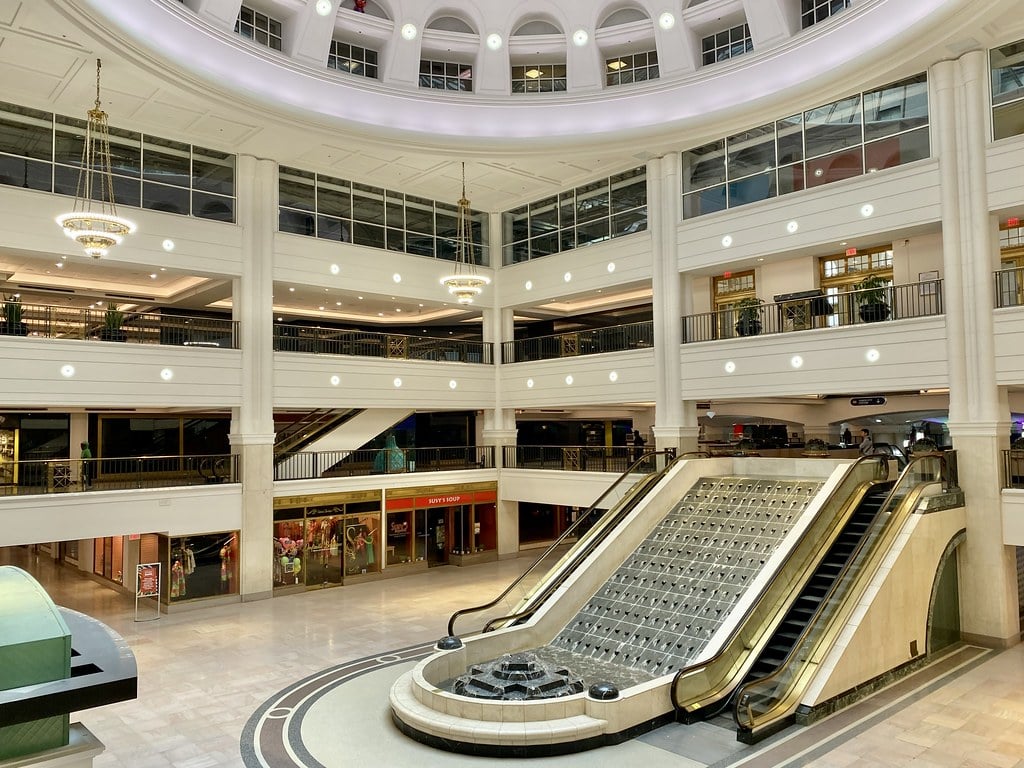
The project's retail core, called The Avenue, was built at about 360,000 square feet across three levels, with 111 tenants.
The mix was broad and specific: fast food, restaurants, clothing and accessories, general merchandise, shoes, specialty shops, plus an 11-screen cinema.
Forest City tried to pull in mid- and upmarket national retailers and treated the mall as a downtown statement rather than a neighborhood convenience.
Transit numbers briefly matched the energy.
Rail ridership rose about 30 percent after the opening, averaging roughly 30,000 passengers per day, with buses bringing about 90,000 more, pushing daily arrivals above 120,000.
Leasing was strong early: about 85 percent of the space was leased in the first year. Rents stayed close to projections, and reported average sales ran around $300 per square foot, unusually strong for downtown retail.
The redevelopment's total cost reached $387,688,000, including acquisition, bridge repairs, construction, design, leasing, tenant buyouts, fees, and significant tenant allowances.
For a few years, Tower City looked like it had found a modern purpose without pretending the old one would return.
Casino, apartments, and unresolved identity
The post-1990 years added connections and removed certainties.
After the Gateway sports district opened in 1994, an indoor walkway linked Tower City to the new venues, and a second walkway connected to the Carl B. Stokes U.S. Courthouse in 2002.
An outdoor amphitheater opened along the river in 2001, expanding the site's role beyond shopping and commuting.
But the retail model relied on anchors that did not last. The Higbee's department store, by then operating under Dillard's ownership, closed in January 2002.
Later, office users moved into that building, including the local visitors bureau and the chamber of commerce, which was a practical reuse and also a quiet signal that retail gravity was weakening.
A major shift in use occurred in the 2010s when part of the complex was adapted for gaming.
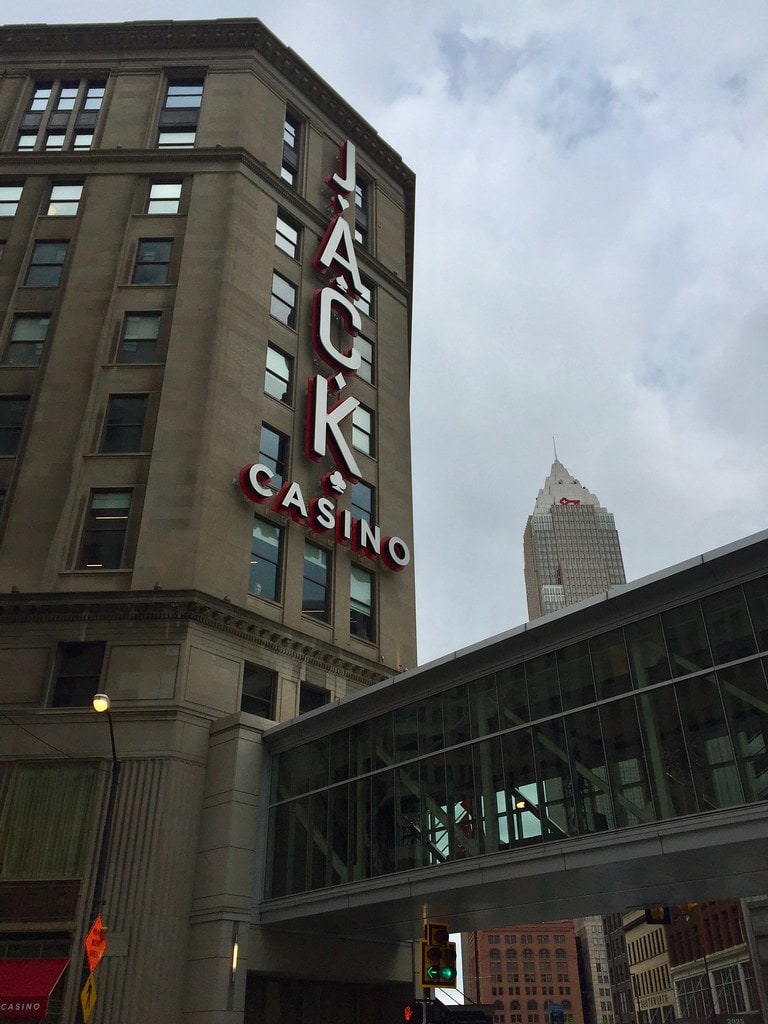
In May 2012, the former department store space within Tower City Center opened as Horseshoe Casino Cleveland, introducing a new, non-retail activity into a property originally built around rail traffic and later retail circulation.
The casino occupied several interior levels and operated independently from the rest of the mall, drawing visitors who often had little reason to move through the surrounding concourses.
In 2016, after a change in management, the facility was rebranded as JACK Cleveland Casino. While the casino generated steady activity and tax revenue, it also reinforced Tower City Center's fragmented identity.
The most decisive change came inside Terminal Tower itself. On September 15, 2016, K&D Group bought the tower for $38.5 million and pursued a mixed-use conversion aimed at bringing residents downtown.
Floors 4 through 14 became roughly 300 apartments, mostly one- and two-bedroom units, generally described as 600 to 1,800 square feet.
The 15th floor was set up as an amenity level with fitness space, offices, and a restaurant with a rooftop deck. Construction began in 2018 and finished in 2020, with occupancy reaching near full.
The conversion leaned on historic tax credits, and it benefited from earlier exterior work completed around 2010, including limestone restoration and upgraded windows and lighting.
A future still being argued over
In the 2020s, the focus shifted from just one building to a long stretch from Public Square to the river.
Bedrock bought The Avenue part in 2016 and started making plans to use Tower City Center as both a building to update and an entrance to a bigger area they want to improve.
Some of the work has been basic but necessary. In June 2021, a water line break caused major damage in the Tower Court area, leading to about $5 million in repairs during winter 2021-2022.
In 2022, permit filings outlined $1.5 million in renovations across parts of the 366,000-square-foot retail space, covering electrical systems, transformers, piping, heating systems, security and fire systems, and tenant space improvements.
The same year, the main atrium was renamed Skylight Park, built with the Cuyahoga Valley National Park and its conservancy, using seasonal greenery and native Ohio plantings.
Bedrock also brought in Sir David Adjaye in 2022 to lead master planning for Tower City Center and the riverfront.
By 2024, Bedrock described a streetscape initiative with LAND Studio to improve walkability between major downtown destinations.
The bigger plan, described as roughly $3.5 billion, calls for more than 2,000 residential units, 1.4 million square feet of commercial space, and new public spaces over multiple decades.
As of 2025, the mall has struggled with tenants and regular foot traffic, and Bedrock has publicly described the search for the best use of the structure as ongoing.
Tower City Center was built to make Cleveland arrive. Today, it waits.