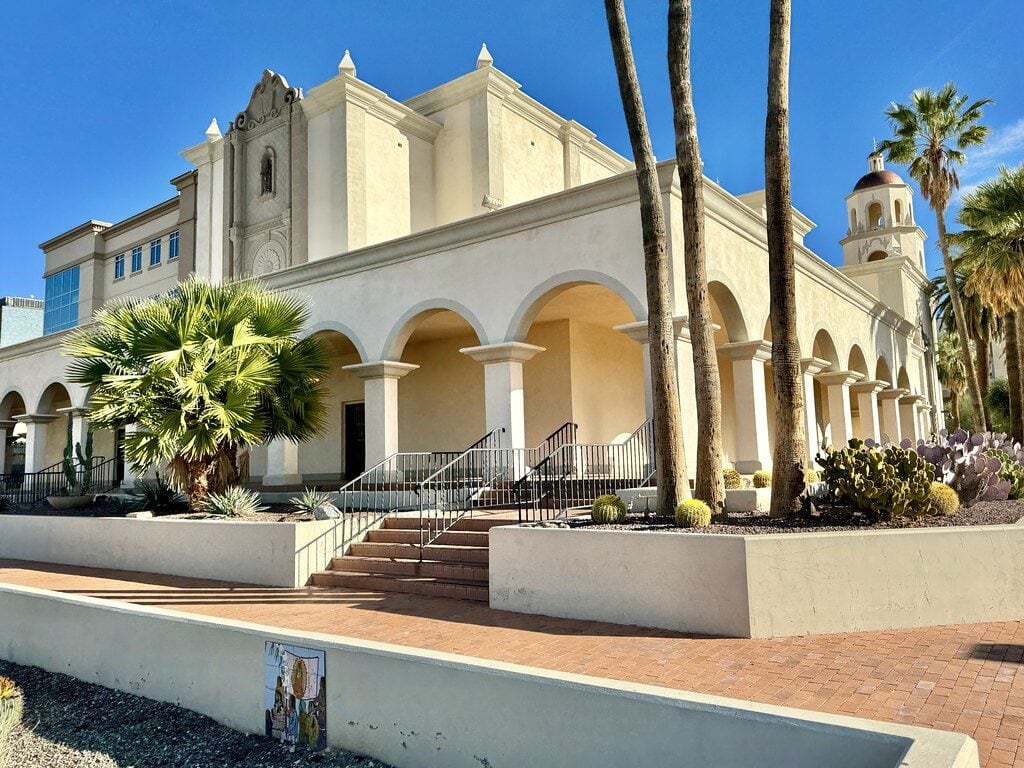
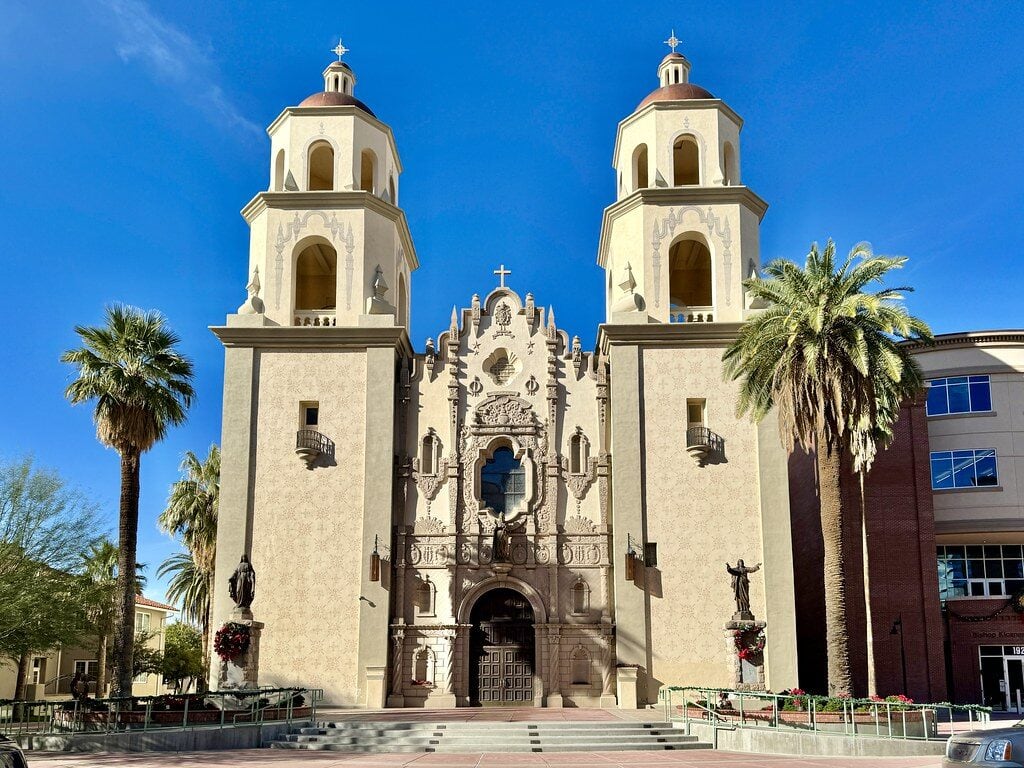
Seen from Stone Avenue, the church appears fixed in place. The white stucco facade, twin towers, and bronze statue of St. Augustine above the doors give it a sense of permanence.
That impression is misleading. The building behind that facade has gone through repeated cycles of demolition and reconstruction, so it does not belong to a single era.
The story reaches back to Tucson's Catholic community of the 1860s and, more broadly, to a Spanish garrison chapel founded in 1776. An adobe church was built in 1868.
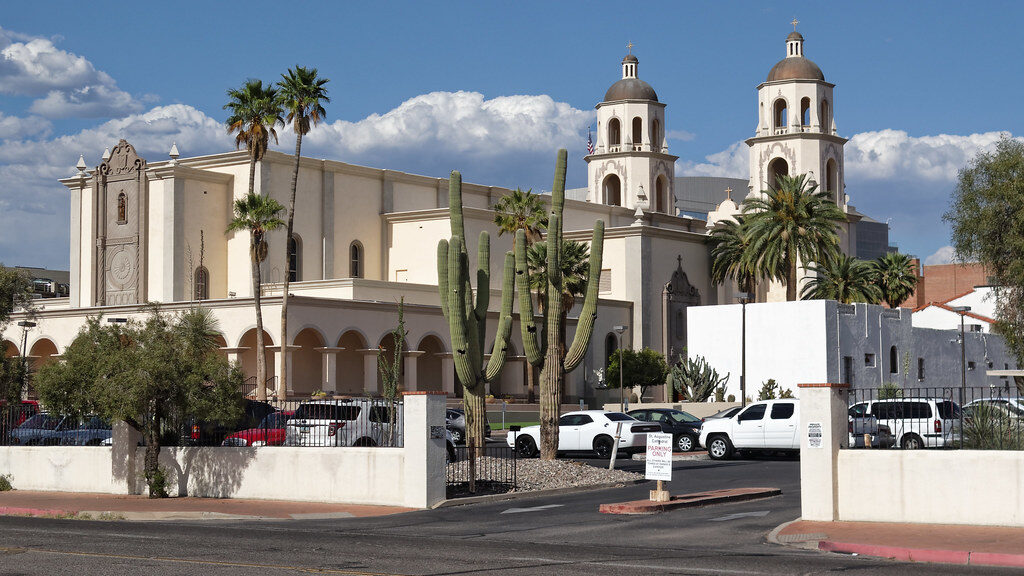
The brick cathedral on the present site was completed in 1897. Later changes continued. The towers, built in the Spanish Colonial Revival style, were added in 1928, decades after the brick church behind them.
In 1967, the nave was removed and rebuilt. Each stage marks a point when the earlier version no longer met the needs of the Diocese of Tucson.
The site is 192 South Stone Avenue in downtown Tucson. Before redevelopment projects in the 1960s and 1970s cleared the area, the cathedral stood within the city's Mexican barrio.
It now stands within a historic cathedral complex that includes the rectory and chancery, Marist College, Our Lady's Chapel, and Cathedral Parish Hall; nearby, the Marist College Historic District is listed on the National Register of Historic Places.
Taken together, these buildings trace more than a century of Catholic life in southern Arizona, with the cathedral at the center of that activity.
From the Presidio Chapel to St. Augustine Parish
The St. Augustine Cathedral's history reaches back to 1776, when a chapel was built by the Royal Presidio of San Agustin del Tucson on the Santa Cruz River.
The presidio was a Spanish military garrison, a fortified base that supported control of New Spain's northern frontier.
By the late 1850s, the chapel had long fallen into disuse, and the garrison had ceased to function. What remained in Tucson was a small adobe settlement without an active Catholic church.
In January 1866, Bishop John B. Lamy sent four representatives from Santa Fe to Tucson: Fathers John B. Salpointe, Francis Boucard, Patrick Birmingham, and a seminarian named Mr. Vincent.
Salpointe and Boucard established the parish of Saint Augustine, with San Xavier del Bac as its largest mission. Mr. Vincent started a school at San Xavier and later relocated it to Tucson.
Although the Gadsden Purchase placed the region under United States control in 1854, the formal creation of the parish still took more than ten years.
As a result, the parish was formally created twelve years after the political change.
Catholic history in the area extends back nearly a century before this, but continuous institutional records in Tucson begin in the early 1860s rather than January 1866.
Adobe Bricks and Arizona's First Bishop
Around 1862 or 1863, Father Donato Rogieri came to Tucson and found no church in place. This was before the parish had been formally established.
Local tradition holds that parishioners gathered adobe bricks from the Solano Leon property and carried them to the site one at a time.
Salpointe took over as pastor in 1866 and pushed the project forward. The adobe church was completed in 1868.
That same year, the Holy See created the Apostolic Vicariate of Arizona and appointed Salpointe as vicar apostolic, making him Arizona's first Catholic bishop.
His authority covered a wide region, from Utah down to the Mexican border and from Yuma across to El Paso County in Texas.
The territory was about the size of Western Europe. It needed a center, and Saint Augustine in Tucson became that center. Later rebuildings of the church reflected the needs of the diocese.

Bishop Bourgade and the 1897 Cathedral
In 1885, Bishop Peter Bourgade bought the Cathedral Block property on Stone Avenue. He decided the adobe church built in 1868 was no longer adequate for a growing city.
In 1896, he ordered a new church in the Romanesque Revival style, designed by architect Quintus Monier.
Construction finished in 1897. In May of that year, Pope Leo XIII raised the Vicariate of Arizona to the Diocese of Tucson, so the new building became a cathedral almost as soon as it was completed.
The 1897 building featured fired-brick towers on either side of the entrance, but they were never built to their full planned height.
The tops remained flat above the second row of arches and stayed that way for about thirty years. Even so, the structure itself was strong.
It served the growing diocese and firmly established Saint Augustine on the site Bourgade had purchased.
When Daniel J. Gercke became bishop in the 1920s, he oversaw a redesign of the cathedral's unfinished towers.
The 1928 Redesign That Defined the Building's Face
Bishop Gercke commissioned the 1928 redesign. D. B. DuBois of the H. O. Jaastad architectural firm drew the plans, and John P. Steffis carried out the construction.
New concrete foundations had to be poured at the tops of the old tower bases before the weight of the new superstructure could safely go up.
The towers were modeled on mission architecture associated with Padre Kino's churches in northern Mexico and Arizona, with four-arch open stories, ornamental buttresses, an octagonal transition above the square lower section, and a balustraded tier for the bells.
A Los Angeles sculptor named Watkins carved the bas-relief castings.
The finished surface was white stucco and gray ornamental cast stone, decorated with saguaro, yucca, and horned lizard, along with heraldic devices tied to the church's authority in Arizona.
A life-size bronze statue of St. Augustine went above the main doors. The rose window was copied from Mission San Jose in San Antonio.
The official parish history calls the result a Mexican baroque appearance inspired by Queretaro Cathedral.
The preservation record calls it Spanish Colonial Revival with strong Sonoran references.
A Campus Built Over Decades Around the Cathedral
Between 1885 and 1967, Cathedral Block grew into a complex of five contributing religious and educational buildings: St. Augustine Cathedral, the rectory and chancery, Marist College, Our Lady's Chapel, and Cathedral Parish Hall, plus a site wall and two sculptures.
The rectory contains interior walls that predate the church's 1885 purchase of the block by about twenty-five years.
Bishop Gercke reworked it in 1931, adding a second story, plastering the exterior, and eventually adding a chancery wing behind it.
The Marist College building was commissioned by Bishop Henri Granjon in 1915 and built by Manuel Flores in adobe.
Granjon had invited Marist Brothers to Tucson after anti-clerical persecution forced them from Mexico, and the school they ran opened to students of both sexes and all races in 1924, while Arizona public schools were still legally segregated.
In 1916, one year after Marist College opened, Our Lady's Chapel and Cathedral Parish Hall were built for the parish and school's expanding population.
Pima County now identifies the rehabilitated Marist College building as the only surviving three-story adobe structure in Arizona.
Tearing Out the Nave and Starting Over
By the 1960s, the nave constructed in 1897 under Bishop Bourgade showed structural deterioration and no longer fit the needs of the parish.
Bishop Francis Green decided to replace it instead of restoring it.
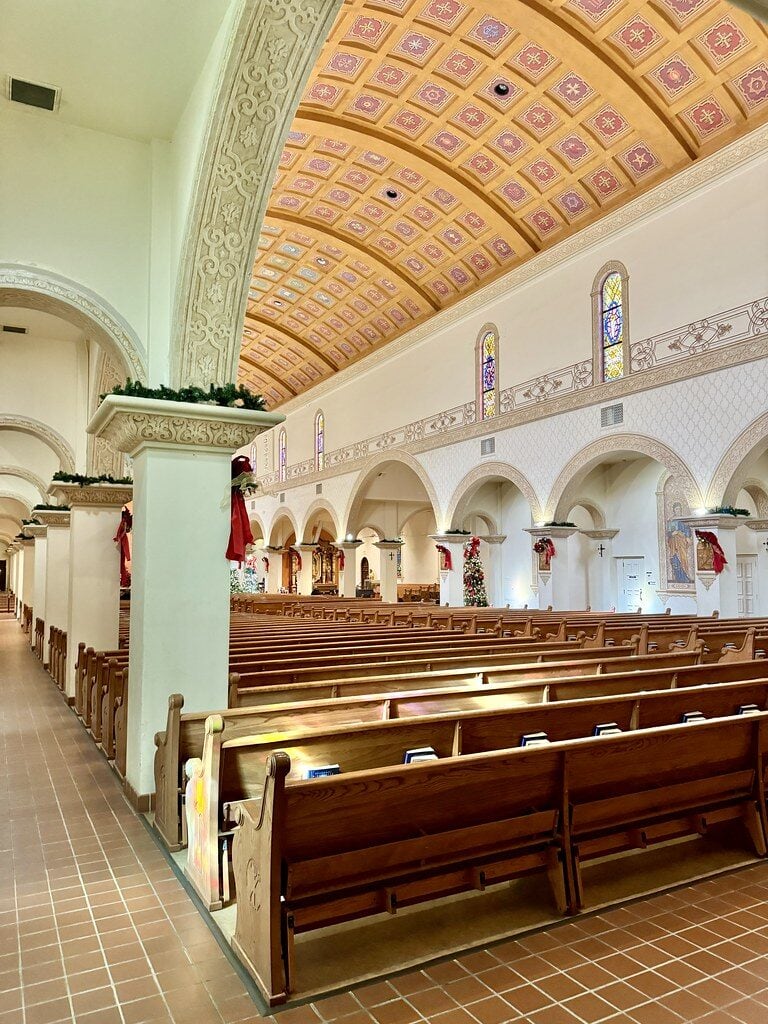
In 1967, the original nave was demolished, and architect Terry Atkinson designed a new one in what preservation records describe as a modernesque interpretation of Spanish Colonial Revival.
The design included white stucco walls referencing San Xavier del Bac and gray cast stone along the top to match the 1928 facade.
Work began in 1966 and was completed in 1968, the 100th anniversary of Salpointe's adobe church.
The project replaced the rear nave but kept the 1928 facade and towers. Inside, the floor has a slight slope, so the altar remains visible from the back.
The cathedral seats about 1,250 people. A crucifix carved in Pamplona, Spain, sometime in the twelfth or thirteenth century hangs behind the altar. It is 17 feet tall and weighs about 2,000 pounds.
Near the north wall, one of the original bells from the Presidio San Agustin del Tucson is displayed, connecting the present cathedral to the eighteenth-century garrison where its history began.
A Million-Dollar Restoration, Rededicated in 2011
By December 2010, the diocese had set February 12, 2011, as the rededication date.
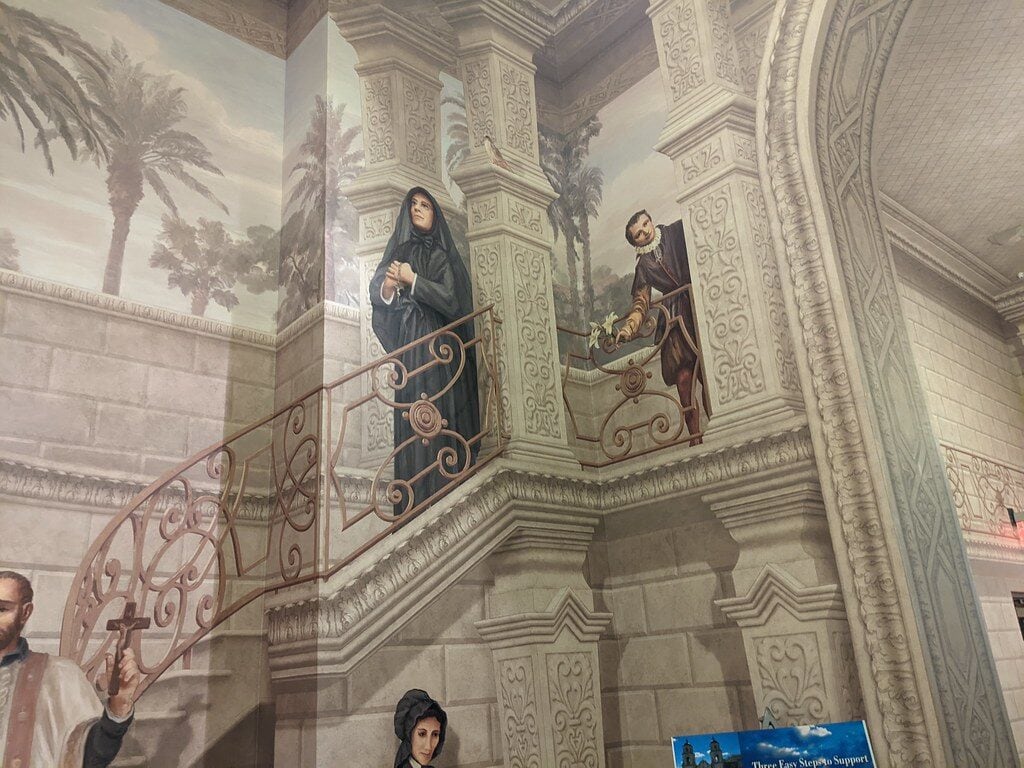
Weekday and weekend Masses moved into Cathedral Hall while electricians, painters, pew installers, sound and light technicians, retablo installers, and artist John Alan finished the work inside.
Under Alan's direction, the cathedral received trompe l'oeil painting, refreshed stained glass, new retablos for the Blessed Sacrament Chapel and the Our Lady of Guadalupe Shrine, upgraded lighting and sound, redesigned pews based on the 1897 originals, reworked tile flooring, exterior repainting, and conservation of century-old statues of the Immaculate Conception and the Sacred Heart of Jesus.
The lower stained-glass cycle tells the history of St. Augustine. The upper level honors the apostles and the first bishops of Tucson.
The diocese spent over $1 million on the work, with additional funding gathered through a campaign called Treasures of the Heart.
The rededication took place on February 12, 2011, with Bishop Gerald Kicanas presiding.
The Cathedral Still at Work After 2011
A 55,000-square-foot building on Cathedral Square, on the site of a former parish hall, opened for occupancy on April 1, 2019.
The diocese named it the Bishop Kicanas Pastoral Center at a 2022 ceremony. The Marist College building was rehabilitated in 2018.
On August 20, 2025, the cathedral hosted an interfaith service marking Tucson's 250th birthday, drawing faith leaders from Jewish, Muslim, Sikh, Buddhist, Mormon, Tohono O'odham, Lutheran, Presbyterian, Episcopal, United Church of Christ, Ukrainian Catholic, and Roman Catholic communities.
In December 2025, after Pope Leo XIV appointed James Misko as the next bishop of Tucson, Misko celebrated a noon Mass at the cathedral the same day he met the diocese's clergy and laity.
On February 20, 2026, he was ordained and installed at St. Augustine as the eighth bishop of Tucson - the first episcopal ordination the diocese had held in 73 years - and nearly 1,500 people filled the building.
In January 2026, the Italian craftsmen were packing all 1,644 organ pipes for shipment to Padova.