
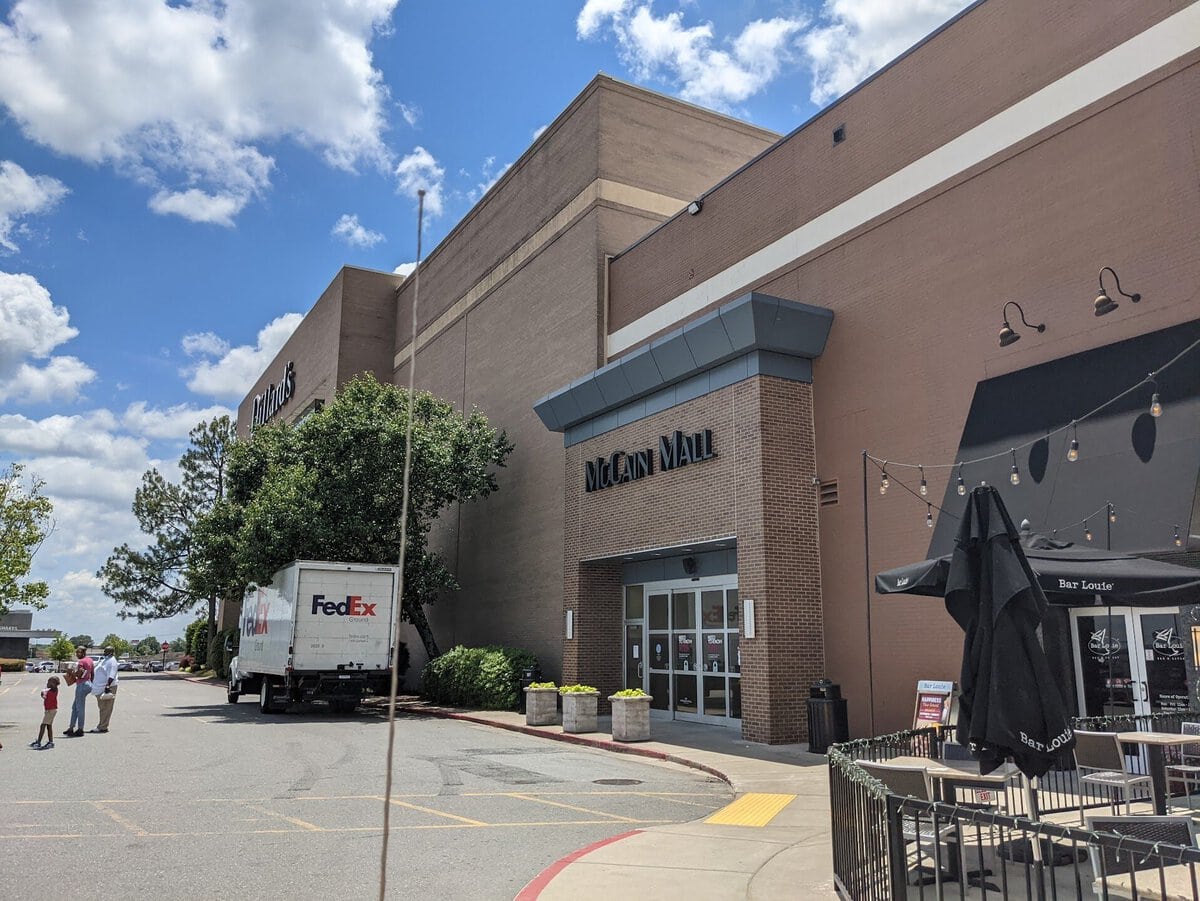
McCain Mall has outlasted nearly every reason people first went there. The department stores that gave it its original shape have been renamed, converted, or closed.
The two-screen theater from 1973 is long gone. The cafeteria, the ice cream parlor, the music stores, and the five-and-dime that filled the original concourse have all disappeared from the national retail map.
The mall's full opening came in April 1973, though its first anchor opened in September 1972. It launched with four department-store anchors and 96 tenants. It was the largest enclosed shopping center in Arkansas.
Today, one of the most visible new anchors in the building is a 12-screen multiplex built inside a former department store's footprint. A restaurant corridor runs along what used to be parking. What kept the place going is a story of constant adaptation, not continuity.
McCain Mall: The Anchor That Opened Before the Rest
Pfeifer-Blass opened on September 14, 1972, and it was bigger than anything on the north side of the river.
Two levels, about 225,000 square feet, and a department-store name that carried Little Rock retail history going back decades.
The rest of the mall was still months from completion. The store opened anyway.
The full mall was dedicated in April 1973 with 96 stores, restaurants, and services.
JCPenney had been dedicated on March 14, occupying about 148,300 square feet across two levels. Sears and M.M. Cohn filled out the anchor corners.
General Cinema Corporation opened the McCain Mall Cinema I & II on August 1, 1973, a two-screen theater built into the concourse.
On the day it opened, McCain Mall was the largest shopping center in Arkansas. That distinction held for thirteen years.
How North Little Rock Was Ready for McCain Mall
North Little Rock's population was 21,137 in 1940. By 1950, it had more than doubled to 44,097.
Camp Joseph T. Robinson and Little Rock Air Force Base pushed residential and commercial growth north and northeast of the river, and McCain Boulevard became one of the principal corridors of that expansion.
Melvin Simon & Associates, an Indianapolis-based mall developer, built the center on more than 56 acres near the junction of McCain Boulevard, Warden Road, U.S. 67/167, and Interstate 40.
That location gave the mall highway access from Sherwood, Jacksonville, Cabot, Maumelle, Conway, and Little Rock. The company later became Simon Property Group.
Central Arkansas already had Park Plaza in Little Rock, which started as an open-air center in 1960, and University Mall, which opened in 1967.
McCain Mall was the third major shopping complex in the metro market and the first large enclosed regional mall north of the river.
The boulevard bore the name of Edward A. McCain, a civic and business figure connected to the Park-Hill-Sylvan Water Company, who died in 1967.
Across McCain Boulevard, The Other Center at 4000 McCain Boulevard developed around the same period, establishing the stretch as a major shopping corridor before the surrounding commercial uses filled in.
Franke's, Farrell's, and the Full 96-Store Opening
Franke's Cafeteria, Farrell's Ice Cream Parlour, Mr. Dunderbak's Bavarian Pantry, and J.G. McCrory 5 & 10 were among the tenants in the April 1973 opening.
Their presence alongside four department stores, multiple shoe chains, a music store, and a pharmacy made the point: this was a full regional shopping destination, not a fashion center.
JCPenney and Sears were the national middle-market anchors; Sears occupied about 110,000 square feet on two levels.
Pfeifer-Blass and M.M. Cohn were Little Rock department-store names. This mix gave the mall both local identity and national retail strength.
The rest of the concourse ran the full range of 1970s mall retail: Musicland, Foxmoor Casuals, Chess King, Orange Julius, Osco Drug, Baker's Shoes, Thom McAn Shoes, Moses Music, J. Riggings, and Tiffany's Bakery.
Restaurant and service outparcels (pad sites built on the outer edges of mall property) would come later, as the surrounding commercial strip filled in.
Pfeifer-Blass Becomes Dillard's, and the Anchor Lineup Holds
The Pfeifer-Blass name lasted less than two years. In 1974, the store was rebranded as Dillard's.
The change came from the ownership lineage William T. Dillard had built through acquisitions of Little Rock department stores in the 1960s; the McCain Mall location had always been part of that line.
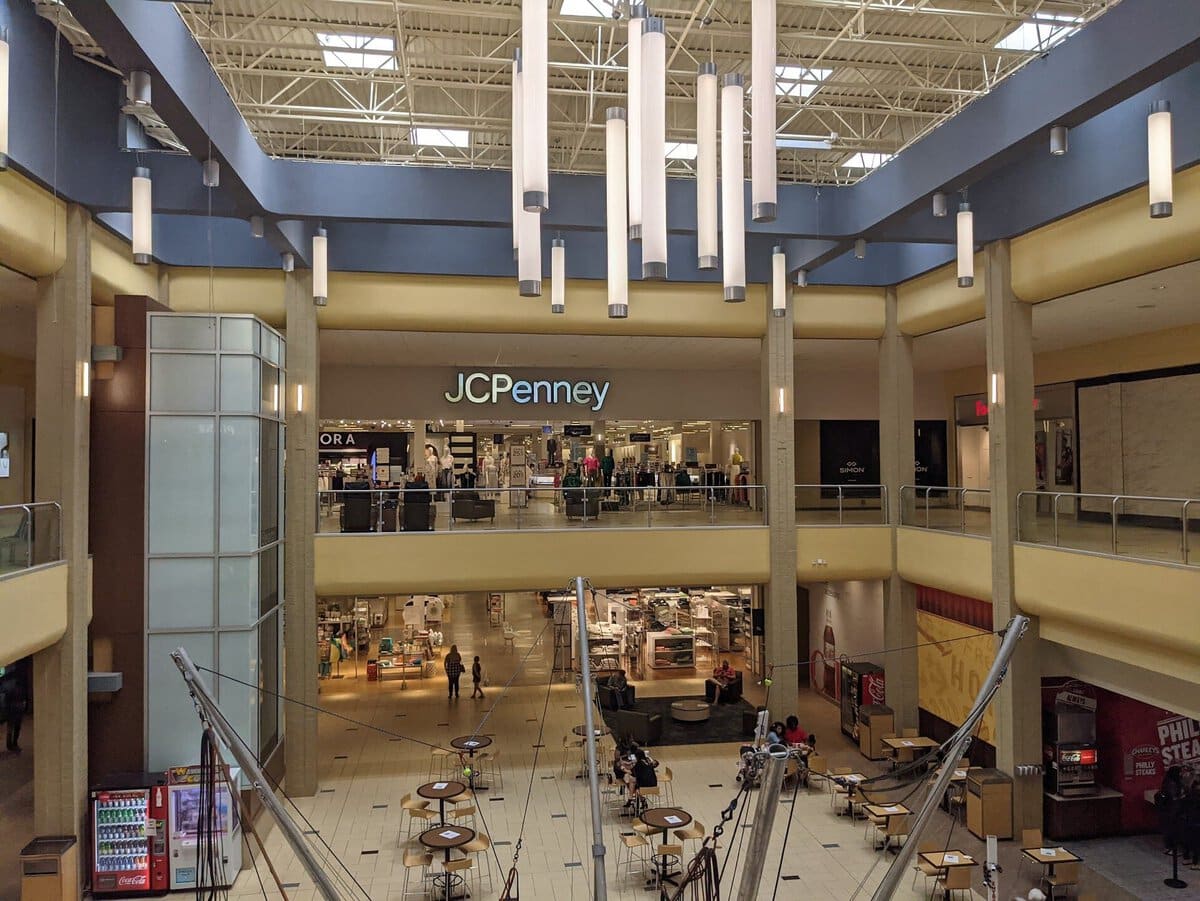
Dillard's has remained one of the mall's principal anchors ever since. JCPenney stayed as well. Sears stayed for more than 46 years. Those three original anchors held together until 2020
In 1986, Central Mall in Fort Smith surpassed McCain Mall as the largest shopping center in Arkansas after an expansion there.
McCain kept the distinction of being the largest enclosed mall in the Little Rock metropolitan area, a title it still holds.
By 2014, the property was listed at 93.4 percent occupancy and 788,200 square feet of gross leasable area.
A $3 Million Update Brings the 1970s Interior Forward
About $3 million went into the mall's first major renovation.
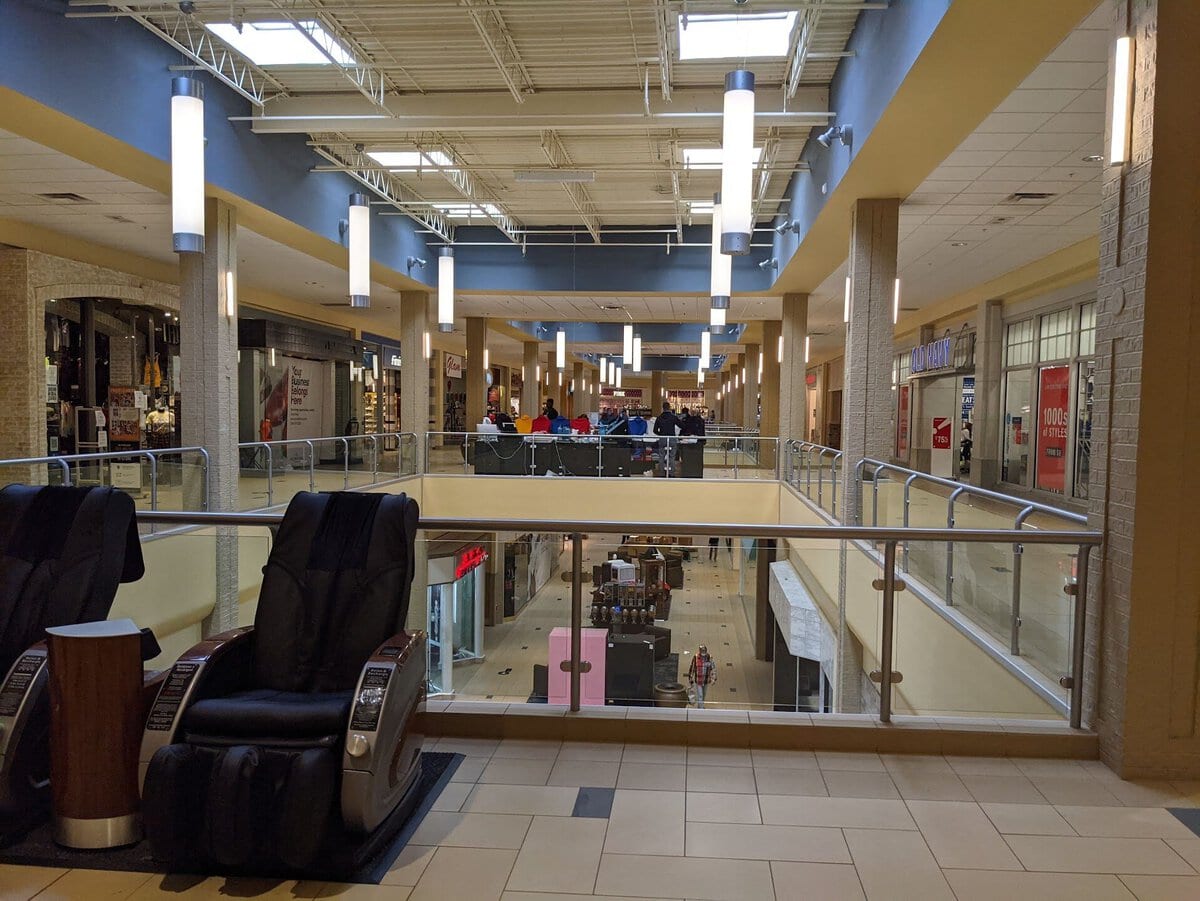
New flooring, lighting, interior landscaping, banisters, handrails, and seating areas were part of the project. Mall entrances were rebuilt, and the exterior was repainted.
JCPenney was enlarged to about 170,000 square feet during the same period. The mall was rededicated on November 20, 1992.
The renovation did not expand the building or add anchor positions. It refreshed finishes, entrances, and interior amenities inside the original 1970s envelope.
By 1992, newer and updated shopping centers had appeared across the region, and the refreshed interior was meant to keep McCain visually competitive without changing what it fundamentally was.
The M.M. Cohn Era Ends, the Movie Theater Era Begins
M.M. Cohn closed on September 16, 2007. It had been one of the four original anchors since the mall's 1973 opening, occupying about 40,200 square feet on one level.
The space stayed vacant for more than four years.
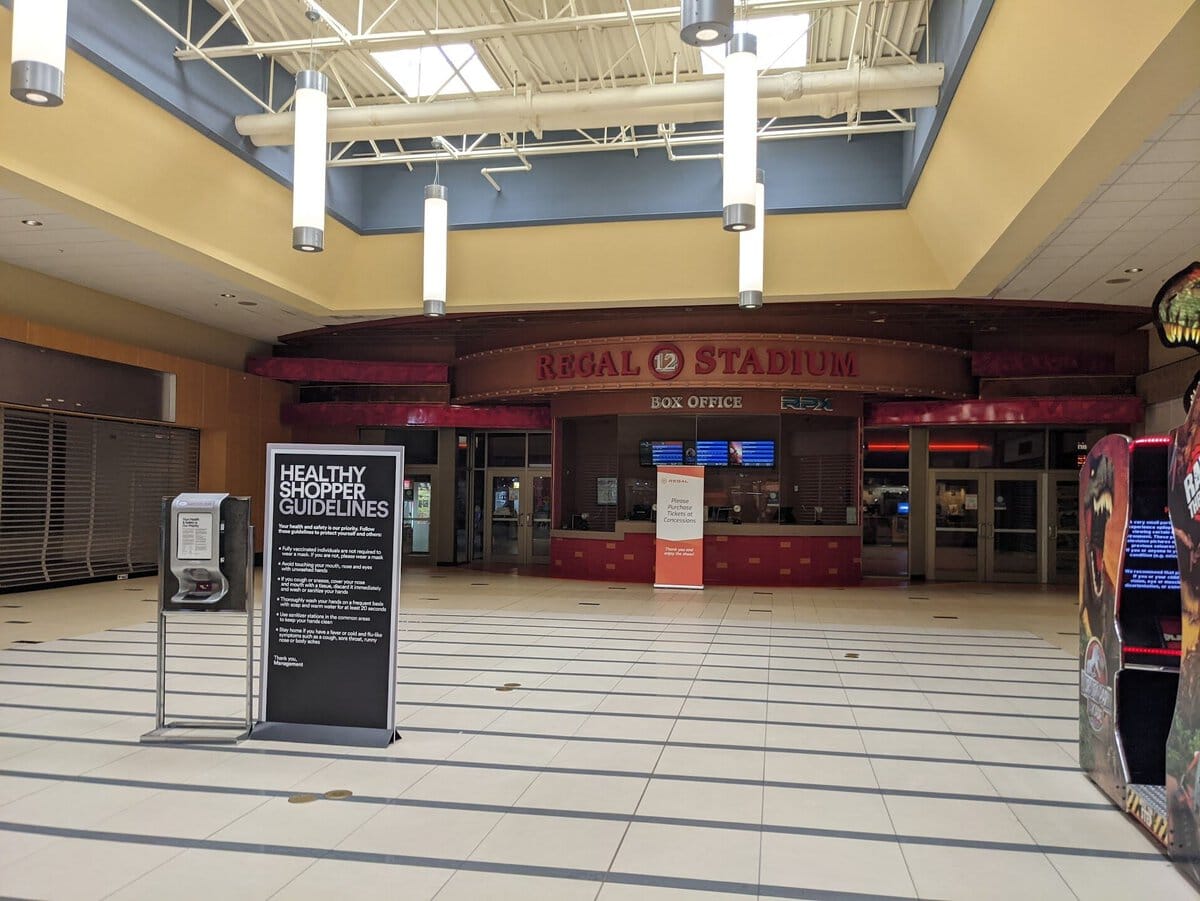
In April 2011, a $5.5 million renovation was announced. The central project was converting the former M.M. Cohn area into a 12-screen multiplex.
The work also added new flooring, lighting, a family restroom, redesigned entrances, signage, a new escalator, and the mall's first elevator.
The first stage was inaugurated on January 9, 2012, with new escalators, a Center Court elevator, and remodeled main entrances.
Regal McCain Mall 12 & RPX was dedicated on September 17, 2012.
The original two-screen General Cinema theater from 1973 had been a small attachment to the mall's retail function.
The Regal multiplex was a different kind of anchor entirely, pulling evening and weekend visits on its own terms.
Converting a closed department-store box into an entertainment anchor was an adaptation to a retail landscape where department stores were weakening, and entertainment was not.
Sears Closes After 46 Years, Leaving a Gap
The Sears store closed on February 2, 2020. It had been one of the original anchors, open since 1972.
The company had been under severe financial pressure nationally for years, and its real estate had been restructured through Seritage Growth Properties and related arrangements.
The former Sears Auto Center, a smaller property of about 21,000 square feet on the edge of the site, had been converted into a LongHorn Steakhouse location through Seritage around 2018, before the main store closed.
The department-store building itself, roughly 159,000 square feet on 13.4 acres, became the mall's largest vacant space.
In 2024, Anchor Realty Investments LLC purchased the former Sears store and its land for $2.3 million, with planning underway for a new use.
As of 2026, no completed mixed-use redevelopment had been confirmed, though the former Sears space had a confirmed retail use as Deep Discount Furniture & Mattress.
The Parking Fields, the Restaurants, and the 2020s
By 2018, the outer parking fields were doing more work than they had in years. Tacos 4 Life was under construction at 4211 Warden Road on land leased from Dillard's, at about 4,000 square feet.
Purple Cow built a 5,000-square-foot location next door on the same leased ground.
Both operators owned their buildings on leased land. BJ's Restaurant & Brewhouse, Chipotle, IHOP, and Waldo's Chicken & Beer joined the broader commercial strip along Warden Road.
In early 2026, JTJ Restaurants announced plans for a Taziki's Mediterranean Café in a freestanding building with a drive-through at the mall, targeted for the end of 2026.
Early regional malls were built with parking fields sized for peak holiday demand. By the 2010s, that pavement was excess on ordinary days.
Converting portions of it into restaurant and service outparcels turned unused land into revenue and additional traffic.
What McCain Mall Is Now, and What It Isn't Yet
McCain Mall remains open. Its major anchors in 2026 are Dillard's, JCPenney, and Regal Cinema.
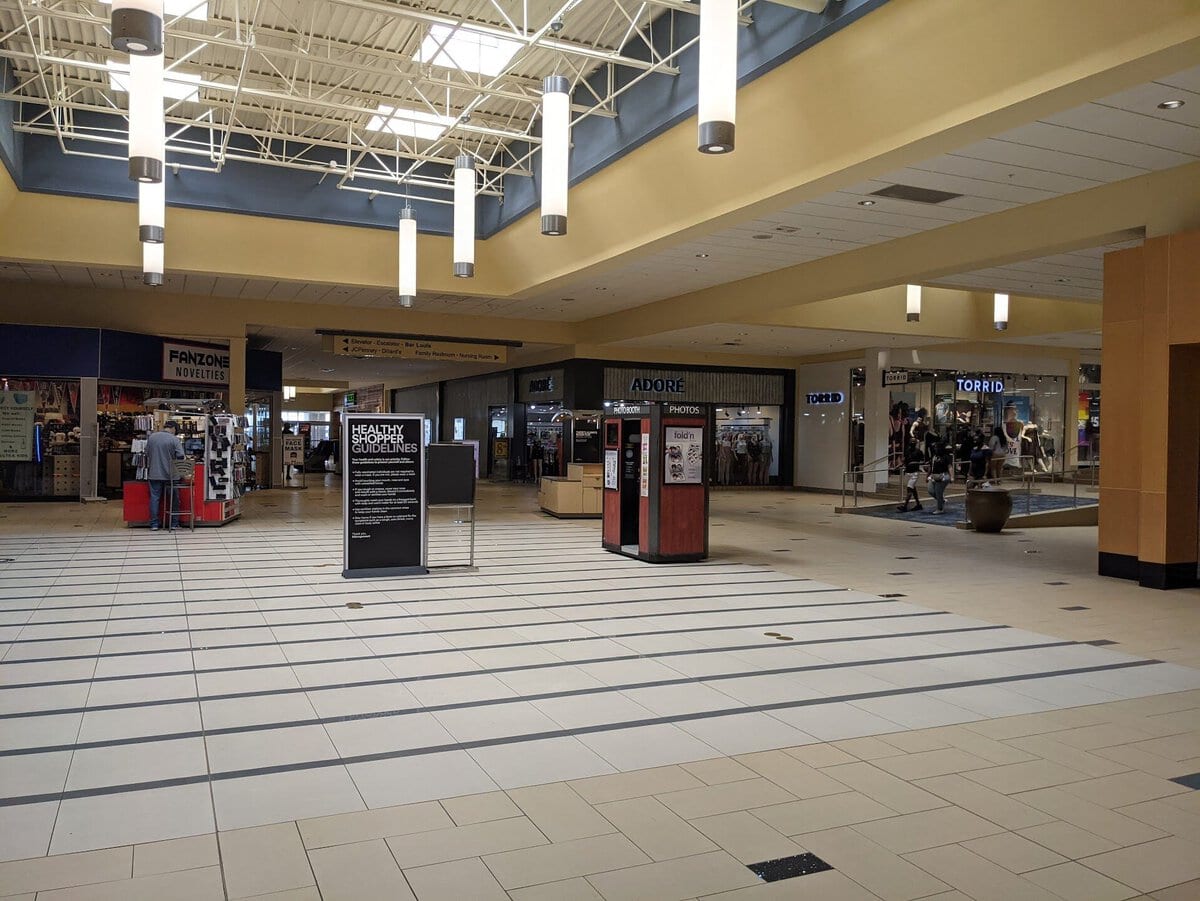
The mall lists more than 70 stores, including Aeropostale, Bath & Body Works, Buckle, Claire's, Foot Locker, Hot Topic, Kay Jewelers, Old Navy, PINK, Spencer's, Torrid, Victoria's Secret, Windsor, Zales, and Zumiez, alongside service tenants, food operators, and local businesses.
Rock Region METRO's Route 10 serves the property with a wheelchair-accessible stop at Dillard's.
In August 2025, Claire's listed its McCain Mall lease in its Chapter 11 bankruptcy proceeding as one that could potentially be assumed or assigned, a small item in the ongoing churn of specialty retail that enclosed malls have absorbed for years.
The names from 1972 and 1973 are mostly gone. Franke's Cafeteria, Farrell's Ice Cream Parlour, Musicland, Chess King, McCrory, and Foxmoor Casuals are not there.
Pfeifer-Blass became Dillard's in 1974 and remains in place.
Sears lasted more than 46 years and closed. M.M. Cohn lasted 34 years and became a movie theater.
What sits at the end of the concourse is the former Sears box, sold in 2024 and without a confirmed long-term redevelopment use.
The mall around it remains active, anchored, and the largest enclosed shopping center in the Little Rock metropolitan area.
What comes next for that former anchor box is the question nobody has fully answered yet.


Independent Publisher Notice
BestAttractions is an independent editorial publisher. We are not affiliated with, endorsed by, or acting on behalf of any location, business, property owner, manager, government agency, or organization described in this article. Comments posted on this page are not forwarded to, reviewed by, or acted upon by any entity mentioned in the article. For official inquiries, complaints, applications, bookings, or other requests, please contact the relevant entity directly through its official website or other verified channels.