
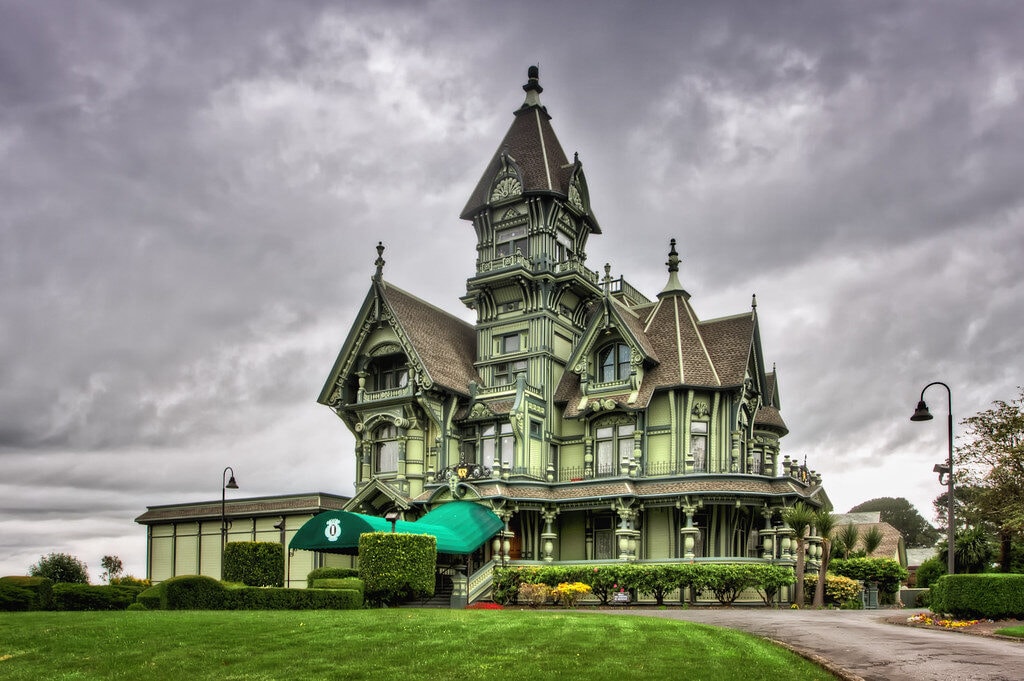
Standing on the bluff at 143 M Street in Eureka, California, sits a redwood house that a lumber company owner built for himself.
William Carson hired the Newsom brothers of San Francisco and put the house up between 1884 and 1886. By July 1885 the expected cost had passed $80,000. His family lived there into the late 1940s.
By 1949, the heirs were trying to sell the house. Eureka turned down a chance to buy it. Local businessmen paid $35,000 for the property in May 1950. They formed the Ingomar Club.
The club still owns it. Members eat dinner in the old rooms, and the public stands on the sidewalk with a camera. No public tours are scheduled for 2026.
Carson built a house to keep 100 men working
In 1884 the redwood market slumped, and William Carson started building anyway.
The site was a bluff at 143 M Street in Eureka, California, directly above his own mills and docks on Humboldt Bay.
What he built there is the Carson Mansion.
The work kept about 100 skilled employees on his payroll through the downturn. It also showed customers what his company could do with wood.
Carson had come west for gold. He reached San Francisco on April 1, 1850, went north to the Trinity River diggings, and got little out of them.
By that November he was cutting sawlogs near Humboldt Bay instead.
By the 1860s his partnership with John Dolbeer ran one of Humboldt Bay's major mills.
Redwood outside, a 103-foot tower on top
Carson hired Samuel and Joseph Cather Newsom, San Francisco architects.
Work ran from 1884 to 1886 with more than 100 men on the job, and by July 1885 the expected cost had passed $80,000.
What went up is a redwood house, 60 feet wide and 90 feet deep, with more than 16,000 square feet across three main floors.
Much of that is porch and stair hall.
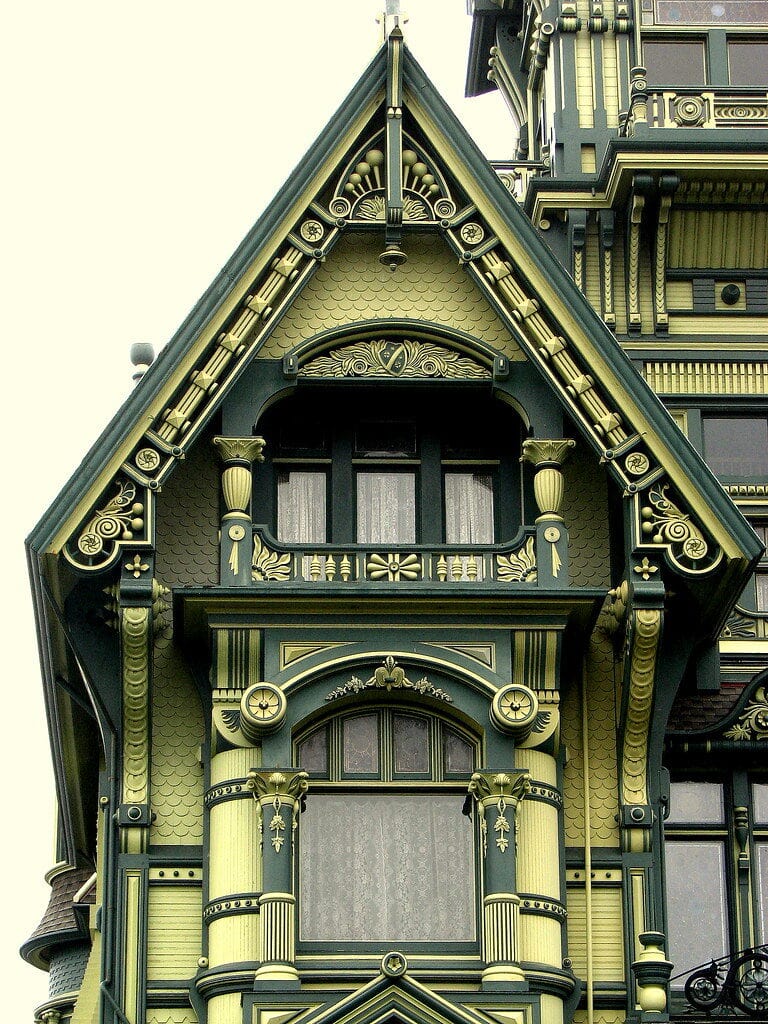
Queen Anne is the usual label, though Gothic, Italianate, and French details sit on the same walls.
In places the shingles make a flat wall read as warped, on purpose.
The tower reaches 103 feet, 88 steps up from the drive. From the top the family could see the bay and the company yards below the bluff.
Seven fireplaces and imported white mahogany
The front doors open onto a long central hall. There are 18 rooms and seven fireplaces, three of them faced in Mexican onyx.
Carson ordered seven imported woods for the rooms visitors would see.
The largest order ran 90,000 to 97,000 board feet of primavera, a pale Central American wood sold as white mahogany. The staircase is full of it.
The stair climbs through a tall well lit by stained glass. No two center medallions in the house match. Birds and butterflies in the parlor.
One window in the music room sits above a fireplace, so the flue bends around it instead of rising straight.
Pocket doors weighing near 300 pounds divide the main rooms, and they still roll.
The Pink Lady and the years after 1912
William and Sarah Carson moved in in 1886 with four children still at home, aged eight to 21.
In 1889 he paid for a second Newsom house across the street at 202 M Street, a wedding gift for John Milton and Mary Amelia Bell.
Later owners painted it pink, and it's been the Pink Lady ever since.
Sarah was gone by 1904, after 18 years in the house. William stayed until February 1912.
Schools and businesses closed for his funeral, and more than 200 company employees walked in the procession to Myrtle Grove Cemetery.
Milton and Mary crossed M Street and stayed roughly three decades. Mary's wallpaper and paint went up over the gaslit rooms through the 1930s.
A small passenger lift, put in for Milton in old age, cut through the ceiling of Carson's study.
At risk in 1949, a private club by 1950
By 1949 the house had been on the market without a buyer.
Eureka turned down the chance to take it because upkeep cost too much. On a site of several acres, demolition was a live option.
J. H. Crothers and Carl Gustafson took an option in October 1949, and their group closed the sale in May 1950 at $35,000 for the house, its furnishings, and artwork.
They soon called their new men's club the Ingomar, after the theatre Carson built downtown and the play he liked best.
Keeping the house occupied saved it and changed it.
In the early 1950s the club added a low, flat-roofed dining wing on the bay side, with banquet seating for more than 100.
A bedroom became a bar, and the third-floor ballroom took pool tables.
What seven years of restoration put back
A federal survey documented the house in 1964, using photographs taken in 1960.
In 1988 the club started a restoration that was still underway seven years later, room by room, working from wallpaper scraps, paint layers, and photographs.
The parlor's rose-leaf paper was recreated and its ceiling went back to cream.
In the dining room a 1930s covering came off, and pieces of blue-and-gold paper turned up behind the sconces.
The carpet was copied from a length found in an upstairs closet, rewoven in Scotland and seamed into room-sized pieces in San Francisco.
Then the 1992 earthquakes. Repairs put new wallboard behind the ballroom's reproduced paper, replacing old plaster.
Outside, the paint never holds. A repaint finished in the late 2010s ran past $90,000, and touch-ups since have run about $10,000 a year.
Who gets inside in 2026
The Ingomar Club still owns Carson Mansion and still eats dinner in it.
There were about 350 members in 2025, and women, admitted decades after the men-only start, hold more than a third.
Guests come in with a member, under rules that ban photography indoors.
Everyone else stops on the sidewalk at Second and M, photographs the exterior, and reads the short history on the QR codes on the fence.
The Carson Mansion Heritage Foundation, formed in 2020, takes tax-deductible donations for the building and its contents.
For the 70 years before that, members paid for the work themselves.
In the mansion's 140th year the job is the same: inspect, patch, repaint, and stop water before it gets in. No public tours are scheduled.
Independent Publisher Notice
BestAttractions is an independent editorial publisher. We are not affiliated with, endorsed by, or acting on behalf of any location, business, property owner, manager, government agency, or organization described in this article. Comments posted on this page are not forwarded to, reviewed by, or acted upon by any entity mentioned in the article. For official inquiries, complaints, applications, bookings, or other requests, please contact the relevant entity directly through its official website or other verified channels.