A $32 million plan for Eastridge Center takes shape
Plans for Eastridge Center were formally announced in February 1968 as a $32 million enclosed shopping mall project located on the expanding east side of San Jose, California.
The site covered about 110 acres that had formerly been the Hillview Golf Course, an open green space of fairways and gentle slopes scheduled for grading, paving, and large buildings.
The project was planned about 6 miles east of San Jose's central business district, in an unincorporated part of Santa Clara County that was later annexed into the city's limits.
The development was led by Bayshore Properties, a San Francisco-based joint venture made up of A. Alfred Taubman, Arthur Rubloff, and Charles Allen Jr. The Taubman Company served as the general contractor.
The mall was designed by Avner Naggar of Burlingame and John Savage Bolles & Associates of San Francisco. Lawrence Halprin and Associates handled the landscape design.
The plan called for a shopping center of about 1.4 million square feet, arranged across three climate-controlled levels.
Eastridge was laid out as a third-generation mall, moving away from earlier formats that centered on a single department store or used a straight anchor-to-anchor "dumbbell" plan.
Instead, it used angled corridors and larger public spaces intended to improve store visibility and circulation.
Woodfield Mall in Illinois used the same approach at roughly the same time. Taubman later applied similar ideas at Fairlane Town Center in Dearborn, Michigan.
Eastridge opens with 'largest in the West' billing
Eastridge Center opened on May 17, 1971, and came out swinging with scale. It was billed as the largest enclosed mall on the West Coast and in the Western United States.
The kind of claim that works best when people can see the building from the freeway and then spend the next four hours trying to find their car.
A few days early, on May 12, thirty-one stores were dedicated, as if the place could not wait to start acting like a place.
That same day, J.C. Penney opened a two-level, 133,700 square foot store, one of the last Penney locations to carry the "New Generation" nameplate from the 1960s era.
Joseph Magnin followed on July 1, 1971, with a 21,500 square foot store. Sears arrived July 21, 1971, in a two-level, 192,500 square foot building.
Liberty House opened on August 1, 1971, with 185,000 square feet across three levels, its first mainland location after expanding from Hawaii.
Macy's California opened on August 12, 1971, in 187,000 square feet over three levels.
The mall promised more than 160 shops and services across three levels, and it also included an 18,100 square foot ice skating arena, because even California has its indoor seasons.
Grand Court red carpet and modern sculpture
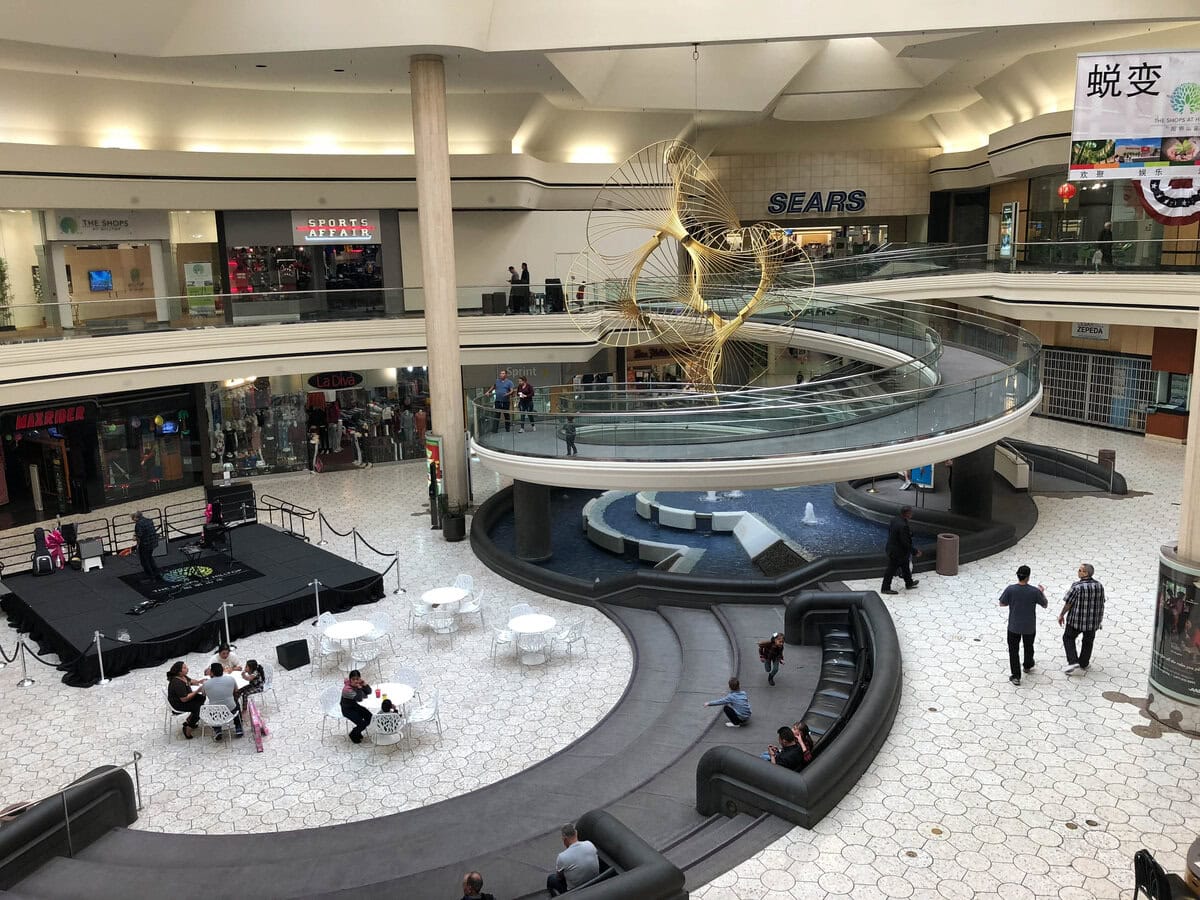
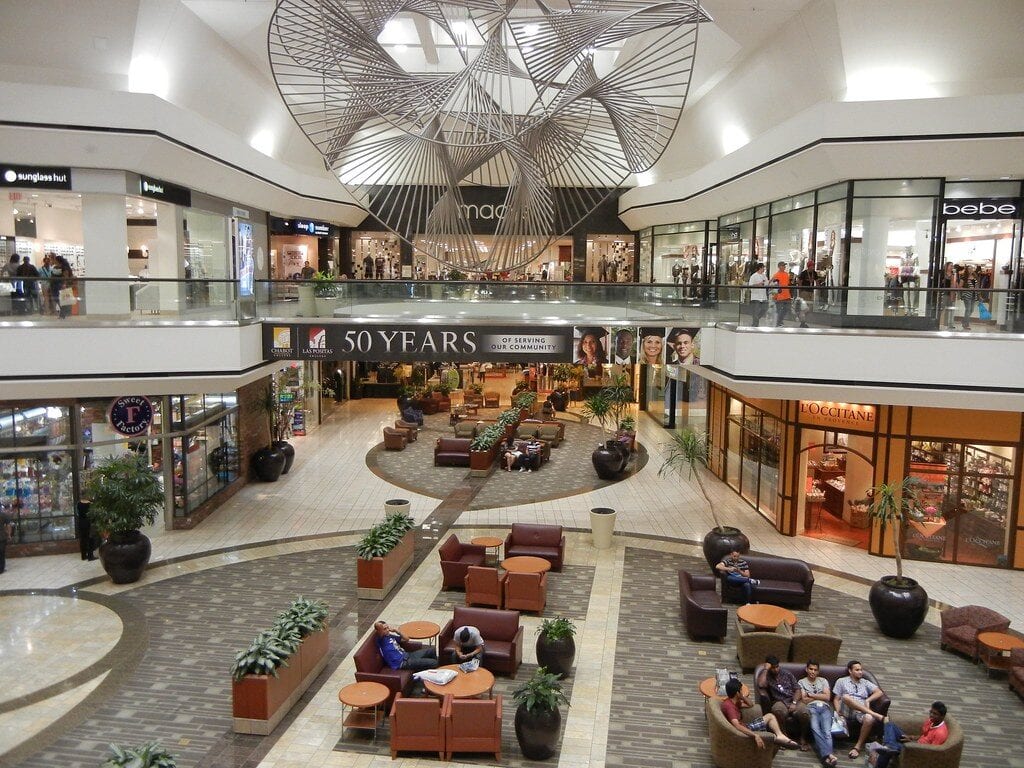
Eastridge's main interior landmark was the Grand Court, built as a three-level atrium at the center of the mall.
Macy's stood at one end and Liberty House at the other, so the space read as a straight visual corridor between two department stores instead of just another intersection of hallways.
The floor finish that people noticed first was the red carpet.
It ran broadly through the court and across the walking areas, giving the atrium a unified look and making the center feel set apart from the surrounding wings.
In the middle of the Grand Court, a multilevel fountain was installed with a steel sculpture rising from the water, created by sculptress Stephanie Scuris.
Near the fountain, a plexiglass information booth was placed under the open atrium volume, positioned as a fixed point for directions and mall services, and lit by the natural and interior light moving through the three levels.
The mall's interiors also included "mod" Constructivist statuary used as decoration in public areas.
The credited artists included Roger Bolomey and Boyd Mefford of New York City, Stephanie Scuris of Baltimore, and Fred Eversley of Los Angeles.
These pieces were part of the common-space design rather than tied to any single store, and they reinforced the mall's modern presentation during its early years.
That same new-build look carried into film use. Eastridge appears in Robert Redford's "The Candidate" in 1972, shot while the mall still had its original finishes and a then-current, futuristic style.
Liberty House at Eastridge: a short run, a long memory
Liberty House opened at Eastridge in August 1971. The building operated as a three-level department store and included a restaurant called the Eucalyptus Room.
The store struggled financially from its early years. In November 1977, the store was sold to the Carter Hawley Hale chain.
Liberty House closed permanently on January 28, 1978, and it never turned a profit during its time at the mall.
One feature of Liberty House remained closely associated with the store after it closed. Inside, glass elevators moved through the atrium with life-size mannequins riding inside them.
The mannequins were posed in fashion displays and traveled up and down in repeated loops, visible from multiple levels across the open interior space.
Shoppers stopped along the railings and in the main walkways to watch the cars rise and drop. Children treated the elevators as part of the visit, and adults paused longer than they planned.
The Liberty House building stayed in place for years after the 1978 closure. It was demolished in 2005.
The elevator mannequins remained the detail people most often mentioned when they recalled Liberty House at Eastridge.
Anchor rebrands, airport pushback, and historic carousel
The Liberty House anchor space was reused quickly. The store reopened on March 1, 1978, under The Emporium name.
The identity shifted again on May 1, 1980, when the store was rebranded Emporium-Capwell after a consolidation.
In 1990, the name was simplified back to The Emporium. The change did not fix the store's performance. The Emporium at Eastridge closed on January 31, 1996.
After the closure, the large department store space sat vacant for seven years, a closed box inside an operating mall.
During the same period, Eastridge continued a cycle of interior and tenant-area upgrades. Major remodels were completed in 1982, 1988, and 1995. The mall also pursued a cinema project that became an external dispute.
In 1986, a proposed eight-screen multiplex drew objections from the operators of Reid-Hillview Airport, located north of the mall across Tully Road.
The airport argued the theater would block access to its runway. The mall owner argued that the airport created a safety hazard and should be shut down.
The compromise moved the multiplex site substantially to the southwest, outside the path of landing aircraft, and expanded the plan to 15 screens.
In 1993, Eastridge added a feature with a longer history than the mall itself. The center installed a restored 3-abreast carousel. The carousel had been built in 1920 by the Spillman Engineering Company.
GGP's $100 million gut and Streetscape
In December 1999, General Growth Properties acquired a majority interest in Eastridge Center.
The mall continued to draw shoppers, but it showed its age, and the former Emporium space remained a large, long-vacant anchor box.
GGP moved toward a full rebuild plan rather than another round of cosmetic work. In January 2003, the company announced a $100 million makeover that would modernize the property and change its layout.
The work removed major pieces of the original complex. The vacant Emporium building was demolished. The adjacent ice arena was also demolished.
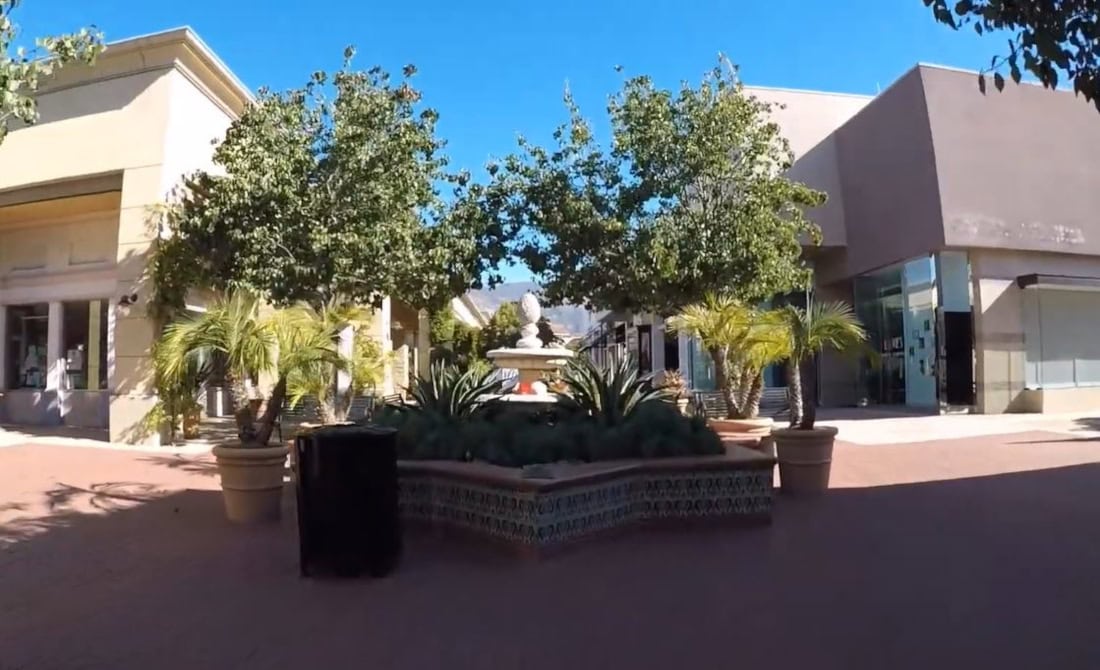
The cleared area was redeveloped as a new open-air "Streetscape" section, which introduced outdoor retail to a center that had previously been fully enclosed.
To tighten and consolidate the interior mall footprint, several inline stores were relocated into the JSPenney wing.
Construction also reshaped the inside of the building. The Grand Court was reconfigured into a new Central Plaza, shifting the main gathering space and altering how shoppers moved through the core.
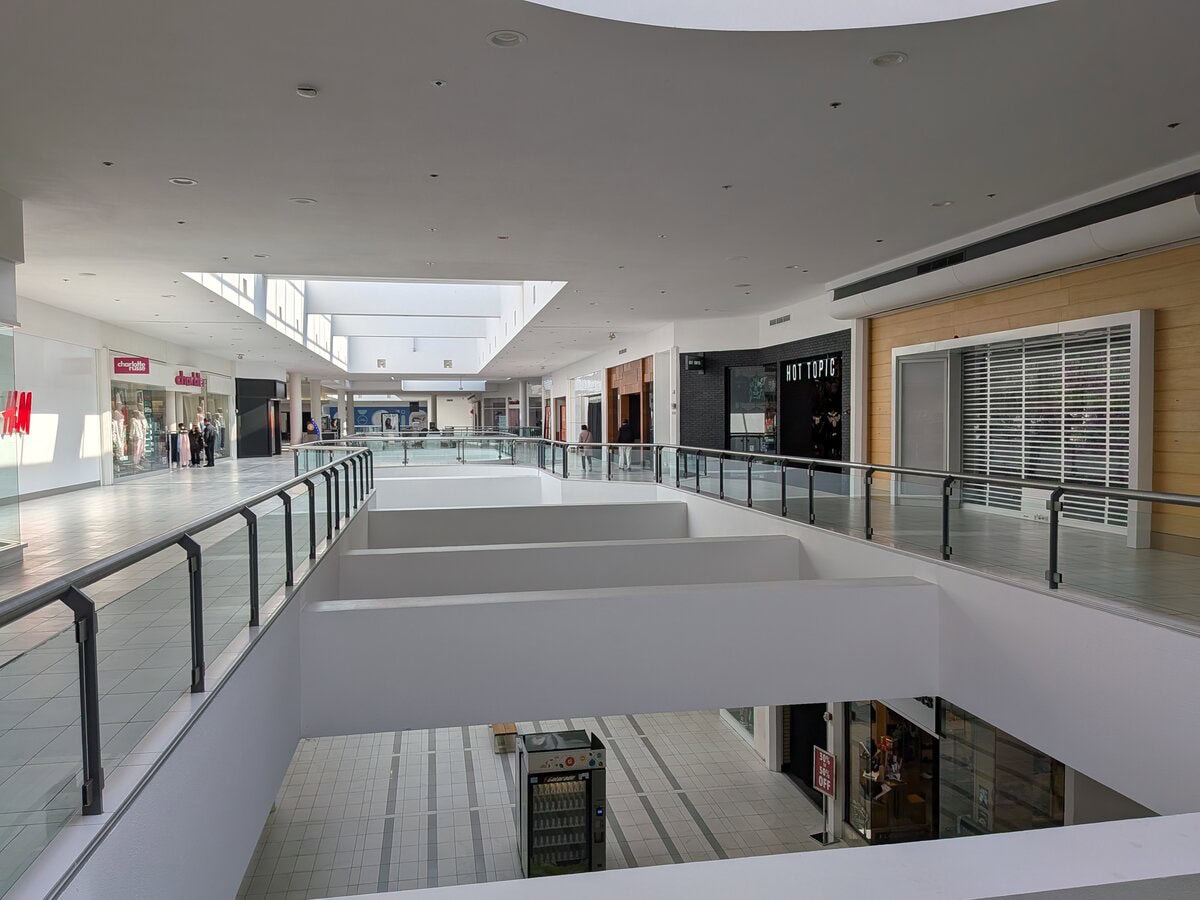
Two sub-level sections were removed entirely. The mall was reoriented to two floors instead of the original three-level plan. On the upper level, the food court was expanded into a nine-bay operation.
Tenant mix changed along with the architecture. Newer national retailers were added during the renovation, including Hollister, Victoria's Secret, Vans, and Old Navy.
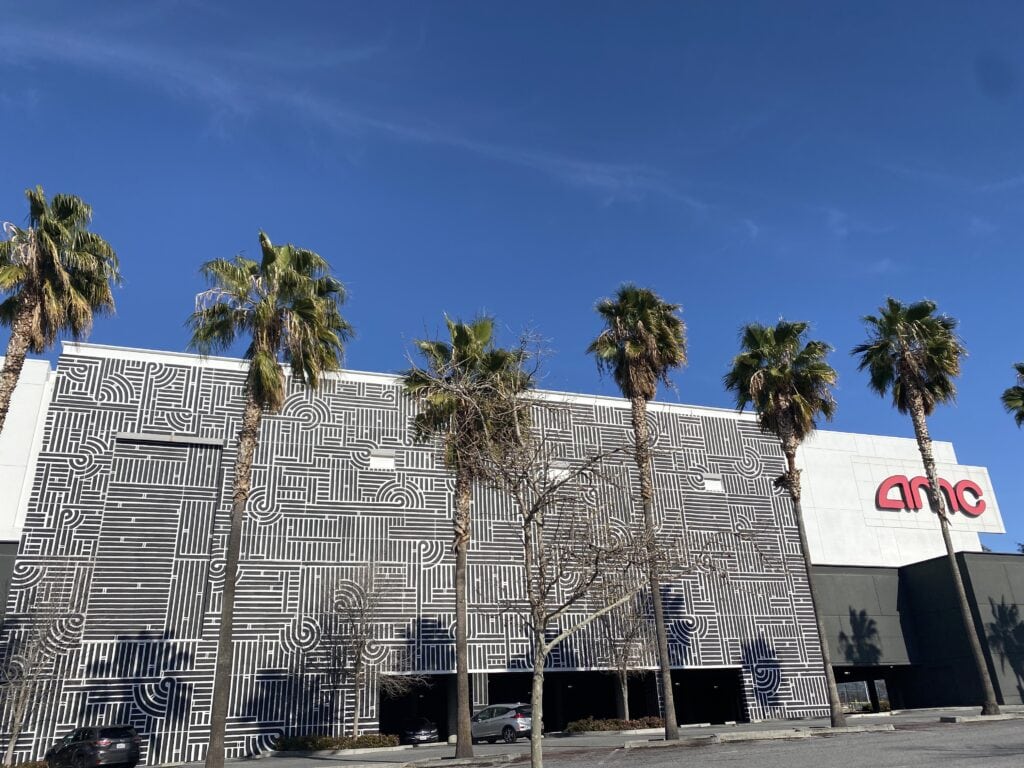
Barnes & Noble opened on March 15, 2005. A long-discussed multiplex finally opened as AMC Eastridge 15 on November 23, 2005, nearly twenty years after the cinema proposal became a public issue.
After the project, Eastridge totaled about 1,310,000 leasable square feet and listed roughly 140 stores and services.
Murals, gyms, and the Sears goodbye
Eastridge kept leaning toward entertainment as retail habits changed.
After Bed Bath & Beyond shuttered in January 2014, its two-level area and adjacent space were reconfigured. A 40,000 square foot 24 Hour Fitness opened in March 2015.
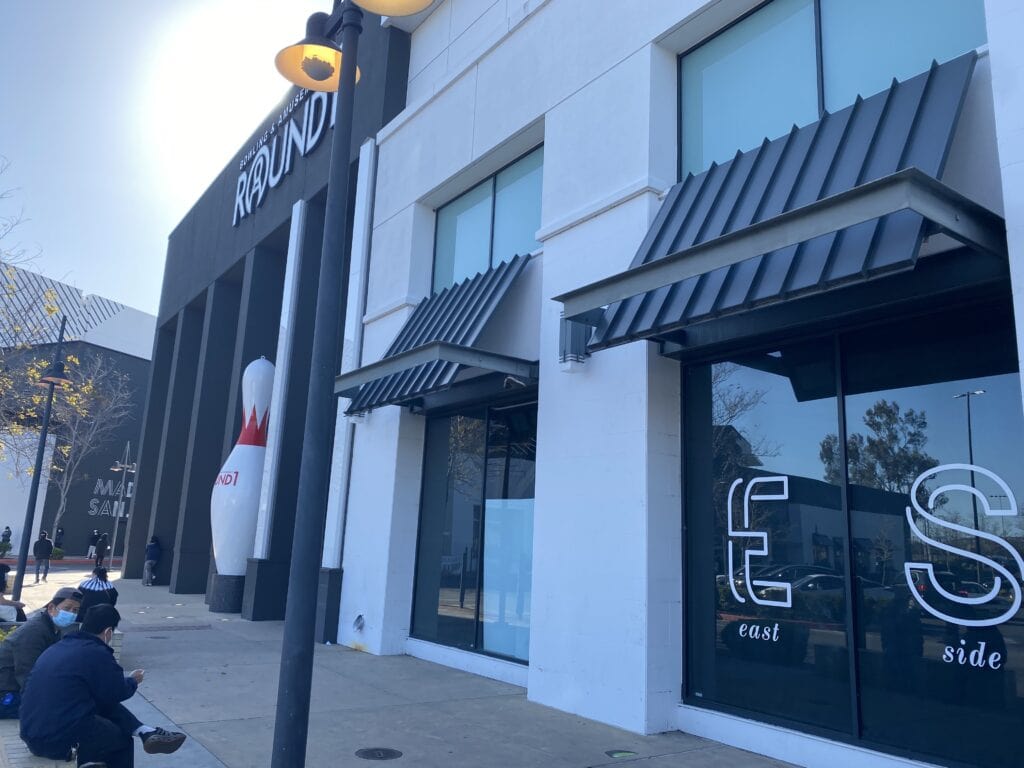
In September 2015, a 50,000 square foot Round 1 Bowling & Amusement Center was dedicated, turning a chunk of the mall into a reason to stay longer than a shopping list requires.
Ownership shifted again on January 15, 2016.
A joint venture between Pacific Retail Capital Partners and Silverpeak Real Estate Partners acquired Eastridge from General Growth Properties for $225 million, excluding the Sears and Macy's department store buildings.
The new owners talked about investing roughly $15 million, and in March 2017, they announced a major renovation.
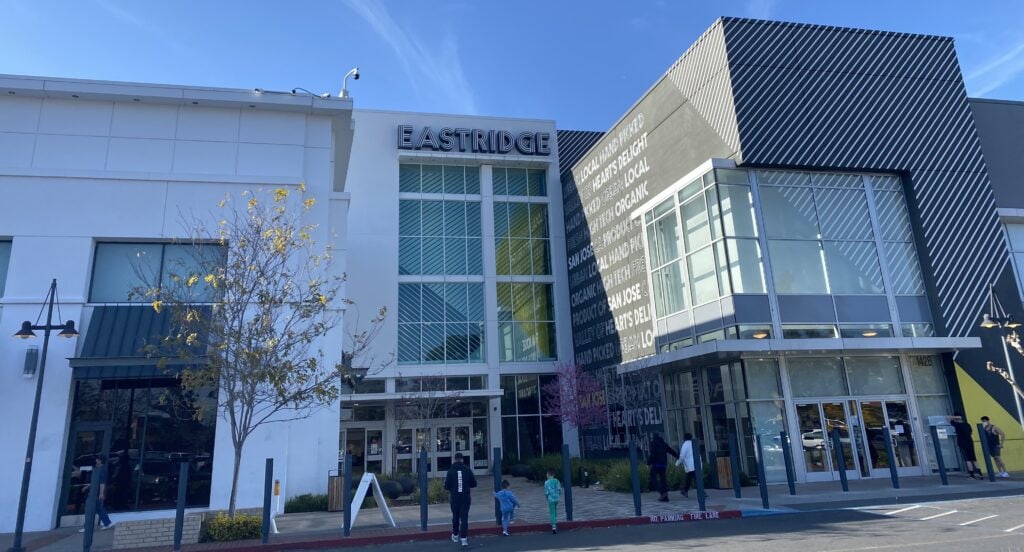
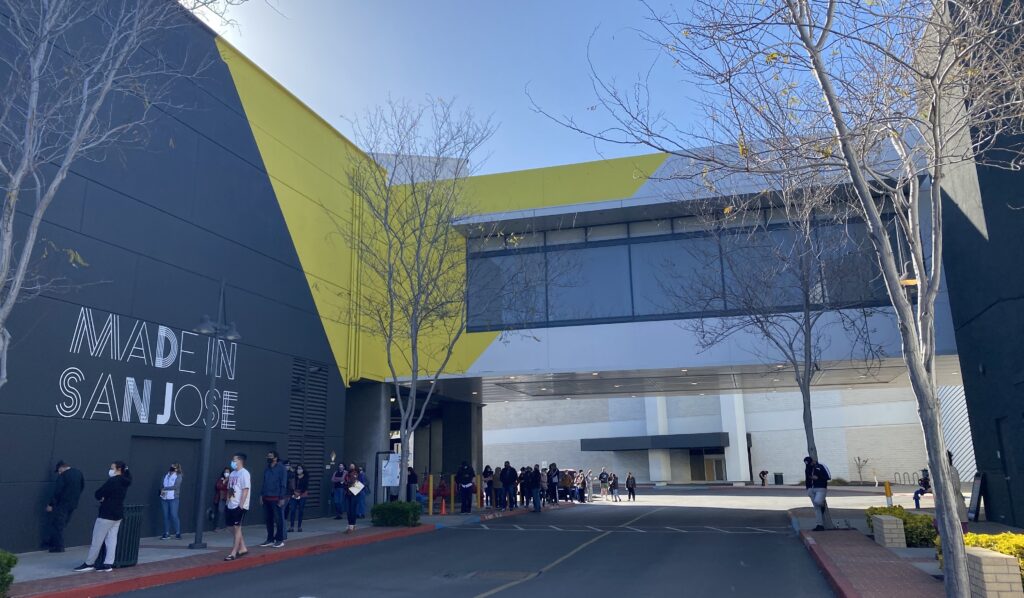
That 2017 work gave Eastridge its loudest exterior identity.
The Eastridge Murals were commissioned as a public art project: four murals, totaling 20,000 square feet and described as the world's largest murals on a shopping center, painted by Aaron de la Cruz, Brendan Monroe, CYRCLE, and Lila Gemellos.
The renovation also added about 16,000 square feet of super graphics across more than 36,000 square feet of facade, based on a concept developed by Gensler.
Inside, a 30-foot digital wall and children's art installations joined the redesign.
In December 2017, it was announced that Barnes & Noble would close in January 2018.
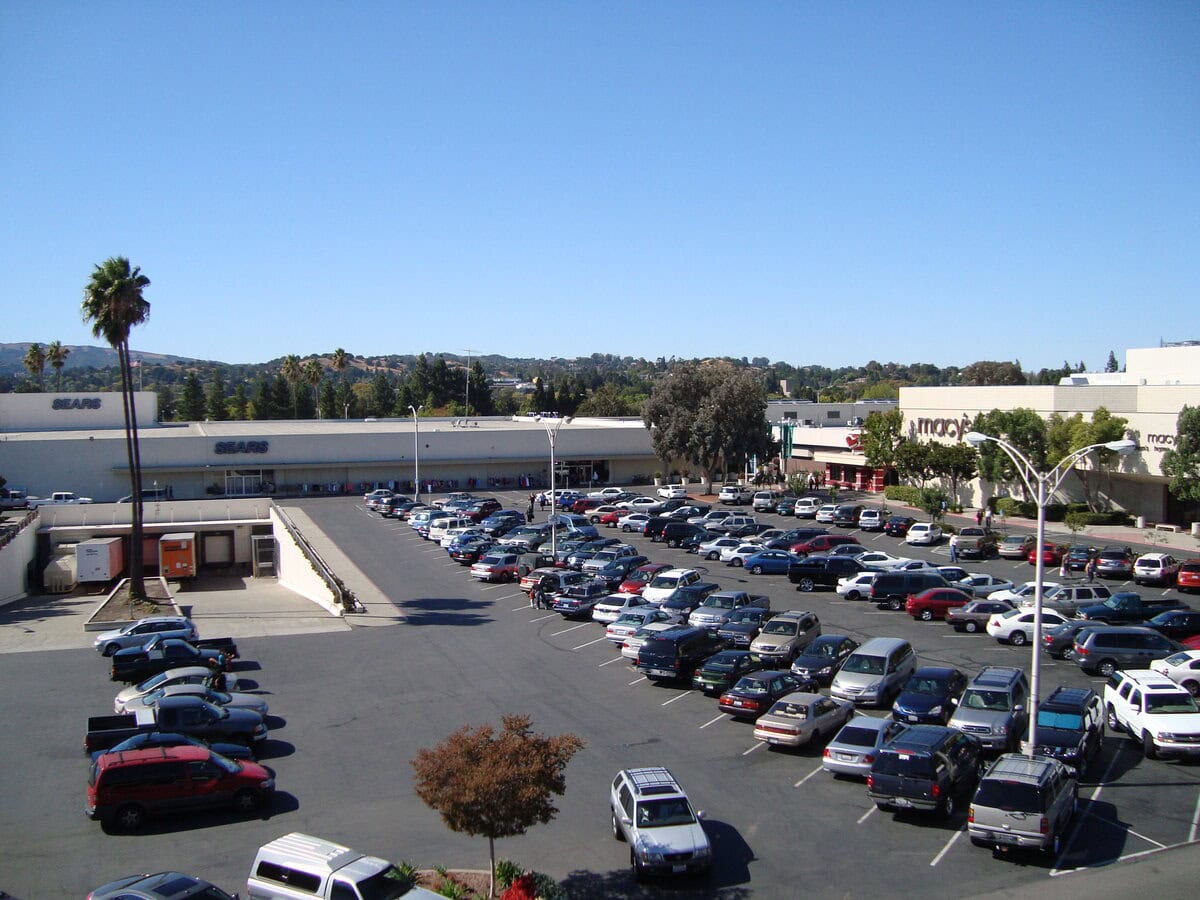
Sears, one of the original anchors since 1971, closed permanently on February 2, 2020, as part of a nationwide plan to close 96 stores.


Eastridge's 2018 upgrades, anchors, and 2024 ownership change
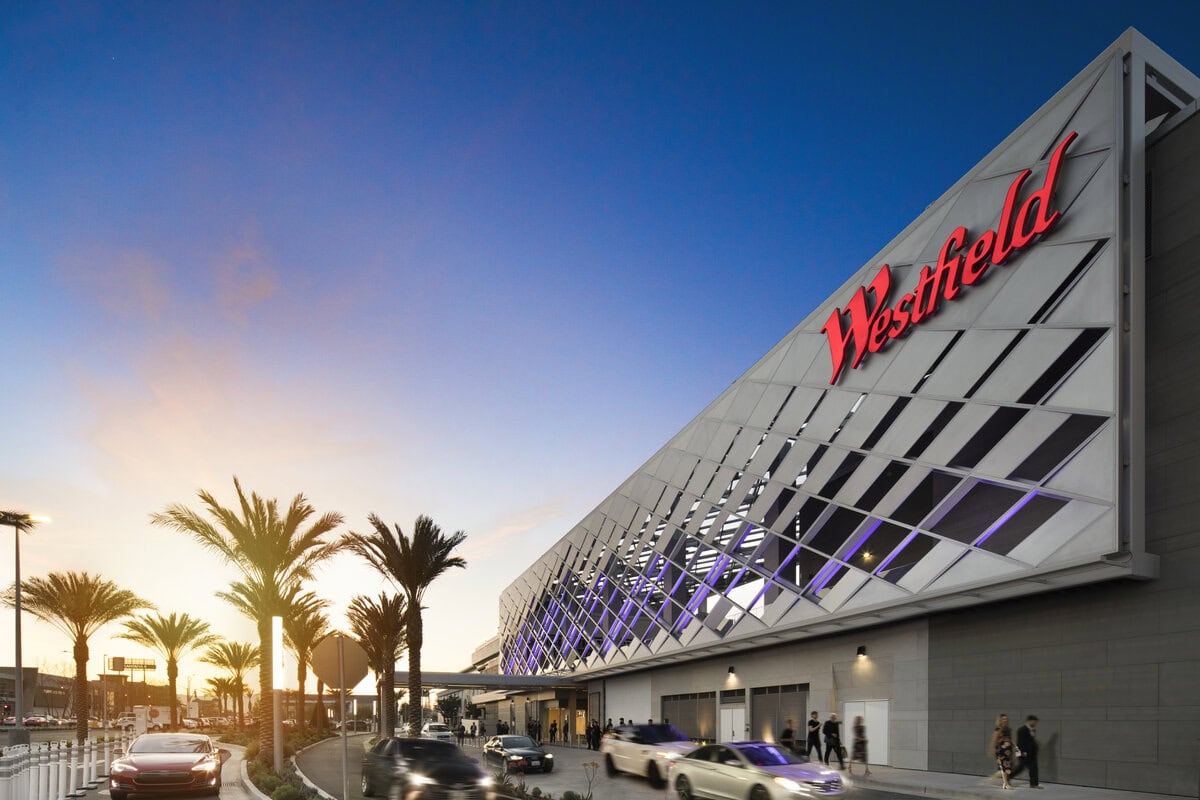
A center-wide renovation completed in 2018 added a kids' PLAY area, state-of-the-art Family Lounges, a refreshed Eatery, grassy lawns with games, and EV charging stations.
By the mid-2020s, Eastridge was leaning into community use as much as retail, positioning itself as pet-friendly and hosting farmers' markets, holiday celebrations, and special activities, with about 13 million annual visitors.
The mall sits at 2200 Eastridge Loop in San Jose's Evergreen district of East San Jose, bounded on the east by Capitol Expressway, near Lake Cunningham and Raging Waters San Jose.
Reid-Hillview Airport remains north across Tully Road. The anchor mix is listed as five: JCPenney, Macy's, AMC Theatres & IMAX, Round 1 Entertainment, and 24 Hour Fitness.
The property carried over one million square feet of shopping, dining, and entertainment with around 100 stores.
In January 2024, Houston-based real estate investor and developer Jiashu Xu purchased the majority of the mall for $135 million, financed with $98 million from Bank of China's Los Angeles branch.
Xu, a Chinese-born developer tied to United Construction and Development, has projects in Queens, including Skyline Tower.
The sale marked a steep discount from the prior era.
The 2016 owner group paid $225 million and later recouped about $43 million by selling seven surrounding properties, leaving roughly $182 million tied up in the core mall.
The $135 million sale price represents about a 26% haircut, before even counting the cost of the 2018 renovation.
BID rollout, Forever 21, and light rail work
Around the mall, East San Jose businesses and the city pushed a Tully Road-Eastridge Business Improvement District covering about 500 businesses along Tully Road between East Capitol Expressway and U.S. 101, including Burdette Drive, Quimby Road, and the mall area.
Proposed annual assessments were set between $300 and $450, projected to generate more than $120,000 a year for cleaning, maintenance, marketing, and events. The district later became official in January 2025.
Tenant churn continued. In March 2025, Forever 21 was reported as planning a closure at Eastridge, with job cuts expected to begin in late April and continue through May.
Transit is the long-range bet. VTA runs the Eastridge Transit Center on the northeast edge of the site along Capitol Expressway.
A 2.4-mile extension of VTA light rail is expected to bring Orange Line service to Eastridge in 2029.
Construction produced dated detours and closures around the mall. A temporary overnight closure of southbound Capitol Expressway at Story Road was noticed for January 25, 2025, to move heavy equipment.
A July 16, 2025, update listed major traffic changes, including turn-lane restrictions and planned overnight work. On December 8, 2025, VTA reported the extension had passed 50 percent completion.