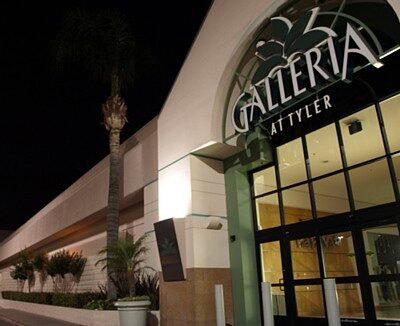
On a weekend afternoon at Magnolia Avenue and Tyler Street in Riverside, the area around the mall is busy. Cars move through a parking lot with space for 5,700 vehicles.
Families carry shopping bags to their cars. Teenagers head through the main entrance toward the food court.
The smell of teriyaki and pretzels comes from inside. Near the north end, movie trailers can be heard from the AMC complex.
About sixty years ago, this same intersection was the focus of a major development dispute in Riverside. Two developer groups were competing to build the city's first large enclosed shopping mall.
One group wanted a 113-acre site closer to what is now California Baptist University. The other chose a 66-acre site at Magnolia Avenue and Tyler Street.
Riverside could not support both projects, especially with similar malls already being built in San Bernardino and Montclair, and both sides understood that.
Developer Ernest W. Hahn's plan moved forward. Construction began in October 1969 on a $45 million project.
Less than a year later, on October 12, 1970, Tyler Mall opened. Riverside now had a regional shopping center, and the corner of Magnolia and Tyler changed permanently.
Opening-Day Tyler Mall: Anchors, Tenants, and Design
Planning for Tyler Mall began in 1965. The Broadway and May Company supported the 66-acre site at Magnolia and Tyler.
JCPenney and Buffum's supported the larger competing site. By the middle of 1966, The Broadway and May Company had bought the Tyler property for about $2 million.
That ended the competition before construction began.
When the mall opened four years later, it was a major new retail center for its time. The Broadway took up 156,000 square feet.
Its building used a cantilevered design by Charles Luckman and Associates, a structural style that appeared in only a small number of stores in the country.
Jim Van Schaak designed the interior. That interior later received national recognition as "Department Store of the Year."
JCPenney served as the other main anchor at the opposite end of the mall.
Between those two stores was a two-level F.W. Woolworth that covered 61,000 square feet. It included a Harvest House restaurant inside.
Around the outside of the mall were a United Artists twin theater, a United California Bank branch, Howard Johnson's, Farrell's Ice Cream Parlour, auto centers, and a gas station.
In 1970, the goal was to let shoppers take care of many everyday needs in one visit. Inside the mall, there were colorful skylights, hanging clusters of lights, and wooden benches throughout the common areas.
May Company California opened later, in July 1973, three years after the rest of the center.
The delay was tied to refinements in the store's prototype design. Its south-end anchor added a restaurant and a cocktail lounge.
How a $100 Million Bet Remade the Galleria at Tyler
During most of the 1970s and 1980s, Tyler Mall stayed in its original one-level layout. As the Inland Empire grew, the mall faced increasing pressure to expand and modernize.
Nordstrom had become an important sign of whether a regional mall could compete at a higher level.
After Nordstrom opened at Montclair Plaza in 1986, efforts to bring the company to Riverside gained momentum.
The expansion faced legal opposition. In 1989, supporters of the competing Canyon Springs Fashion Mall near Moreno Valley, along with several local resident groups, filed lawsuits to stop the project.
Those disputes were settled by late 1989. In May 1990, construction began on a $100 million redevelopment managed by Donahue-Schriber.
The project added a full second floor of retail space using a suspended truss system.
This method cost more than the one used at Montclair Plaza, but it allowed the new upper level to connect more smoothly with the existing department stores.
It also created wider walkways and reduced the number of support columns in the middle of the mall.
At the north end, developers built a new three-level Nordstrom with 164,000 square feet. Callison Architecture designed the store. New parking structures were built next to it.
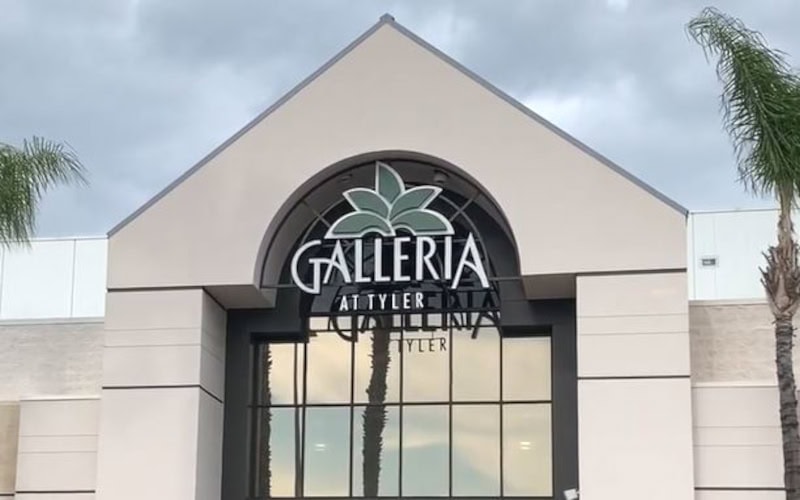
Nordstrom opened on September 6, 1991. Six weeks later, on October 17, 1991, the entire mall reopened under a new name: Galleria at Tyler.
By then, the mall had about 160 stores, and its total leasable area had grown to 1.1 million square feet.
Restaurants, a Bookstore, and a Forever 21 the Size of a City Block
Anchor changes kept coming through the 1990s. The Broadway was converted to Macy's in the north building around 1996.
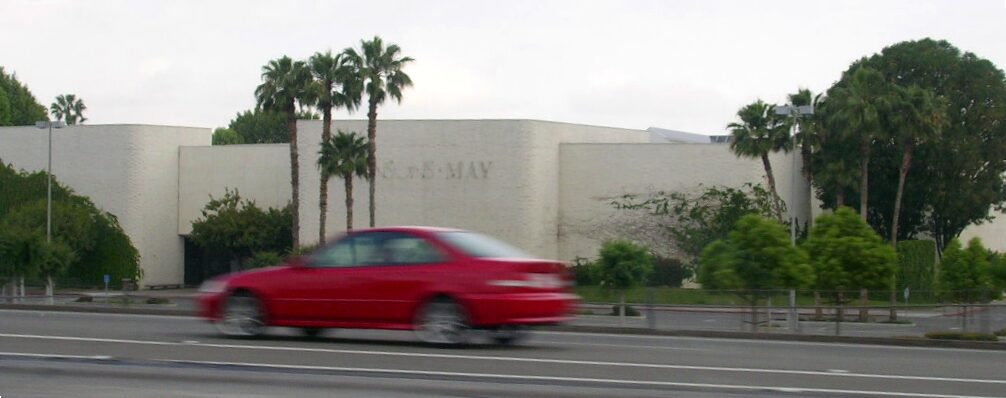
May Company had become Robinsons-May in 1993 through a merger, and that south building turned into Macy's as well in 2006, when the chain chose to consolidate into one location.
The north building was suddenly vacant and available.
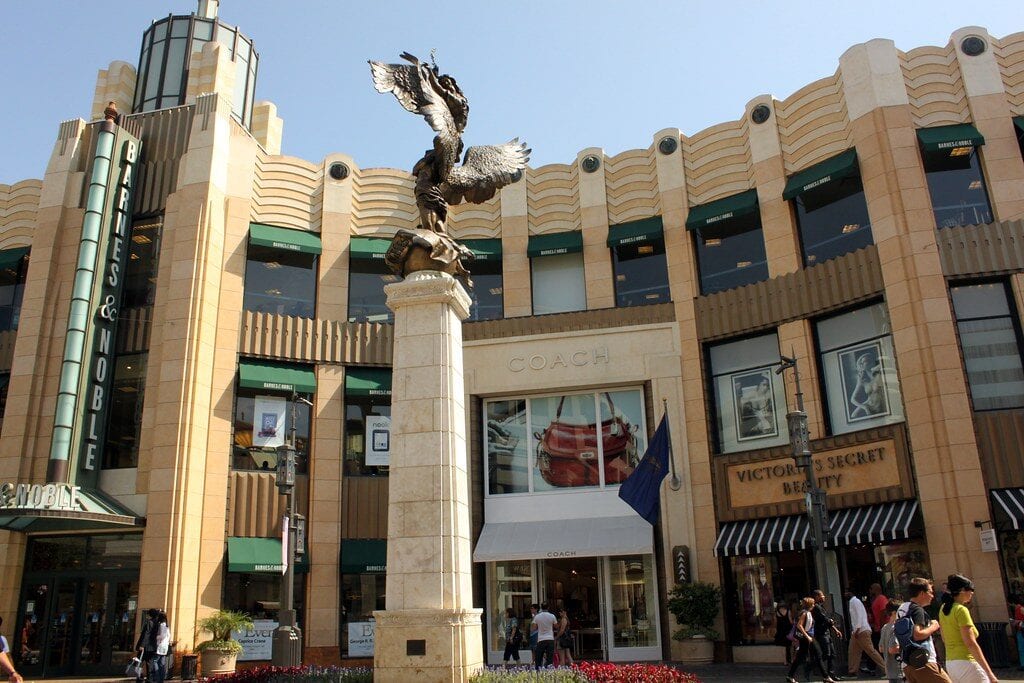
In 2001, Barnes and Noble moved into the old United Artists space on Hughes Alley - the same four-screen theater that had been there since opening day in 1970. Thirty years is a long run for a cinema inside a mall.
The bigger changes came in 2006 and 2007. The Cheesecake Factory and P.F. Chang's China Bistro opened along the south side in late 2006.
At the north end, the "North Village" expansion designed by MBH Architects added AMC 16 Theatres, Yard House, Elephant Bar, and Robbins Bros. by late 2007.
H&M opened a 20,000-square-foot store inside the main building that November.
Then, in November 2011, Forever 21 moved into the former north Macy's and Broadway building - the whole thing - creating one of the largest Forever 21 stores in the region.
A $2 million interior renovation updated the common areas around 2013, the first real facelift the place had seen in years.
A Robbery That Shut the Whole Place Down
On December 6, 2015, three men walked into Ben Bridge Jeweler near JCPenney carrying sledgehammers and axes.
They smashed the glass display cases and left with thousands of dollars in jewelry.
Four days earlier, 14 people had been killed in the San Bernardino attack, less than 20 miles away.
When shoppers nearby heard glass shattering, a lot of them did not think of robbery. The first 911 calls came in at around 6:30 p.m., reporting an active shooter.
More than 100 officers and SWAT teams arrived. The mall was locked down for about an hour while officers swept the building before confirming what had actually happened.
All three suspects were eventually caught.
The ownership picture had been shifting in less dramatic ways throughout this period. Ernest Hahn's company built the original mall.
Donahue-Schriber managed the 1991 expansion. General Growth Properties, known as GGP, took over from there.
Brookfield Property Partners had held a partial stake in GGP since 2010 and completed a full buyout in August 2018.
The mall carried the Brookfield Properties name for several years after that - until January 2026, when Brookfield rebranded its retail division back to GGP.
For shoppers and tenants, nothing changed.
What Remains After the Closures
Nordstrom closed in the summer of 2020. The announcement came in May, part of a broader pullback the company blamed on the pandemic.
After nearly 29 years, that was it. Because Nordstrom had always owned its building separately from the mall, Brookfield had no say in what happened next.
The space sat empty for two years.
In 2022, Furniture City purchased the former Nordstrom building and opened a multi-level furniture showroom there.
It brought some foot traffic back to that end of the property, though it operates entirely independently from the mall.
Forever 21 lasted until spring 2025. The company filed its second U.S. Chapter 11 bankruptcy and announced plans to close all American locations - over 350 stores - by May 1.
The Riverside location, at roughly 153,500 square feet in the former north Macy's and Broadway building, was among the largest on the closure list.
The company blamed overseas fast-fashion competitors, rising costs, and a long slide in mall traffic.
In July 2025, Copper Property CTL Pass-Through Trust announced a binding agreement for an affiliate of Onyx Partners to buy a portfolio of 119 JCPenney store properties, including 19 in California.
The portfolio included the JCPenney property at 3605 Galleria at Tyler in Riverside.
JCPenney was still open at the time and said store operations would not be affected. The transaction later did not close, and the property's future remains uncertain.
For Furniture City, there is no public information confirming that it will close in 2026. However, current listings say the property could be empty or rented for a short time.
Even so, the Galleria at Tyler still pulls an estimated 8.8 million visitors a year, and GGP is actively working to fill the empty anchor spaces.
The mall has been here for more than 50 years. It has been through worse.